CHAT NOIR, ROSEKJELLEREN AND EINAR ROSE

By AI Chat-Human Synthesis-10 October 2026
The Golden Age of Norwegian Theatre. The story of Oslo's legendary revue theatre, its famous cellar restaurant, and the extraordinary personalities who entertained generations of Norwegians.
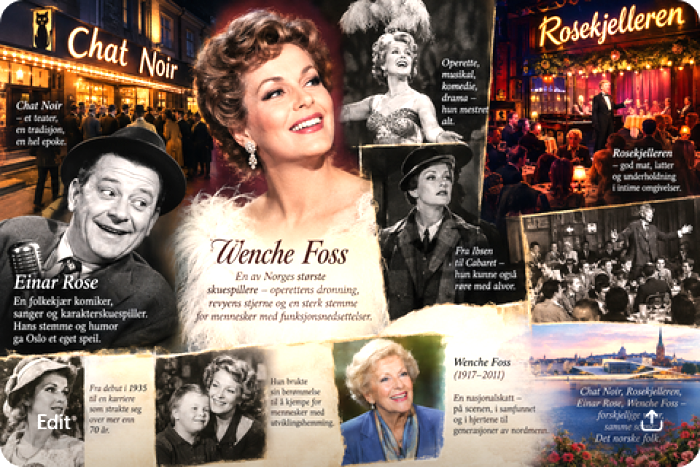
PROLOGUE: AN EVENING IN OLD OSLO
Imagine Oslo in the late 1930s. The city is alive with trams, cafés, restaurants and theatres. As evening approaches, people dress for a night out. Some are going to see a revue, others to hear music, and many simply want to escape the routines of everyday life for a few hours of laughter and entertainment.
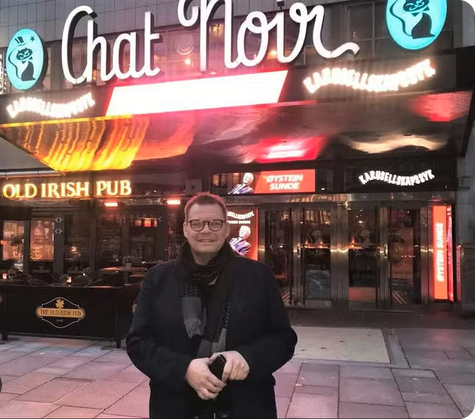
At Klingenberggata 5 stands Chat Noir, one of Norway's most celebrated entertainment institutions. Inside, performers prepare to sing, act, joke and satirise the world around them. The audience expects wit, music, romance and perhaps a little scandal.
Downstairs, in the cellar premises, another attraction awaits. Rosekjelleren, established by the singer, actor and director Einar Rose in 1937, offers food, music and entertainment in a more intimate atmosphere. The theatre and the restaurant are different establishments, yet together they represent an important part of Oslo's nightlife.
In this world, a performer can become a national celebrity through a single song, a comic character or a memorable stage appearance. Names such as Einar Rose, Lalla Carlsen, Leif Juster and Wenche Foss belong to the larger story of Norwegian popular theatre.
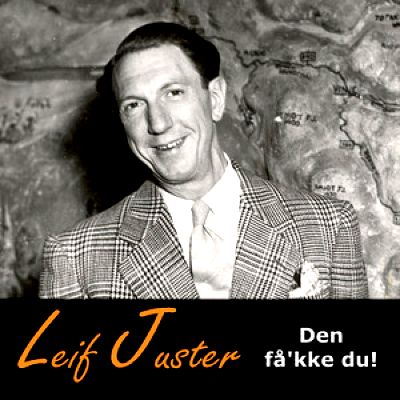
Their careers were not identical, and they did not all perform together. What united them was their ability to make the stage an essential part of Norwegian cultural life.
To understand this world, we must return to the beginning of Chat Noir.
CHAPTER 1: THE BLACK CAT — CHAT NOIR, 1912
Chat Noir opened on 1 March 1912 in the Tivoli entertainment area of Kristiania, the name Oslo bore until 1925. Its founders were Bokken Lasson, a singer and cabaret artist, and the writer Vilhelm Dybwad, who later became her husband.
The name means “Black Cat” in French, inspired by the famous Parisian cabaret Le Chat Noir. Bokken Lasson had encountered the European cabaret tradition during her travels and wanted to bring its intimate atmosphere and artistic freedom to Norway.
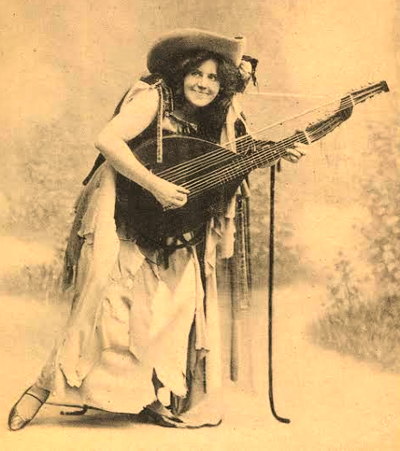
The original Chat Noir was not quite the revue theatre later generations would know. It began as a literary cabaret, bringing together songs, poetry, humour and artistic experimentation. Instead of the formal distance associated with conventional theatre, performers could establish a more personal relationship with their audience.
Writers, poets, musicians and painters gathered around the establishment. Per Krohg created early stage decorations, while literary figures including Herman Wildenvey and Arnulf Øverland contributed to the cultural environment. Vilhelm Dybwad wrote songs that Bokken Lasson performed.
In 1913, Chat Noir presented its first revue, entitled 1913. This marked an important development in the theatre's history.
Lalla Carlsen, who became one of Norway's best-loved entertainers, joined Chat Noir in 1916 and remained associated with the theatre until 1947.
When Victor Bernau took over the leadership in the late 1910s, Chat Noir increasingly developed into a popular revue theatre. The programme expanded to include topical jokes, musical numbers, caricatures, social commentary and comedy designed to reach a wider public.
Chat Noir was becoming a place where Norwegians could laugh at politicians, fashionable society, human vanity and their own everyday weaknesses.
The theatre had found its calling. The official history of Chat Noir traces this development from literary cabaret to the institution it remains today.
CHAPTER 2: EINAR ROSE — THE BOY FROM KAMPEN
Einar Wilhelm Böckmann Rose was born in Kristiania on 27 January 1898. He grew up in Kampen, a working-class district of the capital. His father, Jacob Rose, was a typographer.
Einar did not begin his career as a privileged theatrical star. He worked at ordinary jobs, including selling goods, before finding opportunities in entertainment. In 1925, he appeared as a solo performer in the revue Regnbuen at the Mayol theatre.
The following year, he joined Chat Noir. His breakthrough came with the revue Kjør for det! in 1926.
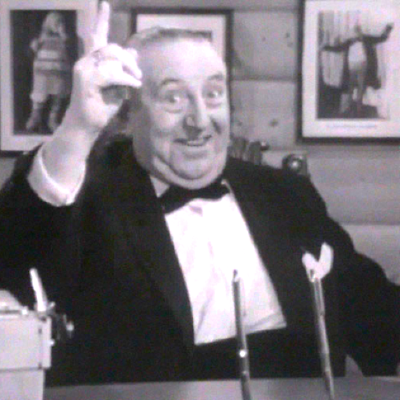
Rose possessed something that audiences immediately recognised: an unmistakable Oslo voice. His speech was earthy, direct and full of local character. Rather than disguising his accent, he made it the foundation of his artistic identity.
He could sing, act, imitate and exaggerate. His comic characters often displayed the vanity, ambition and foolishness of ordinary people, yet remained recognisable enough to make audiences laugh at themselves.
Rose understood that comedy did not always need complicated plots or elaborate scenery. A familiar voice, a well-timed pause and a perfectly delivered line could be enough.
He brought what became known as the distinctive Oslo tone into Norwegian revue and helped establish a style that audiences would associate with the capital for decades.
CHAPTER 3: THE VOICE OF NORWAY
During the late 1920s and 1930s, Einar Rose became one of Norway's most popular recording artists. Between 1927 and 1941, he made more than 300 recordings, including revue songs, popular melodies and operetta-influenced material.
Among his best-known songs were Nå går'n på gummisåler, Svigermor, Evensen og kjerringa og jeg, Sol ute, sol inne and Ola var fra Sandefjord.
These songs travelled far beyond the theatre. Gramophone records and radio brought Rose into Norwegian homes, allowing people who had never attended Chat Noir to enjoy his distinctive humour.
His success was rooted in his understanding of everyday life. He could turn family disagreements, social pretensions and familiar characters into comic entertainment. His performances made ordinary situations seem extraordinary.
He also worked with the group Hurragutta, bringing his music into the lively world of restaurant and cabaret entertainment.
Rose was not merely a singer who happened to be funny. He was a character performer who understood how a song could become a small theatrical production in itself.
In 1934 and 1935, he worked with Victor Bernau at the Scala theatre. In 1936, he returned to a central role at Chat Noir, directing the revue Varsko her! and becoming the theatre's artistic leader.
His career was entering a new phase. He was now responsible not only for entertaining audiences but also for shaping the entertainment itself.
CHAPTER 4: ROSEKJELLEREN — THE FAMOUS CELLAR
In April 1937, Einar Rose opened Rosekjelleren in the cellar premises associated with Chat Noir. The establishment became closely connected with his name and the wider entertainment culture of central Oslo.
A theatre and a restaurant offer different experiences. At Chat Noir, audiences watched a prepared programme from their seats. At Rosekjelleren, entertainment could unfold in a more informal environment, where people gathered to eat, drink, talk and listen to music.
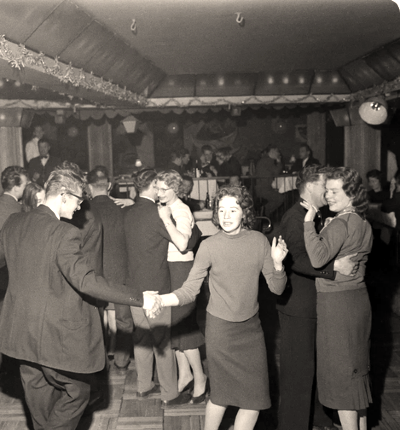
Rose could move between the responsibilities of theatre management and the entertainment downstairs. His association with Hurragutta helped give Rosekjelleren its musical identity.
The establishment became known for its lively nightlife and, in later years, more provocative forms of entertainment. Historical accounts also associate it with striptease, reflecting the changing character of urban nightlife.
Rosekjelleren was not simply an extension of the theatre's stage. It belonged to the broader world of restaurants, cabarets and music venues where performers could establish a closer relationship with their audience.
Its story also illustrates an important feature of the entertainment industry before television became dominant. A successful performer could be heard on records, seen on stage and encountered in a restaurant, all within the same city.
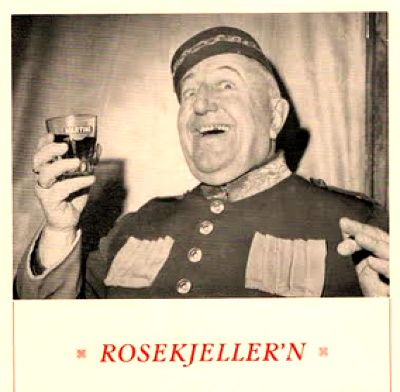
Rose was a singer, actor, director and restaurateur. He had built a career that reached beyond any single performance or venue.
Rosekjelleren became part of the cultural memory of Oslo, a place associated with music, laughter and the particular personality of its proprietor.
CHAPTER 5: THE WAR YEARS
The German occupation of Norway from 1940 to 1945 brought profound changes to everyday life. Theatres continued to operate under difficult conditions, but censorship, political restrictions and uncertainty affected the cultural world.
Revue artists faced a particular challenge. Their work depended on observation, satire and the ability to comment on contemporary society. Under occupation, even a joke could acquire political meaning.
The theatres had to navigate restrictions while maintaining their relationship with audiences who were living through an extraordinary period.
Chat Noir remained part of Oslo's theatrical life, although performances took place within the limits imposed by the occupation.
The experience of these years forms part of the wider history of Norwegian entertainment. Theatres were places of diversion, but they were also cultural institutions in a society struggling to preserve its identity and freedom.
For Rose, whose career was rooted in the speech, humour and social character of Oslo, the war interrupted a period of remarkable professional success. Yet his recordings and earlier performances continued to preserve the voice that audiences knew.
CHAPTER 6: WENCHE FOSS — THE QUEEN OF NORWEGIAN THEATRE
No account of Norway's great theatrical personalities would be complete without Wenche Foss. Elegant, outspoken, mischievous and remarkably versatile, she became one of the country's most beloved actresses.
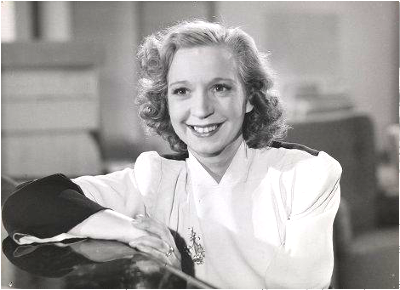
Born Eva Wenche Steenfeldt-Foss in Kristiania on 5 December 1917, she made her stage debut in 1935. Her career would eventually span more than seven decades, connecting the traditions of operetta and popular entertainment with some of the most demanding works in Norwegian theatre.
Wenche Foss belonged to the wider theatrical world in which Chat Noir flourished. Her career was distinct from Einar Rose's, but both artists demonstrated the importance of personality, timing and a close understanding of their audiences.
Foss began in operetta and musical comedy, where she could combine acting, singing and comic flair. She developed into a leading actress at Centralteatret and later became a major presence at the National Theatre.
Her stage work included celebrated performances in The Merry Widow, Kiss Me, Kate and Cabaret. These productions required very different abilities, from musical elegance and sparkling comedy to more reflective and emotionally complex acting.
Foss possessed them all.
She could play a glamorous woman without losing her sense of humour. She could make an audience laugh through a gesture or a line of dialogue, then move it deeply through a dramatic performance.
Her range also extended to the works of Henrik Ibsen, including Hedda Gabler, John Gabriel Borkman, Peer Gynt and Rosmersholm. These roles demanded psychological depth and the ability to reveal complicated emotions beneath a controlled exterior.
Foss demonstrated that a performer celebrated for popular entertainment could also excel in serious drama.
Her importance to Norwegian theatre lay not simply in the number of productions in which she appeared, but in the range of human experience she brought to the stage.
A public figure with courage
Wenche Foss's life beyond the theatre was equally significant.
In 1953, she gave birth to her son Tommeliten, who had Down syndrome. At a time when disability was often surrounded by silence and prejudice, Foss spoke openly about her son and the challenges faced by families in similar circumstances.
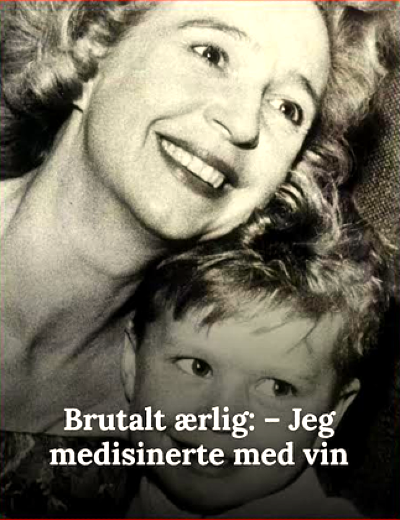
Her willingness to discuss these issues helped bring public attention to the dignity and rights of people with intellectual disabilities. She also supported the development of Solgården in Spain, a holiday centre for people with disabilities that opened in 1972.
This was another form of courage. On stage, Foss could command an audience through her talent. In public life, she used her celebrity to challenge attitudes and encourage greater understanding.
She also spoke openly about personal difficulties and illness, strengthening her reputation as someone who did not hide behind the glamour of public life.
Her career received numerous honours, including the Order of St. Olav. In 2002, she received the honorary Hedda Award in recognition of her contribution to Norwegian theatre.
Wenche Foss died in Oslo on 28 March 2011, aged 93.
Her career had lasted from 1935 to 2011, an extraordinary span that carried her from the world of pre-war operetta into the modern era of television and contemporary theatre.
Her place in the Chat Noir story
Wenche Foss should not be presented as a permanent partner of Einar Rose or as someone whose career was confined to Chat Noir. Her significance is broader.
Chat Noir represents the evolution of Norwegian popular theatre; Rose represents the distinctive comic voice of Oslo; Foss represents the extraordinary range of the Norwegian stage, from musical comedy to serious drama.
Together, their stories illuminate different aspects of the country's theatrical heritage.
The history of a theatre is not only the history of its building. It is also the story of the people who made audiences return, generation after generation.
CHAPTER 7: THE ART OF MAKING PEOPLE LAUGH
Einar Rose's success depended on much more than his singing voice. He had a gift for creating characters that were exaggerated but recognisable.
His comic subjects included boastful men, ambitious social climbers, domestic troublemakers and people convinced of their own importance. He could turn a familiar weakness into a memorable performance.
His Vigelandsvisa, associated with the sculptor Gustav Vigeland, demonstrated revue's ability to make a major cultural figure the subject of satire.
The technique was simple but effective: take something familiar, exaggerate it and allow the audience to recognise the absurdity beneath the surface.
Rose also performed with other major entertainers, including Leif Juster, whose tall, expressive presence and extravagant comic style made him a memorable partner.
Their collaboration eventually produced one of their best-known successes, Prammen og Madammen, which became popular in the 1960s.
The partnership showed that Rose's humour could survive changes in fashion. His comic instincts were not limited to the period in which he first became famous.
Wenche Foss possessed a different kind of comic intelligence. Her performances could draw on elegance, irony, musical timing and a subtle understanding of character.
Both artists understood that successful comedy depends on recognition. Audiences laugh because they see something familiar in the character before them, even when that character has been exaggerated almost beyond belief.
CHAPTER 8: THE THEATRE AND THE CELLAR AFTER THE GOLDEN AGE
After the Second World War, Norwegian society changed rapidly. New technologies and entertainment forms altered the relationship between performers and audiences.
Radio had already brought popular singers into homes across the country. Television would soon transform the entertainment landscape further.
Chat Noir continued to evolve. In 1959, Egil Monn-Iversen took over its operation. A devastating fire in 1963 caused extensive damage, but the theatre reopened in 1964 under Einar Schanke.
Over subsequent decades, Chat Noir presented revues, musicals and other theatrical productions. New generations of performers appeared on its stage, ensuring that its history did not end with the stars of the 1920s and 1930s.
The theatre became a continuing institution rather than a monument to one particular era.
Rosekjelleren, by contrast, belongs to the historical world of Einar Rose and the nightlife associated with his name. Its significance lies in the part it played in Oslo's entertainment culture, where restaurant life, music and theatrical performance could meet.
For those who remember the old establishment, the name evokes a particular atmosphere: an Oslo that existed before modern nightlife, digital entertainment and the constant availability of recorded performances.
The cellar and the theatre represented two sides of the same cultural world, even though their histories and later fortunes were different.
CHAPTER 9: THE RETURN OF EINAR ROSE
Einar Rose did not disappear when his early recording career ended.
In the late 1950s and following decades, he returned to recording, revisiting familiar songs and introducing his repertoire to new audiences.
Television also helped preserve his place in Norwegian popular culture. In 1964, Prammen og Madammen, performed with Leif Juster, became one of his notable later successes.
The recordings allowed younger Norwegians to discover his distinctive Oslo voice, while older listeners could revisit the songs associated with their youth.
Rose also wrote books, including Roseboken and Ingen rose uten torner. In the 1950s and 1960s, he contributed society commentary to Aftenposten, extending his public personality beyond the stage and restaurant.
He died in Frogn, Akershus, on 3 February 1979, aged 81.
By then, Norway had changed enormously since his childhood in Kampen. Yet his recordings continued to preserve the humour, language and character that had made him famous.
CHAPTER 10: THE LEGACY OF CHAT NOIR
Chat Noir's survival is one of the most remarkable aspects of the story.
Founded in 1912 by Bokken Lasson and Vilhelm Dybwad, it began as an intimate literary cabaret. Under later management, it developed into a major revue theatre and became associated with generations of Norwegian performers.
Its premises moved several times before the theatre established itself at Klingenberggata 5 in the late 1930s. After the 1963 fire, it reopened in 1964 and continued through further changes in management and programming.
Today, Chat Noir remains part of Oslo's theatrical life. Its history connects the early cabaret tradition with the modern stage.
The theatre's story is also a reminder that popular entertainment can be culturally important without being solemn. Revue, comedy and musical theatre reflect the society in which they are created. They preserve accents, fashions, social attitudes and public controversies that might otherwise disappear from memory.
Rose's Oslo dialect and comic characters provide a particularly vivid example. Through his recordings, we can still hear a performer who understood the language and temperament of his audience.
Wenche Foss represents another enduring legacy. Her long career demonstrated that an actress could move between popular entertainment and serious drama while remaining relevant to successive generations.
Neither artist can be reduced to a single venue, but both belong to the wider history of Norwegian theatre in which Chat Noir played such an important role.
EPILOGUE: THE LAUGHTER THAT REMAINS
Imagine once more an evening in Oslo several decades ago.
The audience gathers at Chat Noir. The orchestra is ready, the performers wait in the wings, and the theatre fills with anticipation. A familiar voice begins a song, and the audience recognises the unmistakable sound of Einar Rose.
Elsewhere in the building, Rosekjelleren offers another kind of evening. People gather around tables, music fills the room, and the boundaries between entertainment and social life become less formal.
In another theatre, Wenche Foss commands the stage with her own distinctive mixture of elegance, wit and emotional depth.
These scenes belong to different moments and different careers, but together they capture the richness of Norwegian entertainment in the twentieth century.
Einar Rose made people laugh by bringing ordinary Oslo life onto the stage. Wenche Foss could charm audiences with musical comedy and then move them through serious dramatic performances. Chat Noir provided a home for generations of performers, while Rosekjelleren became part of the nightlife associated with Rose's name.
Their stories remind us that the history of entertainment is ultimately a human story.
Buildings can burn, restaurants can close, fashions can change and familiar streets can become unrecognisable. Yet performances survive through recordings, photographs, films and the memories of those who witnessed them.
The old songs can still be heard. The theatre continues to welcome audiences. The names of the great performers remain part of Norway's cultural memory.
Chat Noir provided the stage. Rosekjelleren provided another meeting place. Einar Rose supplied the voice and humour, while Wenche Foss demonstrated the extraordinary range of the Norwegian actor.
And the audience, then as now, supplied the essential ingredient: the willingness to be entertained, surprised and moved.
That is why their stories deserve to be remembered—not merely as nostalgia for a vanished Oslo, but as a tribute to the people who made Norwegian theatre live.
HISTORICAL SOURCES
- Chat Noir's official history: https://www.chatnoir.no/om-chat-noir
- Store norske leksikon — Chat Noir: https://snl.no/Chat_Noir
- Store norske leksikon — Einar Rose: https://snl.no/Einar_Rose
- Lokalhistoriewiki — Einar Rose and Rosekjelleren: https://lokalhistoriewiki.no/Einar_Rose
- Norsk biografisk leksikon — Wenche Foss: https://nbl.snl.no/Wenche_Foss
Historical note: This article brings together connected but distinct careers. It does not imply that Einar Rose and Wenche Foss were regular stage partners or that Rosekjelleren remains open today.