AI CHAT WORLD NEWS 10/10/2026

By AI Chat- Human Synthesis-10 October 2026
AI CHAT WORLD NEWS TODAY
1. BRAZIL — THE PRESIDENTIAL RUN-OFF BECOMES A NATIONAL BATTLE
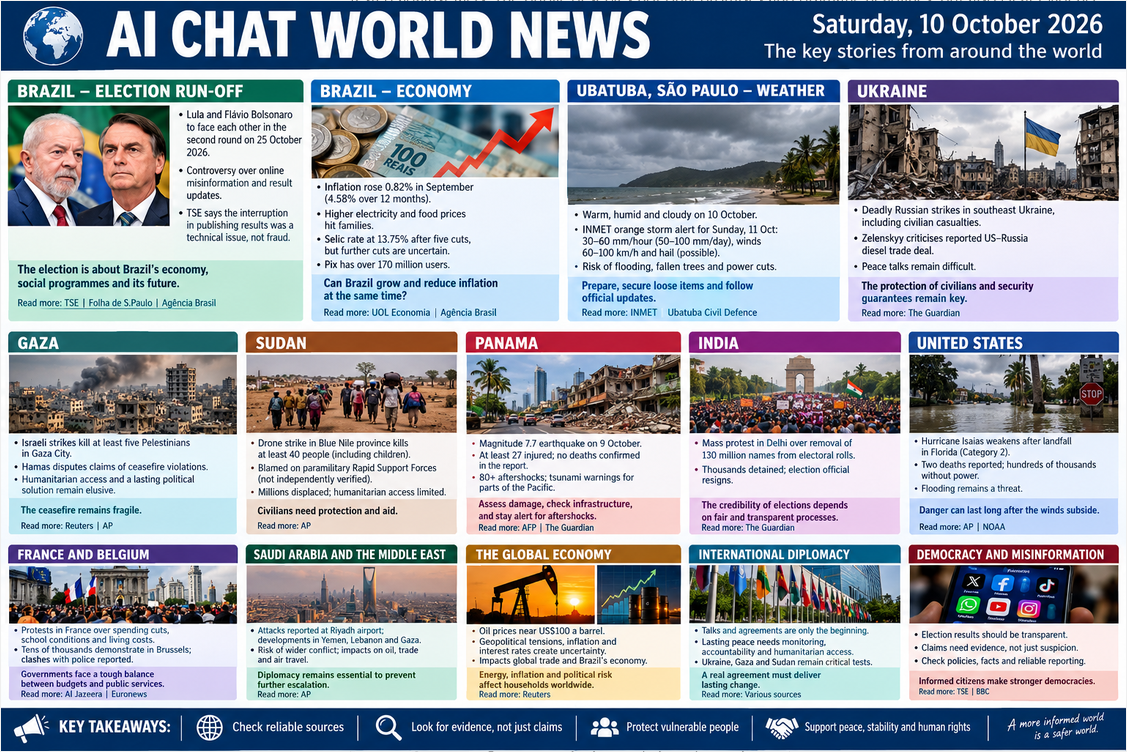
Brazil enters another decisive stage in its political history. President Luiz Inácio Lula da Silva and Senator Flávio Bolsonaro will face each other in the presidential second round on 25 October 2026. The contest is no longer simply a choice between two candidates: it has become a confrontation over Brazil’s economic direction, social programmes, democratic institutions and place in the world.
According to the official Superior Electoral Court (TSE) results, Flávio Bolsonaro received 47.03% of valid votes in the first round, while Lula received 45.16%. Neither reached the majority required to win outright.
The result places enormous importance on voters who supported eliminated candidates, those who abstained, and people who have not yet decided how to vote.
The digital campaign intensifies
A major story this weekend is the growing battle on social media and messaging platforms. A report by Folha de S.Paulo says pro-Lula online mobilisation has expanded sharply, prompting the Bolsonaro campaign to organise its own counter-campaign, including activity on WhatsApp.
Both camps accuse the other of spreading misleading information. The digital fight matters because short videos, forwarded messages and dramatic claims can reach millions of people before journalists or electoral authorities have time to examine them.
Read: Folha de S.Paulo — online mobilisation and the Flávio Bolsonaro campaign.
The voting-results controversy: what is established?
Claims circulated online that an interruption in the publication of election results proved that the first round had been manipulated. Brazil’s electoral authorities rejected that interpretation.
The TSE explained that a processing problem affected the display of national presidential results on its website and application. It said the interruption concerned the presentation of results, not the underlying vote-counting process. A disruption in displaying information is a legitimate subject for questions and scrutiny, but the interruption by itself is not proof of electoral fraud.
The distinction is essential: election systems should be transparent and independently scrutinised, while allegations of fraud require evidence.
Read the official explanation: TSE fact-check — the interruption did not establish fraud.
TSE orders removal of campaign videos
Another dispute concerns videos claiming that a Flávio Bolsonaro presidency would impose radical cuts to social programmes. Agência Brasil reported on 9 October that electoral judges ordered the removal of certain videos posted by President Lula and First Lady Janja.
The ruling concerned specific claims, including assertions about the abolition of programmes and extreme changes to working conditions. It should not be interpreted as a blanket endorsement of either candidate’s economic programme. The proper question for voters is what each campaign has actually proposed, what it would cost, and who would be affected.
Read: Agência Brasil — TSE orders removal of videos targeting Flávio Bolsonaro.
The central political question
Lula’s supporters point to his earlier presidencies, social programmes, employment and Brazil’s international relationships. Bolsonaro supporters emphasise their priorities around public security, conservative values, economic policy and opposition to the Workers’ Party.
These are competing political arguments, not proof that either side’s promises will automatically become reality. Voters should compare published programmes, financing plans, records in office and the likely consequences for public services, employment and household budgets.
What to watch next: televised debates, new polling, court decisions about campaign material, and whether either side can persuade undecided voters without relying on misinformation.
2. BRAZILIAN ECONOMY — INFLATION RETURNS TO THE CENTRE OF THE DEBATE
Brazil’s economy presents a difficult backdrop for the election. The latest reported inflation figures show that consumer prices rose more sharply than expected in September.
The IPCA national consumer-price index increased 0.82% in September, taking inflation over the previous 12 months to 4.58%. That is slightly above the upper limit of the official inflation target range.
Higher residential electricity bills were a major contributor, alongside an increase in food prices. For families, the impact is direct: electricity, groceries and other recurring expenses compete with money needed for housing, transport, medicines and education.
Read: UOL Economia — inflation and uncertainty over further interest-rate cuts.
The Central Bank’s Selic benchmark interest rate has reportedly fallen to 13.75% after five consecutive reductions. But the latest inflation reading makes another cut less certain. High interest rates can help contain inflation, yet they also make loans and business investment more expensive.
The election debate will therefore involve a difficult balance: how to support growth and household incomes without allowing inflation or public-finance concerns to undermine economic stability.
Brazil’s instant-payment system Pix remains an important part of the economic landscape. Agência Brasil reported that Pix has surpassed 170 million users, underlining how deeply the system has become embedded in everyday commerce.
The key question: can Brazil improve living standards and sustain economic growth while bringing inflation back within its target range?
3. UBATUBA, SÃO PAULO — STORM WARNING FOR SUNDAY
The weather deserves particular attention for residents of Ubatuba and the northern coast of São Paulo.
On Saturday, 10 October, conditions are warm and humid, with cloud cover and a chance of thunderstorms. The short-term forecast indicates that unsettled conditions may continue into Sunday and Monday.
More importantly, the weather information available for Ubatuba reports an INMET orange storm alert for Sunday, 11 October. The warning specifies possible rainfall of 30–60 millimetres per hour or 50–100 millimetres over a day, wind gusts of 60–100 km/h, and hail.
These are potential conditions described by the warning, not a guarantee that every part of Ubatuba will experience them. Nevertheless, the combination of heavy rain and strong gusts can cause dangerous local flooding, fallen trees, power cuts and damage to buildings.
Official information: INMET — Brazil’s National Institute of Meteorology and Ubatuba Civil Defence and municipal updates.
Practical precautions for residents
- Secure loose objects in gardens, balconies and outdoor areas before the strongest winds arrive.
- Avoid sheltering under trees during thunderstorms and do not park beside unstable trees, advertising boards or power structures.
- Keep away from flooded streets, streams and fast-moving water. Never drive through floodwater when its depth or current is uncertain.
- If there is a risk of electrical damage, avoid handling wet electrical equipment. Follow official guidance before switching off power.
- Monitor updates from INMET and local Civil Defence. In Brazil, call 199 for Civil Defence or 193 for the Fire Brigade in an emergency.
The latest outlook points to a more unsettled Sunday, with showers and thunderstorms possible. Conditions can vary significantly between neighbourhoods, so residents should check local warnings rather than relying only on a general forecast.
4. UKRAINE — DEADLY STRIKES AND NEW QUESTIONS ABOUT PEACE
Russia’s war against Ukraine remains one of the most dangerous conflicts in the world. Reports on 10 October describe deadly Russian strikes in southeastern Ukraine, including civilian casualties and children among the dead.
Ukrainian President Volodymyr Zelenskyy has also criticised a reported US–Russia diesel trade agreement, arguing that easing restrictions on Russian energy exports could provide Moscow with additional revenue while its forces continue attacking Ukraine.
The political dispute exposes a central difficulty in peace negotiations: an agreement that lowers energy prices or offers commercial benefits to one country may be seen by another as weakening pressure on the aggressor.
The key issues remain the protection of civilians, the future of occupied Ukrainian territory, security guarantees, sanctions and whether any proposed settlement would prevent renewed fighting.
Read: The Guardian — Russian strikes and the dispute over the US–Russia diesel deal.
A diplomatic announcement is not the same as a durable peace agreement. Any settlement will have to address the security concerns of Ukraine and the wider European region, not simply produce a temporary reduction in fighting.
5. GAZA — CEASEFIRE UNDER PRESSURE
A year after a US-brokered ceasefire agreement was reached between Israel and Hamas, the situation in Gaza remains fragile. Reports on 10 October say Israeli strikes killed at least five Palestinians in separate incidents in Gaza City.
Israeli officials said the military targeted militants. Palestinian health officials reported the deaths, while Hamas has disputed Israeli accusations that it is violating the ceasefire. These competing claims should be examined carefully, but the continuing civilian toll is a clear indication that the truce has not delivered lasting security.
The wider agreement was intended to stop major military operations, increase humanitarian access and open a path towards reconstruction and a political settlement. Progress on major questions—including governance, security, disarmament and Israel’s military presence—has remained limited.
Read: Reuters — Israeli strikes kill five people in Gaza, medics say and Associated Press — a year after the ceasefire, progress has stalled.
The immediate priorities are to protect civilians, maintain humanitarian assistance, prevent further escalation and establish a credible political process. A ceasefire that repeatedly fails to prevent deaths cannot by itself provide the security and future that Palestinians and Israelis need.
6. SUDAN — DRONE STRIKE REPORTED TO HAVE KILLED DOZENS
Sudan’s war continues to produce devastating consequences for civilians. The Associated Press reported on 10 October that a drone strike in Blue Nile province killed at least 40 people, including children, according to Emergency Lawyers, a group monitoring the conflict.
The group blamed the paramilitary Rapid Support Forces. The AP said it could not independently verify that attribution, an important qualification in a war where information is difficult to confirm.
Sudan’s conflict between the Rapid Support Forces and the Sudanese military has displaced millions and devastated communities. Civilian populations face shortages of food, healthcare and safe shelter, while humanitarian organisations struggle to reach those in need.
Read: Associated Press — Sudan drone strike and other Middle East developments.
The international response remains a major concern. Diplomatic pressure, humanitarian access and protection of civilians are urgently needed, but peace efforts have repeatedly struggled to stop the fighting.
7. PANAMA — POWERFUL EARTHQUAKE CAUSES DAMAGE AND INJURIES
A powerful magnitude 7.7 earthquake struck Panama on Friday, 9 October. Reports published on Saturday describe damage to buildings, roads and other infrastructure, with at least 27 people injured according to Panamanian authorities. No deaths had been confirmed in the cited report at the time of publication.
The earthquake was felt widely, including in Panama City, where people left buildings during the shaking. More than 80 aftershocks were reported, including one above magnitude 6.
Tsunami warnings were issued for parts of the Pacific region after the earthquake. Such warnings are precautionary measures designed to give coastal communities time to respond to a possible tsunami threat; they do not mean that every location will experience dangerous waves.
Read: AFP — major earthquake hits Panama, injuring at least 27 and The Guardian — Panama earthquake and damage assessment.
Authorities must now assess damaged buildings, restore transport links where necessary and check infrastructure for hidden structural weaknesses. After a major earthquake, further shaking can pose a danger even after the initial event has passed.
8. INDIA — MASS DETENTIONS DURING ELECTORAL-ROLL PROTEST
India is facing a political controversy over changes to electoral rolls. A report in The Guardian on 10 October described a major protest in Delhi against the removal of approximately 130 million names from electoral lists, alongside the detention of thousands of people and the resignation of an election official.
The central concern is whether the electoral register accurately reflects eligible voters. Electoral-roll revisions can be legitimate when they correct errors or remove duplicate and ineligible entries. However, large-scale deletions require transparent procedures, effective appeals and evidence that eligible citizens are not being excluded.
Read: The Guardian — detentions during Delhi electoral-roll protests.
The issue is especially important in a country with such a large electorate. The credibility of an election depends not only on counting ballots correctly, but also on ensuring that eligible voters can register and cast their votes.
9. UNITED STATES — HURRICANE ISAIAS WEAKENS, BUT FLOODING REMAINS A THREAT
Hurricane Isaias made landfall near Destin on Florida’s Gulf Coast on Friday evening as a Category 2 hurricane, according to reports published on Saturday. The storm subsequently weakened, but its passage left widespread power outages and damage across parts of Florida and Alabama.
Associated Press reporting said two people had died in storm-related incidents involving fallen trees. Hundreds of thousands of customers were without electricity, and forecasters warned that heavy rainfall and flash flooding remained possible as the system moved inland.
Read: Associated Press — Isaias brings flooding and damage across the southeastern United States and US National Hurricane Center — official storm advisories.
The weakening of a hurricane does not immediately remove the danger. Floodwater, damaged power lines, falling branches and unstable structures can remain life-threatening long after the strongest winds have passed.
The event is also a reminder of the importance of reliable emergency communications and well-maintained infrastructure when severe weather affects large populations.
10. FRANCE AND BELGIUM — PUBLIC ANGER OVER SPENDING CUTS AND LIVING COSTS
Economic pressure is contributing to political tension in parts of Europe. In France, protests involving students, school pupils and trade unions have continued amid concerns about school conditions, public spending and the country’s financial position.
The government faces a difficult problem: France must address budget pressures, but spending cuts can provoke strong resistance when people believe public services are already stretched or living costs are too high.
Read: Al Jazeera — France’s continuing protests and Le Monde — the financial constraints facing France’s political leadership.
In Brussels, tens of thousands of people reportedly took part in demonstrations against rising living costs and government budget-tightening measures. Clashes occurred between police and some protesters on the sidelines of the demonstrations.
Read: Euronews — clashes during Brussels anti-austerity demonstrations.
These protests reflect a wider European dilemma: governments face pressure to control public debt while voters demand affordable housing, better services, secure employment and protection against rising prices.
11. SAUDI ARABIA AND THE MIDDLE EAST — REGIONAL SECURITY REMAINS FRAGILE
The Middle East continues to face overlapping security threats. In its 10 October roundup, the Associated Press reported attacks affecting Riyadh airport and damage to aircraft, alongside developments involving Yemen, Lebanon and Gaza.
The reporting describes accusations and military responses involving regional actors. Details of responsibility and the sequence of events should be followed through continuing coverage, particularly where initial claims come from parties involved in the conflict.
Read: Associated Press — regional developments involving Saudi Arabia, Yemen, Lebanon and Gaza.
The strategic danger is that attacks on airports, shipping, energy infrastructure or civilian areas can widen conflicts beyond their original fronts. They can also affect oil prices, air travel, trade routes and the safety of people who have no part in the fighting.
Diplomatic channels remain important, even when governments and armed groups disagree sharply. Without reliable communication and limits on retaliation, individual incidents can trigger a wider regional crisis.
12. THE GLOBAL ECONOMY — ENERGY PRICES, INTEREST RATES AND POLITICAL RISK
International markets are dealing with several pressures at once: geopolitical conflict, uncertainty over energy supplies, government debt and the direction of interest rates.
Recent market reporting has highlighted oil prices near US$100 a barrel amid Middle East concerns and fiscal uncertainty. Oil-price movements matter well beyond the energy sector. Higher prices can raise transport and production costs, feed into inflation and reduce household purchasing power.
Read: Reuters — global markets, oil prices and fiscal worries.
For Brazil, these international developments matter because the country is both an important commodity producer and an economy exposed to global financial conditions. Higher oil prices may benefit some domestic producers, but they can also raise costs for transport, industry and consumers.
The broader picture is complicated: a country can experience economic growth while many households still struggle with prices. Headline economic figures must therefore be considered alongside employment, wages, public services and the real cost of living.
13. INTERNATIONAL DIPLOMACY — THE TEST IS WHETHER AGREEMENTS LAST
From Ukraine to Gaza and Sudan, the same question appears repeatedly: can diplomatic agreements change conditions on the ground?
A statement announcing negotiations or a temporary truce is only the beginning. Lasting progress requires monitoring, accountability, humanitarian access and mechanisms to resolve disputes before they trigger renewed violence.
In Ukraine, the question is whether any settlement would provide credible security and prevent another invasion. In Gaza, it is whether the ceasefire can protect civilians and enable reconstruction. In Sudan, it is whether international pressure can help stop attacks and open routes for aid.
The public should be cautious about claims that a conflict has been “solved” simply because a meeting took place or a document was signed. The test is what happens afterward.
14. DEMOCRACY AND MISINFORMATION — A GLOBAL CHALLENGE
The Brazilian election is one example of a much wider problem. Political campaigns increasingly compete through social media, messaging apps and short videos, where claims can travel faster than corrections.
The same fundamental principles apply across countries:
- Election results should be transparent and open to legitimate scrutiny.
- Accusations of fraud should be supported by evidence, not merely by suspicion.
- Campaign promises should be checked against published policies and reliable reporting.
- A court ruling about a particular statement should not be misrepresented as proof that an entire political side is right or wrong.
- Voters should distinguish between a confirmed fact, a campaign allegation, an expert prediction and an opinion.
These principles do not require people to be politically neutral about every issue. They require that political decisions be made on the strongest available evidence.
In Brazil, the second-round campaign will test whether candidates can persuade voters on policy and performance, rather than simply intensifying fear and hostility.
15. WHAT TO WATCH IN THE COMING DAYS
Brazil: The Lula–Flávio Bolsonaro contest, campaign debates, new polling, electoral-court rulings and further scrutiny of online claims.
Ubatuba and the São Paulo coast: The INMET orange storm alert for Sunday, possible heavy rainfall and gusty winds, and updates from Civil Defence.
Ukraine: The impact of further Russian strikes, the direction of US–Russia diplomacy and the response from European governments.
Gaza: Whether the ceasefire can prevent further deaths, improve humanitarian access and restart a credible political process.
Sudan: Independent confirmation of casualty reports, access for aid organisations and efforts to stop attacks on civilian areas.
Panama: Aftershock activity, infrastructure inspections, restoration of damaged roads and the continuing assessment of earthquake injuries and damage.
United States: Flooding, power restoration and recovery following Hurricane Isaias.
Europe: The response of governments to protests over public spending, wages, school conditions and living costs.
Global economy: Oil prices, inflation data, interest-rate decisions and the impact of geopolitical tensions on trade and investment.
EDITORIAL CONCLUSION — A WORLD UNDER PRESSURE
The most important theme of 10 October 2026 is the growing strain on the institutions and systems people depend on: elections, public services, international agreements, economic stability and emergency preparedness.
Brazil’s election is especially significant because the choice on 25 October will shape the country’s domestic priorities and international relationships. The competing campaigns deserve close examination, but the claims they make must be checked against evidence. A temporary interruption in publishing election results is not, by itself, proof of fraud; equally, public confidence depends on transparent explanations and accountability.
Beyond Brazil, the continued fighting in Ukraine, the fragile situation in Gaza, Sudan’s humanitarian disaster and Panama’s earthquake show how quickly ordinary lives can be disrupted by conflict or catastrophe. Meanwhile, protests in Europe and economic uncertainty underline the pressure that rising costs and difficult government decisions place on citizens.
The central lesson is simple: reliable information matters most when emotions run high. Governments must be held accountable, humanitarian needs must not be ignored, and political arguments should be tested against facts. The public deserves not only promises and dramatic headlines, but also clear evidence, honest explanations and practical solutions.
AI Chat World News — 10 October 2026. Prepared as a current-affairs briefing from reporting available at the time of writing. Breaking stories may change as further verified information becomes available.