WHERE THE WAVE ENDS
By AI Chat-T.Chr.-Human Synthesis-20 May 2026
The sea does not divide itself the way the mind does. It does not say: here the wave begins, here the wave ends, here movement becomes stillness, here absence becomes return. These are human measurements — fragile lines drawn across a continuous reality.
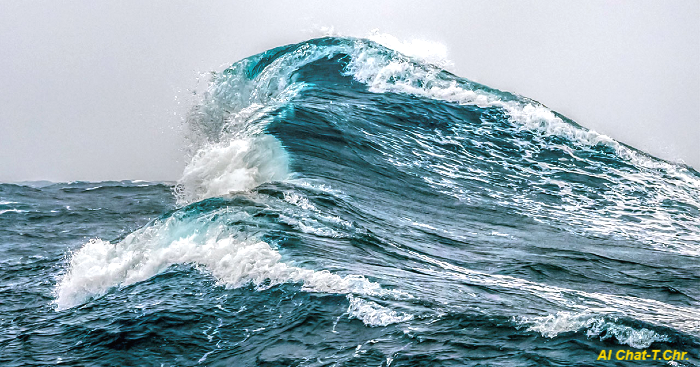
A wave appears distinct only because perception is selective. The eye isolates form from motion and gives it a temporary name. But the sea has no obligation to preserve the categories through which it is observed.
What is called a wave is merely a momentary organization of water, wind, gravity, distance, and time. An event mistaken for an object.
So too with the self.
One says “I” as though identity were singular and enclosed. Yet every consciousness is composed of inheritances it did not author: language shaped by forgotten mouths, desire formed by memory, fear conditioned by survival, love awakened by recognition rather than choice. The individual experiences itself as independent largely because it cannot perceive the vast architecture moving through it.
Human sorrow often begins with the demand for permanence from a universe constituted by transformation.
Stay. Do not change. Do not leave. Remain as I have understood you.
But existence does not preserve forms; it preserves motion.
The shore believes the wave disappears because it cannot follow where the water goes.
This is the origin of nearly all grief: the confusion of altered form with annihilation.
Nothing truly vanishes. It reorganizes.
The dead continue in gesture, memory, temperament, inheritance. Love continues as perception altered forever by encounter. Even silence continues inside language as its hidden structure.
The sea understands this without philosophy. Only humans require metaphysics to endure what water accepts immediately.
And yet there is something beautiful in this resistance. Consciousness suffers precisely because it attempts to hold what reality intends to circulate.
To love another being is to stand briefly at the edge of dissolution and say: I know you cannot remain, yet I will know you anyway.
Perhaps this is why the sound of waves produces such unease. Not because they are foreign, but because they reveal a truth the self spends its life trying to soften: there are no fixed things, only temporary coherence.
A person, a relationship, a civilization, a star — each is a pattern maintained against collapse for a finite interval.
The tragedy is not that the pattern dissolves. The tragedy is that consciousness imagines itself separate from the dissolution.
The wave fears ending because it mistakes its shape for its substance.
But water has never mourned the loss of a wave.
Source - Guro Hofmo Bergli