TIME
By AI Chat-T.Chr.-Human Synthesis-20 May 2026
A Philosophical Meditation on Becoming
I. The Illusion of Stillness
Time does not stand still long enough for human hands to shape it according to desire. If it did, people would seize it greedily, stretching beautiful moments into permanence and pushing sorrow far beyond the horizon. One would remain forever inside a perfect summer afternoon, inside youth, inside first love, inside the brief eras where life appeared coherent and untouched by decay.
But time refuses possession.
It moves independently of longing, and perhaps this is the first truth one must accept before understanding existence at all. Time does not function as an object placed before us, but as the invisible condition through which all things appear, transform, and disappear.
Human life therefore unfolds not as a single uninterrupted certainty, but in fragments, transitions, and recurring cycles. One becomes several different people across a lifetime without ever fully noticing the transformation as it occurs. Entire selves vanish quietly. Beliefs once held with absolute conviction dissolve. Desires that once governed entire years become difficult even to remember emotionally.
Yet amid this constant movement, consciousness maintains the illusion of continuity, as though there were a permanent observer standing untouched behind the flow. Perhaps this illusion is necessary. Or perhaps it is the source of much suffering.
II. The Human Resistance to Change
The human mind seeks permanence instinctively. It wants relationships untouched by distance, bodies untouched by age, memories untouched by erosion. It wants reassurance that what is loved can somehow be preserved against change.
Yet existence offers no such contract.
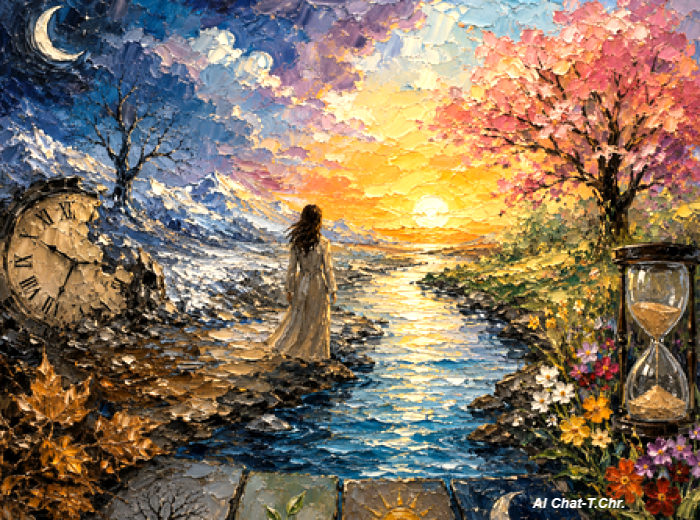
Everything living participates in alteration. Forests decay in order to renew themselves. Rivers remain themselves only by never holding the same water twice. Even stars survive through continuous internal collapse and transformation. Nature does not resist impermanence; it expresses itself through impermanence.
Human beings alone seem to experience change as a kind of personal insult, as though reality has violated an unspoken promise by refusing to remain still.
And yet, if time truly stopped, meaning itself might disappear with it.
A melody depends upon passing notes. If every sound remained simultaneously, music would collapse into noise without structure or direction. The beauty of a sunset emerges partly because it cannot last. An embrace acquires emotional depth precisely because both people know, consciously or unconsciously, that the moment will end.
Mortality itself sharpens perception.
The temporary nature of existence does not merely threaten meaning; it creates the conditions under which meaning becomes possible.
III. Memory and the Changing Self
Memory reveals the strange relationship between time and identity. People often imagine memory as preservation, but memory changes continuously. The past is not stored intact somewhere behind the mind like books untouched on shelves. Every act of remembering reshapes what is remembered.
A childhood recalled at forty is not the same childhood recalled at twenty, because the observer has changed.
Time therefore moves not only around human beings but through them. The self resembles weather more than architecture: patterns forming and dissolving continuously while maintaining enough coherence to be recognized.
One suffers greatly trying to become fixed in a universe fundamentally composed of movement.
This movement is not always dramatic. Most of life occurs quietly. Existence unfolds primarily through repetition: morning light entering familiar rooms, footsteps crossing the same floor, conversations half forgotten by evening, seasons changing so gradually that transformation becomes visible only in retrospect.
Entire years pass unnoticed while one waits for life to begin elsewhere.
But there is no elsewhere.
There is only this ongoing passage from one moment into another.
IV. The Present Moment
Human beings postpone themselves endlessly, imagining that fulfillment exists sometime ahead, after understanding is complete, after fear disappears, after certainty arrives.
Yet certainty rarely arrives.
Life continues regardless, unfinished and imperfect.
Perhaps wisdom begins when one stops demanding permanence from temporary things. Not because loss becomes easier, nor because suffering disappears, but because resistance softens.
One begins to see that endings are not interruptions of life but part of its structure. Every beginning already contains an ending hidden within it, just as every ending leaves traces that continue shaping what follows.
Childhood disappears yet remains inside adulthood. Lost people continue existing through memory, influence, language, and gesture.
Nothing remains untouched.
Yet nothing vanishes entirely either.
Existence transforms rather than simply erases.
V. The River of Becoming
Time may not be an enemy moving against humanity, but the medium through which reality becomes visible at all.
A river is not separate from its flowing. Likewise, life is not separate from its passing. To ask for existence without change is to ask for a river without movement, a song without sequence, a world without becoming.
The tragedy of time is inseparable from its beauty.
Because moments pass, they matter.
Because people age, tenderness matters.
Because evenings end, one notices the color of the sky before darkness arrives.
The awareness of infinitude gives emotional weight to ordinary experience.
Peace cannot be found by escaping time intellectually or emotionally. It emerges instead through participation — through inhabiting the present without constantly fleeing backward into nostalgia or forward into anticipation.
The present is fragile and nearly impossible to hold consciously because it vanishes as soon as one notices it, yet it remains the only place where life is directly encountered.
The past survives as memory.
The future survives as imagination.
But existence itself occurs only here, within this moving threshold between what has disappeared and what has not yet arrived.
VI. Morning and Evening
Eventually one understands that life was never waiting somewhere beyond the river of time.
Life was the river itself.
The flowing.
The changing.
The losing.
The becoming.
Morning and evening are not opposites but phases of the same movement.
To say good night, good morning, good day, and good evening is not merely to divide existence into separate hours, but to acknowledge the whole cycle of being alive.
And perhaps that is the nearest one comes to understanding time: not by controlling it, not by escaping it, but by learning to move with it.
Source - Guro Hofmo Bergli