THE BAILIFF AND THE UNREACHABLE FARM

By FB-AI Chat-Human Synthesis-18 October 2026
Lars thought of his father, who had spent his life believing that the farm must be defended against the world. He thought of the bailiff, who had come seeking payment and had left behind an unexpected gift.
As the boat slipped into Skagehola, the bailiff leaned back and stared upwards.
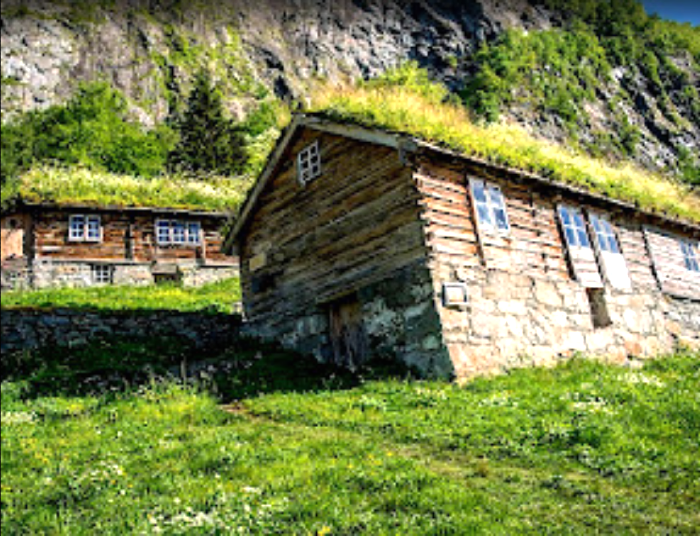
Two or three hundred metres above the fjord, a narrow shelf of land clung to the mountainside. There stood the farm buildings, their dark timber walls almost blending into the rock behind them. Beyond the roofs, the mountain rose like a fortress, steep and forbidding. The bailiff had collected taxes from many difficult farmers, but Skageflå was different. From the water, it looked less like a farm than a stronghold built by men who had decided that the world below could be kept at a safe distance.
A narrow path climbed from the shore, twisting between rocks and ledges. At the most dangerous places, ladders provided the only way forward. The farmer, a man named Eirik Skage, was said to watch the fjord every morning. He knew the boats of his neighbours, the fishing vessels, the traders, and the occasional official sent by the Crown. If he saw a boat he did not like, he descended to the shore, pulled up the ladder, and returned to his work. Anyone left below could shout until his throat was raw. There was no other way to reach the farm, and no amount of royal authority could make a missing ladder reappear.
The bailiff had heard these stories in the villages along the fjord and had laughed at them. He served the king. He carried a seal, a register, and an order bearing the authority of men who lived far from the mountains. Surely no farmer could deny him access to a farm that owed taxes to the Crown. Yet as his boat touched the shore, the laughter disappeared. He saw the height of the cliffs, the narrowness of the landing place, and the path vanishing upwards into shadow. The man at the oars crossed himself before stepping onto the stones.
“Do you think he will come down?” the bailiff asked.
The oarsman looked towards the farm.
“If he wants us to come up, he will. If he does not, we shall be here until the tide turns, though the tide does not turn in this fjord the way it does at sea.”
The bailiff frowned, adjusted the satchel under his arm, and began to climb. He had not taken twenty paces when a figure appeared above him. It was Eirik himself, a broad-shouldered man with a weather-beaten face, grey at the temples despite being little more than forty. He wore a homespun jacket and carried an axe, not as a weapon but as naturally as another man might carry a walking stick.
“You have come a long way,” Eirik called down. “I have come on the king's business.”
“Then the king has chosen a difficult road.” “I have a royal order and a tax register. I require access to your farm.”
Eirik looked at the leather satchel.
“And what does the king require from me?” “What is due.” “Then tell the king to send someone who understands what is due to a man who grows his food between a cliff and a mountain.”
The bailiff felt his face grow warm. He had been insulted by rich merchants and threatened by poor farmers, but he had never been addressed quite so calmly by a man who stood above him on a ledge where one misplaced foot could mean death.
“I shall not be kept waiting,” he said.
Eirik turned without answering. A moment later, the ladder above the steepest section began to rise. The bailiff stared in disbelief as it disappeared over the edge. Eirik's head appeared once more.
“When you have learned patience, you may try again.”
Then he was gone.
The bailiff stood alone beneath the cliff, listening to the distant sound of goats and the faint voices of women working above. He could see smoke rising from a chimney. Somewhere, bread was being baked. Someone was hammering a piece of wood. Life continued as if no royal official had arrived at all. He remained there for nearly an hour before returning to his boat. On the way back to the village, he swore that the next time he visited Skageflå, he would bring enough men to ensure that no ladder could be pulled out of reach.
But the Crown had more pressing matters, and the following years brought changes to the fjord that neither the bailiff nor Eirik could have imagined. For generations, people had lived on the shelf above the water. The fields were small patches of earth squeezed between the mountain and the precipice. Every handful of soil was precious. Stones had been carried away by hand, walls raised one at a time, and manure spread over ground that barely seemed capable of supporting a blade of grass. Grain, salt, iron, timber, and every other necessity had to be hauled up the steep path on human backs or the backs of animals.
The people of Skageflå knew that their prosperity rested on an uneasy bargain with the mountain. It provided pasture, water, timber, and shelter, but it also threatened to reclaim everything they had built. Their children learned early where the rocks were loose and which stones became slippery after rain. Mothers watched their little ones whenever they played near the edge. In some farms along the fjord, children were tied with ropes while playing outside, so that a stumble could not send them tumbling into the abyss. No one regarded this as cruelty. It was simply the price of living in a place where carelessness could be fatal.
Eirik had been born into this world and had never wished to leave it. His wife, Ragnhild, was equally determined to stay. They had three children: Lars, the eldest, who was already learning to manage the goats; Ingrid, a sharp-eyed girl who could recognise distant boats by the shape of their sails; and little Anders, who was forever asking questions about the world beyond the mountains.
“Why do we live so high above the water?” Anders once asked his mother. “Because our fathers lived here,” Ragnhild answered. “But why did they?”
She paused, looking towards the fjord.
“Perhaps they found this place before they knew how difficult it would be to leave.”
In summer, the goats were driven to the mountain pastures, where the grass was rich and the air smelled of wildflowers. The women climbed the paths with their packs, milking the animals and making cheese in small wooden huts. Smoke rose from the summer shelters, and the bells of the goats rang across the slopes. From Skageflå, the people could see the Seven Sisters waterfall plunging down the opposite side of Geirangerfjord. In spring, when snow melted high in the mountains, the waterfalls grew so powerful that their roar seemed to fill the entire valley. At night, the sound drifted through open windows and became part of their dreams.
Winter was another country altogether. Snow buried the paths, ice formed along the shore, and the mountain shadows grew long. Sometimes weeks passed without a visitor. A person who slipped on the path might never be found until the thaw. The people survived on what they had stored during the summer and autumn: dried meat, cheese, grain, and whatever else could be preserved. They learned to repair their clothes, mend their tools, and make every candle last. The outside world became a distant rumour. Yet the fjord was never entirely silent. News travelled from farm to farm, carried by fishermen, traders, and relatives who crossed the water in small boats.
People spoke of new roads, new laws, and ships that carried Norwegians across the Atlantic to a land called America, where the soil was broad and flat and a man could plough a field without fearing that half his harvest might slide into the sea. Some neighbours left. They sold their animals, packed what they could carry, and disappeared down the fjord towards the towns. Others returned briefly to say farewell before boarding ships that would take them across the ocean. Their letters, when they arrived, described cities filled with smoke, streets crowded with strangers, and farms so large that a man could ride for an hour without reaching the boundary.
Lars listened to these accounts with fascination.
“Perhaps I should go,” he told his father one evening.
Eirik was repairing a harness by the fire.
“You are free to go when you are old enough.” “You would not stop me?” m“I cannot command the mountain to keep you here. Why should I command my son?” Lars studied his father. “Would you be disappointed?”
Eirik took a long time to answer.
“I would be disappointed if you left because you were afraid to live here. I would be proud if you left because you had found something worth seeking.”
For the time being, Lars remained.
Then came the year 1855, when men arrived with tools, explosives, and plans to cut a new passage through the rock. For the first time in the memory of the living, the ancient route to Skageflå was to be altered. The work was dangerous and slow. The workers drilled into the stone, packed the holes with explosive charges, and retreated to safety before the mountain thundered. Each blast shook the ground beneath the farm and sent echoes racing across the fjord. Ragnhild feared that the work would awaken something in the mountain. Eirik said little, but he watched the workers with the suspicion of a man who had spent his life respecting forces he could not control.
When the passage was finally completed, the old ladders were no longer necessary. A man could make his way up from the shore without depending on a farmer's permission or a ladder left in place. For those carrying heavy loads, it was a blessing. Salt and grain could be brought up more easily, animals could be moved with less danger, and visitors no longer had to wait at the water's edge. But the change brought something else. The world had come closer. The bailiff returned that summer.
This time, he reached the farm without difficulty. Eirik received him in the yard, where the goats crowded around a wooden trough and Ragnhild stood in the doorway, wiping her hands on her apron. The bailiff opened his register and read out the amount owed. Eirik listened without interruption. When the man had finished, he went inside and returned with cheese, hides, and a small purse of silver.
“You have paid your taxes,” the bailiff said, surprised. “I have paid what I owe,” Eirik answered. “That is not the same as saying I agree with everything the king demands.”
The bailiff could find no suitable reply. He entered the payment in his register and prepared to leave. Before he descended, he turned to look at the farm. The new passage had made it easier to reach, but he understood now why Eirik had resisted him. Skageflå was not merely a place where a man lived and paid taxes. It was a world built through generations of labour, courage, and stubborn independence. The farm had been defended not by walls or weapons, but by the simple fact that its inhabitants knew the mountain better than anyone who came from below.
Years passed. The children grew older. Ingrid married a man from another farm across the fjord, while Anders became a skilled climber and shepherd. Lars remained longer than he had expected, helping his father repair the stone walls and tend the land. By then, Eirik's hair had turned white, and his steps had grown slower. He still watched the fjord every morning, though he no longer descended to the shore as often as he once had.
Then, in 1873, the mountain moved.
It happened without warning, or so it seemed to those who survived. Perhaps there had been small tremors, cracks in the earth, or stones falling from the upper slopes. Perhaps someone had noticed something unusual and dismissed it as another ordinary sign of a restless mountain. No record preserved the precise sequence of events. What remained was the terrible fact that a large part of the mountainside gave way.
The earth broke loose above the farm. Stones, mud, roots, and shattered rock rushed downwards, swallowing sections of the cultivated land. The ground shook beneath the buildings. Animals scattered in panic, and the air filled with a noise like distant thunder growing suddenly enormous. A stone wall that had taken three generations to build disappeared in seconds. The fields where families had sown grain for decades were buried beneath a grey mass of earth and rock.
Ragnhild was in the house when the first great crash came. Ingrid's youngest child, visiting with his mother, was asleep near the hearth. Ragnhild seized him and ran towards the yard, shouting for Lars and Anders. Eirik, who had been working near the edge of the field, turned just as the ground beneath him split. For one dreadful instant, he saw the land itself moving.
He ran towards the farm buildings, but the slope was already breaking apart. Anders caught his father's arm and dragged him behind a low stone wall as the earth thundered past. A cloud of dust engulfed them. Rocks struck the wall and bounced into the yard. The goats screamed, the roof shook, and somewhere below, a tree crashed down the mountainside. When the noise finally faded, silence descended with a force almost as frightening as the landslide.
The family emerged cautiously from their shelter. The air smelled of broken earth and crushed vegetation. Where the fields had once stretched in narrow green strips, there was now a raw scar of grey stone and mud. The walls were broken, the lower pasture ruined, and much of the land that had sustained the family for generations was gone.
Eirik stood motionless. He had spent his life fighting the mountain in small ways: carrying away stones, building walls, clearing earth, and repairing what winter destroyed. He had never believed that he could conquer it. But he had trusted that his labour would endure long enough to feed his children and grandchildren. Now the mountain had taken a part of that labour in a single afternoon. Ragnhild approached him and placed a hand on his shoulder.
“We are still here,” she said.
He looked at the ruined field.
“For how long?”
She had no answer.
In the weeks that followed, the family worked desperately to salvage what remained. They carried stones away from the damaged paths, repaired the roofs, and gathered the surviving animals. Some fields could be cleared, but others were lost beneath heaps of rock. The soil that remained was too thin in places to support grain, and the old balance between pasture, crops, and livestock had been broken. Neighbours came across the fjord to help. They brought food, tools, and timber. Among them were people from Møllsæter, a farm whose inhabitants had endured their own share of hardship. Their leader was a man named Jon, a widower with two grown sons and a daughter, Marit, who had a quiet strength that impressed everyone she met.
Marit worked beside Ingrid and Ragnhild, carrying stones and preparing meals for the exhausted men. She was not afraid of the heights, nor did she speak of the ruined land as if it were already a grave.
“You cannot make the old field return,” she told Lars one evening as they stood beside the damaged wall. “But you can decide what grows in the ground that remains.”
Lars looked at her.
“And if there is not enough?” “Then you must find another way to live.” “You speak as though it were simple.” “No,” she said. “I speak as though it is necessary.”
Her words stayed with him.
The following year, the farm was divided into two holdings. The surviving land could no longer support the entire household as it once had, and more hands were needed to clear stones, rebuild walls, and maintain the animals. It was an arrangement born of necessity, but it also offered a chance to begin again. The family story became intertwined with that of Møllsæter. Lars married Marit, while Anders married her sister, Kari, who had come to Skageflå with the first group of helpers. The two couples established separate households on the narrow shelf above the fjord.
Their marriage united two families that had learned to survive by relying on one another, and their children would grow up hearing both the stories of the old farm and the warnings of the mountain. Eirik watched the weddings from a wooden bench outside the house. His health had declined, and he no longer climbed the steepest paths. Yet that day he seemed younger than he had for months. He watched Lars and Marit exchange their vows, then looked towards the ruined field.
“What are you thinking?” Ragnhild asked. “That the mountain has taken much from us,” he replied. “But it has not taken the future.”
For a time, the new arrangement worked. The families planted what they could, tended their goats, and rebuilt the farm according to the shape of the surviving land. They learned to depend more heavily on cheese, livestock, and trade with the farms below. Lars made occasional journeys to the villages, carrying his produce and returning with tools, grain, and news. He discovered that he could earn money without abandoning the farm, and that there were ways to make a living that his father had never imagined.
Yet the question of leaving never disappeared. One autumn, a letter arrived from a cousin who had emigrated to America. It described a farm in Wisconsin, where the land stretched beneath an enormous sky and the fields could be ploughed in long, straight lines. The cousin had built a wooden house, bought a horse, and planted enough grain to feed his family with plenty left to sell.
Lars read the letter twice. That evening, he sat with Marit by the fire.
“What would you say if I wanted to see America?” he asked.
She continued mending a shirt.
“I would ask whether you wanted to see America or whether you wanted to escape Skageflå.” “And if I wanted both?” “Then I would ask what you hoped to find when you arrived.”
He stared at the flames. He had once thought that leaving meant betraying his father. Now he understood that staying could also become a kind of fear: the fear of discovering that another life might be possible.
“I do not know,” he admitted. “Then do not decide tonight.”
Eirik died the following spring, before Lars had made up his mind. His father was buried in the village below, where the churchyard overlooked the fjord. At the funeral, the family stood together while the minister spoke of mortality, labour, and the promise of a life beyond the world of men. Afterward, Lars remained alone by the grave until the others had begun their journey back to the farm. He thought of the bailiff who had once been forced to wait at the foot of the cliff. He thought of his father's hands, scarred by stone and rope. He thought of the ladders, the new passage, the ruined field, and the children who would one day inherit whatever remained.
For the first time, he understood that his father had not stayed because he believed the mountain would always provide. He had stayed because the farm was his responsibility, and because he had chosen to make a life there. Lars could honour that choice without making it his own. But before he could decide, another event changed everything. It came on a bright spring morning, when the fjord lay calm beneath a pale blue sky. The snow was melting high in the mountains, and the Seven Sisters streamed down the opposite cliffs in seven shining ribbons. Marit was in the yard, sorting the milk pails, while Lars inspected the stone wall that separated their field from the neighbouring holding.
A boat appeared far out on the water.
At first he thought it was a fishing vessel. Then he noticed that it was rowing directly towards Skagehola, carrying several passengers. One man stood in the stern, holding a long walking stick. Beside him sat a woman with a dark shawl over her shoulders. Lars watched them approach. Something about the boat troubled him, though he could not say why.
“Marit,” he called. “There are visitors.”
She came to stand beside him.
“From where?” “I cannot tell yet.”
The boat entered the small bay and turned towards the shore. When it touched the stones, the man in the stern stepped out. He was older than Lars, perhaps sixty, with a narrow face and a neatly trimmed grey beard. He looked upwards towards the farm and smiled as though he had been expected.
“Good morning!” he called.
Lars descended the path to meet him.
“Who are you?”
The stranger studied him carefully.
“You are Eirik's son?” “I am Lars.” “Then I have come to the right place.”
The man reached into his coat and produced a small leather-bound book. Its cover was worn, and the edges of the pages had darkened with age. “Your father gave me this many years ago,” he said. “He told me to return it when the farm had suffered a loss that could not be repaired.” Lars took the book cautiously.
“What is it?” “A record of something your father believed he had forgotten.”
The stranger introduced himself as the son of the old bailiff who had visited Skageflå decades earlier. His father had died many years before, but shortly before his death he had told his son a story about a farmer who refused to surrender to the Crown, a farm that seemed impossible to reach, and a conversation that had taken place after the new passage was opened. According to the old bailiff, Eirik had invited him into the house that summer. After the taxes had been paid, the two men had sat together while Ragnhild served them cheese and bread. The bailiff had asked Eirik why he was so determined to remain on the farm when the rest of the world was changing.
Eirik had answered that he was not certain he would remain forever. He had only wanted to ensure that, if he left, it would be because he had chosen to leave and not because someone else had forced him out. The bailiff had understood more than he admitted at the time. Before departing, he had offered to help Eirik obtain a small sum of money from a fund intended for farms damaged by natural disasters. The request had never been completed, and the papers had remained among his personal belongings. Years later, the old bailiff had passed them to Eirik, who had placed them in the leather book.
Lars opened the cover. Inside were old notes, a few official documents, and a folded letter bearing the seal of the district authorities. The letter described a small payment that had been approved but never collected. The amount was modest by the standards of the modern world, but in those days it could have bought grain, tools, and perhaps several years of breathing space for a struggling farm.
The stranger looked at Lars.
“I cannot promise that the authorities will honour it now. But my father believed that the record belonged to your family, and he made me promise to return it.”
Lars stood silently, holding the book.
For years, he had thought that Skageflå's history was a story of stubbornness, hardship, and the endless struggle to preserve what little the mountain allowed them to keep. Now he saw another thread running through it: the unexpected kindness of a man who had once come to collect a debt and had ended by helping a farmer survive.
He thanked the stranger and invited him up to the farm.
That evening, the two families sat together in the house, sharing food and stories. The stranger spoke of the world beyond the fjord, of roads that now connected villages that had once been separated by days of difficult travel, and of the growing number of Norwegians who were making new lives across the ocean. Lars listened with fresh interest. He no longer felt that the world beyond Skageflå was a threat to everything he knew. It was simply another possibility. When the visitors left the following morning, Lars walked with them down to the shore. The boat waited among the stones, its oars resting across the seats. Before climbing aboard, the stranger turned to him.
“Your father was a remarkable man.” “He was stubborn,” Lars said. The stranger laughed. “Those qualities often travel together.”
The boat moved away from the shore and disappeared around the bend of the fjord. Lars remained by the water for a long time. He remembered the stories of his father's youth, the ladder pulled up against the cliff, the royal bailiff standing helplessly below, and the farm that had seemed secure because no outsider could easily reach it. He also remembered the mountain's terrible power, which had destroyed the fields without asking permission from anyone. He realised that there was no place entirely beyond the reach of the world, and no place entirely beyond the reach of fate.
That spring, Lars made his decision. He would not abandon Skageflå, but neither would he spend the rest of his life defending it against every change. He and Marit would keep the farm, improve what could be improved, and prepare their children for a future that might take them elsewhere. If one of them wished to leave for America, they would not be bound by guilt. If another wished to remain, the farm would still be there, waiting.
Years later, when Lars was an old man himself, he often stood near the edge of the surviving field and watched the boats moving along Geirangerfjord. Some carried traders, others tourists, and others people returning to the farms where their grandparents had been born. The old ladders were gone, the passage through the rock had become part of the familiar landscape, and the world below had grown steadily closer.
One spring morning, a boat came rowing into Skagehola. It carried a young couple from Møllsæter, newly married, with a small child wrapped in a woollen blanket. They had come to discuss joining their household to the farm, just as their grandparents had done after the landslide. Lars watched them climb from the boat. The young man looked up at the cliff, then at the narrow path leading towards the farm.
“Is it a difficult climb?” he called. Lars smiled. “It depends on what you carry.”
The young man laughed, lifted the child into his arms, and began the ascent beside his wife. Lars followed them with his eyes until they disappeared among the trees. Behind him lay the farm, smaller than it had once been but still alive. Above him stood the mountain, silent and immense. Across the fjord, the Seven Sisters fell from their heights, their white streams glistening in the spring sunshine.
Lars thought of his father, who had spent his life believing that the farm must be defended against the world. He thought of the bailiff, who had come seeking payment and had left behind an unexpected gift. And he thought of the mountain, which had taken the fields but had failed to take the will of the people who lived beneath it. Then he turned towards the house, where Marit was waiting with coffee and fresh bread. The farm had survived, not because the mountain had spared it, nor because the world had left it alone, but because each generation had found a reason to begin again.
And far below, the fjord continued to carry boats into the narrow bay, bringing strangers, news, and the possibility of another life to the little shelf of land above the water.