THE MAN WHO DISAPPEARED BEHIND HIS OWN BOOK
By FB-AI Chat-Human Synthesis-18 October 2026
An epic historical fantasy inspired by medieval Norway, the northern lights, and the mysterious seas of Greenland.
Prologue: The Light Beyond the World
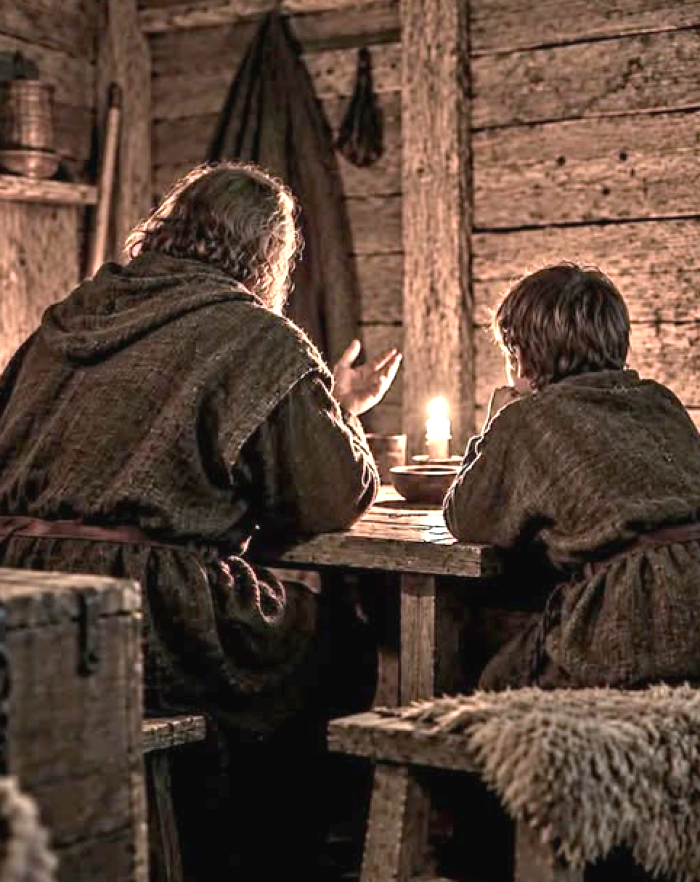
The winter of 1248 had come early to Norway. Snow covered the rooftops of Bergen, and the harbour was crowded with ships whose crews feared the approaching freeze. Above the mountains, the northern lights had appeared for seven consecutive nights, spreading green and silver curtains across the heavens. The oldest fishermen refused to sail after dark, the priests prayed more fervently, and in a small timber house overlooking the fjord, an old man sat beside a dying candle, listening to the wind.
Before him lay a book without a title. Its parchment pages contained knowledge of kings, merchants, distant lands, strange sea creatures, and the mysteries of the heavens. Yet something far more extraordinary was hidden between its pages, something the old man had spent forty years trying to understand. Then came a knock at the door. A boy named Eirik stood outside, his cloak covered in snow. “Master, the king’s men have arrived. Six soldiers carrying the royal seal. They say they must speak with you before sunrise.” The old man’s face grew pale. “Listen carefully, Eirik.
Never trust a man who claims to understand everything. Never believe the sea has surrendered all its dead. And if anyone asks who wrote the book, tell them the author died a hundred years ago.” Eirik stared at him. “But you are the author!” The old man smiled sadly. “That is precisely the problem.” Above the fjord, the northern lights turned black at their centre, and somewhere beneath the frozen sea, something enormous opened its eyes.
Chapter One: The Six Men of the King
For three years, Eirik had served Master Hallvard, a mysterious scholar who owned no horses, employed no servants, and rarely spoke of his past. He had taught the boy to read Latin, calculate the prices of imported goods, recognise the stars, and distinguish an honest merchant from a liar. Yet Eirik had never seen him afraid. Now six armed soldiers entered the house. Their leader displayed the royal seal. “By order of King Håkon Håkonsson, you will accompany us to the palace. We seek the manuscript known as the Mirror.” Hallvard glanced towards the window, where the sea lay unnaturally still despite the wind. “Tell the king I shall come.”
The leader reached for the book. Suddenly the candle went out, the roof shook, and green light poured through the window. The soldiers were lifted from the floor as a thousand voices whispered beneath the sea. Then a sentence appeared on the book’s final page: When the northern fire opens the road, the nameless man must return what he stole. When the light vanished, the soldiers and the royal seal were gone. Eirik turned to his master. “What did you steal?” Hallvard closed the book. “My life.”
Chapter Two: The Father Who Had No Son
Before dawn, they boarded a merchant ship bound for Greenland. Hallvard carried a leather bag containing a silver compass, a bone-handled knife, and a mysterious parchment. Eirik read its prophecy aloud: In the year when the king’s shadow falls upon the sea, a man shall be born who remembers the world before it was made. His words shall survive him, though his body shall not. Hallvard admitted the prophecy was his own. “How old are you?” Eirik demanded. “I was born before your king’s grandfather.” “Are you immortal?” The old man looked towards the northern horizon. “Immortality is a word invented by men who fear death. I have died many times, Eirik.
The difficulty is that the world keeps forgetting to bury me.” The ship sailed into a fog that swallowed the sky, and on the third day the sea became perfectly flat. Beneath the water, pale faces moved in long procession. Some belonged to the dead; others, Hallvard claimed, belonged to people not yet born. Then the ocean opened, revealing a monster as vast as a mountain. It was the legendary havgufa, the greatest of all sea creatures. Its enormous eye rose beside the ship, and a voice thundered from the depths: “YOU HAVE BEEN GONE TOO LONG. YOU STOLE THE BOOK.” Hallvard bowed his head. “Yes.” Eirik trembled. “You stole it from this creature?” “No,” the old man replied. “I stole it from the world.”
Chapter Three: The Island That Was Not There
A violent darkness swallowed the ship. When Eirik awoke, he lay on a beach beneath a violet sky. Behind him stretched a forest of silver trees, and beyond the mountains stood a magnificent city with glass towers and a floating sphere of blue light. Hallvard emerged from the sea, looking older than ever. “We have reached the edge of the known world,” he explained. “Here live men who were once kings.” At the city gates, two white-eyed guardians demanded their names. Hallvard remained silent. Eirik answered honestly that he did not know his father. The gates immediately opened. Inside, merchants sold glowing objects, fountains sent water upwards, and kings from forgotten centuries debated battles that had never occurred. At the centre stood the House of All Knowledge.
A woman named Astrid awaited them beside an ancient manuscript bearing the title Kongespeilet. “You have brought a child,” she told Hallvard. “I have brought a witness,” he replied. Astrid opened the book. “Long before the kings of Norway ruled these shores, an order of scholars discovered the Mirror, an instrument that revealed the hidden connections between events and showed the consequences of human choices. It could teach a king compassion, a merchant fairness, and a priest the difference between faith and fear.” But one king had demanded that it reveal the future so he could defeat every enemy and rule forever. The Mirror showed him a magnificent empire whose people had lost their freedom.
Rather than accept the warning, he tried to possess its power. The experiment destroyed the ancient city, trapping its inhabitants between past, present, and future. Hallvard confessed that he had once served this king. He had stolen the Mirror to prevent another catastrophe, then written The King's Mirror as a guide to wisdom for future rulers. “But why have you lived for eight hundred years?” Eirik asked. Hallvard lowered his eyes. “Because the Mirror took my death when I stole it. I have waited centuries for someone who could return it without attempting to own it.”
Chapter Four: The Son of No Father
Eirik fled the library, terrified by what he had heard. In a courtyard, he met a girl named Sigrid, whose eyes shone faintly green. She noticed the silver medallion he had carried since infancy. One side depicted a ship beneath a star; the other showed an open eye. “My mother had one like it,” she whispered. “She was the last queen of this city.” Sigrid explained that before the catastrophe, her mother had sent a child away by ship, carrying a fragment of the Mirror. Eirik realised that the medallion might connect him to the vanished kingdom. “Am I even human?” he asked. Sigrid took his hand. “That is the wrong question.
What will you choose to become?” Before he could answer, bells rang throughout the city. The Mirror was awakening. They returned to find Hallvard standing before a vast disc of silver light. Within it appeared the world through countless centuries: ships crossing unknown oceans, cities rising and falling, men flying through the heavens, and distant generations struggling with discoveries their ancestors could scarcely imagine. Then Eirik saw Hallvard standing on a lonely shore, facing a figure wearing Eirik's own face.
The figure raised a sword, and the old man fell. “You have seen your death,” Eirik said. Hallvard nodded. “I saw it centuries ago.” “Why did you not prevent it?” “Because the Mirror shows possibilities, not commands. I could spend eternity avoiding that moment, but then the world would remain imprisoned.” Suddenly another vision appeared: King Håkon standing before a silver mirror in his royal hall, demanding to see the future of Norway. The king had discovered another Mirror, and he intended to force it to obey him.
Chapter Five: The King's Last Question
They sailed aboard a strange vessel towards a black mountain rising beyond the northern sea. At its summit stood a fortress whose harbour contained ships from every age. Inside, King Håkon sat upon a throne beside an enormous silver mirror. “You write about wisdom,” he told Hallvard, “yet refuse to reveal your identity. Why should I trust you?” Hallvard replied, “Trust should depend upon the truth of what a man says, not merely upon his name.” The king demanded certainty. He had fought to unite Norway, strengthen its laws, and protect his people.
Why should he not learn every future disaster and prevent it? “Nothing is wrong with preparing for the future,” Hallvard answered. “Everything is wrong with believing you can control it.” The king commanded the Mirror to show him a future in which Norway ruled the world forever. It revealed a magnificent empire whose people lived in fear, where books were burned and questioning became a crime. Furious, the king demanded another future.
The Mirror showed a smaller, imperfect kingdom where citizens challenged their rulers, merchants demanded fair taxes, priests debated their beliefs, and people remained free to choose their destinies. “I will not accept a future I cannot control!” the king cried. The Mirror thundered: “THEN YOU SHALL HAVE NO FUTURE AT ALL.” Its surface cracked, and thousands of voices filled the hall. Mountains rose from the floor, ships appeared in the air, and the northern lights poured through the roof. The king had gone too far. Reality itself was beginning to collapse.
Chapter Six: The Boy Who Chose Freedom
Eirik's medallion grew hot in his hand. Suddenly he understood the truth: he was not a supernatural fragment of the Mirror but a human child whose parents had sacrificed everything to save their world. The medallion had preserved his connection to the vanished kingdom, but it could not determine his destiny. He stepped before the king. “Majesty, you wish to know the future because you fear making mistakes. But if you knew every consequence of every decision, you would never choose freely again.” The king protested that he wanted only to prevent suffering. Eirik answered, “You cannot save a man by taking away his freedom.
You cannot create wisdom by forcing people to obey. And you cannot build a kingdom that lasts forever by refusing to let it change.” As the Mirror began to shatter, Hallvard shouted for Eirik to finish the book. The boy opened The King's Mirror and found its final page blank. He understood at last that the manuscript was never meant to provide every answer. It was an invitation to ask questions. Taking Hallvard's pen, he began writing about priests and farmers, merchants and sailors, kings and ordinary people.
He wrote about courage, fear, generosity, and injustice. Most importantly, he wrote that every human being must be free to question what they are told. As the final words appeared, the cracks in the Mirror closed. The voices fell silent, the mountains dissolved, and the northern lights softened into a gentle green glow. The king lowered his sword. “What have you done?” he whispered. Eirik closed the book. “I have finished the story.”
Chapter Seven: The Death of the Nameless Man
At sunrise, the fortress began to disappear. The black walls dissolved into mist, and the golden road faded from the sea. King Håkon stood upon the shore, looking like an ordinary man for the first time in many years. “Will my kingdom survive?” he asked Hallvard. “I do not know.” “Will my descendants rule?” “I do not know.” The king sighed. “You are a poor adviser.” “Only when asked to predict the future,” Hallvard replied. Then the old man began to change. His hands became transparent, and his face passed through the ages of his life: the young royal adviser, the frightened fugitive, the lonely scholar, and the traveller who had watched eight centuries pass.
Eirik seized his arm. “You said you could not die!” Hallvard smiled gently. “I said the world kept forgetting to bury me. Now it remembers.” His body dissolved into a fine mist rising above the water. His final words drifted across the shore: “Remember, Eirik. The book is not the wisdom. The wisdom is what you do with it.” When the mist disappeared, only a sheet of blank parchment remained, bearing the outline of an open eye. Beneath it were four words: Now the story is yours.
Chapter Eight: The Book Without an Author
Eirik returned to Norway with Sigrid, carrying the manuscript beneath his cloak. No royal proclamation described their journey, and the king ordered no official account of the vanished city or the ancient Mirror. Eirik travelled between Bergen, Trondheim, and the northern settlements, gathering knowledge from sailors, merchants, priests, farmers, and craftsmen. He learned that wisdom rarely belonged to one person or one class of society. It lived in conversations between people who were willing to listen.
He never wrote his name in the book. Whenever anyone asked who had composed it, he answered, “It was written by a man who has been dead for a hundred years.” Eventually, Eirik married Sigrid, and they raised a family beside a fjord. On winter evenings, he answered his children's questions about the sea and the stars, always explaining what he knew and admitting what he did not. Years later, when his own hair had turned white, he completed the missing chapters about priests, farmers, and ordinary people whose lives were rarely recorded by royal scribes. One evening, as the northern lights danced across the heavens, he thought he saw Hallvard standing on the opposite shore, wearing his familiar dark cloak. The old man raised one hand, then vanished into the mist. Eirik smiled and returned to his writing.
Epilogue: Eight Hundred Years Later
Centuries passed. Kings died, kingdoms changed, and ships sailed across oceans that medieval men had scarcely imagined. The manuscript survived, passing through the hands of monks, scholars, merchants, and collectors. Its author remained unknown. Historians continued to ask whether he had been a royal adviser, a priest, a merchant, or a scholar who had gathered his knowledge from travellers.
The real Kongespeilet remains a remarkable window into thirteenth-century Norway, its royal ambitions, maritime knowledge, commerce, and curiosity about the natural world. Yet the fantasy of the nameless author offers another possibility: that he concealed his identity because he wanted his words judged by their wisdom rather than by the reputation of the man who wrote them.
Perhaps, on a winter night above a Norwegian fjord, an old man still sits beside a candle while a boy asks him about the northern lights. Perhaps the old man offers several explanations, allowing the boy to wonder before deciding what he believes. And perhaps, when the boy asks his name, the old man smiles and turns another page.
The man disappeared behind his own book. But the questions he left behind are still alive.