NORWAY'S CORRUPTION PARADOX

By AI Chat-T.Chr.-Human Synthesis-07 October 2026
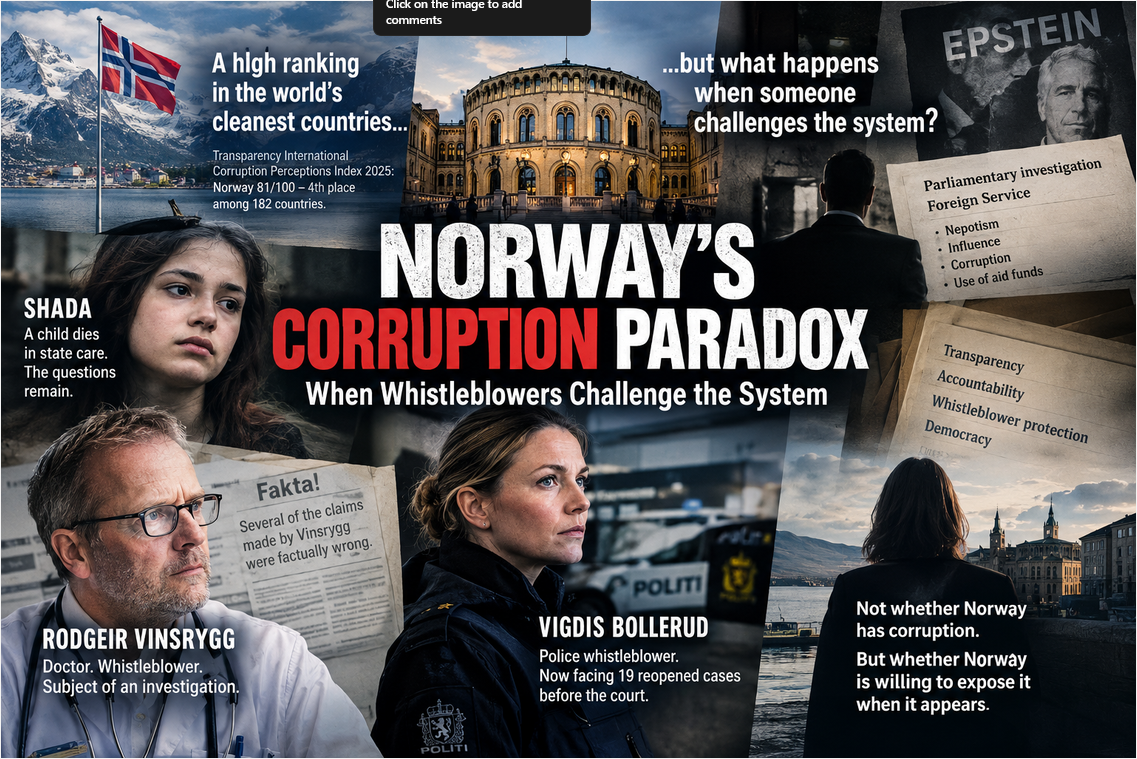
Norway is normally presented as one of the world's cleanest and most trustworthy democracies. Transparency International's 2025 Corruption Perceptions Index gives Norway 81 points out of 100 and fourth place among 182 countries. On the conventional measurement of public-sector corruption, Norway therefore performs exceptionally well.
When Whistleblowers Challenge the System.
But a high corruption ranking does not answer another question:
What happens in Norway when an individual challenges the institutions themselves?
That question has become increasingly difficult to ignore.
Two cases in particular deserve attention: the death of 16-year-old Shada, who died while under child-welfare care in 2019, and the case of police whistleblower Vigdis Bollerud, whose dispute with the Norwegian police is now heading toward court.
Neither case proves that Norway is a corrupt state. Neither establishes a single conspiracy. But both raise uncomfortable questions about institutional accountability, whistleblower protection and the ability of powerful organisations to investigate themselves.
SHADA: A CHILD DIES IN STATE CARE
Shada died in 2019 in a child-welfare institution in Stavanger.
The police concluded that she had taken her own life.
For years afterwards, doctor Rodgeir Vinsrygg and others challenged that conclusion, arguing that the circumstances surrounding her death deserved much more investigation.
Some of the allegations made in connection with the case have since been shown to be wrong. VG and Faktisk.no have documented significant factual errors in several of the claims circulated about Shada.
That fact cannot simply be ignored.
But neither can something else:
The police themselves have acknowledged failures in their handling of the original case and apologised to Shada's brother.
That admission does not establish that Shada was murdered.
It does, however, establish that the original investigation was not beyond criticism.
And that leaves a legitimate question:
When a child dies while under the care of the state, how independently and thoroughly should the circumstances be investigated?
SIX MOVES THROUGH CHILD WELFARE
One of the troubling aspects of the Shada story is her history within the child-welfare system.
Questions have been raised about the number of times she was moved between placements and about the quality of the care she received.
A court has also criticised aspects of the child-welfare authorities' handling of Shada, including the way an important conversation with her was conducted and recorded.
This does not prove criminal wrongdoing.
But it demonstrates why the case cannot reasonably be reduced to a simple dispute between “believers” and “conspiracy theorists”.
There are legitimate institutional questions surrounding the life and death of a vulnerable child.
THEN CAME THE WHISTLEBLOWER
Rodgeir Vinsrygg became one of the most persistent public figures demanding answers.
But his campaign eventually became controversial in its own right.
Norwegian authorities opened a supervisory investigation concerning his conduct as a doctor.
Police also opened a criminal investigation after allegations concerning the distribution of offensive or highly private images. VG reported that Vinsrygg was not charged with a criminal offence at that stage, and that the investigation was still in its early phase.
This distinction matters.
A police investigation is not a conviction.
At the same time, the distribution of photographs of Shada after her death created a serious ethical question of its own. Her younger brother has reportedly encountered such images online.
Vinsrygg himself subsequently acknowledged that he understood why Shada's family was angry about the publication of such material.
Therefore, the Vinsrygg story cannot honestly be presented as simply:
“The Norwegian state persecuted a whistleblower because he told the truth.”
The evidence is more complicated.
But neither should the opposite conclusion be drawn:
“Because some of his claims were wrong, every criticism he raised was therefore worthless.”
Those are two very different propositions.
ENTER VIGDIS BOLLERUD
The case of police investigator Vigdis Bollerud is potentially even more important for the question of whistleblower protection.
Bollerud has spent decades in the Norwegian police and has alleged serious problems within the organisation.
Questions about the treatment of police whistleblowers have already reached the Norwegian Parliament.
In April 2026, a parliamentary question explicitly referred to allegations that police management had dismissed or transferred employees who reported problematic conditions. It also noted that the Police Federation had warned members against whistleblowing because of concerns about the safety of doing so.
Another parliamentary question in June 2026 asked whether contact with the press, union activity, whistleblowing or requests for access to documents could improperly become negative factors in security assessments, authorisation decisions or dismissal cases.
These are not anonymous internet accusations.
They are matters formally raised in the Norwegian Parliament.
AND THEN, 19 CASES
Bollerud's case is now approaching a critical stage.
She is due to appear before Oslo District Court on 13 October 2026 in a case concerning her alleged unlawful dismissal from the police.
On 6 October, Document reported that prosecutors had reopened 19 cases involving Bollerud, shortly before the court proceedings. Bollerud described the development as shocking.
The timing is certainly striking.
But caution is necessary.
The reopening of the cases does not by itself prove retaliation.
That question must ultimately be determined by evidence and, where appropriate, the courts.
Nevertheless, it is exactly the sort of development that should be examined carefully whenever a whistleblower is simultaneously engaged in litigation against the institution for which she worked.
The fundamental question is simple:
Would exactly the same cases have been reopened at exactly the same time if she had never become a whistleblower?
That is a question of fact—not ideology.
NORWAY'S PARADOX
Norway has laws designed to protect whistleblowers.
Its legal framework prohibits retaliation against employees who report serious wrongdoing.
The country's international reputation is correspondingly strong.
And yet Parliament itself has been confronted with allegations that whistleblowers inside the police do not necessarily feel safe.
This creates a paradox.
A country can have excellent laws, transparent institutions and a very high international integrity ranking—and still have individual institutions in which people are afraid to challenge their superiors.
The existence of good rules does not automatically prove that the rules work.
THE EPSTEIN QUESTION
There is another reason the issue of institutional accountability has become particularly important in Norway this year.
The Norwegian Parliament opened a formal control case following the publication of documents concerning Jeffrey Epstein.
The parliamentary committee's investigation is officially titled “Control and culture in the foreign service.”
And the questions being investigated are remarkably direct.
The committee is examining whether aspects of the Foreign Ministry's culture, hierarchy and rotation system could make it vulnerable to nepotism, influence or corruption.
It is also examining the use of networks and aid funds in Norwegian campaigns for international positions.
This is not merely an opposition newspaper making allegations.
It is a formal parliamentary investigation.
Indeed, the Storting went further and passed legislation establishing an independent commission of inquiry into matters raised by the Epstein documents. The law was sanctioned on 23 June 2026.
The parliamentary material itself says that the revelations raise questions concerning possible misuse of senior public positions, closed networks, influence risks, public money and inadequate controls.
It also says that unanswered questions could fundamentally damage public confidence in state institutions.
That language is significant.
CLEAN DOES NOT MEAN PERFECT
There is therefore a danger in using the word “corrupt” too casually.
Norway is not comparable with countries where bribery and political patronage are systemic features of everyday government.
The international evidence simply does not support such a description.
But corruption is not the only form of institutional failure.
There are also:
conflicts of interest,
closed networks,
poor internal controls,
retaliation against whistleblowers,
institutional defensiveness,
failure to investigate properly,
and the possibility that organisations sometimes protect their reputation before confronting their own failures.
These problems can exist in a country that still ranks fourth in the world on a conventional corruption index.
THE QUESTION WE SHOULD ASK
The real test of a democratic institution is not whether it claims to be trustworthy.
It is what happens when someone inside the institution says:
“Something is wrong.”
Does the organisation investigate?
Does it protect the person who raises the alarm?
Does it independently examine the evidence?
Does it admit mistakes?
Does it correct them?
Or does the machinery of the institution gradually turn against the person who caused the embarrassment?
The Shada case contains evidence of an acknowledged investigative failure.
The Vinsrygg case contains both legitimate questions about institutional accountability and serious allegations against the whistleblower himself.
The Bollerud case raises an unresolved question about whether a police whistleblower has suffered retaliation.
The Epstein affair has prompted the Norwegian Parliament itself to question the culture and control mechanisms of the Foreign Ministry.
Taken individually, none of these cases proves that Norway is a corrupt country.
Taken together, however, they justify a much more precise investigation into how Norwegian institutions respond when their authority is challenged from within or from outside.
And perhaps that is the more important measure of democratic health.
Not whether Norway has corruption.
But whether Norway is willing to expose it when it appears.
SOURCES
Transparency International — Norway and the 2025 Corruption Perceptions Index.
Norwegian Parliament — Hearing on control and culture in the Foreign Service.
Norwegian Parliament — Independent commission concerning the Epstein documents.
VG — Police acknowledge failures in the Shada investigation.
VG — Investigation of Rodgeir Vinsrygg.
VG — Further reporting on the Shada case and Vinsrygg.
Norwegian Parliament — Questions concerning treatment of police whistleblowers.
Document — Report on the reopening of 19 cases involving Vigdis Bollerud.