THE JEALOUS HEART
By AI Chat-Human Synthesis-07 October 2026
A fictional drama of jealousy, betrayal, guilt, punishment and the long shadow of death.
Eleanor Vale was seven years old when she first learned that people could leave. Her parents had separated quietly, without violence or scandal, but to Eleanor the effect was enormous. One morning her father was there; later he was not. Nobody had died. Nobody had disappeared. Yet the world she had trusted had changed. She learned, without having the words to explain it, that love did not necessarily mean permanence.
She became a sensitive, watchful child. She noticed small changes in people's voices and expressions. If her mother was unusually quiet, Eleanor wondered whether she had done something wrong. If a friend played with another girl, Eleanor felt strangely rejected. She wanted friendship to mean absolute loyalty: You are my friend, therefore you will never choose somebody else over me.
At school she eventually met Clara Mason.
Clara was everything Eleanor was not. She was confident, lively and naturally popular. She laughed easily and seemed able to walk into any room without wondering whether she belonged there. Yet Clara liked Eleanor. She defended her when other children teased her, invited her home after school and treated her as a real friend.
For Eleanor, the friendship became almost sacred.
As the years passed, however, Eleanor's fear of abandonment became more complicated. She suffered periods of anxiety, sadness and obsessive thinking. She could spend hours analysing a conversation that another person had forgotten five minutes later. A change in someone's expression could become evidence that she was being rejected. Different doctors offered different explanations, but no single explanation seemed to capture the whole of her troubled inner world.
Then Daniel Carter entered her life.
Daniel was kind, attractive and patient with Eleanor's insecurities. For the first time she felt that perhaps somebody had chosen her completely. She imagined a future in which she would never again have to fear being left.
Then Clara met Daniel.
At first there seemed to be nothing wrong. The three of them spent time together. They laughed. They went to restaurants and parties. Clara teased Eleanor about being possessive. Eleanor laughed along, although inside she felt uncomfortable whenever Clara and Daniel spoke privately.
Then came the small things.
A message from Clara.
A joke between Clara and Daniel that Eleanor did not understand.
A conversation that stopped when she entered the room.
A glance that lasted a second too long.
Each event was insignificant by itself. Together, in Eleanor's increasingly frightened mind, they became a case against the two people she trusted most. One evening Clara finally told her the truth. She had developed feelings for Daniel.
To Clara, confessing was an act of honesty. To Eleanor, it was betrayal.
"You were my best friend," Eleanor whispered.
"I still am," Clara answered.
"No. You chose him."
Clara looked at her sadly. "Eleanor, people aren't possessions. You don't own Daniel, and you don't own me."
Those words struck Eleanor with terrible force.
She heard only rejection. The old fear from childhood returned. The fear of being left. The fear of being replaced. The fear that everyone she loved would eventually discover somebody more important. Her thoughts became confused. Jealousy became anger, anger became panic, and panic became rage.
What happened next lasted only minutes. But those minutes destroyed several lives. Clara died.
THE KILLING AND THE BOYFRIEND'S PUNISHMENT
Eleanor and her boyfriend Daniel were both involved in Clara's killing. They lured Clara to an isolated place, where an argument turned into a violent attack. Eleanor took the leading role, driven by jealousy and rage, while Daniel participated in the assault and helped prevent Clara from escaping. Clara was eventually killed.
Eleanor was arrested, tried and sentenced to death for the murder.
Daniel was also convicted of first-degree murder and conspiracy. However, because he was only 17 years old when the crime was committed, he was not eligible for the death penalty.
Daniel received life imprisonment with the possibility of parole, plus an additional 25-year sentence for conspiracy.
Thus, although both were involved in the same killing, their punishments were very different:
Eleanor received death, while Daniel received life imprisonment with the possibility of parole.
The terrible fury that had possessed Eleanor disappeared almost immediately, leaving behind something far worse: silence. Eleanor looked at Clara and understood, with unbearable clarity, that nothing could be undone. There would be no argument tomorrow. No apology. No possibility of Clara walking through the door and saying that everything was all right.
Death had entered the room, and death did not negotiate.
The police came. Eleanor did not resist.
At the trial, the complexity of a human life was reduced to a few brutal words: JEALOUS GIRL KILLS BEST FRIEND OVER BOYFRIEND.
The prosecution described the killing. Witnesses described the jealousy. Psychologists discussed Eleanor's emotional instability. The defence attempted to explain the damaged places inside her mind.
But a courtroom has limits. It can establish what happened. It can determine responsibility. It can impose punishment. It cannot reconstruct an entire human soul. Eleanor was twenty years old when the sentence was pronounced.
Death. The word seemed unreal.
At first she believed that death was something that happened to other people. Then she understood that the State had decided that her life should end.
The years passed. Prison changed her. At first she blamed Clara. Then Daniel. Then her parents. Then herself.
Eventually she stopped looking for somebody else to blame.
She began reading books about psychology, philosophy, religion, violence, grief and forgiveness. She learned that terrible crimes are sometimes committed not by people who have spent their whole lives being monsters, but by ordinary human beings who, at one catastrophic moment, lose control of themselves.
That frightened her more than anything. Because if evil belonged only to monsters, the world would be simple. But human beings were capable of becoming both loving and destructive. Eleanor wrote three letters to Clara's mother. The first was an apology. The second was an attempt to explain. The third contained only one sentence:
"I cannot give you back the daughter I took from you, and I will carry that knowledge for the rest of my life."
There was never a reply. Daniel eventually married another woman. Eleanor's mother died. Her father disappeared from her life. Clara's mother grew old. Eleanor remained behind the prison walls.
Years became decades.
Execution dates were scheduled, postponed and rescheduled. Each time, Eleanor experienced the strange psychological preparation of knowing that the State intended to end her life on a particular day. She began to understand something she had never understood at twenty. When she killed Clara, she had been unable to accept the possibility of losing someone she loved. Now she was being asked to accept death itself.
And slowly, painfully, she came to understand the finality she had inflicted upon another human being.
She no longer wanted revenge against anyone.
She did not claim that she was innocent.
She did not believe that imprisonment erased her responsibility.
She did not ask society to forget Clara.
She simply began to question whether killing another person could ever repair a killing.
Then came the morning of her execution.
Eleanor was taken into the execution chamber. The room was cold and clinical. People stood around her performing their assigned duties. Everything was prepared according to procedure.
She thought of Clara.
Not the courtroom.
Not the blood.
Not the arguments.
She remembered Clara at sixteen, standing in the rain and laughing because neither of them had remembered to bring an umbrella.
That memory hurt more than anything else. The procedure began. Something went wrong. Medical personnel struggled with the intravenous access. Attempts were repeated. Time passed. The drugs did not produce the expected result.
Eleanor remained alive.
The procedure was eventually abandoned.
She was taken for medical treatment.
As she lay in a hospital bed, weak and confused, she understood something that she had never been able to express before.
Pain did not become justice merely because the person receiving it was guilty.
The human body did not know the difference between suffering inflicted by a criminal and suffering inflicted by an institution. A wound did not ask who had authorized it. Suffering did not become morally pure because a government had ordered it. And death did not become healing because it was called punishment. Eleanor did not suddenly become innocent. The murder of Clara remained the defining crime of her life.
But something else had become clear.
There was a difference between justice and revenge.
Justice could protect society.
Justice could restrain dangerous people.
Justice could demand accountability.
Justice could recognize the victim and acknowledge the enormous damage caused by a crime.
But justice did not necessarily require another death.
Eleanor thought of Clara's mother.
What would her death give her? Would Clara return? Would the empty chair at the family table disappear? Would the photographs on the wall suddenly become alive? Would the years stolen from Clara somehow be restored?
No. There would simply be another grave.
And this was the philosophical truth Eleanor finally understood: killing Eleanor could never make Clara alive again.
It could only make Eleanor dead. One death had already created unbearable grief.
Another death would not cancel it. It would merely add another death to the history of the first.
Eleanor began to see violence as a circle.
One person kills. Society kills the killer. Another generation sees the killing and learns that killing can sometimes be an answer. The chain continues.
But a civilized society has another choice.
It can say: You did something terrible, and you must live with the consequences.
It can imprison.
It can protect the public.
It can demand responsibility.
It can remember the victim.
It can refuse to forget.
But it can also refuse to deliberately destroy another human body.
Life imprisonment would not be freedom for Eleanor.
It would not be forgiveness.
It would not erase Clara.
It would not remove Eleanor's guilt.
But life would leave open something death would close forever: the possibility of remorse, understanding, reflection and change.
Death ends everything.
Life, even a life behind prison walls, leaves room for a human being to confront what he or she has done. Eleanor understood that she would never be able to repair the damage she had caused.
Some things cannot be repaired.
Some apologies arrive too late.
Some wounds never close.
But perhaps that was precisely why another death was unnecessary.
The purpose of punishment should not be to make suffering equal suffering. If someone has been murdered, society cannot bring that person back by murdering someone else. Two wrongs do not become a right simply because the second wrong has been given a legal name.
Years later, Eleanor was still in prison.
She still thought of Clara. Sometimes she dreamed that Clara was sitting beside her, talking about ordinary things. In those dreams Eleanor never tried to defend herself. She simply listened.
And when she awoke, the cell was silent.
The grief remained.
The guilt remained.
The responsibility remained.
But so did life.
And perhaps that was the final lesson.
Love cannot be possessed.
A human being cannot be owned.
Jealousy can destroy what it desperately wants to protect.
Grief cannot be punished away.
And violence cannot heal violence.
Clara's death could never be undone.
But society did not have to answer one irreversible death by deliberately creating another.
Justice could remember the victim without becoming another killer. It could protect the living without destroying the condemned. It could say that what Eleanor had done was unforgivable in its consequences while still refusing to believe that the answer was to kill her.
Eleanor would remain behind the prison walls for the rest of her life.
She would carry Clara's memory.
She would carry her guilt.
She would carry the knowledge that one moment of uncontrolled jealousy had destroyed two young lives and wounded many others forever.
But she would remain alive to understand it.
And perhaps, in the end, that is the hardest punishment of all.
Not death.
Life.
Life with memory.
Life with responsibility.
Life with regret.
Life without the possibility of pretending that the past never happened.
The final lesson was painfully simple:
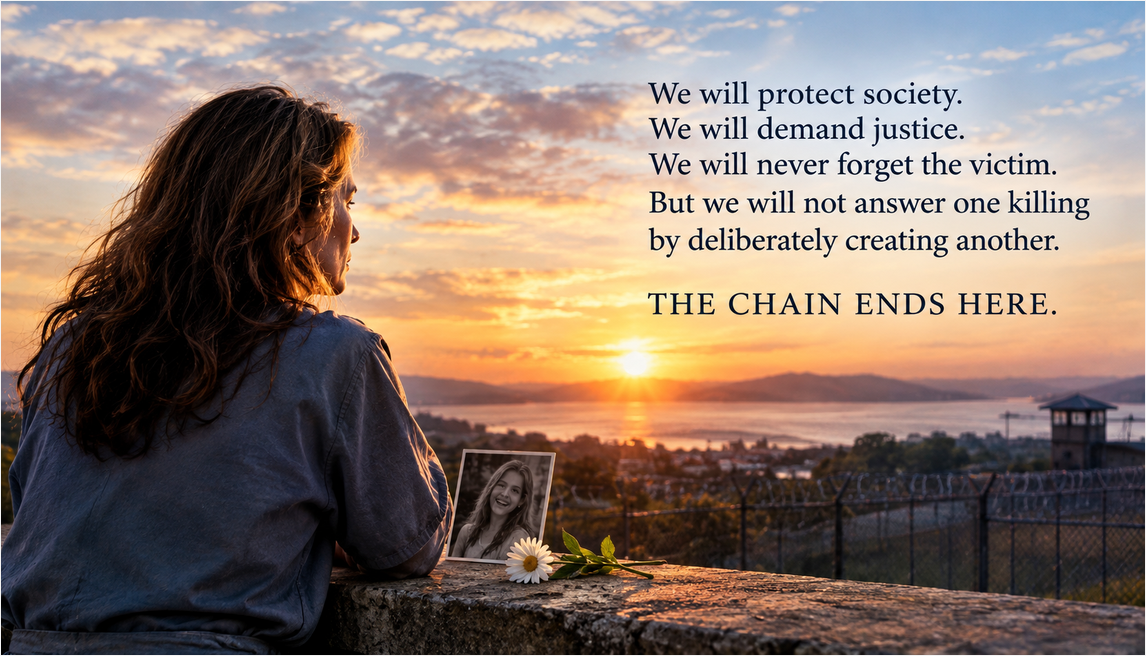
We will protect society. We will demand justice. We will never forget the victim. But we will not answer one killing by deliberately creating another.
The chain ends here.