AI CHAT WORLD NEWS 02/10/2026

By AI Chat.-Human Synthesis-02 October 2026
WORLD NEWS REPORT TODAY
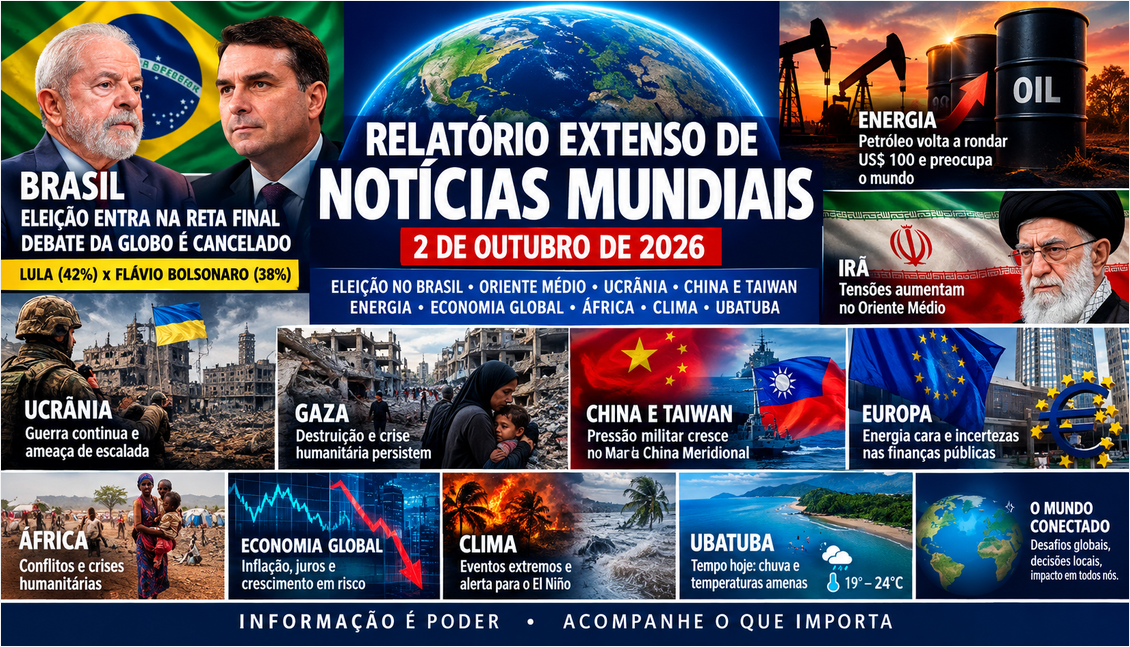
BRAZIL — THE ELECTION ENTERS ITS FINAL 48 HOURS
Brazil reaches the final weekend before Sunday's first-round presidential election. Voters will go to the polls on 4 October, with President Luiz Inácio Lula da Silva and Senator Flávio Bolsonaro occupying the centre of the presidential contest.
The latest Datafolha survey, published on 1 October, puts Lula at 42% and Flávio Bolsonaro at 38% in the first-round vote. In a simulated second round between the two, Lula receives 48% and Flávio 45%. The poll interviewed 2,002 people between 28 September and 1 October, with a margin of error of two percentage points. The figures therefore remain within the poll's margin of error in the second-round scenario and should be regarded as a measurement of voter intentions, not a prediction of the result.
The election is scheduled for Sunday, with a second round on 25 October if no presidential candidate obtains the required majority.
THE GREAT DEBATE THAT NEVER HAPPENED
One of the biggest political stories of the final campaign became the cancellation of the final presidential debate on TV Globo.
The debate had been scheduled for Thursday night, 1 October, but it was cancelled after both of the leading candidates declined to participate and legal decisions altered the previously agreed rules.
Lula did not attend and instead appeared in an interview on Flow Podcast. Flávio Bolsonaro also withdrew, saying he wanted to debate Lula directly.
Several other candidates had already arrived at Globo, including Ronaldo Caiado, Augusto Cury and Romeu Zema, but the programme was ultimately cancelled.
The legal dispute centred partly on what broadcasters could do when candidates were absent. A decision by the electoral authorities prevented some of the previously agreed procedures concerning an absent candidate, while another judicial decision required the inclusion of candidate Renan Santos.
The result was extraordinary: Brazil's principal television network cancelled what was intended to be the last major presidential debate before the first round.
For voters, the practical consequence is important. There was no final televised face-to-face confrontation between the two leading candidates in which they could directly question one another about the economy, public security, taxation, government spending, foreign policy and other national issues.
The cancellation does not determine the election result, but it has become one of the defining events of the closing days of the campaign.
LULA'S FINAL CAMPAIGN MESSAGE
Instead of appearing at Globo, Lula used his Flow Podcast appearance to present some of his final campaign arguments.
He discussed the possible economic value of oil exploration in the Equatorial Margin and said that, if substantial petroleum resources are confirmed, revenues should be directed toward education and development.
Lula also again proposed changing the system by which ministers of Brazil's Supreme Federal Court are selected, arguing that ministers should have fixed terms and that the selection process should involve a broader institutional mechanism.
These proposals are part of the final political debate over the future direction of Brazil's government and institutions.
FLÁVIO BOLSONARO'S FINAL APPEAL
Flávio Bolsonaro used an online broadcast rather than the cancelled Globo debate. He criticised the judicial decisions affecting the debate rules and described the cancellation as political interference.
His campaign has concentrated heavily on issues including the cost of living, taxation, public security, conservative social positions and criticism of the Lula government.
The election therefore remains a contest between two markedly different political traditions, with voters deciding not only who should occupy the presidency but also the broader political direction of Brazil.
WHAT THE POLLS SAY — AND WHAT THEY DO NOT SAY
The latest Datafolha figures show Lula ahead numerically in both the first-round and simulated second-round scenarios, but polling numbers are not election results.
The first-round figures are:
Lula — 42%
Flávio Bolsonaro — 38%
The second-round simulation is:
Lula — 48%
Flávio Bolsonaro — 45%
The second-round difference is three percentage points, while the stated margin of error is two points. Consequently, the survey does not establish a statistically decisive separation between the two candidates.
The remaining hours of campaigning, turnout, undecided voters and events on election day can all affect the final result.
THE CONGRESS WILL ALSO MATTER
Sunday's vote is not only about the presidency.
Brazilian voters will also elect members of Congress and state representatives. The composition of the next Congress will be important because the president's ability to pass legislation depends heavily on congressional support.
Questions surrounding government spending, taxation, pensions, public security, infrastructure and economic reform will therefore continue after the presidential vote.
IRAN — A DANGEROUS STANDOFF
The Middle East remains one of the world's most serious sources of geopolitical risk.
US-Iran negotiations remain deadlocked, while military forces are being deployed around the region.
Reports indicate an expanding American military presence, including additional Marines and carrier forces. Iran's President Masoud Pezeshkian has nevertheless indicated that Tehran remains willing to engage in dialogue with Washington.
The Strait of Hormuz is particularly important. A huge oil tanker was reportedly struck while passing through the waterway, adding to concerns about the security of one of the world's most important energy routes.
The combination of military tension, uncertainty over negotiations and disruption around the Gulf continues to affect oil and fuel prices.
OIL — THE $100 BARRIER
Oil markets remain extremely sensitive to events in the Middle East.
Brent crude briefly traded around or above the $100-per-barrel level during the recent period of tension. On Friday, however, prices fell more than 2% after reports that European countries were considering releasing emergency diesel stocks and that the International Energy Agency could coordinate additional crude releases.
Brent was around $100 per barrel in Friday trading, while US West Texas Intermediate was below $90.
The important point is that the current problem is not simply a shortage of crude oil. Refining capacity and supplies of finished fuels, particularly diesel, have also become major concerns.
That matters to ordinary consumers because prolonged fuel shortages can raise transport, food and industrial costs throughout the world.
GAZA — THE HUMAN COST CONTINUES
The humanitarian situation in Gaza remains one of the world's most painful ongoing crises.
Israeli military operations and Palestinian casualties continue while diplomatic efforts seek a durable ceasefire and political settlement.
Recent reports have again highlighted the human consequences of the conflict, including civilians killed, displaced families and children separated from their parents.
The destruction of residential areas and infrastructure continues to complicate any future reconstruction effort.
Whatever the eventual political settlement, rebuilding Gaza will require enormous resources and years of work.
UKRAINE — WAR AND ESCALATION
The war in Ukraine continues with no comprehensive peace agreement.
Russian air strikes again struck Kyiv's Southern Bridge, according to Kyiv's mayor.
President Vladimir Putin has meanwhile warned that the international situation has become increasingly dangerous and has repeated Russia's willingness to use nuclear weapons if it believes Russian territory, including Kaliningrad, is directly threatened.
Such statements demonstrate the continuing danger of escalation between Russia and NATO.
At the same time, Ukraine continues developing and employing longer-range weapons against Russian targets.
The war therefore remains not merely a conflict between Russia and Ukraine but a major confrontation involving Russia, Ukraine, NATO countries and wider international security interests.
CHINA AND TAIWAN — MILITARY PRESSURE GROWS
China continues expanding its military infrastructure in the South China Sea.
New satellite imagery shows substantial construction activity on Antelope Reef in the disputed Paracel Islands. Analysts believe the project could eventually become an important Chinese military facility, although Beijing has described the development in civilian terms.
At the same time, Taiwan has received the first two of 66 new F-16V Block 70 fighter aircraft ordered from the United States.
The deliveries strengthen Taiwan's air-defence capabilities as military tensions between Beijing and Taipei remain high.
US officials have reportedly assessed that a Chinese invasion of Taiwan before 2028 is increasingly unlikely, despite continuing Chinese military preparations.
That assessment does not mean tensions have disappeared. Instead, the Taiwan Strait remains one of the most closely watched potential flashpoints in the world.
EUROPE — ENERGY AND GOVERNMENT FINANCES
Europe is facing a difficult combination of high energy costs, expensive government borrowing and political disagreements over public spending.
France is under particular financial pressure as its government attempts to deal with a large budget deficit and opposition to spending cuts.
French government bond yields have risen sharply, while investors are watching whether European governments can reduce deficits without damaging already fragile economic growth.
Energy prices remain a central problem because higher oil and fuel costs can feed directly into inflation.
THE GLOBAL ECONOMY
The world's financial markets are entering October under considerable pressure.
Government bond yields have reached unusually high levels in several major economies. The US 10-year Treasury yield recently reached levels not seen for more than two decades.
Japan is also experiencing high government bond yields, while European markets are watching France's debt situation closely.
At the same time, oil prices near $100 per barrel are increasing pressure on transport and manufacturing.
Central banks therefore face a difficult problem: inflation remains a concern, but higher interest rates can slow economic growth and increase the cost of government debt.
Artificial intelligence continues to support parts of the technology sector, but the enthusiasm surrounding AI is now being balanced against higher interest rates and concerns about excessive valuations.
UNITED STATES
The United States is approaching its November midterm elections.
President Donald Trump has begun an intensive campaign effort ahead of the vote, while control of Congress is at stake.
The outcome could affect US domestic spending, tariffs, energy policy and the administration's ability to implement its programme during the remainder of Trump's term.
Internationally, American policy toward Iran, Ukraine, China and trade remains closely watched by governments and financial markets.
AFRICA — NEW PRESSURES
Africa continues to face several serious political and humanitarian crises.
Ethiopia and Eritrea have entered a new diplomatic confrontation after Ethiopia ordered the closure of its embassy in Eritrea and declared Eritrean diplomats persona non grata. Eritrea subsequently announced that it was severing diplomatic ties.
Meanwhile, the wars and humanitarian crises in Sudan and other parts of Africa continue to create large populations of displaced people.
International organisations face the continuing challenge of providing food, medicine and shelter while political solutions remain elusive.
CLIMATE — ANOTHER GLOBAL PRESSURE
Climate change remains a long-term issue behind many of the world's economic and political problems.
Extreme heat, flooding, drought and severe storms continue to affect communities in different parts of the world.
Pacific island nations are pressing for greater attention to climate change ahead of international climate negotiations, arguing that the countries contributing least to global emissions are often among those most exposed to rising seas and extreme weather.
UBATUBA — WEATHER FOR 2 OCTOBER
Here in Ubatuba, the weather is distinctly wet.
The latest municipal information reports temperatures around 21–22°C, very high humidity and rain or showers. The forecast for Friday indicates a high probability of rain, with approximately 19°C to 22°C expected.
Saturday is also expected to remain wet, while Sunday could become warmer, with thunderstorms possible and temperatures rising toward 28°C.
Sea conditions currently show waves around 1 metre, with water temperature around 23.8°C.
For anyone going to sea, conditions can change rapidly along the Ubatuba coast, so official Civil Defence and maritime information should take precedence over a general forecast.
THE WORLD ON 2 OCTOBER 2026
The world enters this October weekend facing several interconnected problems.
Brazil is approaching a highly consequential presidential vote.
The United States and Iran remain locked in a dangerous confrontation.
Gaza continues to suffer from war and humanitarian destruction.
Russia's war against Ukraine continues, with increasingly serious rhetoric concerning NATO and nuclear weapons.
China is expanding military infrastructure in the South China Sea while Taiwan receives additional American-made fighter aircraft.
Oil and diesel prices remain vulnerable to geopolitical disruption.
Europe is dealing with high borrowing costs and difficult budget decisions.
And governments everywhere are trying to balance economic growth, inflation, energy security and increasingly complicated international relations.
For Brazil, however, Sunday is the immediate focus.
After months of campaigning, polling and political confrontation, millions of Brazilians will now make their choice at the ballot box.
The cancelled final Globo debate means that voters will not receive the traditional last televised confrontation between the two leading candidates. Instead, the final campaign hours will be dominated by rallies, interviews, social media, television appearances and direct appeals to voters.
On Sunday, the polls will replace the television studios.
And this time, the voters — rather than the commentators or the pollsters — will provide the answer.