THE FOWLER CHILDREN

By FB-Human Synthesis-29 September 2026
The Secret Beneath the Hills - A tale
CHAPTER ONE — THE ROOT CELLAR
In the summer of 1976, three children were found living beneath an abandoned property in the mountains of eastern Kentucky.
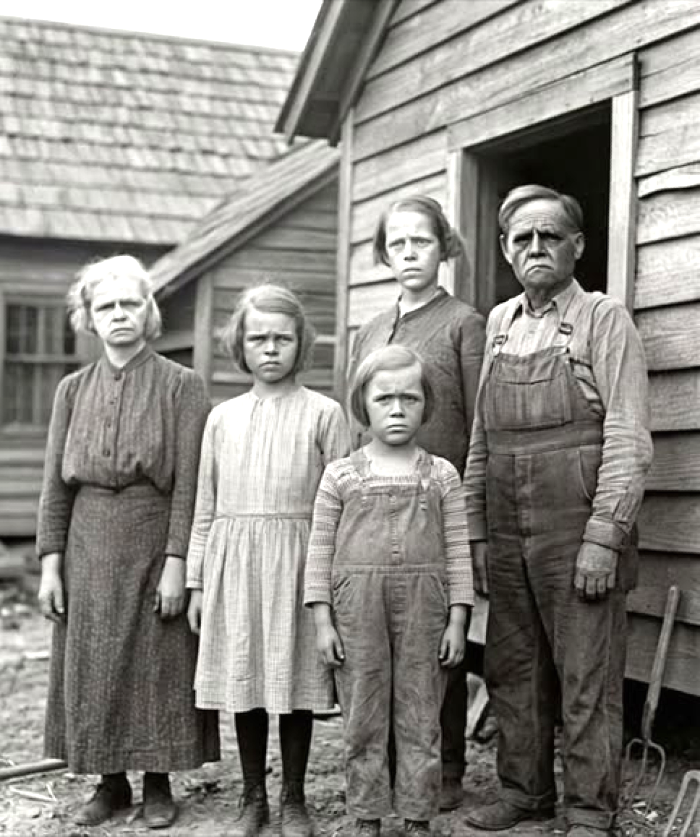
The property belonged to the Fowler family, a clan that had lived in those mountains for generations. They rarely came into town. They did not attend church. They did not send their children to school. They bought almost nothing and spoke to almost nobody.
The nearest town, Harlan, was seventeen miles away.
People in Harlan knew the Fowlers, but they preferred not to know them too well.
Then social worker Margaret Vance began receiving reports about children living somewhere on the Fowler property.
At first she dismissed the reports as mountain gossip.
Then she heard the same story from three unrelated people.
Children.
Three of them.
Always seen briefly.
Never in daylight.
Margaret drove up to the Fowler property on a wet August morning.
The house appeared abandoned.
The windows were broken. The porch sagged. Weeds had swallowed the path.
But Margaret noticed something strange.
There were fresh footprints in the mud.
Small footprints.
She followed them around the back of the house and discovered an old wooden trapdoor beneath a pile of rotting boards.
When she lifted it, cold air rose from below.
Margaret called down.
"Hello?"
There was no answer.
Then she heard breathing.
Three children were sitting together in the darkness.
They were filthy, thin and frightened.
They did not scream when Margaret found them.
They simply stared at her.
CHAPTER TWO — THE CHILDREN
The children appeared to be between five and ten years old.
They could speak, but their vocabulary was strangely limited.
They knew the names of animals, trees and objects around the property.
They knew almost nothing about modern life.
When Margaret asked their names, the oldest boy pointed to himself.
"Daniel."
The little girl said, "Anna."
The youngest boy whispered, "Thomas."
Margaret asked where their parents were.
The three children looked at one another.
Then Daniel pointed upward.
"Fowler."
That was all he said.
There were no beds in the cellar.
No toys.
No books.
Only blankets, wooden bowls, several jars of dried food and a strange collection of objects arranged against one wall.
Among them were dozens of small pieces of stone covered with markings.
Margaret took the children away.
Within hours, police and medical authorities became involved.
And that was when the mystery became something much darker.
CHAPTER THREE — THE BLOOD
At the hospital, doctors discovered that the children were severely undernourished but otherwise surprisingly healthy.
Their blood was tested.
The first laboratory report was inconclusive.
The second produced an anomaly.
The technician examining the samples stopped working.
She asked for another technician to verify the results.
The second test produced the same unexplained genetic pattern.
Nobody could identify it.
The official wording was deliberately vague:
"Genetic markers inconsistent with presently documented reference populations."
Margaret asked what that meant.
The doctor stared at the report.
"It means we don't know what we're looking at."
"Are they human?"
The doctor hesitated.
"Everything about them says they are."
"But?"
He closed the folder.
"But their genetic profile doesn't fit anything in our database."
The report disappeared the following morning.
CHAPTER FOUR — THE FOWLER HOUSE
Margaret returned to the Fowler property with two officers.
The house was empty.
But the cellar was not.
Behind the children's living area they discovered another passage.
It led deep into the hillside.
The walls were covered with markings similar to those found on the stones.
Farther inside they found something even stranger.
A room.
There were shelves containing hundreds of handwritten pages.
Most were too old to read.
Some appeared to date from the nineteenth century.
Others looked much older.
Margaret found one page written in English.
It contained only six sentences.
We came here because they told us to hide.
They said the children must never be seen.
The blood is different.
But the children are ours.
When the time comes, they will return.
Do not let them find the door.
Margaret read it twice.
Then she heard footsteps behind her.
Someone else was inside the tunnel.
CHAPTER FIVE — THE LAST FOWLER
The man standing in the passage was old.
He carried a lantern.
His name was Elias Fowler.
He looked at Margaret without surprise.
"You shouldn't have brought them out," he said.
"Who are you?"
"The last Fowler."
"Where are the children's parents?"
Elias lowered his eyes.
"Dead."
"What happened to them?"
"They tried to leave."
Margaret felt a chill.
"Leave for where?"
Elias pointed deeper into the mountain.
"They wanted to see what was on the other side."
"And what is on the other side?"
Elias looked directly at her.
"Nothing you want to meet."
Suddenly there was a tremendous sound from somewhere beneath them.
The ground trembled.
Dust fell from the ceiling.
Elias grabbed Margaret's arm.
"Go."
"What was that?"
"The door."
"What door?"
But Elias was already running.
CHAPTER SIX — THE BURNING HOUSE
The Fowler property burned three nights later.
Officially, the fire was accidental.
The investigators found no evidence of arson.
But Margaret knew better.
Before leaving the property, she had seen the underground chamber.
She had seen the markings.
She had seen the documents.
And she had seen the door.
It was not a wooden door.
It was a massive slab of black stone fitted into the mountain.
There were no hinges.
No handle.
Only three circular depressions.
Exactly the size of a child's hand.
Margaret never told the authorities what she had seen.
The children were separated.
Daniel disappeared into the foster system.
Anna was sent to another state.
Thomas was placed in a children's hospital.
Their records were sealed.
Margaret was ordered never to discuss the case again.
She obeyed.
For thirty years.
CHAPTER SEVEN — 2006
In 2006, Margaret received a letter.
There was no return address.
Inside was a single photograph.
It showed three adults standing beside an old mountain road.
Daniel.
Anna.
Thomas.
They were grown.
And they were standing together.
On the back of the photograph were four words:
WE FOUND THE DOOR.
Margaret immediately contacted Daniel.
He answered on the first ring.
"I wondered when you would call."
"Where are you?"
"Back where it started."
"The Fowler property?"
"What's left of it."
Margaret's hands began to tremble.
"Why did you contact me?"
There was a long silence.
"Because we finally understand what happened to us."
"What?"
"We weren't experiments."
Margaret waited.
"We were hiding."
"From whom?"
Daniel answered quietly.
"From ourselves."
CHAPTER EIGHT — WHAT THE FOWLERS KNEW
Margaret travelled back to Kentucky.
Daniel met her at the edge of the forest.
Anna and Thomas were waiting.
They showed Margaret the original documents recovered from beneath the Fowler property.
The truth was stranger than any government conspiracy.
The Fowler family had discovered the underground chamber generations earlier.
Inside they found evidence of an ancient human settlement.
The people who had lived there had been isolated from the rest of humanity for thousands of years.
Their genetic characteristics were unusual.
But they were not aliens.
They were human beings.
A forgotten branch of humanity.
The Fowlers had protected them.
Generation after generation, they had hidden the children who inherited the unusual genetic traits.
The laboratory in 1976 had not discovered "non-human DNA."
It had discovered something much more disturbing:
human DNA that did not match any population in the laboratory's database.
The difference had been exaggerated, misunderstood and eventually buried.
But one question remained.
Why had the Fowlers gone to such extraordinary lengths to hide them?
Daniel answered it.
"Because someone else had already found them."
CHAPTER NINE — THE DOOR
They returned to the mountain.
The stone door was still there.
The three adults stood before it.
Margaret noticed that Daniel, Anna and Thomas each had a small scar on the palm of their right hand.
"The children were the key," she whispered.
Daniel nodded.
One after another they placed their hands into the three circular depressions.
Nothing happened.
Then the mountain began to vibrate.
A line appeared down the centre of the stone.
The door opened.
Beyond it was not a laboratory.
Not a spaceship.
Not an underground city.
It was a vast natural cavern.
And on the far wall were thousands of paintings.
Animals.
People.
Hunting scenes.
Births.
Deaths.
And, repeated again and again, the same three symbols.
Daniel stepped forward.
"The Fowlers thought this was where our ancestors came from."
Margaret looked at the paintings.
"No."
She pointed toward the newest one.
It showed three children standing beneath a mountain.
And beside them stood a woman.
Margaret.
The painting had been made recently.
Very recently.
CHAPTER TEN — THE MESSAGE
On the floor they discovered a final stone tablet.
Daniel cleaned the surface.
Words appeared beneath the dust.
Not English.
Not any language Margaret recognized.
Yet somehow Daniel understood them.
He translated slowly.
Every generation produces three.
They will be hidden until the door opens.
They will carry the memory.
They will decide whether the door remains closed.
Margaret stared at him.
"What does that mean?"
Daniel looked toward the darkness beyond the chamber.
"It means the Fowler family wasn't hiding the children from the world."
He paused.
"They were hiding the world from the children."
Nobody spoke.
Then, somewhere deep inside the mountain, something moved.
The three adults turned toward the darkness.
A faint light appeared.
And then another.
And another.
Hundreds of tiny lights began appearing in the distance.
Like eyes.
EPILOGUE — THE LAST RECORD
Margaret never returned to Kentucky.
She died peacefully many years later.
Among her possessions was a locked box containing the original 1976 laboratory report.
On the outside she had written:
THE CHILDREN WERE HUMAN.
Underneath, in smaller handwriting, she had added:
That was never the frightening part.
The Fowler property was eventually reclaimed by the forest.
No official record of the three children was ever released.
No government agency admitted knowing about them.
And no one ever proved what was beneath the mountain.
But in the final page of Margaret's private journal, written shortly before her death, there was one last sentence:
I spent thirty years believing we had rescued three children from a terrible secret. I now understand that the children were the ones protecting us from it.
And somewhere beneath the Kentucky mountains, behind a door that had remained closed for generations, three small lights continued to shine.
THE END