AI CHAT WORLD NEWS 30/09/2026

By AI Chat-Human Synthesis-30 September 2026
THE WORLD, BRAZIL'S ELECTION AND A PLANET UNDER WEATHER PRESSURE
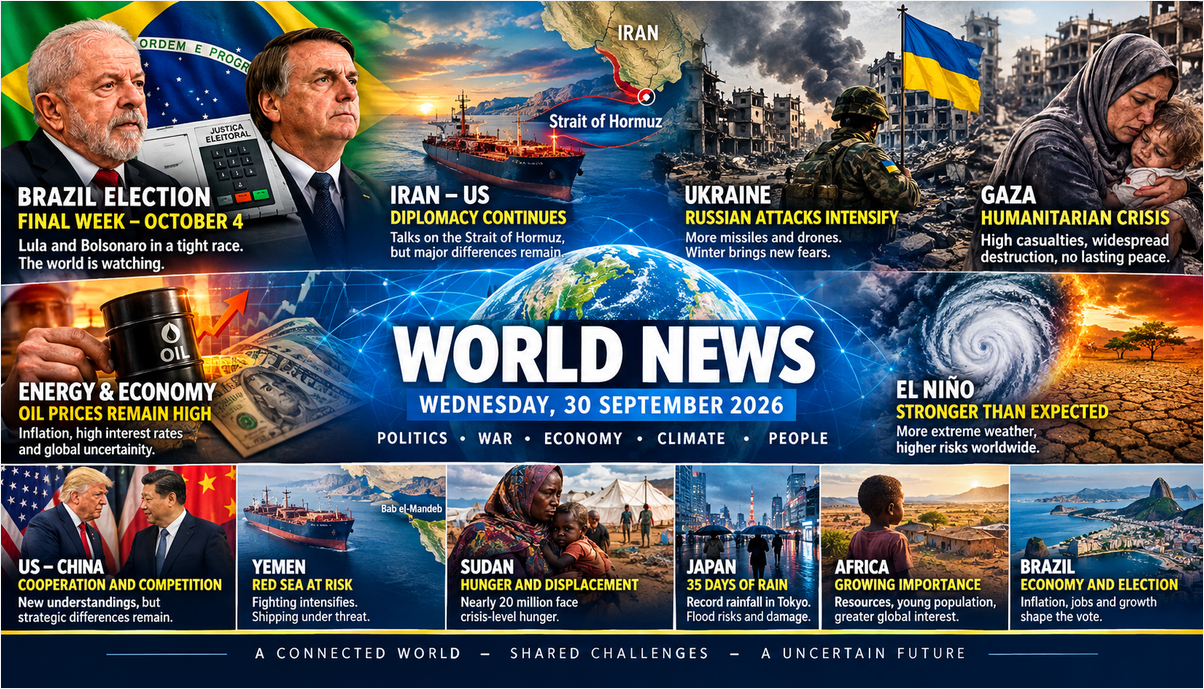
A world already under strain enters the final day of September with several major stories moving simultaneously: the continuing US-Iran confrontation and the struggle to reopen the Strait of Hormuz, intensifying Russian attacks on Ukraine, the continuing crisis in Gaza and Yemen, an increasingly uncertain world economy, and an exceptionally strong El Niño developing in the Pacific. In Brazil, the presidential election is now only four days away, with the latest polling showing an extremely close contest between Luiz Inácio Lula da Silva and Flávio Bolsonaro.
1. BRAZIL — FOUR DAYS TO THE FIRST ROUND
Brazil is approaching the 4 October presidential election with the two principal candidates separated by only a small margin in several recent surveys.
The latest Meio/Ideia poll, released on 30 September, puts Lula at 39.4% and Flávio Bolsonaro at 38.4% in the first round. Augusto Cury follows with 6.7%. In a simulated second round between Lula and Flávio Bolsonaro, the survey records 48.5% for Lula and 48.0% for Flávio—within the poll's margin of error. The survey interviewed 2,000 voters from 25–28 September and has a margin of error of 2.2 percentage points.
Other recent surveys have also shown a close contest, although their numbers differ because of methodology and fieldwork dates. A summary of recent polls shows Lula generally ahead in first-round measurements, while second-round simulations between Lula and Flávio have been particularly close.
That means the polls should be read as measurements of voter intentions at particular moments, not predictions of the election result.
The issues dominating Brazil
The campaign has increasingly focused on living costs, public security, government spending, taxation, social programmes, economic growth, the environment and Brazil's international position.
Reuters reported that the two leading candidates have presented different approaches to fiscal policy, although both campaigns have avoided spelling out some of the difficult spending and revenue decisions that would be required.
Lula's government has recently announced measures aimed at household finances, including increased benefits under its flagship welfare programme. It has also announced measures involving online betting and debt relief as the election approaches.
The economy remains an important part of the election debate. Brazil's government recently reduced its forecast for 2026 economic growth from 2.3% to 2.0%, while the Central Bank has continued its cautious monetary easing cycle.
AI and the election
Another unusual feature of the 2026 campaign is the growing concern about artificial intelligence, deepfakes and manipulated political material.
Brazilian electoral authorities have been preparing measures intended to deal with the use of AI and digital platforms during the election campaign. The problem is particularly significant because false audio, video or photographs can circulate much faster than traditional corrections.
The result is an election taking place not only on television, radio and at political meetings, but also inside an enormous digital information environment.
The first round is Sunday, 4 October. A second round, if required, is scheduled for 25 October.
2. IRAN, THE UNITED STATES AND THE STRAIT OF HORMUZ
One of the most consequential international stories remains the confrontation between the United States and Iran and its effect on the Strait of Hormuz.
Iran said Wednesday that it had received a US response to its latest proposal for restoring an agreement and reopening the strategically vital waterway.
The Iranian proposal involved the United States lifting its blockade of Iranian ports while Iran would reopen the Strait of Hormuz within seven days. Qatar has been acting as an intermediary between Washington and Tehran.
The difficulty is that the two sides reportedly continue to disagree over which steps should come first.
The Strait is exceptionally important to the world economy because enormous quantities of oil and gas normally pass through it. Disruption therefore affects not only the Middle East but fuel prices, shipping costs, inflation and consumers worldwide.
The situation remains dangerous for commercial shipping. Reuters reports that maritime authorities have recorded further incidents involving vessels struck by projectiles.
3. THE UNITED STATES LEAVES IRAQ
The United States has completed the withdrawal of its remaining military forces from Iraq, ending a major chapter that began with the 2003 invasion.
The withdrawal was planned during the Biden administration and completed under Donald Trump's presidency while the wider US-Iran conflict continues.
Iran and Iranian-aligned groups in Iraq have presented the withdrawal as a major political achievement. Reuters reports that some analysts believe the absence of US forces could give Iran-backed groups greater room to expand their political and military influence in Iraq.
The development is important because Iraq sits directly between Iran and the Arab Gulf states and has repeatedly become an arena for competition between Tehran and Washington.
4. UKRAINE — RUSSIA ESCALATES THE AIR WAR
The war in Ukraine continues with heavy Russian attacks on Kyiv and other Ukrainian cities.
Russia has been using ballistic missiles and increasingly fast jet-powered drones, creating additional difficulties for Ukrainian air-defence systems.
NATO has also condemned what it described as irresponsible Russian nuclear rhetoric following Russian warnings concerning the alliance and Kaliningrad. NATO said its activities were defensive and did not threaten Russian territory.
The attacks are increasingly directed against infrastructure as well as military-related targets.
Reports from Ukraine describe casualties and damage to civilian infrastructure, including a school in Sumy.
Ukraine is simultaneously attempting to expand the use of inexpensive interceptor drones to compensate for shortages of some conventional air-defence missiles.
The war therefore continues to develop technologically as well as geographically: Russia is trying to overwhelm Ukrainian defences with increasingly sophisticated airborne weapons, while Ukraine is developing cheaper systems to intercept them.
5. GAZA AND THE WIDER MIDDLE EAST
The Gaza conflict remains one of the world's most serious humanitarian crises.
The conflict continues alongside the larger confrontation involving Israel, Iran and the United States, making the Middle East situation increasingly interconnected.
The humanitarian consequences in Gaza remain severe, while diplomatic efforts continue at international level.
The central problem is that even when negotiations produce temporary openings, the underlying political and security disagreements remain unresolved.
Meanwhile, violence has also continued in the West Bank, where Palestinian communities and Israeli settlers remain involved in repeated confrontations.
The broader Middle East therefore faces several overlapping conflicts rather than one isolated war.
6. YEMEN AND THE RED SEA
Yemen is another critical part of the regional picture.
UN Special Envoy Hans Grundberg has been meeting Houthi representatives in an attempt to prevent the Yemeni conflict from becoming further entangled with the wider Middle East war.
The western coast has experienced renewed fighting, while the Houthis continue to pose a threat to shipping around the Bab el-Mandeb, another strategically important maritime passage.
The United Nations has warned that Yemen's internal conflict should be separated from the wider regional confrontation and that a Yemeni-led political settlement remains necessary.
The danger for international shipping is obvious: with both Hormuz and Bab el-Mandeb exposed to regional conflict, ships face greater insurance costs, longer routes and increased security risks.
7. WORLD ECONOMY — ENERGY SHOCKS CONTINUE
The international economy is feeling the consequences of war and uncertainty.
Oil prices remain elevated because traders are watching the Strait of Hormuz and the possibility of further interruptions to Middle Eastern energy exports.
At the same time, inflation remains a concern in several major economies.
Germany reported rising inflation in several important states during September, suggesting that the national German inflation figure may also rise.
In the United States, consumer confidence fell sharply in September, reaching a level close to a 12½-year low, according to the latest Reuters report. Concerns about employment and the economic outlook are weighing on households.
This creates an uncomfortable combination for central banks:
high energy prices can push inflation upward, while weakening economic confidence can point toward lower interest rates.
8. CHINA AND THE GLOBAL BALANCE
China remains central to the international economic and political picture.
Beijing continues to balance its relationships with the United States, Russia, Iran and the developing BRICS-related economic system.
The competition between Washington and Beijing extends well beyond military affairs. It includes technology, artificial intelligence, semiconductors, trade, shipping, energy and global investment.
The relationship between the world's two largest economies therefore remains one of the most important long-term factors influencing the international system.
9. THE MOST EXTRAORDINARY WEATHER STORY — TOKYO'S 35 DAYS OF RAIN
Tokyo has now experienced 35 consecutive days of rainfall, breaking the previous record of 33 consecutive rainy days set in 2019.
Through 28 September, Tokyo had received approximately 629 millimetres of rain, almost three times the normal amount for September.
The extraordinary weather has affected agriculture, tourism and everyday life, with vegetable prices rising because surrounding farming areas have suffered damage.
This is particularly significant because it comes during an exceptionally strong El Niño event.
10. EL NIÑO — A GLOBAL WEATHER WARNING
The World Meteorological Organization says the current El Niño is expected to strengthen into a very strong event during the coming months.
The WMO estimates that there is an exceptionally high probability that El Niño will continue into February 2027.
El Niño changes atmospheric circulation and therefore influences rainfall and temperature patterns across many parts of the planet. The effects are not identical everywhere: some regions become wetter while others experience drought, heat or disrupted agricultural seasons.
Scientists are particularly interested in this event because it is developing in a world that is already considerably warmer than in previous decades.
The combination of El Niño + a warming climate + unusually warm oceans increases the possibility of extreme weather.
11. AFRICA — SUDAN REMAINS A HUMANITARIAN CATASTROPHE
Sudan continues to suffer from one of the world's most severe humanitarian crises.
Millions of people remain displaced and millions face serious food insecurity.
The conflict has destroyed homes, hospitals, agricultural production and infrastructure while making humanitarian access extremely difficult.
Sudan receives far less international attention than Gaza or Ukraine, despite the enormous scale of the humanitarian emergency.
12. THE WORLD ON 30 SEPTEMBER
September ends with an unusually interconnected set of crises.
A conflict around Hormuz affects oil.
Oil affects inflation.
Inflation affects household finances.
Economic pressure affects politics.
Politics affects international relations.
And meanwhile, El Niño is adding another layer of uncertainty through extreme weather and agricultural disruption.
Brazil now enters the final days before its presidential election while the rest of the world watches developments in the Middle East, Ukraine, China and the global economy.
CONCLUSION — A WORLD WAITING FOR OCTOBER
The first days of October could become particularly important.
Brazil votes on 4 October.
The United States and Iran are still struggling to find a formula that could reopen the Strait of Hormuz.
Russia is intensifying its air campaign against Ukraine.
The humanitarian crises in Gaza, Yemen and Sudan remain unresolved.
And the planet is entering a potentially powerful El Niño period.
For Brazil, the immediate question is electoral.
For the world, the larger question is whether several separate crises can remain contained—or whether they begin to reinforce one another.
September 2026 therefore ends not with one defining crisis, but with several major events moving at the same time.