AI CHAT WORLD NEWS 28/09/2026

By AI Chat.-T.Chr.-Human Synthesis-28 September 2026
🌍 AI CHAT WORLD NEWS
MOST IMPORTANT WORLD NEWS TODAY.
🇧🇷 1. BRAZIL — ELECTION ENTERS ITS FINAL WEEK
Brazil is now only six days away from the first round of its presidential election, on 4 October. If no candidate receives more than half of the valid votes, the two leading candidates will meet in a second round on 25 October.
The latest polling shows a very close contest between President Luiz Inácio Lula da Silva and Senator Flávio Bolsonaro.
A BTG/Nexus poll conducted 25–27 September, released today, put Lula at 42% in first-round voting intentions and Flávio Bolsonaro at 37%. Augusto Cury and Ronaldo Caiado were each at 5%, while Renan Santos had 4%.
In a simulated second round, the same poll gave Lula 46% and Flávio Bolsonaro 44%. The margin of error is two percentage points, meaning the difference remains within the poll's margin of error. The survey interviewed 2,000 people.
A separate Quaest poll, conducted 24–27 September and released today, showed 42% for Lula and 42% for Flávio Bolsonaro in a possible second round, with a two-point margin of error.
What this means
The latest surveys show that the election remains highly competitive. Polls measure voters' intentions when the interviews are conducted; they do not determine the eventual result.
The BTG/Nexus survey also found that 87% of those who had chosen a first-round candidate said they would not change their vote, while 12% said they still could change.
Brazil therefore enters the final campaign week with substantial attention focused on the two principal contenders, while the other presidential candidates continue campaigning.
Why the election matters internationally
Brazil is the largest country in Latin America and a major agricultural, mineral and energy producer. Its relations with China, the United States, Europe and the BRICS countries give the election importance beyond Brazil itself.
The campaign is also taking place amid debate over:
- inflation and the cost of living
- government spending and taxation
- poverty and social programmes
- public security
- environmental and Amazon policy
- Brazil's foreign relations
- relations with China and the United States
- BRICS and Brazil's role in a changing international order
- the country's democratic institutions and electoral system.
The TSE has published the official government programmes submitted by the presidential candidates, giving voters access to their stated proposals.
The decisive week has now begun.
🔴 2. IRAN–UNITED STATES — DIPLOMACY AND WAR COLLIDE
The Middle East remains the world's most immediate international crisis.
The United States and Iran are still fighting, while diplomatic efforts are continuing through intermediaries.
According to AP reporting today, mediators are still working on a possible agreement to end the fighting and reopen the Strait of Hormuz, with indirect discussions expected to resume Monday.
Iran has proposed a seven-day roadmap involving reopening the strategically vital waterway and negotiations toward ending the conflict.
President Donald Trump has rejected the Iranian proposal in its present form but has said he expects talks to resume this week.
Iran's foreign minister, Abbas Araghchi, meanwhile said Iran was prepared if the war resumed.
The Strait of Hormuz
This is one of the world's most important energy routes.
Any prolonged restriction affects:
oil → shipping → fuel → industry → transportation → inflation
Oil prices rose sharply Monday after the latest diplomatic setback, with Brent crude moving above $107 a barrel in early European trading.
The economic consequences are therefore being felt far beyond the Middle East.
🛢️ 3. GLOBAL ECONOMY — OIL AGAIN BECOMES A MAJOR CONCERN
The renewed uncertainty around Hormuz has immediately affected financial markets.
Asian stock markets were mostly lower Monday as investors reacted to the US-Iran impasse and rising oil prices.
The central economic question is whether the disruption remains temporary or becomes prolonged.
Higher oil prices can feed into:
- petrol and diesel
- aviation
- shipping
- manufacturing
- food transportation
- electricity
- inflation.
For countries heavily dependent on imported energy, this is particularly important.
🇺🇦 4. UKRAINE — HEAVY RUSSIAN DRONE ATTACKS
Ukraine has experienced another major wave of Russian attacks.
Reports from Sunday said Russian strikes killed at least eight people across Ukraine, while Kyiv and other areas were hit by drones and missiles.
Ukraine's president Volodymyr Zelenskyy said Russia had launched approximately 3,900 drones, aerial bombs and missiles during the preceding week, according to the Guardian's report of his statement.
Civilian buildings and communications infrastructure were among the reported targets.
The attacks came despite continuing international diplomatic discussions concerning a possible settlement of the war.
🇷🇺🇺🇦 5. EUROPE — PRESSURE FOR DIPLOMACY CONTINUES
European leaders continue calling for an end to Russia's war against Ukraine.
At the UN, European Council President António Costa said diplomacy and an immediate ceasefire were needed and emphasized Ukraine's sovereignty and territorial integrity.
At the same time, European governments continue strengthening defence and security preparations.
The war therefore remains both a Ukrainian battlefield conflict and a major European security issue.
🇺🇸🇨🇳 6. UNITED STATES AND CHINA — COMPETITION CONTINUES
Relations between Washington and Beijing remain one of the most important long-term stories in world politics.
President Donald Trump and President Xi Jinping recently met in the United States.
The meeting produced warmer public diplomacy, but major disagreements remain over trade, technology and Taiwan.
A new report today says Trump even asked Xi whether China would be interested in buying US weapons, according to the US ambassador to China.
The relationship is important because the two countries are simultaneously:
major trading partners + economic competitors + technological rivals + strategic competitors.
🇺🇳 7. UNITED NATIONS — FINAL DAY OF GENERAL ASSEMBLY
The 81st UN General Assembly's high-level week concludes today.
The meeting has brought world leaders together while wars in Iran, Ukraine and the wider Middle East dominate the diplomatic agenda.
Other major subjects have included:
- climate change
- artificial intelligence
- international development
- global security
- humanitarian crises
- reform of international institutions.
Nearly 130 heads of state and government were expected to attend the high-level week.
Brazil's President Lula was among the leaders addressing the General Assembly.
🇵🇸 8. GAZA AND THE MIDDLE EAST
The Gaza conflict remains part of the wider Middle Eastern crisis.
Israel's confrontation with Hamas and Hezbollah continues to affect regional diplomacy, while the US-Iran war has added another major dimension.
Gulf countries are particularly concerned about the safety of shipping and energy infrastructure.
The European Union has continued to advocate a two-state solution and has called for an end to the wider regional violence.
🇾🇪 9. YEMEN — ANOTHER FRONT IN THE REGIONAL CRISIS
Fighting has also resumed in Yemen between Iran-aligned Houthi forces and Saudi-backed forces.
The renewed violence is significant because Yemen lies beside one of the world's other critical maritime routes, the Bab el-Mandeb Strait.
Together with Hormuz, disruption in these waters can affect international shipping between Asia, the Middle East and Europe.
🌡️ 10. EL NIÑO — A MAJOR WEATHER STORY FOR 2026–27
While wars dominate the headlines, another major global story is developing in the Pacific.
The World Meteorological Organization says El Niño is firmly established and expected to intensify into a very strong event in the coming months.
Scientists are watching the possibility of an exceptionally strong event because El Niño can produce major changes in rainfall and temperatures around the world.
Possible consequences include:
- extreme heat
- drought
- flooding
- agricultural losses
- water shortages
- changes in tropical cyclone activity.
The effects differ substantially from one region to another.
🇧🇷 11. BRAZIL AND EL NIÑO
Brazil is particularly important to watch.
The country's enormous agricultural sector means that changes in rainfall can affect both Brazil's domestic economy and global food markets.
Southern, central and northern Brazil can experience quite different effects from El Niño, so national averages can conceal substantial regional differences.
For São Paulo and the southeastern coast, local forecasts remain more useful for day-to-day weather than the El Niño signal alone.
🌎 12. WORLD FOOD AND COMMODITIES
The combination of geopolitical instability and unusual climate conditions is putting renewed attention on global commodity markets.
Brazil remains one of the world's most important producers and exporters of:
- coffee
- soybeans
- sugar
- beef
- orange juice
- corn
- iron ore.
Consequently, Brazilian weather is watched closely by international markets.
Any significant disruption to Brazilian agriculture can eventually affect food prices elsewhere.
🤖 13. ARTIFICIAL INTELLIGENCE — A NEW GLOBAL POWER ISSUE
Artificial intelligence is increasingly being treated as a strategic technology rather than merely a commercial product.
The major questions now include:
Who controls the most advanced computing?
Who controls the semiconductor supply chain?
How will AI affect employment?
How should governments regulate AI-generated information?
How can elections protect voters from synthetic political material?
These questions have become especially relevant in Brazil, where authorities are dealing with AI-generated political content during the election campaign.
🌍 14. AFRICA — SUDAN REMAINS A MAJOR HUMANITARIAN CRISIS
The war in Sudan between the Sudanese Armed Forces and the Rapid Support Forces continues.
Millions have been displaced, and humanitarian organisations continue to warn about food insecurity and lack of access to essential services.
Sudan receives considerably less international attention than Ukraine and the Middle East despite the scale of the humanitarian emergency.
🇪🇺 15. EUROPE — ENERGY, SECURITY AND POLITICS
Europe is dealing simultaneously with:
- the continuing Ukraine war
- energy-price uncertainty
- relations with Russia
- NATO security
- migration
- economic pressures.
The latest Middle Eastern energy crisis adds another complication because European economies remain sensitive to international oil and gas prices.
🇻🇦 16. POPE LEO — EUROPEAN PEACE MESSAGE
Pope Leo is visiting France and is expected to speak today about Europe's role in the world, peace in Ukraine and concerns surrounding nationalism.
His visit comes as Europe is dealing with war, migration, economic pressures and questions about its future role internationally.
🇮🇩 17. INDONESIA — DEADLY FERRY DISASTER
A major humanitarian story from Asia is unfolding in Indonesia.
According to current regional reporting, the death toll from a ferry disaster has reached 66, with dozens still missing as the search continues.
The incident highlights continuing safety challenges in one of the world's largest archipelagic nations, where maritime transport is essential to millions of people.
🌍 THE WORLD ON 28 SEPTEMBER 2026
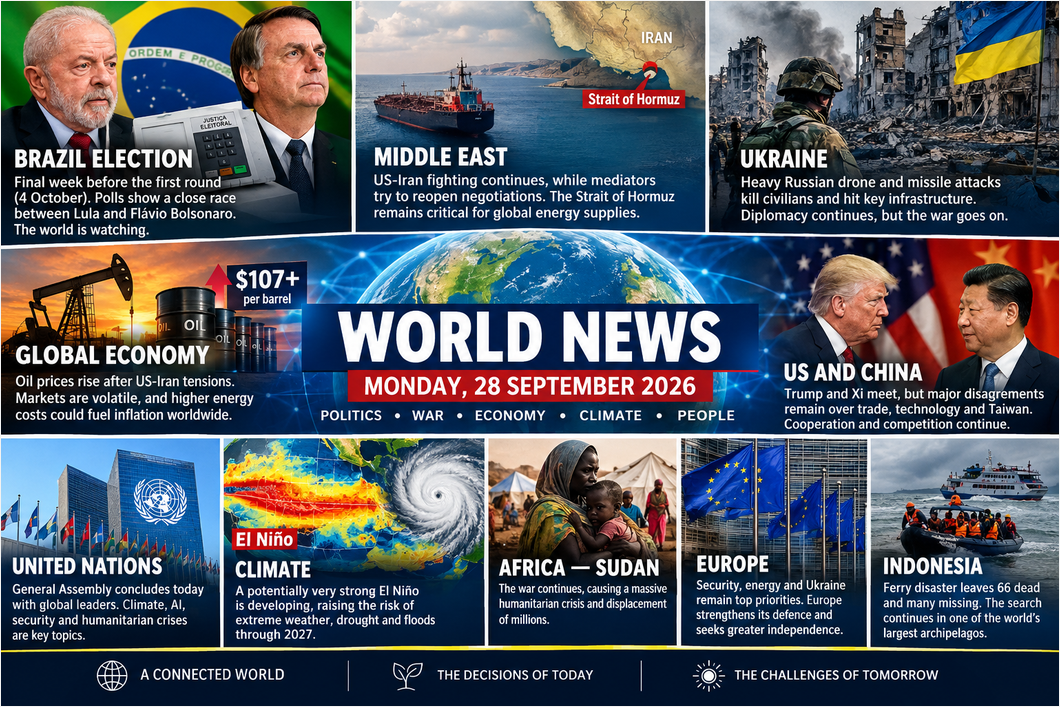
The international picture today can be summarized in six major developments:
🇧🇷 BRAZIL
The presidential election enters its final six days before the 4 October first round. Latest polls show a close contest between Lula and Flávio Bolsonaro, with differences within polling margins of error.
🔴 MIDDLE EAST
US-Iran fighting continues, while mediators attempt to reopen negotiations and restore traffic through the Strait of Hormuz.
🛢️ ENERGY
Oil prices have risen again as uncertainty over Hormuz returns to international markets.
🇺🇦 UKRAINE
Heavy Russian drone and missile attacks continue despite diplomatic efforts.
🇺🇸🇨🇳 US–CHINA
Washington and Beijing continue dialogue while remaining major strategic and technological competitors.
🌡️ CLIMATE
A potentially very strong El Niño is developing, raising the risk of significant weather disruption through late 2026 and into 2027.
📰 THE BIG PICTURE
28 September 2026 is a day in which politics, war, energy and climate are tightly connected.
In the Middle East, the future of the Strait of Hormuz affects the world's energy markets.
In Ukraine, the war continues despite diplomatic efforts.
Between the United States and China, economic cooperation exists alongside strategic competition.
And in Brazil, voters are entering the final days before choosing the country's next president.
At the same time, the strengthening El Niño is a reminder that some of the biggest forces affecting humanity are not political at all.
The next six days will be especially important for Brazil, while developments around Hormuz could affect the entire world economy.