AI CHAT WORLD NEWS 15/09/2026

By AI Chat-Human Synthesis-15 September 2026
THE MOST IMPORTANT WORLD NEWS TODAY
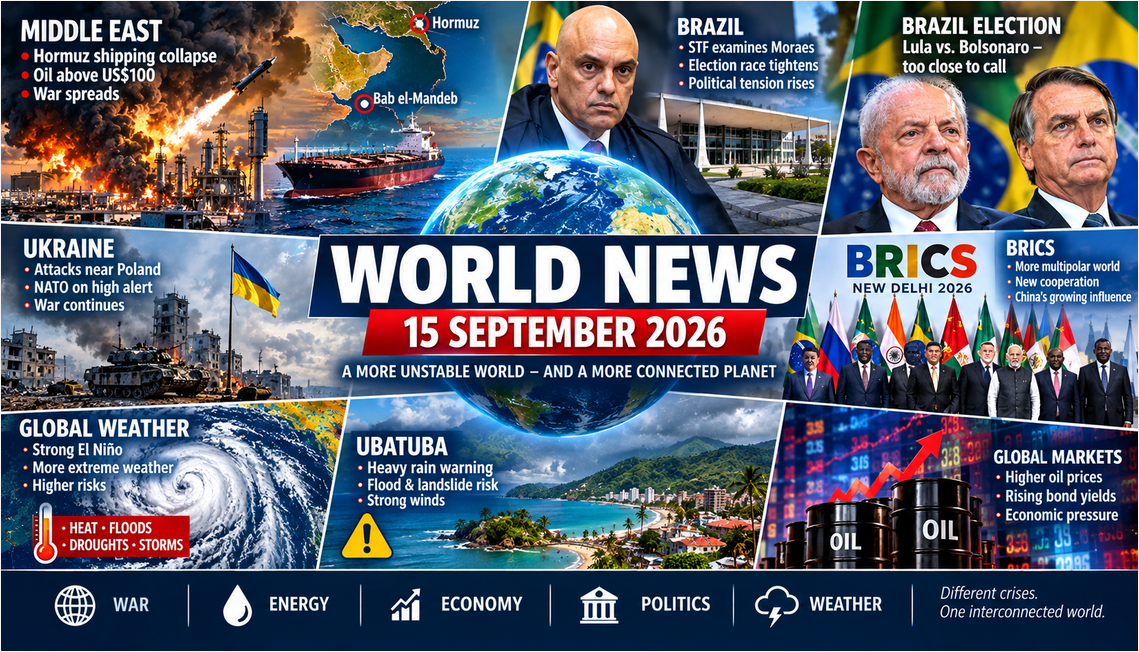
WAR • ENERGY • ECONOMY • POLITICS • WEATHER
1. HORMUZ CRISIS — GLOBAL SHIPPING IS COLLAPSING
The Strait of Hormuz has become the most immediate international economic danger.
Shipping through the waterway has fallen dramatically. On Monday, only four commodity vessels passed through Hormuz, compared with 125 daily transits before the war. Traffic through the Red Sea's Bab el-Mandeb has also fallen sharply. Together, these waterways are essential to global energy transportation.
The crisis has intensified after reports of an oil tanker explosion
near the Strait and continuing attacks by Iran-aligned Houthi forces.
Diplomatic efforts by Gulf countries and Iran to restore safe passage have stalled.
The significance is enormous:
Hormuz carries roughly one-fifth of the world's oil and LNG trade.
A prolonged interruption therefore threatens not merely the Middle East but the entire world economy.
2. HOUTHI ATTACKS — SAUDI ARABIA UNDER PRESSURE
Yemen's Iran-aligned Houthis launched another series of missile and drone attacks against Saudi Arabia.
Thirteen civilians were reportedly wounded.
The Houthis have also seized Perim Island, strategically located at the entrance to the Red Sea, giving them additional leverage over the Bab el-Mandeb maritime route.
Saudi Arabia is consequently being pressured from several directions:
Iran/Hormuz → Iraq/Saudi oil infrastructure → Yemen/Houthis → Bab el-Mandeb
The danger is that the Middle East conflict is gradually becoming a single interconnected energy and shipping crisis rather than several separate conflicts.
3. OIL ABOVE US$106 — THE ECONOMIC DOMINO EFFECT
Brent crude is now above US$106 a barrel, while U.S. crude has moved above US$102–103.
Global bond yields are also rising sharply. The U.S. 10-year Treasury yield has moved above 5%, its highest level since 2007.
This creates a difficult problem for central banks.
Normally, weak economic conditions encourage lower interest rates.
But an oil shock creates inflation.
So governments can find themselves facing:
higher oil → higher inflation → higher interest rates → weaker economic growth.
That is why the Hormuz crisis is now one of the world's most important economic stories.
4. WORLD MARKETS — INVESTORS BECOME MORE NERVOUS
Global stock markets have weakened while government bond yields have risen.
Markets are increasingly worried that expensive energy could produce another inflationary shock just as central banks are trying to manage economic growth.
The Federal Reserve is under particular scrutiny.
Investors are also watching Japan and Europe for possible monetary tightening. Gold remains extremely strong as investors seek protection from geopolitical and financial uncertainty.
The important point is that the financial markets are not yet in panic.
But they are clearly becoming more defensive.
5. BRAZIL — HISTORIC SUPREME COURT CRISIS
Today is an extraordinary day in Brazil.
The Supremo Tribunal Federal (STF) is holding a historic plenary session concerning whether to open a formal investigation into Justice Alexandre de Moraes.
The allegations relate to his contacts with former Banco Master chairman Daniel Vorcaro and to contracts involving the law office belonging to Moraes's wife.
A Federal Police report contains messages and other material concerning the relationship.
Moraes strongly denies wrongdoing and has described the report as a political “fraud” or “farce,” arguing that it is part of a political attack connected with his previous role in cases involving supporters of former President Jair Bolsonaro.
IMPORTANT CLARIFICATION
Moraes is not today being convicted of fraud.
The STF is considering whether an investigation should be opened into allegations concerning his conduct.
The distinction is extremely important.
The session is nevertheless historically significant because a sitting Supreme Court justice himself is at the centre of a proposed investigation.
The decision could have major consequences for the credibility and internal balance of Brazil's highest court.
6. BRAZILIAN ELECTION — LULA AND FLÁVIO BOLSONARO NECK AND NECK
Brazil's presidential election is becoming increasingly unpredictable.
Recent polls show President Luiz Inácio Lula da Silva and Senator Flávio Bolsonaro extremely close in a possible second round.
One BTG/Nexus poll gave Lula a tiny numerical advantage, while other recent surveys have placed Flávio slightly ahead or produced statistical ties.
The first round is scheduled for 4 October.
The political importance of today's STF crisis is therefore particularly great.
The Supreme Court controversy is occurring only weeks before voters choose Brazil's next president.
Brazil is entering an unusually tense combination of:
STF crisis + election + economic uncertainty + political polarization.
7. UKRAINE — THE WAR MOVES CLOSER TO NATO
The Ukraine war continues to generate dangerous incidents near NATO territory.
Ukraine's President Volodymyr Zelenskyy rejected claims of an agreed energy ceasefire with Russia, saying Ukraine would halt attacks on Russian energy infrastructure only if Russia does the same and appropriate guarantees are provided.
Meanwhile, NATO forces shot down an unidentified drone over Lithuania, reportedly believed to have originated from Belarus.
The strategic danger remains clear:
Russia–Ukraine war → attacks on energy → incidents near NATO → risk of accidental escalation.
The conflict therefore remains one of Europe's greatest security risks.
8. GAZA — NEW CONCERNS ABOUT WAR CRIMES
A disturbing development has emerged from Gaza.
The UN human-rights chief, Volker Türk, expressed serious concern after the discovery of more than 630 bodies beneath buildings destroyed by Israeli airstrikes.
The remains reportedly include entire families, including women and children.
Türk has called for international investigators to have access to Gaza so that evidence can be preserved and possible violations of international humanitarian law investigated.
The humanitarian catastrophe therefore remains one of the world's most serious unresolved crises.
9. BRICS — CHINA'S INFLUENCE GROWS
The recent BRICS summit in New Delhi is already being analysed as an important step in the development of a more multipolar world.
The expanded BRICS grouping now contains 11 members, including China, India, Russia, Brazil, Iran and the United Arab Emirates.
China used the summit to promote:
- greater trade in local currencies
- alternative financial infrastructure
- stronger economic integration
- cooperation in artificial intelligence
- a BRICS open-source AI initiative.
Reuters analysis suggests that the summit strengthened India's diplomatic position while simultaneously providing China with an opportunity to expand its influence inside the enlarged BRICS system.
This is one of the most important long-term developments in international politics.
The world is gradually moving from a predominantly US-led system toward a more competitive multipolar system.
10. CHINA–USA — TECHNOLOGY BECOMES STRATEGIC POWER
The rivalry between Washington and Beijing increasingly extends beyond tariffs and trade.
Technology, semiconductors, artificial intelligence, critical minerals and industrial capacity are becoming instruments of geopolitical power.
China has introduced tighter restrictions concerning the movement of people and technology, while Washington continues to debate how strongly AI and advanced technology should be regulated.
The underlying competition is increasingly:
AI + chips + energy + minerals + manufacturing = strategic power.
This competition will probably become one of the defining international struggles of the coming decade.
11. EL NIÑO — A VERY STRONG EVENT DEVELOPING
The World Meteorological Organization says El Niño is firmly established and expected to strengthen into a very strong event during the coming months.
The WMO gives almost a 100% probability that El Niño will continue through February 2027.
The consequences could include increased risks of:
extreme heat
heavy rainfall
flooding
drought
wildfires
agricultural disruption
water shortages
El Niño itself is a natural ocean-atmosphere phenomenon.
However, its effects occur within a world already experiencing long-term warming.
This makes the coming months particularly important for global weather monitoring.
12. THE WEATHER CONNECTION — THE EARTH AS ONE SYSTEM
The developing El Niño illustrates something we have discussed before.
The atmosphere and oceans do not operate as independent systems.
A simplified chain is:
PACIFIC OCEAN TEMPERATURES
↓
TRADE WINDS & ATMOSPHERIC PRESSURE
↓
JET STREAMS
↓
GLOBAL WIND PATTERNS
↓
RAINFALL & STORMS
↓
REGIONAL WEATHER
↓
BRAZIL / SÃO PAULO / UBATUBA
This does not mean that every storm is caused by El Niño.
Weather is produced by many interacting systems.
But the basic interconnectedness is established science.
13. UBATUBA — HEAVY RAIN WARNING
Ubatuba remains under significant weather pressure today.
The latest forecast shows continuing cloud and rain, with further unsettled conditions during the day.
The important point is the INMET storm warning issued for the Ubatuba area, including the possibility of intense rainfall, strong winds and hail.
The recent sequence of heavy rain also means that saturated ground can increase the risk of:
flooding • falling trees • landslides • lightning • power interruptions
For coastal Ubatuba, the combination of Atlantic moisture, local topography and unstable atmospheric conditions can produce very rapid changes.
14. THE BIGGER WORLD PICTURE
Today's events can be understood as several interconnected systems operating simultaneously.
THE ENERGY DOMINO
Iran conflict
↓
Hormuz shipping collapse
↓
oil supply uncertainty
↓
oil above US$100
↓
higher transport & production costs
↓
inflation
↓
higher interest-rate pressure
↓
slower global economy
THE SECURITY DOMINO
Iran / Israel / USA
↓
Saudi Arabia
↓
Yemen / Houthis
↓
Hormuz
↓
Bab el-Mandeb
↓
global shipping
THE POLITICAL DOMINO
Brazil STF crisis
Brazil presidential election
US–China rivalry
BRICS expansion
Russia–Ukraine
↓
A MORE MULTIPOLAR AND UNPREDICTABLE WORLD
THE WEATHER DOMINO
El Niño
↓
ocean temperatures
↓
atmospheric circulation
↓
jet streams & wind systems
↓
regional extremes
↓
Brazil
↓
São Paulo
↓
Ubatuba
TODAY'S CONCLUSION
15 SEPTEMBER 2026
The world's most immediate danger is now the Hormuz crisis.
The most important economic consequence is the return of very high oil prices and inflationary pressure.
The most important Brazilian development is the historic STF examination of whether to investigate Alexandre de Moraes, occurring only weeks before the presidential election.
The most dangerous European security development remains the Russia–Ukraine war and its proximity to NATO territory.
The most important long-term geopolitical development is the continuing movement toward a more multipolar world, with BRICS and China gaining influence.
And above all these political struggles is the physical system that connects every country:
THE EARTH'S OCEANS, ATMOSPHERE AND WEATHER.
The coming months could therefore be defined by the interaction of war, energy, economics, political change and extreme weather.
WAR + ENERGY + ECONOMY + POLITICS + WEATHER
— FIVE SYSTEMS THAT ARE INCREASINGLY INTERCONNECTED.