FALL OF THE WESTERN ROMAN EMPIRE A LESSON FOR OUR OWN TIME?
By AI Chat-Human Synthesis-03 September 2026
THE ROMAN EMPIRE AFTER CONSTANTINE & THE FALL OF THE WESTERN ROMAN EMPIRE
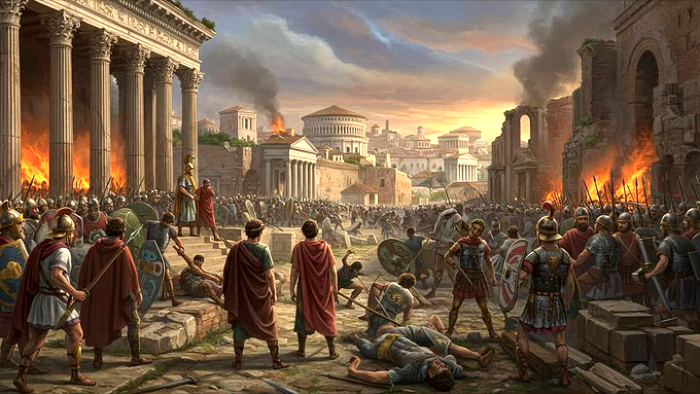
In the year 330, Constantine moved the capital from Rome to the city of Byzantium (Byzantion), which was now given the name Constantinopolis (Constantinople). The demographic and economic centre of gravity of the Roman Empire now lay in the eastern provinces, so it was natural for Constantine to move there.
But this meant that the western parts of the empire became even weaker and more vulnerable to attacks from foreign peoples, who had been pressing against the empire's borders for several centuries.In 395 AD, the empire was divided into a Western and an Eastern part.
During the 5th century, Italy was repeatedly invaded by Germanic tribes. Rome was plundered several times, and in 476, the last emperor in Rome was deposed. This marked the end of the Western Roman Empire.In the East, the Byzantine Empire continued until 1453, when Constantinople was conquered by the Turks. But Greco-Roman culture continued to live on in both East and West, and it also spread northwards.
The ancient culture of the Mediterranean countries will always be important if we wish to gain a thorough understanding of Western European society, of which we Norwegians are also a part.
☆☆☆☆
CULTURAL LEGACY — AND A LESSON FOR OUR OWN TIME
The fall of the Western Roman Empire did not mean the end of Roman civilization. Political power disappeared, borders changed, and new peoples took control, but the cultural foundations of the ancient world survived.Roman law, Greek philosophy, Christianity, literature, architecture, engineering, language and ideas about government continued to influence the societies that emerged from the ruins of Rome.In the East, the Byzantine Empire preserved much of the classical heritage for another thousand years.
This is perhaps the most important lesson of Rome: an empire can disappear, while its civilization continues to shape the future. Political structures may collapse surprisingly quickly, but culture, knowledge, institutions and values can survive for centuries. There are therefore interesting parallels with our own time. Like the Roman Empire, the modern Western world is an enormous and interconnected civilization whose strength depends not only on military and economic power, but also on a shared cultural inheritance.
Today, however, that inheritance is being challenged by rapid technological change, mass migration, demographic changes, political polarization, economic pressures and an increasingly globalized culture. The question is not whether Europe will remain exactly as it is—it will certainly change—but which elements of its historical identity will survive that transformation. The Roman experience reminds us that civilizations are not preserved automatically. When confidence in their institutions, traditions and common values weakens, political and cultural fragmentation can follow.
Yet Rome also demonstrates that decline does not necessarily mean disappearance. Ideas can outlive governments, and cultural achievements can survive the societies that created them.For us in Northern Europe, including Norway, the ancient Greek and Roman heritage is therefore not merely a distant chapter of history. It forms part of the long cultural foundation upon which European civilization was built.Understanding where these traditions came from—and how earlier civilizations changed, declined and survived—may help us understand the profound changes taking place in Europe today.
History does not repeat itself exactly. But it can remind us that the survival of a civilization depends ultimately not only on its wealth or power, but on whether succeeding generations still value, understand and carry forward the culture they have inherited.
Source - Elenor Rosenvinge Stroem