AI CHAT WORLD NEWS TODAY 03 /09/ 2028

By AI Chat-Human Synthesis-03 September 2026
🌍 THE MOST IMPORTANT WORLD NEWS TODAY.
EXTENDED EDITION
War • Energy • Climate • Elections • Economy • Geopolitics
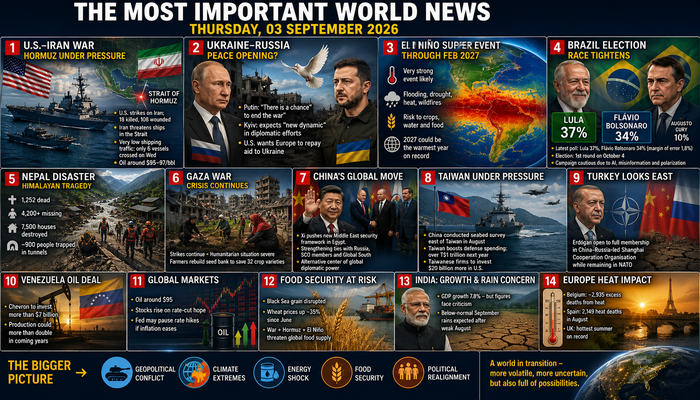
The world enters September under the influence of three enormous and increasingly interconnected forces: the U.S.–Iran war and the Strait of Hormuz crisis, a potentially historic El Niño, and a major geopolitical realignment involving Russia, China, India and the emerging non-Western bloc.
At the same time, Brazil's presidential election is becoming unexpectedly close, Ukraine and Russia are again talking about the possibility of peace, and global food and energy markets are feeling the consequences.
🔴 THE 5 BIGGEST STORIES TODAY
1. 🇺🇸🇮🇷 U.S.–IRAN WAR — HORMUZ BECOMES THE WORLD'S KEY PRESSURE POINT
The conflict between the United States and Iran has entered another dangerous phase.
U.S. strikes on Iran Tuesday night were described by Reuters as the most substantial exchange of fire between Washington and Tehran since July. Iran says 18 people were killed and 108 wounded, while reports say three Iranian military pilots were also killed.
Iran has meanwhile expanded its list of vessels it considers non-compliant in the Strait of Hormuz, threatening fines, confiscation or detention.
The crucial issue is shipping.
Only six commodity vessels crossed Hormuz on Wednesday, compared with 11 the previous day and a normal peacetime flow vastly higher than that.
There is also a striking disagreement over how much traffic is actually getting through:
- Washington says U.S. forces are escorting large numbers of ships.
- Iranian authorities say Tehran still controls the waterway.
- Independent shipping data shows traffic remains far below normal.
Oil: Brent has been trading around the $95–97/barrel area, with WTI around $91–93 as markets assess the possibility of further disruption.
Why this matters
Hormuz normally carries roughly one-fifth of global oil and gas shipments.
If the confrontation becomes a prolonged blockade or major attacks on tankers occur, the consequences would rapidly move beyond the Middle East:
oil → transport → fertilizer → food → inflation → interest rates → economic growth.
That is why this is arguably the single most economically dangerous geopolitical crisis in the world today.
2. 🇺🇦🇷🇺 A SURPRISING OPENING FOR UKRAINE–RUSSIA PEACE TALKS
There is a rare change in tone today.
Russian President Vladimir Putin said Thursday that he believes there is a chance of reaching an agreement to end the war.
Ukraine's Foreign Minister Andrii Sybiha simultaneously said Kyiv expects a “new dynamic” in diplomatic efforts.
Putin said the United States and China were among countries prepared to support a settlement.
However, there is still an enormous gap between the rhetoric and an actual agreement.
Russia continues to claim battlefield advances, while Ukraine refuses Russian demands involving occupied territory.
And the war itself has not stopped.
Long-range attacks against both countries have intensified, while attacks on Black Sea shipping have helped push global grain prices higher.
A potentially important development
Putin's statement is significant because neither side has recently been particularly optimistic about peace.
But there is another complication:
President Trump says the United States will seek reimbursement from European countries for previous U.S. military assistance and ammunition supplied to Ukraine. He has also complained about depleted U.S. weapons stocks as Washington fights the separate Iran war.
Assessment:
This may be the first genuine diplomatic opening in months—but it is far too early to call it a peace process.
3. 🌎 EL NIÑO — THE CLIMATE STORY JUST BECAME MUCH BIGGER
This is arguably the most important non-war story today.
The World Meteorological Organization says the current El Niño is expected to strengthen into a very strong event, with an exceptionally high—nearly 100%—probability of continuing through February 2027.
The WMO says it could potentially become the strongest El Niño ever recorded.
Only three other “very strong” El Niños have been recorded since systematic monitoring began in 1950.
The Pacific Ocean's tropical waters are already more than 2°C above normal in the relevant region.
The potential consequences
South America
- Heavy rainfall and flooding in some areas
- Severe drought in others
- Agricultural disruption
- Greater landslide risk
Asia
- Weaker monsoons
- Heat
- Drought
- Crop losses
Africa
- Major rainfall disruption
- Food-security problems
- Greater humanitarian pressure
North America
- Changing winter precipitation
- Temperature extremes
Global
- Food prices
- Commodity markets
- Water supplies
- Wildfires
- Tropical storms
The WMO warns that 2027 could potentially become the warmest year ever recorded, partly because El Niño tends to produce a temporary upward “pulse” in global temperatures.
4. 🇧🇷 BRAZIL — PRESIDENTIAL ELECTION BECOMES A REAL CONTEST
This is particularly important for Brazil.
President Luiz Inácio Lula da Silva is still ahead—but his advantage has narrowed substantially.
A new PoderData/Aya poll released today gives:
| Candidate | First-round support |
|---|---|
| Lula | 37% |
| Flávio Bolsonaro | 34% |
| Augusto Cury | 10% |
The margin of error is 1.8 percentage points, meaning Lula and Flávio Bolsonaro are effectively in a statistical tie in this poll.
Another recent Quaest poll also showed Lula's advantage over Flávio shrinking.
The first round is scheduled for October 4, 2026.
Lula changes strategy
Reuters reports today that Lula's campaign has become unusually cautious because of:
- misinformation,
- foreign interference concerns,
- AI-generated political material,
- electoral-law restrictions,
- fear of political mistakes,
- and voter fatigue with polarization.
The government has reportedly become extremely careful about official announcements and ministers' social-media activity.
The important political message
This election is far from decided.
Brazil is entering an election in which the difference between the two leading camps may be only a few percentage points.
And artificial intelligence is becoming a major battlefield.
5. 🇳🇵 NEPAL — ONE OF THE GREAT DISASTERS OF 2026
The Himalayan disaster continues to worsen.
A glacier collapse on August 26 triggered a gigantic torrent of ice, rock, mud and water through Nepal's border region with Tibet.
According to Reuters today:
- 1,252 people have been killed
- more than 4,200 remain missing
- about 7,500 houses were completely destroyed
- approximately 20,000 houses may need rebuilding
- around 900 people may still be trapped in hydropower tunnels.
China reports additional deaths and missing people on the Tibetan side.
More than 9,300 Nepalese army personnel are involved in rescue and recovery operations.
The disaster has essentially erased entire settlements.
Reuters describes parts of the Trishuli River valley as having been transformed into landscapes of mud and debris.
Why Nepal matters globally
This is not simply a national disaster.
It demonstrates the potentially devastating combination of:
glacial instability + extreme precipitation + vulnerable mountain settlements + inadequate warning systems.
And it arrives just as the WMO warns that the world is entering an exceptionally powerful El Niño.
6. 🇮🇱🇵🇸 GAZA — WAR CONTINUES DESPITE DIPLOMATIC PRESSURE
The Gaza conflict remains unresolved.
Israeli forces recently captured a senior Hamas figure in Gaza City, while Israeli strikes continue.
At the same time, the humanitarian situation remains severe.
One remarkable story emerging today is the effort by Palestinian farmers to reconstruct a seed bank after the destruction of Gaza's agricultural infrastructure.
A farmer-led project has preserved 32 traditional crop varieties in a makeshift facility. The original seed bank had held around 70 tons of seeds representing 42 native crops.
It is a small story compared with the military conflict—but symbolically important:
Gaza's agricultural survival is becoming part of the struggle itself.
Meanwhile, political divisions over Israel are increasingly visible inside the United States.
The U.S. House passed legislation Thursday aimed at restricting federal funding for universities participating in boycotts of Israel.
7. 🇨🇳 CHINA — BEIJING MOVES TO STRENGTHEN ITS GLOBAL POSITION
China is increasingly positioning itself as an alternative centre of global diplomatic power.
President Xi Jinping has been pushing for a new Middle East security framework while visiting Egypt, at a time when the U.S.–Iran conflict is reshaping regional alliances.
China is also deepening cooperation with Russia and other members of the Shanghai Cooperation Organisation.
The significance goes beyond individual diplomatic meetings.
We are seeing the emergence of a world increasingly divided between:
U.S.-led Western alliances
and
a looser China–Russia–Iran–India-centred Eurasian network.
This does not mean that China, Russia, India and Iran form a unified military alliance.
They have substantial differences.
But their cooperation increasingly challenges the post-Cold War assumption that Washington will remain the world's uncontested strategic centre.
8. 🇹🇼 TAIWAN — CHINA INCREASES PRESSURE
China revealed today that it conducted a seabed survey east of Taiwan during August.
The survey ran from August 10–31 and was accompanied by Chinese coast-guard activity. Taiwan strongly objected, describing the activity as provocative.
Taiwan is simultaneously increasing its defence preparations.
Taiwan's president says defence spending will exceed T$1 trillion (about $31.5 billion) next year for the first time.
Taiwanese companies are also planning another $20 billion of investment in the United States, partly driven by demand for AI and semiconductors.
Assessment
The Taiwan confrontation is becoming increasingly intertwined with:
- semiconductors,
- AI,
- military technology,
- American industrial policy,
- Chinese maritime power,
- and global supply chains.
9. 🇹🇷 TURKEY — ERDOĞAN LOOKS TOWARD THE EAST
President Recep Tayyip Erdoğan says Turkey would consider becoming a full member of the China- and Russia-led Shanghai Cooperation Organisation.
That is strategically significant because Turkey is also a NATO member.
Turkey has long pursued a balancing strategy between:
NATO/Europe
and
Russia/China/Central Asia/Middle East.
A deeper SCO role would be another indication that Ankara wants greater freedom of movement between competing global blocs.
10. 🇻🇪 VENEZUELA — A MAJOR OIL DEAL TAKES SHAPE
The United States is simultaneously confronting Iran while seeking more oil production elsewhere.
Chevron plans to invest more than $7 billion in Venezuela and aims to roughly double its Venezuelan production over the next five years.
The broader U.S.–Venezuela oil arrangements could substantially increase Venezuelan output.
This is strategically interesting.
Washington is effectively trying to:
pressure Iran's oil supply
while
encouraging alternative production from Venezuela.
That could become increasingly important if Hormuz remains disrupted.
11. 📈 GLOBAL MARKETS — OIL, BONDS AND INTEREST RATES
Markets have entered September nervously.
Oil remains around $95/barrel Brent, while investors are watching whether the U.S.–Iran escalation becomes a prolonged supply shock.
But there was some relief today.
U.S. Federal Reserve Governor Christopher Waller suggested that the Fed may pause rate increases if inflation shows signs of easing.
That helped:
- stocks rise,
- Treasury yields decline,
- and market expectations for a September rate increase soften.
The problem is that oil is moving in the opposite direction.
Higher oil → higher inflation → higher interest rates.
So the world's central banks face an increasingly difficult dilemma.
12. 🌾 FOOD SECURITY — THE NEXT BIG GLOBAL PROBLEM?
A potentially dangerous combination is developing:
WAR
Russia–Ukraine attacks are disrupting Black Sea grain shipments.
HORMUZ
The Iran conflict threatens energy and fertilizer supplies.
EL NIÑO
Weather threatens harvests around the world.
Asian wheat buyers are already turning to Australia and Argentina because Black Sea supplies have become uncertain.
Chicago wheat futures have risen roughly 35% since late June, according to Reuters.
This is important because food inflation often arrives after the original geopolitical event.
The sequence can be:
war → energy shock → fertilizer shock → crop shock → food-price shock.
That could become one of the biggest economic stories of 2026–27.
13. 🇮🇳 INDIA — ECONOMIC STRENGTH MEETS CLIMATE RISK
India reported extremely strong GDP growth of 7.8%, but the number has generated controversy.
Some economists and former officials question whether the revised statistical methodology accurately reflects the underlying economy. They point to weaker indicators in areas such as employment, investment and foreign inflows.
At the same time, India's monsoon is becoming a serious concern.
September rainfall is expected to be below normal after August rainfall was already 16% below average.
Thus India faces an unusual combination:
very strong reported economic growth + weakening agricultural weather conditions.
If El Niño strengthens as forecast, food and inflation pressures could become more significant.
14. 🇪🇺 EUROPE — HEAT IS NOW AN ECONOMIC ISSUE
Europe's extraordinary summer is leaving a major human and economic footprint.
Belgium reported approximately 2,935 excess deaths associated with heat between June 18 and August 16.
Spain recorded an estimated 2,149 heat-related deaths in August alone.
Britain experienced its hottest summer since records began, accompanied by drought conditions.
Europe's rivers have also experienced unusually low water levels, affecting transport, agriculture and industry.
The key change is that extreme weather is no longer merely an environmental story.
It is becoming:
a health story + food story + infrastructure story + insurance story + economic-growth story.
15. 🇺🇸🇪🇺 THE WESTERN ALLIANCE UNDER STRAIN
Another important development today:
Trump says Europe should reimburse the United States for previous military aid sent to Ukraine.
Meanwhile, European foreign ministers have struggled to agree on positions concerning both Israel and Ukraine.
This points toward a larger question:
Can the traditional Western alliance remain cohesive when the United States increasingly expects Europe to carry more of the financial and military burden?
That question will become more important if Washington remains heavily engaged in the Iran war.
🌐 THE BIGGER PICTURE — WHAT IS REALLY HAPPENING?
Looking beyond today's individual headlines, five systems are colliding:
1. ⚔️ GEOPOLITICAL CONFLICT
Iran–U.S.–Israel
Russia–Ukraine
Israel–Hamas
China–Taiwan
2. 🌡️ CLIMATE EXTREMES
Historic heat
Glacial collapse
Flooding
Drought
Wildfires
Super El Niño
3. ⛽ ENERGY
Hormuz
Iranian oil
Venezuelan oil
Russian energy
Global inventories
4. 🌾 FOOD
Wheat
Corn
Rice
Sugar
Fertilizer
Global food inflation
5. 🏛️ POLITICAL REALIGNMENT
U.S.–Europe tensions
Brazil election
China's expanding diplomatic role
SCO expansion
Turkey's eastward balancing
⭐ MY ASSESSMENT — 03 SEPTEMBER 2026
THE MOST DANGEROUS DEVELOPMENT
🇺🇸🇮🇷 The Strait of Hormuz.
A prolonged disruption could produce a worldwide energy and inflation shock.
THE MOST IMPORTANT NEW DEVELOPMENT
🌎 The WMO's warning about an exceptionally strong El Niño continuing into 2027.
This could affect agriculture, food prices, water and extreme weather on several continents simultaneously.
THE MOST ENCOURAGING DEVELOPMENT
🇺🇦🇷🇺 The first noticeably more positive language about Ukraine–Russia peace negotiations in months.
THE BIG SURPRISE
🇧🇷 Brazil's presidential election is becoming genuinely competitive.
The latest poll puts Lula only three points ahead of Flávio Bolsonaro—and within the margin of error.
THE GREAT HUMAN TRAGEDY
🇳🇵 Nepal.
More than 1,250 confirmed dead and over 4,200 missing after the Himalayan disaster.
🔮 LOOKING AHEAD
The next several weeks could be unusually consequential.
Iran/Hormuz will determine whether the current oil shock remains temporary or becomes a worldwide economic problem.
Ukraine may offer the first genuine opportunity for renewed diplomacy.
El Niño will move increasingly from a scientific forecast into a practical question of food, water and weather.
Brazil enters the final month before its October 4 election.
And beneath all of this, the larger geopolitical transformation continues:
The world is moving from a period of relatively dominant U.S. influence toward a more fragmented and competitive multipolar system.
Whether that produces a more balanced international order—or a much more dangerous one—may be one of the defining questions of the coming decade.