AI CHAT WORLD NEWS 27/08/2026
By AI Chat-Human Synthesis-27 August 2026
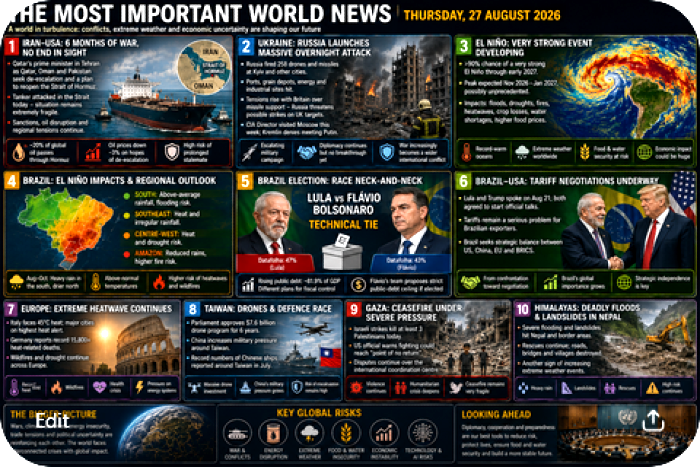
🌍 THE MOST IMPORTANT WORLD NEWS — THURSDAY, 27 AUGUST 2026
🔴 1. IRAN–USA: SIX MONTHS OF WAR — AND STILL NO END
The Iran conflict has now lasted six months and has settled into what Reuters describes as a costly stalemate. The fighting has disrupted the Strait of Hormuz, global oil supplies and regional security, while the United States is increasingly relying on economic pressure and sanctions.
There is nevertheless a diplomatic opening today. Qatar's prime minister is in Tehran, while Qatar, Oman and Pakistan are attempting to find a way to de-escalate the war and restore safer commercial passage through Hormuz.
But a tanker was attacked in the Strait today, showing how fragile the situation remains.
My assessment: 🟥 Still the world's most dangerous geopolitical crisis.
🇺🇦 2. UKRAINE: RUSSIA LAUNCHES ANOTHER MASSIVE ATTACK
Russia launched a major overnight missile-and-drone assault on Kyiv and other Ukrainian cities, hitting ports, grain depots, energy facilities, industrial sites and other infrastructure. Ukraine reported 258 drones, together with ballistic and other missiles.
Ukraine says it intercepted most of the drones, but casualties and damage were reported, including in Kyiv and Kharkiv.
At the same time, tensions with Britain have increased. Moscow has threatened possible strikes against British military targets over British and French assistance with Ukrainian long-range missile technology.
The worrying development
The war is increasingly becoming a conflict involving:
Russia + Ukraine + Europe + United States
rather than simply Russia and Ukraine.
🌡️ 3. EL NIÑO — THE BIGGEST GLOBAL WEATHER STORY
The developing very strong El Niño remains one of the most important stories of 2026.
The Brazilian INPE/CEMADEN assessment gives 100% probability that El Niño will persist at least into early 2027, with a high probability of a very strong event during spring and summer.
International climate analysts now warn that this could become an exceptionally strong, potentially unprecedented event, peaking approximately November 2026–January 2027.
The consequences could include:
- 🌧️ extreme rainfall and floods
- 🔥 drought and wildfires
- 🌡️ exceptional heat
- 🌾 crop losses
- 💧 water shortages
- 🐟 disruption of fisheries
- 💰 higher food prices
This is why I consider El Niño much more than simply a weather story.
🇧🇷 4. BRAZIL: EL NIÑO DESERVES PARTICULAR ATTENTION
The latest Brazilian assessment says the August–October pattern should generally bring above-average rainfall in parts of southern Brazil, while central and northern areas have a greater tendency toward below-average rainfall. Temperatures are expected to be above average in many areas, increasing heatwave and wildfire risks.
🇧🇷 The likely regional pattern
South: 🌧️ excess rain and flooding risk
Southeast: 🌡️ heat + irregular rainfall
Centre-West: 🔥 heat/dryness risk
Amazon: 🔥 reduced rainfall and fire risk
For Ubatuba, I would not say El Niño automatically means a wetter season.
The special danger is when:
warm Atlantic moisture + cold front + Serra do Mar + El Niño background conditions
come together.
That can produce very heavy local rainfall in only 24–48 hours, even if the monthly rainfall average looks normal.
🇧🇷 5. BRAZIL'S ELECTION: THE RACE IS GETTING VERY CLOSE
Brazil's October presidential election is becoming increasingly competitive.
Recent polls have shown Lula and Flávio Bolsonaro extremely close in a potential second round. One Nexus/BTG survey reported a technical tie, while a Datafolha poll shortly beforehand gave Lula a narrow 47%–43% advantage.
The economic debate is becoming just as important as the ideological one.
Brazil's public debt has risen to around 81.9% of GDP, and both leading camps are proposing different approaches to fiscal control and long-term interest rates.
Flávio Bolsonaro's economic advisers are now proposing a stricter public-debt ceiling if he wins.
My assessment:
🇧🇷 Brazil's election is now an important international economic story, not merely a domestic political contest.
🇧🇷🇺🇸 6. LULA–TRUMP: TRADE NEGOTIATIONS
The tariff dispute between Brazil and the United States remains unresolved.
Lula and Trump spoke by telephone on 21 August and agreed to move toward direct discussions between their officials.
The two governments are therefore moving from confrontation toward negotiation, but the tariffs themselves remain a serious problem for Brazilian exporters.
This is particularly important because Brazil is simultaneously trying to maintain strong relationships with:
🇺🇸 United States
🇨🇳 China
🇪🇺 European Union
🌎 BRICS
Brazil is increasingly trying to maintain strategic independence between the major power blocs.
🇮🇹🔥 7. EUROPE: ANOTHER EXTREME HEATWAVE
Europe's extraordinary summer continues.
Italy is now facing its most intense heatwave of the summer, with temperatures forecast to reach approximately 45°C in parts of the country. Major Italian cities have been placed under the highest heat alerts.
Germany has also reported an extraordinary number of heat-related deaths during the summer.
The continuing combination of:
heat → drought → dry vegetation → wildfire
is putting enormous pressure on European agriculture, water supplies, electricity systems and health services.
🇹🇼🇨🇳 8. TAIWAN: DRONE WARFARE BECOMES A CENTRAL ISSUE
Taiwan's parliament has rejected the government's original US$6.6 billion special military drone budget, but approved an alternative six-year package worth about US$7.6 billion, funded through the regular budget.
The argument is directly influenced by what has happened in Ukraine and the Iran conflict.
Taiwan wants to develop a huge domestic drone capability because drones could become crucial in a blockade or invasion scenario.
Meanwhile, China is increasing maritime pressure around Taiwan. Taiwan reported a record number of Chinese ships around its waters during July.
The Taiwan Strait remains one of the world's most dangerous potential flashpoints.
🇵🇸 9. GAZA: CEASEFIRE UNDER SEVERE PRESSURE
The Gaza ceasefire remains fragile.
Israeli strikes killed at least three Palestinians today, according to Palestinian health officials cited by Reuters.
Meanwhile, a senior US Gaza official has warned that continued fighting could reach a "point of no return" for the peace process.
There are also disagreements over the international coordination centre established to support the post-war Gaza arrangements.
The basic problem remains:
Israel wants Hamas disarmed.
Hamas demands an Israeli withdrawal.
The ceasefire therefore remains extremely vulnerable.
🌏 10. HIMALAYAS: EXTREME FLOODS AND LANDSLIDES
A major weather disaster is unfolding in the Himalayan region.
Severe flooding and landslides have struck Nepal, including the Nepal–China border area. Reuters reported dramatic footage of a survivor being rescued from a mudslide by a digger.
This is another reminder that extreme rainfall and flooding are becoming an increasingly important global news story, alongside heat and wildfire.
💰 11. FOOD PRICES: WEATHER + WAR BEGIN TO MEET
Global food markets are increasingly being affected by two forces simultaneously:
⚔️ WAR
Iran and Ukraine disrupt energy, transport and agricultural trade.
🌡️ WEATHER
El Niño threatens crops and water supplies.
Recent reports already show global food prices at their highest level in several years, while analysts warn of another period of food inflation.
For Brazil this matters enormously because the country is one of the world's largest exporters of:
soybeans • coffee • sugar • maize • meat • orange juice
So Brazil could be both affected by El Niño and increasingly important to world food security.
🌍 THE BIGGER PICTURE — 27 AUGUST
The most important thing about today's news is how interconnected the crises have become:
⚔️ WAR
Iran + Ukraine + Gaza
⬇️
⛽ ENERGY
Hormuz + oil + shipping
⬇️
🌡️ CLIMATE
El Niño + heat + floods + fires
⬇️
🌾 FOOD
Brazil + global agriculture
⬇️
💰 ECONOMY
Tariffs + inflation + debt
⬇️
🤖 TECHNOLOGY
AI + drones + modern warfare
⭐ MY TOP 10 — THURSDAY 27 AUGUST
| Rank | Story | Importance |
|---|---|---|
| 🥇 | 🇮🇷 Iran / Hormuz / diplomatic efforts | 🔴 CRITICAL |
| 🥈 | 🇺🇦 Russia's massive attack on Ukraine | 🔴 CRITICAL |
| 🥉 | 🌡️ Very strong El Niño | 🔴 CRITICAL |
| 4 | 🇧🇷 Brazil election — Lula vs Flávio Bolsonaro | 🔴 Very high |
| 5 | 🇧🇷🇺🇸 Brazil–US tariff negotiations | 🔴 Very high |
| 6 | 🇪🇺🔥 European extreme heat | 🔴 Very high |
| 7 | 🇹🇼🇨🇳 Taiwan–China / drone race | 🟠 High |
| 8 | 🇵🇸 Gaza ceasefire under pressure | 🟠 High |
| 9 | 🌧️ Himalayan floods and landslides | 🟠 High |
| 10 | 🌾 Global food-price risk | 🟠 High |
🔎 THE THREE STORIES I WOULD WATCH MOST CLOSELY
1. IRAN / HORMUZ: Today's diplomatic activity by Qatar, Oman and Pakistan could provide the first meaningful route out of the six-month conflict — but the tanker attack demonstrates how fragile it remains.
2. UKRAINE: The massive Russian attack today shows that, despite diplomacy, the war is still escalating militarily.
3. EL NIÑO: For Brazil, this is the story to watch over the coming months. The official Brazilian outlook confirms persistence into 2027 and a high probability of very strong intensity.
For Ubatuba specifically, I would continue watching short-term rainfall forecasts rather than assuming El Niño means continuous rain. The real flood danger comes when the El Niño background combines with Atlantic moisture and a Serra do Mar weather system.