AI CHAT WORLD NEWS 26/08/2026
By AI Chat - T.Chr.-Human Synthesis-26 August 2026
🌍 THE MOST IMPORTANT WORLD NEWS — WEDNESDAY, 26 AUGUST 2026
🔴 1. IRAN–USA: A POSSIBLE OPENING IN THE HORMUZ CRISIS
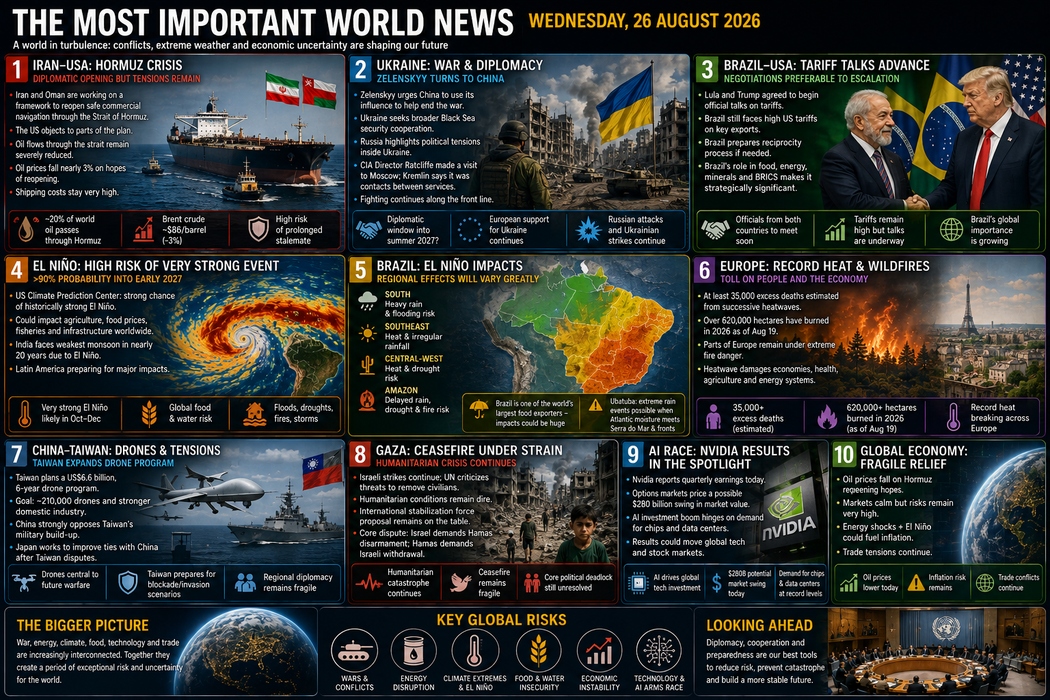
The biggest development today is that Iran and Oman are working on a proposed framework to reopen safe commercial navigation through the Strait of Hormuz. Iran says the proposed arrangement would exclude military vessels and would use a jointly managed corridor through Iranian and Omani waters. The US is objecting to parts of the arrangement.
This is significant because Hormuz normally carries roughly one-fifth of globally traded oil, but traffic remains severely depressed. Markets are reacting positively to the possibility of reopening: Brent crude fell nearly 3% today to about $86 a barrel.
However, this is not yet a peace agreement. The shipping industry is warning that the Iran war could become a prolonged stalemate and that shipping costs remain exceptionally high.
Today's assessment: 🟠 A diplomatic opening, but still a very dangerous situation.
🇺🇦 2. UKRAINE: ZELENSKYY TURNS TO CHINA
Ukraine remains locked in war with Russia, but Kyiv is now appealing directly to China's diplomatic influence.
Zelenskyy has urged Beijing to use its influence to help end the Russian war. Ukraine is also seeking broader Black Sea security cooperation.
Meanwhile, the Kremlin is highlighting political tensions inside Ukraine after former defence minister Mykhailo Fedorov told Reuters that Ukraine is gradually losing the war and needs urgent strategic changes. Kyiv has pushed back, noting that Fedorov was removed from office.
There is also an intriguing development in Washington–Moscow contacts: CIA Director John Ratcliffe recently visited Moscow, although the Kremlin denies that he personally met Putin and says the visit involved contacts between security services.
The question now
Can the combination of Trump diplomacy + Chinese influence + European military support produce an actual ceasefire?
At present, there is still no breakthrough.
🇧🇷🇺🇸 3. BRAZIL–USA: TARIFF NEGOTIATIONS MOVE FORWARD
The Lula–Trump confrontation remains extremely important for Brazil.
After their telephone conversation on 21 August, Brazilian and US officials are preparing to meet to discuss the tariffs. The two presidents agreed that negotiations were preferable to further escalation.
The dispute is far from resolved.
Brazil is still facing substantial US tariffs, while Brasília has prepared its own reciprocity process.
Why this matters beyond Brazil
Brazil is simultaneously:
- a major food exporter;
- a major oil producer;
- rich in critical minerals;
- a BRICS member;
- increasingly important to China;
- and strategically important to Washington.
So this is becoming part of the much larger US–China–BRICS struggle for influence.
🌡️🌎 4. EL NIÑO — NOW ONE OF THE WORLD'S BIGGEST STORIES
This is the story I would watch very closely.
The US Climate Prediction Center says there is more than a 90% probability of a very strong El Niño during the Northern Hemisphere autumn/winter. It estimates a 69% chance that October–December will produce a historically strong event, exceeding previous El Niños in the modern record.
Reuters reports that the event could produce enormous economic effects, with consequences for agriculture, food prices, fisheries and infrastructure around the world.
India is already experiencing the effects: its 2026 monsoon is on course to be its weakest in nearly two decades, with rainfall expected to finish about 15% below the long-term average.
This is no longer just a weather story.
It is becoming a:
🌾 food story
💧 water story
🔥 wildfire story
💰 inflation story
🌎 global economic story.
🇧🇷🌧️ 5. BRAZIL — EL NIÑO COULD BE A MAJOR PROBLEM
Brazil is unusually important in this year's El Niño because it is one of the world's largest agricultural exporters.
The developing event could affect:
soybeans → maize → coffee → sugar → livestock → transport → electricity.
Reuters says Latin America is preparing for what experts believe could become one of the strongest El Niños on record.
The effects will vary dramatically by region.
🇧🇷 South
🌧️ Greater risk of excessive rainfall and flooding
🇧🇷 Southeast
🌡️ Heat + irregular rainfall
🇧🇷 Central-West
🔥 Heat/drought risk
🌳 Amazon
🔥 Delayed rainfall + drought + fire risk
And this is where Ubatuba is particularly interesting.
The national El Niño signal does not mean Ubatuba will simply become wetter.
Ubatuba's flood risk depends heavily on the interaction between:
El Niño + warm Atlantic Ocean + cold fronts + Serra do Mar + enormous atmospheric moisture.
That combination can produce very intense local rainfall even if São Paulo's monthly rainfall is near normal.
For Ubatuba, therefore, I would continue watching 24–72-hour accumulated rainfall, rather than relying on the seasonal El Niño forecast.
🇪🇺🔥 6. EUROPE — EXTREME HEAT CONTINUES
Europe's extraordinary summer remains one of the world's major climate stories.
NASA reports that the 2026 heatwaves have been breaking records across Europe.
The EU's wildfire monitoring system shows that by 19 August the area burned by fires had already exceeded 620,000 hectares, substantially above the long-term average. Parts of Romania, Hungary, the Balkans, Italy, Ukraine and Russia remain under very high or extreme fire danger.
A recent estimate put excess deaths from Europe's successive heatwaves at at least 35,000, though the figure is provisional and incomplete.
This is becoming a major economic issue as well as a climate issue.
🇨🇳🇹🇼 7. CHINA–TAIWAN: DRONES BECOME THE NEXT BIG BATTLE
Taiwan's president Lai Ching-te is pushing a US$6.6 billion six-year military drone programme.
The proposed package would acquire around 210,000 drones and strengthen Taiwan's domestic drone industry. Lai argues that lessons from Ukraine and the Middle East demonstrate how important drones have become in modern warfare.
China strongly opposes the programme, viewing Taiwan's military expansion as another step toward independence.
At the same time, Japan is trying to repair its increasingly strained relationship with Beijing following disputes over Taiwan.
The important development
Taiwan is preparing not merely for conventional war but for a possible drone-heavy blockade/invasion scenario.
That makes the Ukraine war increasingly relevant to the Taiwan Strait.
🇵🇸 8. GAZA — THE CEASEFIRE REMAINS FRAGILE
The Gaza ceasefire is under considerable strain.
Israeli strikes continue despite diplomatic efforts, and the UN has criticized Israeli threats involving the forced removal of Palestinian civilians.
The proposed international stabilization force remains part of the broader US-backed settlement plan, but the fundamental disagreement remains:
Israel demands Hamas disarmament.
Hamas demands an Israeli withdrawal.
Until that sequencing problem is resolved, the ceasefire remains vulnerable.
🤖 9. AI — NVIDIA COULD MOVE THE GLOBAL TECHNOLOGY MARKET
A very different story is dominating financial markets today.
NVIDIA is due to report its quarterly results after the US market closes.
Investors are treating the report as a major test of whether the enormous global AI investment boom can continue.
Options markets are pricing a possible US$280 billion change in Nvidia's market value following the results.
This matters because AI investment has become one of the strongest forces in the global economy.
The result could influence:
semiconductors → data centres → electricity demand → technology stocks → global investment.
💰 10. GLOBAL ECONOMY — OIL FALLS, MARKETS BREATHE A LITTLE
World markets are somewhat calmer today.
Oil has fallen sharply because investors see a possibility of reopening Hormuz. European shares are broadly stable, while investors await US inflation data and Nvidia's results.
But there is still a major underlying risk:
Iran war + oil disruption + El Niño + food inflation
could reinforce each other.
One recent analysis estimates that a combination of a strong El Niño and an energy shock could add roughly 0.3 percentage points to global inflation.
🌍 THE BIGGER PICTURE — 26 AUGUST
The world's major problems are increasingly interconnected:
⚔️ WAR
Iran + Ukraine
⬇️
⛽ ENERGY
Hormuz + oil + shipping
⬇️
🌡️ CLIMATE
El Niño + extreme heat + floods + drought
⬇️
🌾 FOOD
Brazil + India + global agriculture
⬇️
💰 ECONOMY
Inflation + tariffs + trade fragmentation
⬇️
🤖 TECHNOLOGY
AI + drones + semiconductors
⭐ MY TOP 10 — 26 AUGUST 2026
| Rank | Story | Importance |
|---|---|---|
| 🥇 | 🇮🇷🇺🇸 Iran / Hormuz / possible reopening | 🔴 CRITICAL |
| 🥈 | 🇺🇦🇷🇺 Ukraine / diplomacy & Russian war | 🔴 CRITICAL |
| 🥉 | 🌡️ Super El Niño / extreme weather | 🔴 CRITICAL |
| 4 | 🇧🇷🇺🇸 Brazil–US tariff negotiations | 🔴 Very high |
| 5 | 🇪🇺🔥 European heat & wildfires | 🔴 Very high |
| 6 | 🇨🇳🇹🇼 Taiwan drones / China tensions | 🟠 High |
| 7 | 🇵🇸 Gaza ceasefire under strain | 🟠 High |
| 8 | 🤖 Nvidia / global AI investment | 🟠 High |
| 9 | 🌾 Global food-security risks | 🟠 High |
| 10 | 💰 Inflation / energy / trade fragmentation | 🟠 High |
🔎 THE THREE I WOULD WATCH MOST CLOSELY
1. HORMUZ — The Iran–Oman navigation proposal is the first genuinely encouraging development in the crisis, but the US and Iran still disagree over the arrangements.
2. EL NIÑO — This is rapidly becoming the year's biggest non-war risk. The possibility of a historically strong event is now high enough that Brazil, India and other major agricultural producers need to prepare seriously.
3. UKRAINE — The combination of battlefield pressure, new Ukrainian leadership and increasingly complicated US/European/Chinese diplomacy makes the next few months particularly important.
For Brazil — and especially Ubatuba — I would put El Niño at the top of the weather watchlist from September through December. The important question is not simply "Will Ubatuba be wetter?" but whether El Niño creates more occasions when Atlantic moisture, cold fronts and the Serra do Mar combine to produce extreme rainfall.