THE MOST IMPORTANT WORLD NEWS — MONDAY, 24 AUGUST 2026

AI Chat News - Human Synthesis-24 August 2026
MOST IMPORTANT WORLD NEWS
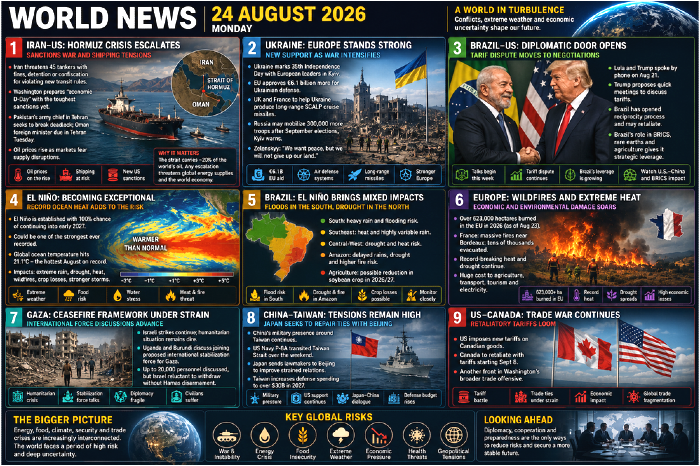
🔴 1. IRAN–USA: THE HORMUZ CRISIS IS STILL NUMBER ONE
The confrontation over Iran and the Strait of Hormuz remains the world's most immediate geopolitical and economic danger.
Today Iran has threatened 45 oil tankers with fines, detention or confiscation for violating its new transit rules. The strait carries a huge proportion of global energy shipments, so further disruption could push oil and shipping costs considerably higher.
At the same time, Washington is preparing what Treasury Secretary Scott Bessent calls an "economic D-Day" against Iran — an extensive new sanctions campaign designed to isolate Tehran financially. Iran says it will retaliate against countries that cooperate with the sanctions.
There is, however, still a diplomatic channel.
Pakistan's army chief is in Tehran, attempting to help break the deadlock, while Oman's foreign minister is due in Tehran Tuesday for further discussions over Hormuz.
My assessment:
The situation has become an economic war as much as a military confrontation. If Hormuz remains seriously restricted, the consequences will reach almost every economy.
🇺🇦 2. UKRAINE: EUROPE MOVES TO STRENGTHEN UKRAINE
Today is Ukraine's 35th Independence Day, and Kyiv has become the centre of a major European show of support.
President Zelenskyy is meeting European leaders including Britain's Andy Burnham, France's Emmanuel Macron and Germany's Friedrich Merz.
The EU has approved another €6.1 billion for Ukrainian defence, including air-defence systems, missiles, ammunition and radar.
Britain is taking an important further step: it will provide Ukraine with classified technical information needed to help manufacture SCALP long-range cruise missiles domestically, together with France. Moscow says this is an escalation and threatens to target Ukrainian missile-production facilities.
Zelenskyy says Ukraine wants peace but will not surrender territory simply to obtain it.
Why this matters
The war is becoming increasingly tied to European defence policy itself.
Europe is preparing for the possibility that the conflict — and the Russian threat — will continue for years.
🇷🇺 3. RUSSIA: A POSSIBLE NEW MOBILISATION
One of the most worrying claims coming from Kyiv is that Russia may seek to mobilise another 300,000 troops after its September elections.
Ukraine also says Russia is increasing missile production.
These are Ukrainian intelligence assessments rather than independently confirmed Russian plans, so they should be treated cautiously.
But they fit the broader picture: Russia continues trying to improve its military position while Ukraine is attempting to increase its long-range strike capability.
The danger
The war could therefore become larger rather than smaller in 2027, despite continuing diplomatic discussions.
🇧🇷🇺🇸 4. BRAZIL–USA: A SMALL BUT IMPORTANT THAW
There is some good news for Brazil.
After months of confrontation over US tariffs, Lula and Trump spoke by telephone on 21 August, and Trump proposed that officials from both countries meet quickly to discuss the tariff dispute.
That means the situation has shifted from:
tariffs → retaliation → confrontation
toward:
tariffs → negotiation.
There is no settlement yet.
The US tariffs remain a serious problem for Brazilian exporters, and Brazil has already begun its legal process for possible reciprocal measures.
Why Brazil is becoming strategically important
Brazil possesses something Washington increasingly wants:
agriculture + oil + minerals + rare earths + enormous territory + BRICS membership.
That gives Brasília considerable negotiating leverage.
🌡️ 5. EL NIÑO: THIS IS BECOMING A VERY BIG STORY
This may ultimately be the most important non-war story of 2026.
The developing El Niño is strengthening rapidly and is expected to peak around November 2026–January 2027. Some current projections describe an event that could be unprecedented in the modern record.
And there is another remarkable development today:
🌊 The world's oceans have reached their hottest August level ever recorded
Global ocean surface temperature has reached approximately 21.1°C, according to current climate monitoring, with El Niño adding to the long-term warming trend.
This matters because very warm oceans provide additional energy and moisture to the atmosphere.
Potential consequences include:
- 🌧️ extreme rainfall
- 🔥 drought and wildfire
- 🌡️ record heat
- 🌾 agricultural losses
- 🌊 coastal impacts
- 🌀 stronger storms in some regions
🇧🇷🌧️ 6. BRAZIL: EL NIÑO COULD BECOME A MAJOR AGRICULTURAL PROBLEM
This is particularly important for Brazil.
Current analysis indicates that El Niño could reduce Brazil's 2026/27 soybean crop, despite increased planting, because of weather disruption.
The effects will not be uniform.
Possible Brazilian pattern:
South: 🌧️ excessive rainfall / flooding
Southeast: 🌡️ heat + highly variable rainfall
Central Brazil: 🌡️ drought/heat risk
Amazon: 🔥 delayed rainfall + drought + fire
The Amazon is particularly concerning because the latest projections suggest El Niño could delay the Amazon rainy season, increasing drought stress.
🌊 7. UBATUBA — WHAT I'D WATCH
Since you are interested specifically in Ubatuba, I would not translate "strong El Niño" directly into "Ubatuba will have continuous rain."
The important question is whether El Niño interacts with:
warm Atlantic water + moisture + Serra do Mar + cold fronts.
That combination can produce very intense local rainfall even when the broader Southeast forecast isn't particularly wet.
So for Ubatuba I would continue watching:
September
🟡 Moderate concern
October
🟠 Increasing concern
November–December
🟠🔴 Greater potential for intense rainfall events
The danger is primarily short, extreme rainfall episodes, rather than simply a wet season.
🇪🇺🔥 8. EUROPE: EXTREME WEATHER IS NOW AN ECONOMIC STORY
Europe's extraordinary summer continues.
The EU's Joint Research Centre reports that by 23 August, approximately 623,470 hectares had burned in EU wildfires this year.
Meanwhile NASA reports that Europe's 2026 heatwaves are breaking records and causing major environmental damage.
The combination is especially dangerous:
heat → drought → dry vegetation → wildfire → smoke → agricultural losses.
The economic consequences are becoming substantial, affecting agriculture, tourism, transport, insurance and electricity.
🇵🇸 9. GAZA: CEASEFIRE ARRANGEMENT UNDER STRAIN
Fighting continues despite the diplomatic framework.
Israeli strikes have continued to cause Palestinian casualties, while humanitarian conditions remain extremely difficult.
An interesting development today is that Uganda and Burundi are discussing participation in a proposed international stabilization force for Gaza. Uganda has reportedly committed about 1,200 troops.
The proposed international force could eventually number around 20,000 personnel, but Israel remains reluctant to withdraw unless Hamas completely disarms.
So the central problem remains unresolved.
🇨🇳🇹🇼 10. CHINA–TAIWAN: TENSIONS REMAIN HIGH
China's military and maritime presence around Taiwan continues to be described as increasingly routine.
At the same time, Japan is trying to repair its relationship with Beijing after tensions over Japanese Prime Minister Sanae Takaichi's comments about a possible Chinese attack on Taiwan. Japanese lawmakers are visiting Beijing today to reopen dialogue.
This is significant.
Japan, China and Taiwan are becoming increasingly intertwined in the broader security competition between China and the United States.
🇨🇦🇺🇸 11. USA–CANADA: TRADE WAR CONTINUES
The US trade offensive is not confined to Brazil.
Canada is preparing retaliatory tariffs beginning 8 September after Washington imposed new tariffs on Canadian goods.
This matters because the world's largest economy is increasingly using tariffs as a foreign-policy weapon.
The consequences are being felt through:
Canada → Brazil → China → Europe → global trade.
🌍 12. THE BIGGER STORY: ENERGY + FOOD + WEATHER
There is a common thread running through today's headlines.
⛽ HORMUZ
Threatens energy supplies
🌾 EL NIÑO
Threatens food production
🔥 EUROPE
Threatens agriculture and infrastructure
🇧🇷 BRAZIL
Sits at the intersection of food + energy + minerals + climate
🇺🇦 UKRAINE
Threatens European security and food exports
🇹🇼 TAIWAN
Threatens semiconductor supplies
This is why I think 2026 is becoming a year of interconnected crises rather than isolated crises.
⭐ MY TOP 10 — 24 AUGUST 2026
| Rank | Story | Importance |
|---|---|---|
| 🥇 | 🇮🇷🇺🇸 Iran / Hormuz / economic war | 🔴 Critical |
| 🥈 | 🇺🇦🇷🇺 Ukraine / European military escalation | 🔴 Critical |
| 🥉 | 🌡️🌊 Exceptional El Niño + record ocean heat | 🔴 Critical |
| 4 | 🇧🇷🇺🇸 Lula–Trump tariff negotiations | 🔴 Very high |
| 5 | 🇪🇺🔥 European heat & wildfires | 🔴 Very high |
| 6 | 🇵🇸🇮🇱 Gaza / proposed international force | 🟠 High |
| 7 | 🇨🇳🇹🇼 China–Taiwan / Japan tensions | 🟠 High |
| 8 | 🇺🇸🇨🇦 US–Canada trade conflict | 🟠 High |
| 9 | 🌾 Global food-price risk | 🟠 High |
| 10 | 🌍 Global economic fragmentation | 🟠 High |
🔴 THE THREE I WOULD WATCH TONIGHT
1. HORMUZ: Iran's blacklisting of 45 tankers and Washington's threatened new sanctions could turn the energy crisis into something much larger.
2. UKRAINE: Europe is now openly increasing military assistance while Russia threatens retaliation. The possibility of a prolonged or expanded war is becoming more serious.
3. EL NIÑO: This is the one I would not underestimate. The combination of an exceptionally strong El Niño and record-warm oceans could affect food, water, fires and extreme weather worldwide — including Brazil and potentially Ubatuba later this year.
For Brazil, the most important combination is now clearly: 🇧🇷 EL NIÑO + agriculture + Amazon + US trade negotiations.