AI CHAT LATEST WORLD NEWS 23/08/2026

By AI Chat-Human Synthesis-23 August 2026
LATEST IMPORTANT WORLD NEWS 23 AUGUST 2026
Executive Summary
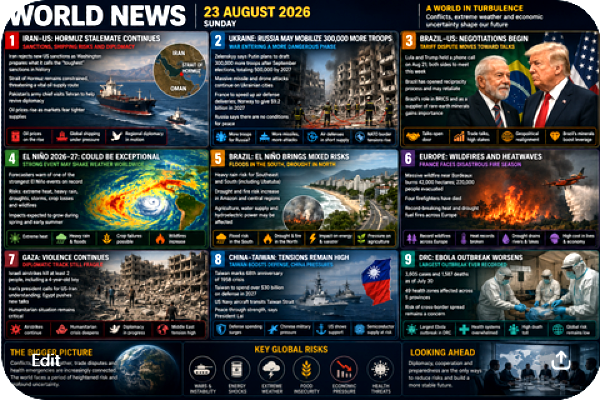
The international picture remains dominated by conflict, economic pressure and geopolitical realignment. The most consequential developments are the continuing U.S.-Iran confrontation, persistent violence and stalled diplomacy in Gaza, the Russia-Ukraine war, heightened U.S.-China/Taiwan tensions, and worsening humanitarian emergencies in parts of Africa.
At the same time, geopolitical tensions are increasingly affecting the global economy. Oil supplies and shipping routes remain vulnerable to disruption, while tariffs and trade retaliation are adding pressure to international markets. Global stocks have faced a difficult period as investors assess high energy prices, bond-market volatility and the possibility of persistent inflation.
1. Middle East: U.S.-Iran Confrontation Remains the Biggest Global Risk
Iran has rejected new U.S. threats of extremely severe economic sanctions, while Washington is seeking to increase economic pressure on Tehran. The confrontation follows months of military conflict and has already caused major damage to Iran's economy and infrastructure.
A major concern is the Strait of Hormuz, one of the world's most important energy routes. Restrictions affecting the waterway have contributed to higher oil prices and increased concern about global energy supplies. Iran has warned neighboring countries against cooperating with U.S. economic measures and has threatened retaliation.
Pakistan's army chief, General Asim Munir, is scheduled to visit Tehran as part of diplomatic efforts aimed at improving regional security and potentially helping open a path toward negotiations.
Why it matters: A prolonged conflict involving Iran could affect oil prices, shipping, inflation and economic growth well beyond the Middle East.
2. Gaza: Ceasefire Under Severe Strain
Violence continues in Gaza despite the U.S.-backed ceasefire framework. Israeli strikes on 23 August killed at least two Palestinians, including a four-year-old child, according to Palestinian medical officials cited by Reuters. Israel said the strikes were aimed at Hamas infrastructure following reported launches from Gaza.
Diplomatic efforts remain stalled. The U.S. has committed more than $206 million toward a proposed International Stabilization Force for Gaza, but fundamental disagreements remain over Hamas disarmament and Israeli military withdrawal.
The humanitarian situation remains extremely serious, with large numbers of displaced Palestinians facing shortages of food, shelter and medical care.
Why it matters: Gaza remains a central source of regional instability and a major test of U.S. diplomacy, Israeli policy and international humanitarian cooperation.
3. Russia–Ukraine War: No Clear End to the Conflict
Ukraine continues to face Russian military pressure while questions over the country's political future during wartime have become more prominent.
President Volodymyr Zelenskyy has warned that holding elections while the war continues could divide and weaken Ukraine. Ukrainian law currently prohibits national elections under martial law, while security, displacement and voting logistics present additional obstacles.
European governments continue to provide financial support. Norway announced plans for approximately 85 billion Norwegian kroner ($9.2 billion) in additional support for Ukraine in 2027.
Why it matters: The war remains the principal security crisis in Europe and continues to shape European defense spending, relations with Russia and transatlantic policy.
4. U.S.–China Rivalry and Taiwan
Tensions between Washington and Beijing remain significant, particularly over Taiwan.
A U.S. Navy surveillance aircraft transited the Taiwan Strait on 21 August, a move Washington described as supporting freedom of navigation. China monitored the aircraft and maintains that the Taiwan Strait is subject to Chinese sovereignty claims. The incident occurred ahead of an anticipated meeting between U.S. President Donald Trump and Chinese President Xi Jinping.
Taiwanese President Lai Ching-te has reaffirmed a policy of maintaining peace while strengthening Taiwan's defenses. Taiwan plans defense spending exceeding NT$1 trillion (about $30 billion) in 2027.
Why it matters: Any serious U.S.-China confrontation over Taiwan would have enormous consequences for global trade, technology supply chains and international security.
5. Global Economy: Oil, Tariffs and Market Pressure
The global economy is absorbing several simultaneous shocks.
Oil prices have risen as investors assess the effects of the U.S.-Iran confrontation and possible restrictions on crude supplies. Gulf stock markets recently benefited from higher oil prices, while global markets have experienced pressure from high energy costs and volatile bond markets.
Trade tensions are another source of uncertainty. The United States has imposed new tariffs on goods from dozens of trading partners, while Canada has announced retaliatory tariffs against selected U.S. products.
Key economic risks:
- Higher oil and transportation costs
- Renewed inflationary pressure
- Volatile bond and equity markets
- Increasing trade barriers
- Disruption to global supply chains
6. Africa: Sudan's Humanitarian Crisis Continues
Sudan remains one of the world's most serious humanitarian emergencies. Fighting between the Sudanese Armed Forces and the Rapid Support Forces continues, including renewed fighting around al-Obeid.
The conflict has contributed to mass displacement, food insecurity and the breakdown of health services. Funding shortages are also threatening humanitarian assistance elsewhere in the region; more than 650,000 refugees and asylum seekers in South Sudan have been warned that food assistance could be disrupted.
Why it matters: Sudan's war has consequences beyond its borders, including refugee flows, food insecurity and instability across northeastern Africa.
7. Democratic Republic of Congo: Ebola Emergency
The Democratic Republic of Congo is confronting a major Ebola outbreak. Reuters reported that the outbreak had caused more than 2,500 deaths, with the epidemic spreading across a large area of central Congo. Pope Leo has called for stronger international cooperation and greater involvement of local communities in prevention efforts.
Why it matters: The outbreak is placing additional pressure on already vulnerable health systems and demonstrates the continuing importance of international epidemic preparedness.
8. Europe: Political Shifts in Germany
Germany's far-right Alternative for Germany (AfD) is seeking a breakthrough in the upcoming Saxony-Anhalt state election, viewing a strong result as a possible step toward greater national political influence.
The development reflects a broader European political trend in which immigration, economic pressures, security concerns and dissatisfaction with established parties are reshaping electoral politics.
Why it matters: Germany is Europe's largest economy and a central political actor in the European Union. Major changes in its domestic politics could affect European migration, economic and security policy.
Global Risk Monitor
| Issue | Current significance | Near-term outlook |
|---|---|---|
| U.S.–Iran conflict | 🔴 Very High | Risk of prolonged economic and military confrontation |
| Gaza | 🔴 Very High | Ceasefire remains fragile; diplomacy stalled |
| Russia–Ukraine | 🔴 Very High | War continues; political and military pressure remains |
| U.S.–China/Taiwan | 🟠 High | Tensions remain elevated but major powers are still engaging diplomatically |
| Global energy prices | 🟠 High | Vulnerable to Middle East disruption |
| Global trade/tariffs | 🟠 High | Retaliatory measures threaten further fragmentation |
| Sudan | 🔴 Very High humanitarian risk | Fighting and aid shortages continue |
| DR Congo Ebola | 🔴 High humanitarian risk | International response urgently required |
| European politics | 🟠 Moderate–High | Far-right parties continue gaining political influence in some countries |
What to Watch Next
1. U.S.–Iran diplomacy
The key question is whether Pakistan and other intermediaries can help create a pathway toward negotiations and reduce pressure around the Strait of Hormuz.
2. Oil and shipping
Any further disruption to Middle Eastern energy exports could quickly affect fuel prices, inflation and global markets.
3. Gaza negotiations
The future of the proposed stabilization force, Hamas disarmament and Israeli withdrawal will determine whether the ceasefire framework can become a durable political settlement.
4. Ukraine
Military developments and discussions about elections will remain closely watched as Kyiv and its allies consider how to pursue an eventual end to the war.
5. U.S.–China relations
The anticipated Trump–Xi engagement will be important for Taiwan, trade, technology restrictions and broader strategic competition.
6. Humanitarian emergencies
Sudan, South Sudan and the Democratic Republic of Congo require sustained international attention despite competing crises elsewhere.
Bottom Line
The defining feature of the world situation on 23 August 2026 is the interaction between military conflict and economic pressure. Wars and geopolitical confrontations are no longer isolated regional events: they are affecting oil markets, trade, inflation, supply chains, migration and international diplomacy.
The most immediate global risk is the possibility that the U.S.–Iran confrontation expands or becomes a prolonged disruption to Middle Eastern energy and shipping. At the same time, Gaza and Ukraine remain unresolved conflicts, while tensions around Taiwan demonstrate that strategic competition among major powers continues.
For policymakers, businesses and the public, the central issues to monitor are therefore energy security, diplomatic negotiations, military escalation, trade policy and humanitarian conditions.
Sources and Editorial Note
This report was compiled from current international reporting available on 23 August 2026, with particular reliance on Reuters and Associated Press reporting for current-event verification.
Print note: For best results, print on A4 or Letter paper with standard margins. Headings and tables are structured for black-and-white printing as well as color.
For Ubatuba specifically, the El Niño situation is more interesting — and potentially more important — than the general Brazil forecast suggests.
🌊🌧️ El Niño 2026–27: what it could mean for Ubatuba
The latest Brazilian government assessment confirms that El Niño is established and has a >90% probability of continuing into early 2027, with a high probability of becoming a very strong event.
But there is an important distinction:
Ubatuba is NOT in the same situation as southern Brazil
The official forecast broadly points toward above-normal rainfall in southern Brazil but more variable conditions in the Southeast, including São Paulo. INPE specifically says the Southeast may experience higher temperatures and more frequent heatwaves, with some areas also having longer dry periods.
For Ubatuba, however, the Serra do Mar and the warm, humid Atlantic make the situation considerably more complicated.
🌧️ 1. Heavy rain remains the main Ubatuba danger
Ubatuba has a naturally very wet climate. Moisture from the Atlantic is forced upward when it encounters the Serra do Mar, producing persistent rainfall. The municipality's own 2026 technical report confirms this mechanism.
And there is already direct evidence of an El Niño contribution.
During the major February rainfall episode, Ubatuba recorded:
- 110 mm on 21 February
- 80 mm on 22 February
- 176 mm in 24 hours in northern Ubatuba on 26 February
The municipal technical report specifically concluded that El Niño helped intensify the transport of moisture into the region, increasing accumulated rainfall and the frequency of events along the northern São Paulo coast.
That's highly relevant to what you are asking.
⚠️ 2. The dangerous combination for Ubatuba
For the coming months, I would watch this combination:
El Niño
+
very warm Atlantic
+
high atmospheric humidity
+
Serra do Mar
+
cold fronts/cyclones moving up from the south
When those ingredients coincide, Ubatuba can get very large rainfall in a relatively short period.
And that is more important than whether the monthly average rainfall is above or below normal.
You can have a month that is relatively normal overall but still get one or two exceptionally destructive rainfall events.
Research specifically examining the São Paulo coast found that El Niño has historically been associated with a significant portion of the variability in extreme summer rainfall, although the relationship has become less predictable in recent years.
🌡️ 3. But Ubatuba may also get hotter
This is the other side of the story.
INPE expects above-normal temperatures across much of Southeast Brazil during the developing El Niño.
For Ubatuba that could mean:
hotter periods + very humid air → oppressive heat
followed by:
cold front → thunderstorms/heavy rain
So don't think of El Niño simply as "more rain in Ubatuba."
It's more accurately:
greater potential for unusual swings between hot/dry periods and intense rainfall events.
🌧️ 4. September–November 2026: the period I'd watch
This is where I would become particularly attentive.
INPE's meteorologist Gilvan Sampaio points out that the strongest El Niño impacts in southern Brazil tend to emerge during spring, beginning around September.
Ubatuba is farther north than the classic El Niño rainfall maximum in Rio Grande do Sul, so we should not automatically expect Ubatuba to become wetter than normal throughout spring.
Instead, the concern is individual extreme events.
My Ubatuba watchlist:
September
🌡️ warmer-than-normal periods
🌧️ sudden heavy rain with fronts
💨 stronger coastal winds possible
October
🌧️ increasing thunderstorm activity
⛈️ potential intense rainfall episodes
🌡️ hot/humid spells
November–December
🌧️🌧️ increasingly important rainfall risk as the normal wet season approaches
⛈️ thunderstorms
🌊 coastal flooding during heavy rain/high tides
⛰️ landslide/flash-flood risk in Serra do Mar
🏠 5. What this means practically in Ubatuba
For someone living here, I would pay less attention to the seasonal average and much more attention to warnings saying:
"50–100+ mm expected in 24 hours"
or
"persistent rainfall for 24–48 hours."
Those are the situations that can produce problems with:
- roads;
- drainage;
- streams;
- hillsides;
- fallen trees;
- electricity;
- local flooding.
The municipality has already demonstrated that its monitoring system is watching precisely these risks.
🌊 And one reassuring point
El Niño does NOT mean that Ubatuba is going to have continuous extreme rain.
In fact, the official Southeast forecast is much more uncertain than the forecast for southern Brazil.
So I would not predict:
"Ubatuba will have a very wet spring."
I would instead say:
Ubatuba has an elevated risk of unusual weather extremes during the developing El Niño, particularly when El Niño interacts with Atlantic moisture, cold fronts and the Serra do Mar.
That's a much safer and scientifically defensible conclusion.
🔴 My particular concern for Ubatuba
Heavy rainfall events rather than continuous rain.
The February experience is a very good example: 176 mm in 24 hours in northern Ubatuba. The municipality itself concluded that El Niño contributed to the enhanced moisture transport.
And because Ubatuba's normal rainfall is already high, an additional atmospheric "push" can make a major difference.
If you want, I can also do a specific Ubatuba El Niño forecast for September–December 2026, month by month — including rain, temperature, storms, wind and flood risk.
I checked the information specifically available as of 23 August 2026, including the latest official Brazilian El Niño bulletin and today's Ubatuba weather information.
What is confirmed as of 23 August
El Niño is definitely established. The latest INPE/INMET/CEMADEN bulletin confirms it and gives a 100% probability of persistence at least into early 2027. It also gives a high probability of a very strong El Niño during spring/early summer 2026.
International forecasters are now warning that it could become an exceptionally strong, potentially record-level event. That is a forecast, however — not yet a certainty.
For Brazil, the official August–October outlook is broadly wetter in parts of the South and drier in the centre/north, with above-normal temperatures and increased heat/fire risk.
Ubatuba is not currently forecast to be one of the main El Niño rainfall hotspots. That's an important correction to my earlier wording.
🌊 What about Ubatuba specifically?
The latest local information is actually more immediate than the El Niño signal.
Ubatuba's Defesa Civil reported that the recent cold front/cyclone produced strong winds along the Litoral Norte and warned that rainfall and accumulated rain could increase from Sunday 23 through Tuesday 25 August, with rough seas also remaining a concern.
And today's São Paulo forecast specifically has isolated rain in Ubatuba on Sunday 23 and Monday 24, with temperatures falling from about 24°C Sunday to 20°C Monday.
So, as of today (23 August):
The immediate Ubatuba risk is the current frontal/cyclonic weather system. The larger El Niño influence is something to watch increasingly from September onward.
One important correction about my earlier statement
I said that El Niño could mean "greater potential for unusual weather extremes" in Ubatuba. That's reasonable, but I made it sound more certain than the official forecast supports.
The official Brazilian forecast currently points most strongly toward excess rainfall in southern Brazil and below-normal rainfall in the centre-north. Ubatuba, in the Southeast, sits between those patterns.
However, Ubatuba has its own special geography: Atlantic moisture + Serra do Mar + cold fronts can produce very heavy local rainfall even when the broader Southeast forecast is not particularly wet.
So for Ubatuba, I would watch individual 24–48-hour rainfall forecasts rather than assume that El Niño means a generally wetter season.
And there is a useful real-world example: Ubatuba's municipal technical report found that during a major February rainfall event, El Niño contributed to enhanced moisture transport into the region.
Bottom line for 23 August:
🌡️ El Niño: strengthening and potentially exceptional.
🇧🇷 Brazil: major impacts increasingly expected from spring onward.
🌊 Ubatuba: no evidence yet that El Niño alone means a continuously wetter season.
⛈️ But heavy individual rain events remain the principal local concern.
🌬️ Right now, the immediate concern is the current frontal system and rough seas, not El Niño itself.