VIKING NAALBINDING

By FB - Human Synthesis-23 August 2026
The Vikings did not knit. This is one of those small corrections that changes how you see an entire civilization. Because when you picture a Norse household in winter, you probably imagine something recognizable: wool, needles, rhythm. The same basic craft your grandmother might have known. But knitting, as we understand it, did not exist in Scandinavia in the 10th century. What did exist was something older, stranger, and in some ways more demanding. It was called naalbinding.
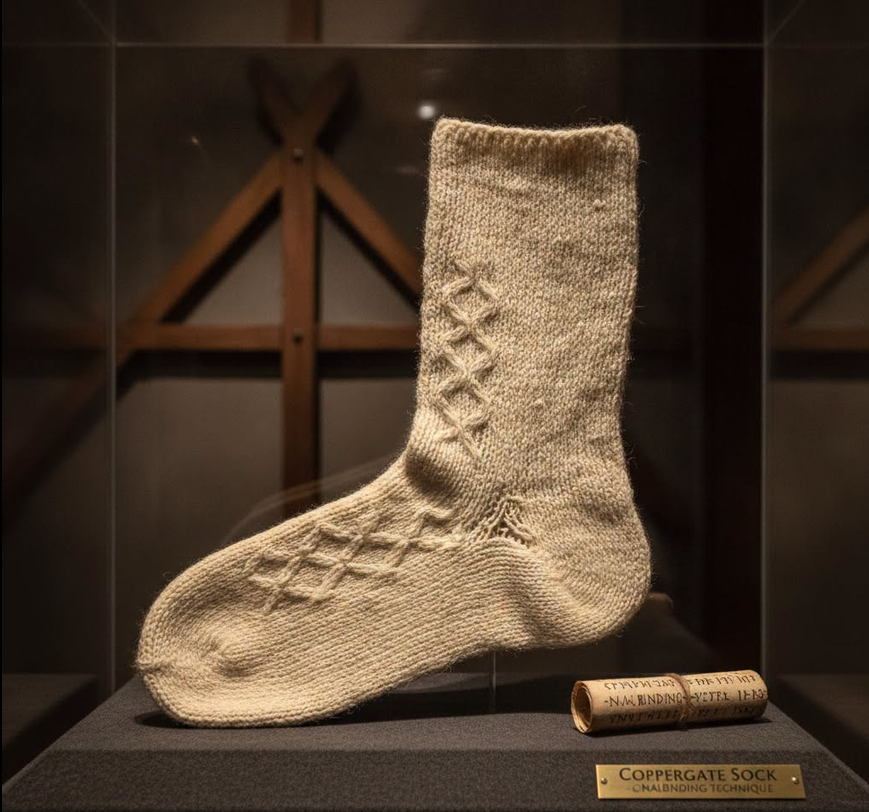
The technique uses a single needle and a short length of yarn. The loops are worked through each other with the thumb, building fabric stitch by stitch in a way that is structurally different from knitting at its core. The resulting textile is denser, more elastic, and harder to unravel. A dropped stitch in knitting can unravel a row. In naalbinding, it cannot. We know this is what the Norse wore because one example survived. Between 1976 and 1981, archaeologists excavating the Coppergate site in York, the city the Norse called Jorvik, recovered a single woollen sock from the 10th century.
Dated to somewhere between 930 and 975, it is one of the best-preserved textile finds from any Norse settlement in Britain. The sock is small. Made for one foot. Worked in a pattern now called the York stitch, a specific naalbinding variation identifiable by the way each loop is anchored. It was not decorative. It was not ceremonial. It was someone's everyday sock, pulled on in the dark of a York winter and eventually lost to the ground beneath what is now a busy shopping street. The Coppergate sock sits today in the collections at JORVIK Viking Centre in York. It is not glamorous to look at. Wool, roughly foot-shaped, worn at the heel.
But it carries something that a sword or a helmet cannot: the domestic texture of a life. ,Someone made this. Someone sat in firelight and worked a needle through loops of wool, building something useful against the cold. The technique they used was already ancient when they used it, and it was skilled work. The popular image of Vikings tends toward the dramatic. Longships, raids, runes carved in stone. But the Coppergate sock is also Viking. And what it suggests is a culture that valued craft, that understood textiles at a technical level most modern hobbyists would find genuinely challenging, and that left behind, in the mud of a York street, evidence of an ordinary winter day.
Naalbinding is still practiced today, mostly by textile historians and craft revival communities. If you have ever tried it, you know how counterintuitive it is at first. The technique does not have the meditative flow of knitting. It demands attention.Which is, perhaps, exactly the kind of attention a Norse household brought to surviving a northern winter.