GRØNTOFT FAMILY ROOTS

By AI Char.-Human Synthesis-21 August 2026
It is no more than forty years ago that Danish archaeologists learned how to locate and excavate prehistoric houses. Before that time, practically nothing was known about how people lived in prehistoric times.
Today, however, we know something about housing conditions and ways of life during several periods of antiquity. This applies particularly to the Early Iron Age, during which so many house sites have now been investigated that two basic types are beginning to emerge: the “normal farm” — the longhouse with living quarters at the western end and a stable at the eastern end — and the smaller house intended for people who did not keep livestock.
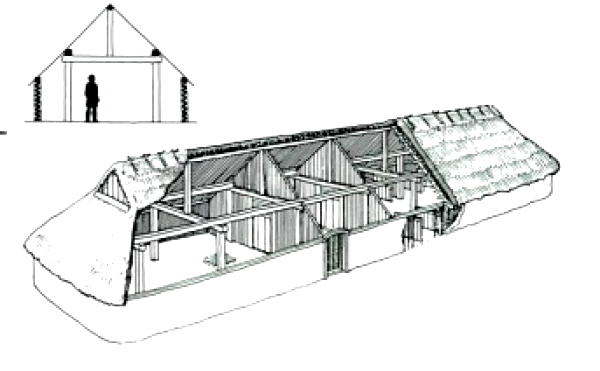
In most places, at least in Jutland, the houses were gathered together in villages, some of which remained inhabited for several hundred years. In certain cases, archaeologists have even found the associated fields, still recognizable because of the low earth banks enclosing them.
By C. J. Becker
On the whole, we now know quite a lot about the farming communities of the Iron Age. But, as often happens in such matters, the more our knowledge increases, the more questions arise. One of the problems is this: How large was such a village, and what did it actually look like?Only one village has so far been completely excavated — at Borremose in Himmerland — but it is uncertain how many of its more than twenty longhouses were in use at the same time, since the finds show that the houses are not all of the same age.
In every other case, excavations have revealed only fragments of village plans. Quite unexpectedly, the question of what a complete village plan looked like became relevant during an excavation carried out by the National Museum on the fields of the Grøntoft farm in Nørre Omme parish, halfway between Ringkøbing and Holstebro. If the excavation began somewhat by chance, this was certainly not because of any lack of goodwill or encouragement from the local community — and in any event, it was certainly not the fault of the late farmer, Valdemar Kristensen. Every winter, during the preceding years, the farmer had deep-ploughed one of his fields, and on more than one occasion pottery fragments and other prehistoric remains had been brought to the surface.
They were collected and surveyed by the tenant farmer, Jørgen Engestoft of Grønbjerg, and the finds were reported to the Ringkøbing Museum, which passed the information on to the National Museum. The first excavation took place in 1959, and it was followed by larger and smaller investigations in the years that followed.Initially, there was some hesitation about undertaking a large and expensive excavation because there was reason to believe that everything had been destroyed by the deep ploughing. On closer examination, however, it became clear that this was not the case. When the upper, disturbed layer of soil, 30–40 centimetres deep, was removed, an unexpected number of traces of postholes and wall trenches were found. These were sufficiently well preserved for the individual houses to be clearly identified.
The dark, humus-filled soil in the holes stood out clearly against the sand and gravel of the low hill on which the settlement had been established. It was not only the houses that revealed themselves in this way. A narrow ditch ran around the entire site. It could hardly have been anything other than the remains of a fence surrounding the village. This was discovered at an early stage of the excavation, and at the same time the age of the settlement was established. The ditch contained pottery fragments which showed that the entire settlement dated from approximately the 3rd century BC. Although the actual house remains — walls, floors and hearths — had been destroyed by agricultural activity, it was nevertheless possible to draw a complete plan of the village.
The enclosing fence had survived and held the whole picture together, revealing the size of the settlement: approximately 90 metres long and 25–30 metres wide. The village had not, however, always been the same size.The fence had several lines, showing that it had been moved from time to time. This had happened at least twice. The first time was after a fire which reduced almost all the village houses to ashes, and the second may have been for the same reason. On the final occasion, the enclosed area was somewhat reduced; the length of the enclosed settlement was then only 78 metres.
Source: C. J. Becker, “Grøntoft,” - Skalk 1964:3, - Fonden Skalk.