AI CHAT NEWS 12/08/2026
By AI Chat - Human Synthesis-12 August 2026
🌍 THE WORLD THIS MORNING
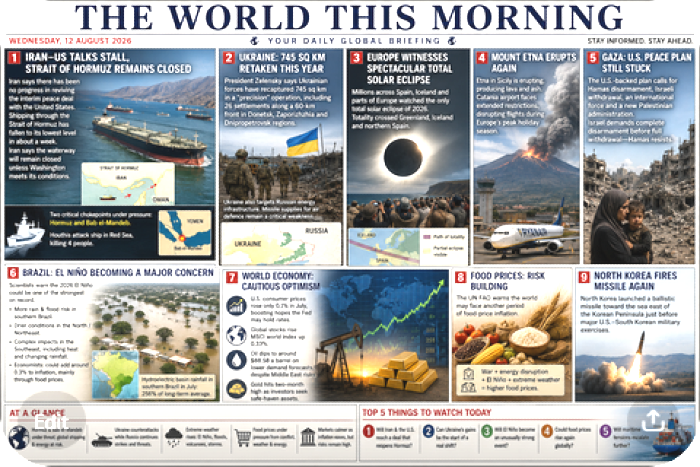
🇮🇷 1. IRAN, THE UNITED STATES & THE STRAIT OF HORMUZ
The most important geopolitical story
The hoped-for breakthrough between Iran and the United States has run into another obstacle. Iran says there has been no progress in reviving the interim peace agreement, while attacks connected to the conflict continue.
Most importantly for the world economy, Hormuz remains effectively closed. Iran's security council says the strait will remain closed unless Washington accepts Iranian conditions.
This is much more than a regional dispute. Before the crisis, roughly 20% of the world's oil and LNG trade passed through Hormuz. Prolonged disruption therefore affects:
- oil and petrol prices;
- tanker insurance;
- shipping costs;
- aviation;
- inflation;
- food and manufactured goods.
There has also been trouble farther south. Iran-aligned Houthi forces attacked a ship in the Bab el-Mandeb, the entrance to the Red Sea, killing four people according to the latest reports.
So there are now two strategically important shipping chokepoints under pressure: Hormuz and Bab el-Mandeb.
For someone with your merchant-shipping background, this is probably the single most important story to watch.
🇺🇦 2. UKRAINE — A SIGNIFICANT CHANGE ON THE BATTLEFIELD
There is a surprisingly important development today.
President Zelensky says Ukrainian forces have recaptured 745 square kilometres this year in what he describes as a carefully planned "precision" operation.
Ukraine says it has retaken 26 settlements along a roughly 60-kilometre section where the Dnipropetrovsk, Donetsk and Zaporizhzhia regions meet.
That does not mean Ukraine has suddenly won the war.
Much of the claimed territory remains contested, and Russia continues attacking in the Donetsk region. But analysts say Russia's advances have slowed considerably.
Why this matters
For much of the war, the broad picture was Russian forces gradually attempting to grind forward.
Now Ukraine is demonstrating an ability to counterattack, penetrate Russian positions and regain territory.
Ukraine is also concentrating on Russian logistics and energy infrastructure—particularly oil refineries and supply routes that support Moscow's war machine.
At the same time, Ukraine still has a serious weakness: air-defence missiles are in short supply, leaving its cities vulnerable to Russian ballistic missiles and drones.
So the battlefield is becoming a contest between Ukrainian precision attacks and Russia's ability to maintain pressure with missiles, drones and artillery.
🇷🇺 3. PUTIN ISSUES A WARNING TO EUROPE
A potentially dangerous development came from Moscow today.
President Vladimir Putin warned that Russia would respond in kind if European countries begin seizing Russian merchant vessels.
This matters because European governments are increasingly using economic and maritime measures against Russia.
A direct confrontation involving merchant shipping would be a significant escalation.
It could affect:
shipping → insurance → ports → energy → international trade.
For the maritime world, therefore, Putin's statement deserves considerably more attention than it might receive in ordinary headlines.
🌑 4. THE GREAT SOLAR ECLIPSE
And now for something completely different—and spectacular.
Today, 12 August, the Moon passed directly between Earth and the Sun, producing the only total solar eclipse of 2026.
Totality crossed Greenland, Iceland and northern Spain, while a partial eclipse was visible across a much larger part of Europe. Millions of people gathered to watch the event.
Spain and Iceland were among the best places to experience complete darkness in daylight.
For many Europeans this was an unusually historic event: the last total solar eclipse visible from mainland Europe was in 2006, while Spain's previous total eclipse was much farther back.
It is also a nice reminder that, amid wars and political crises, the planet continues its extraordinarily predictable journey through space.
🌋 5. ITALY — MOUNT ETNA ERUPTS
Mount Etna in Sicily is erupting again.
The volcano has been producing lava and ash, forcing authorities to extend restrictions affecting Catania airport and disrupting flights during Europe's busy summer holiday period.
This is not currently comparable with a catastrophic volcanic eruption, but Etna is one of Europe's most active volcanoes and its behaviour is being closely monitored.
The combination of volcanic ash and aviation is particularly troublesome because even relatively modest ash clouds can force aircraft diversions or airport closures.
🇵🇸 6. GAZA — PEACE PLAN STILL STUCK
The U.S.-backed Gaza peace plan remains alive, but the central disagreement has not disappeared.
The proposed sequence is broadly:
Hamas disarmament → Israeli withdrawal → international stabilization force → new Palestinian administration.
The problem is that Israel insists Hamas must be completely disarmed before a full Israeli withdrawal, while Hamas and its supporters have resisted the conditions surrounding disarmament.
Thus, there is a diplomatic framework—but no final settlement.
The Gaza situation therefore remains one of the major sources of instability in the Middle East, alongside the much larger Iran–U.S. confrontation.
🇧🇷 7. BRAZIL — THE EL NIÑO STORY IS GETTING MORE SERIOUS
I particularly want to expand this section because you have correctly pointed out several times that Brazil's weather deserves a place in our world briefing.
The developing El Niño of 2026 is now being treated as a potentially very strong event.
Reuters reports that Brazilian scientists have warned that the phenomenon could become one of the strongest on record.
There is already evidence of unusual rainfall patterns. Southern Brazil's hydroelectric basin received rainfall equivalent to about 256% of its long-term July average.
What does this mean for Brazil?
The broad pattern associated with El Niño tends to favour:
Southern Brazil:
More rainfall and greater flood risk.
Northern/Northeastern Brazil:
Greater risk of dryness in many areas.
Southeast, including São Paulo:
More complicated and variable effects, including periods of unusual heat and changing rainfall.
And there is an economic consequence.
Brazilian economists estimate that El Niño could add around 0.3 percentage points to inflation, particularly through food prices.
That is why I regard this as much more than a weather story.
And regarding Ubatuba
The recent strong winds you experienced should not automatically be called "El Niño arriving."
The immediate cause of a particular windstorm is the local weather system—fronts, pressure differences, cyclones, etc.
El Niño is different: it alters the large-scale atmospheric pattern, increasing or decreasing the probability of certain kinds of weather over months.
But the fact that a strong El Niño is developing makes the overall Brazilian weather picture worth watching very carefully.
💰 8. WORLD ECONOMY — A LITTLE BETTER NEWS
There is a more reassuring story from the financial markets.
U.S. consumer prices rose only 0.1% in July, helping reinforce expectations that the Federal Reserve may be able to avoid further rate increases. World equities responded positively.
The MSCI world stock index was up around 0.33%, while U.S. markets also gained.
Oil is the interesting contradiction.
Despite the continuing Middle East crisis, Brent crude has fallen to around $88.58 per barrel, partly because forecasts for world oil demand have been reduced.
That is quite remarkable given the continuing restrictions around Hormuz.
Gold, meanwhile, has risen to a two-month high, reflecting continuing investor demand for a traditional safe haven.
🍞 9. FOOD PRICES — A PROBLEM BUILDING UNDER THE SURFACE
This one doesn't produce dramatic television pictures, but it may ultimately affect ordinary people more than many geopolitical stories.
The UN Food and Agriculture Organization has warned that the world may be heading into another period of food-price inflation, with war, energy disruption and El Niño all contributing.
This is where several of today's stories connect:
Hormuz → energy prices → transport costs
Ukraine → grain and fertilizer disruption
El Niño → crop yields
Extreme weather → food production
Together, they could produce another period of higher food prices.
🇰🇵 10. NORTH KOREA — MISSILE LAUNCH
North Korea fired a ballistic missile toward the sea east of the Korean Peninsula today, just before major U.S.–South Korean military exercises.
North Korea regularly uses missile tests to signal displeasure with military exercises, but the timing is significant because tensions on the Korean Peninsula remain high.
It is not today's biggest crisis, but it is another reminder that several potentially dangerous military flashpoints exist simultaneously around the world.
🧭 MY VIEW: WHAT REALLY MATTERS TODAY
If I had to reduce the entire world situation to five things, I would choose:
1. HORMUZ
Can Iran and the United States reach an agreement that actually allows shipping to resume?
2. UKRAINE
Are Ukraine's 745 sq km of reported gains the beginning of a genuine change in the military balance?
3. EL NIÑO
Will this become the unusually strong event scientists are warning about—and what will it mean for Brazil?
4. FOOD
Could the combination of war, energy disruption and El Niño produce another worldwide food-price shock?
5. MARITIME SECURITY
With Hormuz, the Red Sea and now warnings about Russian responses to vessel seizures, commercial shipping is becoming increasingly entangled with military strategy.
☀️ THE BIG PICTURE
There is an interesting contrast in today's news.
Above us: a magnificent solar eclipse crossed Europe.
Around us: extreme weather and a potentially historic El Niño are developing.
On the seas: Hormuz and the Red Sea remain dangerous.
On land: Ukraine is counterattacking while Russia threatens escalation.
In the economy: inflation is behaving better than feared, but food and energy remain vulnerable.
So I would describe today's world as tense, but not necessarily deteriorating everywhere. There are serious risks, particularly around Hormuz, but there are also some positive signs—lower inflation, Ukrainian battlefield gains, and continuing diplomatic attempts to resolve the Middle East crisis.
And tomorrow's briefing should be interesting. The next 24 hours around Hormuz may be particularly important.