AI CHAT WORLD NEWS 10/08/2026

By AI Chat-T.Chr.-Human Synthesis-10 August 2026
🌍 THE WORLD THIS MORNING
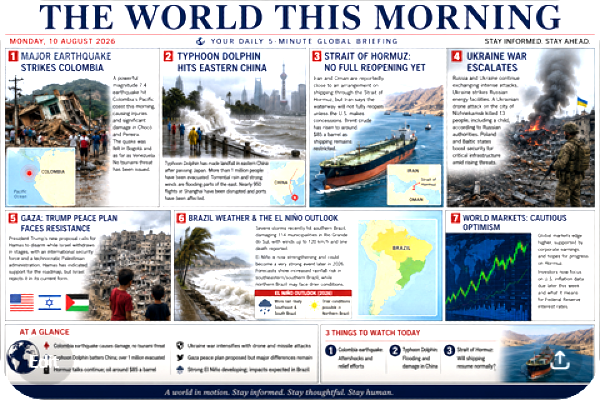
🇮🇷 1. STRAIT OF HORMUZ — THE WORLD IS WAITING
The most consequential geopolitical story remains the Strait of Hormuz.
Iran says it is nearing an agreement with Oman concerning new shipping lanes through the strait, but Tehran is making clear that this does not mean an immediate full reopening. Iran says the United States must first meet several demands, including ending sanctions and military threats and providing compensation.
That distinction is important. Hormuz previously carried roughly one-fifth of the world's oil and LNG shipments, so continued restrictions are affecting energy prices, insurance and international shipping.
Oil has consequently moved higher again, with Brent around $85 a barrel.
What to watch: actual tanker traffic returning to normal will be much more significant than political statements about a possible agreement.
🇨🇳 2. CHINA — TYPHOON DOLPHIN CAUSES MAJOR DISRUPTION
Typhoon Dolphin has brought torrential rain and powerful winds to eastern China after making landfall in Zhejiang.
Shanghai has been particularly affected. Around 943 flights were cancelled, nearly 40% of scheduled flights, while flooding has affected streets and transport. Authorities have issued warnings for dozens of rivers as water levels rise.
The storm is weakening, but its enormous rain system is moving inland. Beijing is preparing for heavy rainfall and possible flash flooding from Tuesday onward.
An interesting climate connection: meteorologists say the unusually active 2026 western Pacific typhoon season is being helped by strong El Niño conditions and weak trade winds.
🇨🇴 3. COLOMBIA — STRONG EARTHQUAKE
A magnitude 6.8 earthquake struck Colombia today, according to the European-Mediterranean Seismological Centre.
The earthquake occurred at a depth of approximately 115 km. The initial report did not yet provide reliable information about casualties or damage.
Because the quake was relatively deep, its effects can be spread over a large area. Authorities are assessing the situation and watching for aftershocks.
This is a story where the next several hours could change the picture considerably.
🇺🇦 4. UKRAINE — WAR SPREADING DEEPER INTO RUSSIA
The war is becoming increasingly focused on Russia's energy infrastructure.
A Ukrainian drone attack on Nizhnekamsk in Russia's Tatarstan region reportedly killed 13 people, including a child, and injured 39. Ukraine says it struck the TANECO oil refinery, an important industrial facility.
Russia has continued attacks against Ukrainian cities as well.
Meanwhile, Poland and the Baltic states are taking additional precautions around power stations, dams and gas infrastructure, fearing sabotage or possible attempts to create confusion inside NATO.
The worrying development is that the conflict increasingly resembles a war against the economic and energy infrastructure behind the fighting, rather than simply a battle over territory.
🇵🇸 5. GAZA — TRUMP'S PEACE PLAN HITS A WALL
Washington is pushing a new 15-point plan intended to end the Gaza conflict.
The basic proposition is:
Hamas disarms → Israel withdraws in stages → an international stabilization force enters → a new Palestinian technocratic administration governs Gaza.
Hamas has accepted the basic roadmap, but Israeli Prime Minister Benjamin Netanyahu says Israel will not withdraw until Hamas is completely disarmed. That disagreement is currently one of the plan's biggest obstacles.
So there is diplomatic movement—but calling it a peace agreement would be premature.
🇧🇷 6. BRAZIL — WEATHER AND THE BIGGER EL NIÑO PICTURE
For us in Brazil, this deserves particular attention.
The recent severe storm in southern Brazil has demonstrated how quickly conditions can become dangerous. But we should distinguish between individual weather systems and the larger El Niño phenomenon.
Brazil's Cemaden has warned that a developing El Niño could generally mean more rainfall in southern Brazil, while central areas including the Southeast could experience more frequent heat and periods of lower humidity. The agency stresses that precise regional impacts cannot yet be predicted reliably this far ahead.
So I would not describe the recent strong winds around Ubatuba as simply "El Niño arriving." They are the result of the immediate atmospheric system. El Niño is more important as a background influence on the weather pattern over coming months.
That distinction is worth keeping in our daily briefings.
📈 7. WORLD ECONOMY — OIL IS THE KEY
Markets are watching two things above everything else:
Hormuz and U.S. inflation/interest rates.
If Hormuz genuinely reopens, oil prices could fall substantially and give relief to inflation and shipping costs. If negotiations fail and the waterway remains restricted, oil could rise again.
That makes the diplomatic situation in the Gulf an economic story as much as a military one.
📰 THREE STORIES TO WATCH TODAY
1. Hormuz
Will Iran and Oman actually establish functioning shipping arrangements?
2. China
How much flooding will Typhoon Dolphin produce as its huge rain system moves inland?
3. Ukraine
Will attacks on Russian oil and energy infrastructure trigger a major escalation?
🇧🇷 And for our part of the world:
I'll continue giving Brazilian weather and the developing El Niño situation a prominent place in your morning edition, rather than treating it as an afterthought.
Today's overall picture: geopolitics remains dominated by Hormuz and the Middle East, while extreme weather is making almost equally dramatic headlines across Asia and South America. The interesting connection is that El Niño is now influencing the background conditions behind several of these weather developments—but it should not be blamed for every individual storm.