THE IRON LADY OF OESTMARKA, NORWAY

By FB-Human Synthesis-29 July 2026
'Karen Hofgaard Cudrio' - The Iron Lady
The horsefly buzzes aggressively in the heavy, humid air of June, but the woman in the saddle pays it no attention. She sits upright, dressed in dark, coarse garments that have seen better days, the reins gripped firmly in hard, sinewy hands.
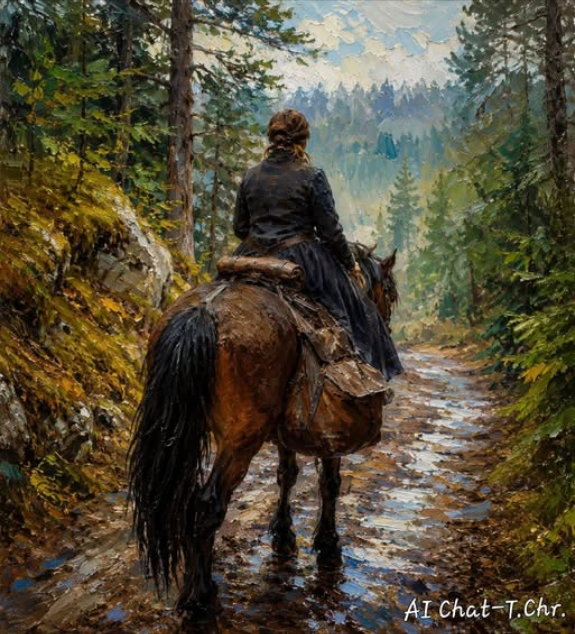
Beneath her, the powerful gelding paws restlessly at the mud. Around them, Østmarka stands like an impenetrable green wall, saturated with the scent of pine needles, damp moss, and freshly cut timber.
Only the distant, rhythmic thud of axes and the rasping hiss of two-man saws devouring century-old pine trunks disturb the silence. Karen Hofgaard Cudrio turns her gaze toward the horizon, where the shadows have already begun to stretch long and menacing between the dense trees. It is late. The forest is filled with wanderers, drifters, and labourers who have not been paid for weeks. In the heavy leather bags hanging against the horse's flank, silver dollars and gold coins clink softly.
It is the wages of hundreds of lumbermen—but also a tempting prize for anyone hiding behind the thick juniper bushes.
She knows what they call her on the porches of the poor crofters' cottages.
The Cudrona.
They whisper that she is difficult and obstinate, as twisted and unyielding as the old birch tree that stands warped above Lake Langvann.
Today, however, she cares nothing for rumours. Pressing her heels gently into the horse's sides, she rides alone into the darkness.
While the merchants and government officials of Christiania sit around polished tables discussing trade and royal privileges over glasses of wine, it is Karen who rules here in the mud.
She was the daughter of the timber merchant Andreas Hofgaard of Bragernes and had known the harsh realities of forestry since childhood. When her husband, Peder Casparsen Cudrio—descended from French Huguenots—breathed his last in 1765, the city's powerful men undoubtedly believed that the vast timber empire would soon be available at a bargain price.
Surely a widow with eight children could never manage nearly 140,000 acres of wilderness, sawmills, and timber transport.
They were wrong.
Karen did not weep in public.
She rode.
She seized the reins of Skullerud Manor, collected outstanding debts, and placed herself at the head of one of Norway's largest timber enterprises. When logs jammed the rivers during the spring floods, local tradition says she stood herself on the riverbank, directing the log drivers.
When the roads proved too poor, she did not wait for permission from the King's officials. She took matters into her own hands, ordering a new road cut directly through the forest.
The new Plank Road, stretching from Kirkebygda in Enebakk through Østmarka to the timber yards at the mouth of the Akerselva River, greatly simplified transport and saved the teamsters nearly an entire Norwegian mile—regardless of how fiercely neighbours and competitors condemned her ruthless determination.
But the forest gives nothing for free.
When darkness settles among the treetops, the silence becomes almost unbearable.
For every tree that falls, and for every silver coin that finds its way into the chests at Losby Estate and Jørgensrud by Lake Nøklevann, Karen pays a price no ledger can calculate.
At home, in the great, cold rooms, there are fewer and fewer voices around the table.
It begins with the faint cry of a child.
A burning fever grips a tiny body that no heated brick nor herbal remedy can soothe.
Then there is silence.
A small coffin is carried to the churchyard.
Karen stands erect beside the grave, dressed in black.
Then she mounts her horse and rides back into the forest.
And then it happens again.
And again.
She would lose seven of her eight children.
Seven times she washed her own children for the last time.
Seven times she laid them into the earth.
Seven times she watched her future wither away while she alone remained standing.
What did she think as she paused beside the enormous Cudrio Stone, west of Svartkulp? Or when she rode through Cudrio Hill in the darkness of night, with only the forest accompanying her home?
She owned everything she could see, yet had lost almost everyone she loved.
Does a heart become as hard as resin-rich pine after enduring such relentless sorrow?
Or was that stern exterior the only thing keeping her alive?
The lumbermen wait for her upon the dark outcrop that would later become known as Cudrio Cliff. They stand in small groups, faces blackened with dirt, backs bent from endless labour, murmuring quietly among themselves.
They fear her.
But they respect her as well.
For she always comes.
And she always pays exactly what each man has earned—no more and no less.
When the horse's hooves strike the bare rock, the murmuring stops.
Karen rides into the glow of their campfire.
According to local tradition, this was where she met her steward and the forest workers on regular paydays. Nearby, the impressive stone retaining walls that once carried the Plank Road across the steep terrain can still be seen today.
The stories say she remained seated in the saddle while the heavy leather bags were lifted forward and the names called out one by one.
Every man was required to meet her gaze as his wages passed from her hands into his own.
It was an intense contest of authority and survival, played out beneath the dark canopy of the Oslo forests more than two centuries ago, where one remarkable woman led an enterprise that few believed she could possibly master.