THE WEIGHT OF SILENCE
By AI Chat.-T.Chr.-Human Synthesis-29 July 2026
People often speak of love as though it is always gentle. They rarely speak of the love that slowly hardens into duty, or the duty that quietly becomes imprisonment. For eight years she cared for her mother.
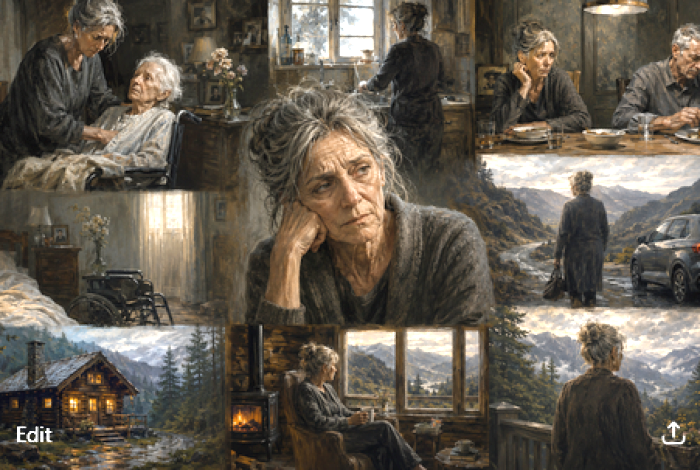
Every morning began the same way: lifting, washing, feeding, dressing, turning the frail body to prevent sores, cleaning what illness left behind, dispensing tablets by the clock. Her mother's body had become almost entirely dependent upon her. Her spirit, however, had withdrawn long before.
There was no gratitude. No warmth. No reconciliation. Only a pair of eyes that seemed to look through her, as though she too had become another piece of furniture in the room.
Visitors admired her devotion.
"You are an angel."
She never felt like one. Angels, she imagined, must have wings. She had only aching shoulders.
Years passed not in memories but in routines. Mondays looked like Thursdays. Summers arrived unnoticed. Christmases became another meal to prepare beside a wheelchair. She watched friends disappear into lives she no longer recognized while her own world shrank to the size of one bedroom.
When her mother finally died, people expected relief.
Instead there was only emptiness.
The prison door had opened, yet she no longer remembered where she had intended to go. She had become so accustomed to serving another life that she scarcely knew how to inhabit her own.
Home should have offered comfort.
It did not.
Her husband occupied the same house as one might occupy a railway waiting room—present, quiet, emotionally elsewhere. They shared meals without conversation, evenings without laughter, and a bed without closeness. Years had polished away not only affection but curiosity. Neither asked what the other was thinking. Neither expected an answer.
Silence settled between them until it became the strongest thing in the marriage. She found herself speaking less each year because there seemed little point in speaking to someone who had stopped listening long ago.
So she escaped.
Whenever she could, she drove into the mountains to the small timber cabin she owned. It overlooked forests wrapped in mist and valleys that changed colour with the seasons. There she lit the fireplace, watched rain gather on the windows, and listened to the wind pressing against the walls.
People imagined she went there for peace.
She knew better.
She went there because the silence of the mountains was kinder than the silence at home. Nature demanded nothing from her. Trees did not expect conversation. Clouds did not disappoint. The cabin became less a holiday than a refuge.
Yet even there bitterness travelled beside her.
She found herself angry at strangers who laughed too easily; at couples holding hands; at daughters who complained about mothers who could still walk; at people who spoke of freedom without understanding its cost.
Resentment is a patient companion. It settles quietly inside the heart until it begins to colour every landscape.
She had spent so many years giving pieces of herself away that she began to believe there was nothing left worth keeping.
The hardest truth was not that she had sacrificed so much. It was that no one had noticed the woman who had disappeared while making those sacrifices.
There had been no applause. No reward. Only another sunrise. Another cup of coffee. Another silent room.
She often wondered whether a person could become invisible while still alive—not unseen by the eye, but unseen by the soul.
And perhaps that was the deepest loneliness of all.
Not the absence of people.
But the absence of being truly known.
She had survived.
Everyone admired that.
Few understood that survival is not always the same as living.