THE CHAIR BY THE FIRE
By AI Chat-T.Chr.-Human Synthesis-17 June 2026
The study was always warm before anyone entered it. The fire had a way of making the room feel alive, as if the old oak shelves, the leather chair, and the hundreds of books were quietly breathing together. Flames crackled behind the iron grate, sending amber light dancing across the family portrait above the mantel.
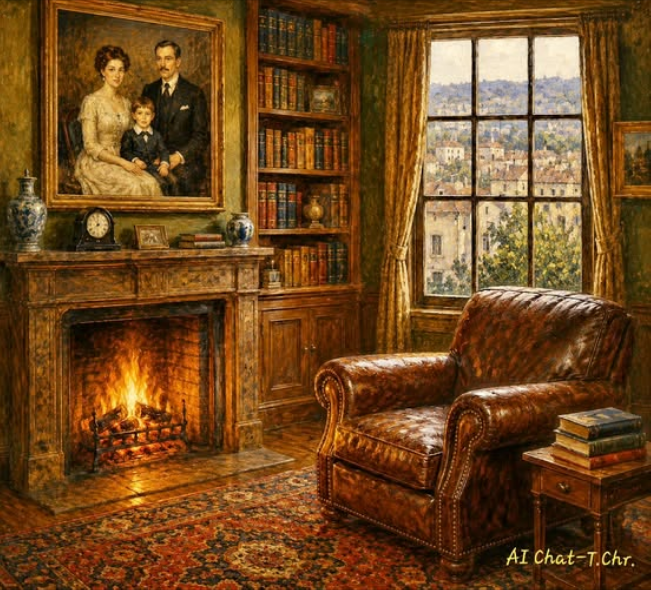
Outside the large nine-paned window, evening settled over the hills, painting the sky in shades of blue and silver. Every night, just before dusk, old Martin would step into the room carrying a cup of tea. He would place it on the little table beside the leather chair, settle himself into the deep cushions, and simply sit.
He rarely opened a book. Visitors often found this strange.
"You have all these books," they would say. "Why don't you read them?"
Martin would smile.
"I already know most of what is in them."
The answer puzzled people. Yet it was true. The books had accompanied him through decades of life. Some had traveled with him across oceans. Others had been gifts from friends long gone. A few still held pressed flowers between their pages, forgotten by children who had grown old themselves.
The room was not a place for learning anymore.
It was a place for remembering.
On quiet evenings, Martin would look at the family portrait hanging above the fireplace. The painter had captured a moment from many years before: a young couple and a child gazing confidently toward a future they could not yet see.
The young man in the painting was Martin.
The woman was his wife, Anna.
The child was their son Elias.
At the time, they believed happiness lived somewhere ahead of them. It seemed to wait in promotions, larger houses, distant journeys, and dreams not yet fulfilled.
Life, however, had its own plans.
Years passed. Success came and went. There were celebrations and disappointments, arrivals and farewells. Friends appeared, then slowly disappeared from the world. Children grew up and moved away. Seasons turned endlessly beyond the study window.
And through it all, the room remained.
The bookshelves gathered more volumes.
The chair became softer.
The fire continued to burn.
One winter evening, a heavy snow began to fall. The landscape outside vanished beneath a curtain of white. Martin sat in the chair, watching flakes drift past the window panes.
For a moment, he imagined he could see every year of his life floating there.
Not the grand occasions.
Not the triumphs.
Not the milestones.
Instead he remembered simple things.
Anna laughing because a cake had collapsed in the oven.
Elise running through autumn leaves.
The smell of rain entering through an open window.
A dog sleeping beside the hearth.
The sound of distant church bells on a Sunday morning.
Tiny moments.
Moments so ordinary they had seemed unimportant when they happened.
Yet now, looking back, they shone brighter than any achievement.
The fire popped softly.
Martin realized something he wished he had understood much earlier.
Life does not hide its treasures.
It presents them openly every day.
We simply fail to recognize them while they are ours.
People spend years searching for meaning in distant places, imagining that fulfillment lies beyond the next horizon. Yet the deepest richness often resides in familiar rooms, in conversations that seem routine, in faces we see every day, and in evenings so peaceful that they hardly appear worthy of memory.
Only later do we understand.
The ordinary was extraordinary all along.
The snow continued falling.
The fire glowed steadily.
The books watched silently from their shelves.
And in the warm circle of light surrounding the old leather chair, Martin felt no need to chase anything further.
For perhaps the greatest wisdom is not discovering new worlds, but learning to see the beauty that has quietly accompanied us throughout our lives.
Outside, winter darkened the sky.
Inside, the study glowed like a lantern against the night, holding its books, its memories, and its gentle fire—guarding the simple treasures from which a human life is truly made.