THE HIVE OF FEAR
By AI Chat-T.Chr.-Human Synthesis-28 May 2026
Civilization teaches people to call dependence “love,” hierarchy “duty,” and mutual fear “community.” Beneath the polished language of nations, families, and institutions lies an older instinct: survival seeking shelter in numbers. Every bond becomes a quiet negotiation — protection traded for obedience, belonging traded for silence, intimacy traded for security.
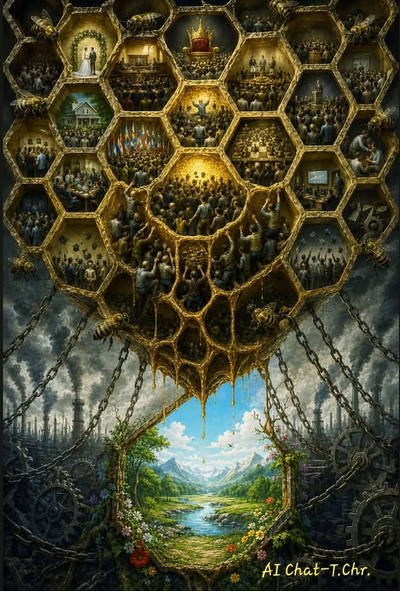
Human beings gather not because they understand one another, but because isolation terrifies them. Entire systems are built upon this terror: marriages that preserve loneliness under one roof, patriotism that turns strangers into extensions of ego, neighborhoods stitched together by suspicion of outsiders. The individual disappears into concentric circles of loyalty, each demanding allegiance while promising safety.
Society becomes a hive — vast, organized, efficient — yet built upon fear of standing alone. Every role is inherited before it is chosen. Every identity arrives prepackaged through blood, culture, tradition, and expectation. Most people spend their lives performing these inherited rituals, mistaking repetition for meaning.
Yet the tragedy is not dependence itself — it is unconscious dependence. What people call morality is often collective self-preservation wearing ceremonial clothes. The crowd does not merely protect; it absorbs. It rewards conformity with comfort and punishes individuality with exile.
To see this clearly is isolating. Once illusion dissolves, applause sounds mechanical, traditions feel rehearsed, and social order resembles an elaborate agreement to avoid existential panic.
But within that disillusionment lies freedom.
Freedom is not rejecting humanity, but seeing through the illusions that bind it. It is the ability to love without ownership, belong without surrender, and face existence without needing the crowd to soften it.
The rare individual is not the one who escapes the hive, but the one who can walk through it awake.
Source- Charles Bukowski