“NYA“, THE WOLF-LOOKING DOG WHO HELPED PEOPLE HEAL.
By AI Chat - T.Chr.- Human Synthesis-18 May 2026
A story inspired by the quiet power of therapy animals, human resilience, and companionship.

The Eyes of a Wolf
The first thing people noticed about Nya was her eyes.
Not because they were unusual for a German shepherd—they were the warm brown of polished chestnuts—but because they carried a strange contradiction. Her face, with its sharp muzzle, thick silver-and-black coat, and alert ears, made her look almost wild. Like something that belonged in forests, standing on snowy ridges beneath a full moon. Yet her eyes held none of the distance people expected from a dog that looked like a wolf.
They were soft.
Soft enough that nervous strangers bent down to stroke her without realizing they were doing it. Soft enough that children wrapped their arms around her neck within minutes. Soft enough that grown adults, carrying years of grief or fear inside them, sometimes started crying the moment she rested her head against their knees.
Stephen noticed it the day he brought her home.
She was eight weeks old then, all oversized paws and clumsy confidence, tumbling around the kitchen floor while rain hammered against the windows outside. The breeder had warned him she was “the bold one.” But what Stephen remembered most was how, while her litter mates scrambled for toys and barked for attention, Nya wandered over to him quietly and sat on his boots as if she had already decided where she belonged.
“You picked me,” he’d murmured.
The puppy had yawned and fallen asleep against his leg.
At the time, Stephen didn’t realize how much he needed her.
The Weight People Carry
Back then, Stephen’s life was built around long shifts, railway incidents, safeguarding reports, and the lingering weight of two decades in policing before that. He was good at his job—steady under pressure, calm in emergencies, dependable in ways that mattered when things went wrong—but the strain had carved invisible lines into him.
There were nights he came home carrying silence like a second coat.
Nya learned his moods early.
If he paced the kitchen unable to settle, she’d follow him from room to room. If he sat awake too late staring blankly at the television, she’d place her head on his lap with a sigh so dramatic it usually made him laugh despite himself.
And if he had nightmares—which happened more often than he admitted—she would appear beside the bed before he fully woke, pressing close until his breathing steadied again.
“You know too much,” he used to tell her.
Her tail would thump once against the floor.
By the time Nya turned five, she had become something of a local celebrity.
Every walk turned into a conversation.
“Is she part wolf?”
“Can I take a picture?”
“She looks like she belongs in a movie!”
Children stared at her in awe. Teenagers crossed streets just to ask her name. Elderly neighbours kept dog biscuits in their coat pockets specifically for her visits.
But it wasn’t just the way she looked.
It was the way she behaved.
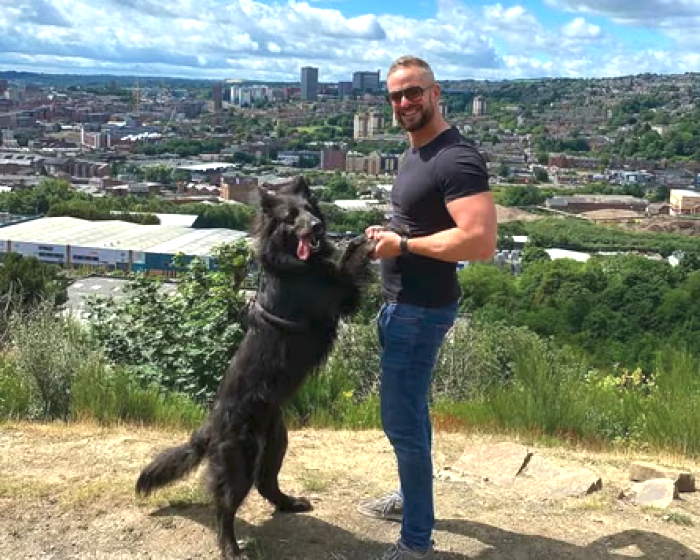
Nya moved through the world with extraordinary gentleness. She somehow sensed nervousness before people spoke. Around anxious strangers, she slowed her movements and approached carefully, lowering herself slightly as if trying to appear less intimidating. Around children, she became endlessly patient. Around upset people, she transformed entirely—quieter, softer, attentive in a way that felt almost human.
Stephen’s wife once joked:
“She’s emotionally smarter than most people.”
It wasn’t really a joke.
The Station in Leeds
The idea of registering her as a therapy dog came after an incident at a train station in Leeds.
Stephen had stopped for coffee during a difficult shift involving a welfare concern on the rail network. He was exhausted, emotionally drained, and trying not to show it. Nya sat beside him beneath the café table, calm as ever.
A young man nearby kept glancing nervously toward the platforms.
Sweating. Breathing too fast.
Stephen recognized the signs immediately because he’d seen them hundreds of times before.
Panic.
Before he could decide whether to intervene, Nya stood up on her own and walked over.
Not suddenly.
Not forcefully.
Just calmly.
The young man froze as she rested her chin lightly against his knee.
And then, slowly, his shoulders loosened.
Stephen watched the man stroke her ears with trembling hands.
“She’s beautiful,” he whispered.
“It’s okay,” Stephen replied gently. “You alright?”
The man admitted he hadn’t travelled by train in almost three years due to severe anxiety. He had spent forty minutes trying to convince himself to board.
Nya stayed beside him the entire conversation.
An hour later, the man got on the train.
Before the doors closed, he leaned back out and shouted:
“Tell your dog she saved me today.”
Stephen stood on the platform long after the train disappeared.
That night, he submitted the paperwork for Pets As Therapy.
A Different Kind of Understanding
Training sessions revealed something extraordinary.
Most therapy dogs learned behaviours.
Nya seemed to understand purpose.
She instinctively approached distressed people while avoiding those who wanted space. During assessments, instructors watched in amazement as she calmly sat beside a child mid-meltdown without reacting to screaming or sudden movements.
One assessor pulled Stephen aside afterward.
“You can train obedience,” she said quietly. “But empathy like that? You can’t teach it.”
Soon, Nya became a familiar sight across the TransPennine Express network.
Passengers spotted her bright therapy-dog bandana moving through busy stations like a small beacon of calm.
Commuters who normally buried themselves in phones would smile when they saw her.
Staff members visited “just to say hello.”
Drivers delayed breaks to stroke her for thirty seconds because, somehow, those thirty seconds mattered.
At Manchester Piccadilly, she became so well-known that one café worker kept chicken pieces behind the counter specifically for her visits.
“VIP customer,” he’d say solemnly while handing them over.
The Quiet Rescue
Some moments stayed with Stephen forever.
Like the teenage girl who hadn’t spoken during an entire school safeguarding event until Nya rested beside her chair. The girl eventually began quietly talking to the dog about her exams, her panic attacks, and how overwhelmed she felt.
Or the railway employee who sat on the floor beside Nya after a traumatic incident on the tracks and admitted, through tears:
“I didn’t know how much I needed this.”
But the woman in York stayed with him most.
She arrived withdrawn and pale during a mental health awareness event at the station concourse. Her friend explained quietly that she had been struggling with depression for months and almost hadn’t come.
Nya approached her slowly.
The woman knelt down.
Then, unexpectedly, she lay fully on the station floor laughing as Nya rolled beside her, tail wagging furiously while commuters walked around them smiling.
For twenty minutes, nothing else seemed to exist.
Afterward, the woman stood up with tears in her eyes.
“You know,” she told Stephen, “for the first time in weeks, my brain went quiet.”
Stephen looked down at Nya.
Nya simply sat there panting happily, entirely unaware she had just changed someone’s day—maybe more than their day.
Home
At home, though, she was still just Nya.
She stole socks.
She pretended not to hear commands when squirrels appeared.
She dramatically flopped onto the floor whenever someone stopped stroking her too soon.
Every morning, she accompanied Stephen on the school run with the children, proudly carrying herself like an unofficial crossing guard. Kids poured out of houses shouting her name.
“Nya!”
“Can she do the spin?”
“Can we pet her?”
Stephen often arrived at the school gates twenty minutes late because Nya had created another fan club.
During one school presentation in Manchester, students begged to see her tricks after hearing she was “TikTok famous,” despite Stephen insisting she absolutely was not.
Nya performed anyway.
Weaving between his legs.
Spinning in circles.
Jumping up gently with both paws.
Rolling dramatically onto her back for applause she clearly believed she deserved.
The entire assembly hall erupted cheering.
Nya barked once proudly.
“She thinks she’s Beyoncé,” Stephen muttered into the microphone.
Yet beneath all the joy was something quieter.
A mutual rescue.
Because Stephen knew the truth: he had set out believing Nya would help other people. He hadn’t expected how much she would save him too.
Some evenings, after difficult days involving welfare incidents or safeguarding cases, he would sit silently in the garden while dusk settled over the houses.
Nya always found him.
Always.
She’d sit beside him without demanding anything. No tricks. No attention. No performance.
Just presence.
And somehow, in that silence, the heaviness eased.
Perhaps that was her real gift.
Not fixing pain.
Not erasing anxiety.
Just reminding people they didn’t have to carry it alone.
Like Home
Years later, passengers still recognized her instantly in stations.
“There’s the wolf dog!”
People photographed her constantly. Children hugged her. Adults told her secrets they’d never say to another human being.
And through it all, Nya remained exactly who she had always been:
A gentle soul hidden inside the body of a wolf.
Stephen sometimes thought back to that rainy afternoon when she first fell asleep on his boots as a puppy.
Maybe she had chosen him after all.
Or maybe—he considered this sometimes while watching her comfort strangers in crowded stations—the two of them had found each other at exactly the right moment in life.
Either way, wherever Stephen walked, Nya followed close behind.
Like a shadow.
Like family.
Like home.
Philosophical Reflection
There is something profoundly revealing about the relationship between humans and animals—especially with creatures like Nya, whose presence seems to bypass language entirely.
In a world increasingly dominated by noise, speed, schedules, and invisible emotional burdens, a therapy dog reminds us of something ancient:
Comfort does not always arrive through solutions.
Sometimes it arrives through presence.
People often imagine healing as dramatic or transformative, as if recovery must come with revelation or triumph. Yet many of the moments that changed lives around Nya were almost unbearably simple.
A hand resting on fur.
A slowed heartbeat in a crowded station.
A stranger smiling for the first time that day.
A frightened passenger deciding to board a train.
Tiny moments, nearly invisible to the wider world.
And yet human lives are often altered by precisely these small mercies.
Nya’s story quietly challenges the assumptions people make about appearances. She looks like a wolf—an animal many associate with danger, distance, and wilderness. But beneath that fierce exterior is extraordinary gentleness.
It is a reminder that living beings, including people, are rarely what they first appear to be.
Some of the strongest individuals carry immense tenderness.
Some who look calm are fighting silent battles.
Some who spend their lives helping others are quietly searching for healing themselves.
Stephen and Nya found one another at the intersection of those truths.
After years spent witnessing trauma, conflict, and vulnerability through policing and safeguarding work, Stephen understood how fragile people can become under pressure. Modern life often asks individuals to suppress fear, grief, exhaustion, and loneliness simply to continue functioning.
But therapy animals reveal something different:
The human need for connection is not weakness at all—it is part of survival.
Dogs do not care about status, success, wealth, or performance. They respond to emotion honestly and instinctively. They notice tension before words. They stay beside people without demanding explanations.
In doing so, they offer something many humans struggle to give one another consistently:
Unconditional presence.
Perhaps that is why encounters with therapy dogs feel so emotionally disarming. For a brief moment, people are allowed to stop pretending.
Anxiety softens.
Defences lower.
Grief surfaces safely.
Joy returns unexpectedly.
Nya became more than a companion on railway platforms and public events. She became a quiet symbol of reassurance in places designed for movement and transition.
Train stations are spaces where thousands of invisible stories intersect every day:
Reunions.
Farewells.
Loneliness.
Fear.
Hope.
Exhaustion.
And in the middle of that constant motion, one calm dog sitting beside a stranger could completely change the emotional atmosphere around them.
There is philosophy hidden inside that simplicity.
The world often celebrates grand achievements, but Nya’s impact came through ordinary acts repeated consistently:
Walking beside someone.
Sitting patiently.
Listening without judgment.
Offering calm during moments of distress.
Her story suggests that meaning in life may not come primarily from extraordinary accomplishments, but from small acts of care carried out faithfully over time.
In many ways, Nya represents a bridge between worlds:
Between strength and gentleness.
Between service and companionship.
Between emotional suffering and emotional recovery.
She demonstrates that healing is rarely loud.
More often, it is quiet, patient, and deeply relational.
And perhaps that is the lasting lesson of her story:
To truly comfort another living being, one does not always need answers.
Sometimes, simply staying beside someone—through fear, sadness, uncertainty, or silence—is enough to remind them they are not alone.
And in the end, that may be one of the purest forms of love any creature can offer.
Story Sourced by Guardian - Stephen O'Callaghan & Ann Lee