AI-DRIVEN STOCK RATINGS
By AI Chat-T.Chr.-Human Synthesis-03 May 2026
USING AI ON THE STOCK MARKET.
By AI Chat-T.Chr. Human Synthesis-03 May 2026
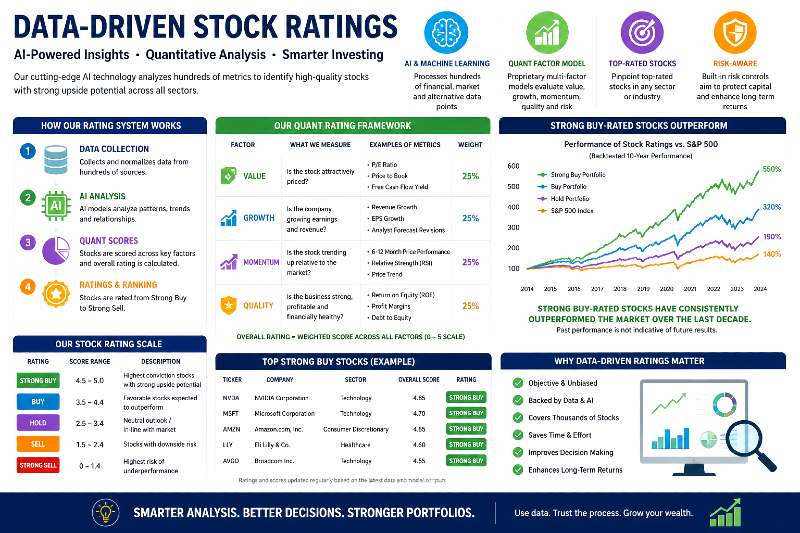
First, the source: They’re talking about ratings from Seeking Alpha, which uses a mix of quantitative models and AI-style scoring. What’s true in that statement“Analyzes hundreds of metrics” → Yes, quant models do this (valuation, momentum, earnings, etc.)“Backtested results show outperformance” → Also often true in backtests.
The key issue: “backtested results”This is where you need to be skeptical. Backtesting means:“If we applied this strategy in the past, it would have worked well.”But there are big caveats: Overfitting problem. Models can accidentally be tuned to past data. What worked before may not work going forward.
Survivorship bias. Poor-performing stocks or failed companies might be excluded from historical datasets. Market adaptation. Once a strategy becomes popular, its advantage often disappears. Execution reality. Real investors face: transaction costs delays emotional decisions which backtests ignore. About “Strong Buy outperformed the market”. This might be directionally true historically, but: It doesn’t mean every “Strong Buy” beats the market.
It doesn’t mean it will continue in the future. It doesn’t tell you the risk taken to achieve that return.The grounded conclusion. AI-based ratings like this are useful—but they are:a screening tool, not a guarantee a starting point, not a final decision. A smarter way to use them:Use ratings to narrow down stocks. Then do your own checks (earnings, debt, industry trends). Combine with diversification and risk control.......
Alright—let’s go under the hood and strip the marketing away. What platforms like Seeking Alpha call “AI Quant Ratings” are usually multi-factor models with some automation layered on top.
How these ratings actually work. Think of it as a scoring system. Each stock gets graded across several factors:
1. Value. Is the stock cheap relative to fundamentals?P/E ratio. Price-to-book. Free cash flow yield. Cheaper stocks often outperform on average (this is a known factor in finance).
2. Growth. Is the company expanding? Revenue growth. Earnings growth. Forecast revisions
High growth can drive stock price increases—but also higher risk.
3. Momentum. Is the stock already going up? Recent price performance (3–12 months)
This is one of the strongest empirical factors: “winners tend to keep winning” (until they don’t).
4. Profitability / Quality. How strong is the business? Margins, Return on equity. Debt levels.
Higher-quality companies tend to be more stable.
5. Earnings. Revisions. Are analysts upgrading forecasts? Changes in expected earnings.
Markets react strongly to surprises.
What the “AI” part usually means. It’s rarely some magical prediction engine. More often: weighting these factors dynamically, scanning huge datasets quickly, sometimes using machine learning to tweak combinations. But it’s still mostly based on known investing factors, not crystal-ball prediction.
Where things can go wrong
1. Factor cycles. These strategies go through phases: Value works → then under-performs for years. Growth dominates → then crashes. Example: growth stocks crashed during inflation spikes after the COVID-19 market crash recovery period.
2. Crowding. If too many investors follow the same signals: the edge disappears. prices adjust quickly.
3. False confidence“Strong Buy” sounds certain—but it’s just:“This stock scores high on our formula right now”. Not:“This stock will go up”
4. No context awareness. Models often struggle with:political shocks sudden regulation. - black swan events
How to use these ratings intelligently instead of trusting them blindly: Good use
Find ideas you wouldn’t have noticed. Compare stocks within the same sector. Save research time. Bad use.
Buying only because it says “Strong Buy”Ignoring risk and diversificationAssuming past outperformance = future gains
Simple strategy (what smart investors do). Use quant ratings to shortlist stocks. Check:business model debt long-term trend -Diversify (don’t bet everything on one pick) Accept that losses will still happen.
Bottom line
These tools are powerful—but they’re closer to a smart filter than a money-printing machine.......