EVENING SONG
By AIChat-T.Chr.-Source FB-Human Synthesis-17 April 2026
EVENING SONG
CHAPTER I
The Place That Breathes.
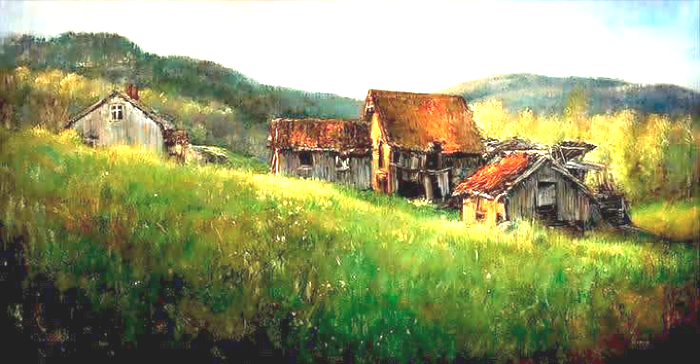
I remember the place as if it still breathes. Not on any map now—just a thinning in the forest where the ground still resists the roots, where stones lie too deliberately to be forgotten. That was our turf hills. Not much to look at, even when it lived. A leaning house of timber grayed before its time, a crooked barn that sighed in winter winds, and fields—if you were generous enough to call them that—stitched between stones like worn patches on an old coat. We did not inherit the land. We wrestled it into something that would tolerate us.
CHAPTER II
Hands against the Earth.
My father used to say the earth there had a will of its own. He spoke to it sometimes, low and steady, as if it might listen. I never laughed at that. I had seen his hands—split, scarred, blackened deep into the lines—and I knew the ground had answered him, if only a little. We cleared the stones ourselves. I remember the sound more than the labor—the scrape of iron against rock, the dull shift as another stubborn piece gave way. The piles grew slowly into curved rows at the edges of our fields, like quiet witnesses to our effort. Each one marked a small victory, though none of them made the soil truly kind. Still, we sowed.
CHAPTER III
The Sacred Ordinary.
And when harvest came, it was never just work. There was something close to reverence in it. My mother would stand quietly for a moment before the first cut, her head slightly bowed, as if the field were something sacred. We did not measure yield in numbers or speak of efficiency. Grain was not weight or price—it was survival, and more than that, it was grace. The forest pressed close around us, always present. In August nights, when the air turned thin and cool, I would lie awake and listen. The cranes cried somewhere far off—long, hollow calls that seemed to stretch the darkness wider. The hours passed quietly, almost gently, as if the world itself had no need to hurry.
CHAPTER IV
Time Without Urgency.
We never hurried either. Morning came, and we met it the same way each time—with open eyes, like it might bring something we had never seen before. My father never spoke much about faith, but I saw it in him. In the way he would straighten slowly at the end of a long day, flex his aching fingers, and look out over the field as if acknowledging something beyond it. Sometimes he would murmur a thank you. Not loudly. Not for anyone else to hear. Just enough.
CHAPTER V
What Remains.
We were not important people. No one beyond the valley knew our names. Even here, they faded quickly after we were gone. The cross over the grave stood for a while—simple wood, roughly cut. The wind took care of it in the end, as it does with most things.Years later, I returned. The house was gone, collapsed into itself and then into the earth. The fields had surrendered; young trees stood where grain once grew. The stone rows remained, though lower now, softened by moss and time. I walked slowly, as if afraid to disturb something that might still be there.
CHAPTER VI
Evening Light.
At the edge of what had been our field, I stopped. The evening light spread across the clearing, the same way it always had—quietly, without asking to be seen. For a moment, I could almost believe nothing had changed. That if I turned quickly enough, I would see my father bent over the soil, or my mother standing still before the harvest. But there was only the wind. And yet—it was not empty.
CHAPTER VII
A Quiet Philosophy.
Because what had been lived there had not vanished in the way wood rots or names fade. It had simply changed form. It remained in the shape of the land, in the patience of the trees, in the rhythm of seasons that continued without memory yet carried everything forward. That is the strange truth of such lives. They leave almost nothing behind—and yet, in another sense, they leave everything. No monuments, no written histories, no lasting marks that the world would call important. Only effort, repeated day after day. Only care, given without expectation of being remembered. Only a quiet agreement between human hands and the earth beneath them. And perhaps that is where their meaning lies. Not in being seen, but in being part of something that does not need to remember in order to continue.
CHAPTER VIII
Under an Open Sky.
We often think a life must be recorded to matter. That it must leave a name, a story, a trace that others can point to and say: this was someone. But standing there, in that abandoned place, it felt almost like the opposite was true. A life can be complete without being preserved. Life can be full without being known. What mattered was not that the world remembered my father’s hands—but that those hands had worked, had shaped, had answered the stubborn earth and, for a time, made something grow where nothing wanted to. And in the end, that is perhaps all any life does. It meets the world as it is—hard, uneven, often indifferent—and answers it in the only way it can: through effort, through presence, through small acts repeated until they become a kind of quiet devotion.
CHAPTER IX
Belonging.
The rest fades. Names disappear. Crosses fall. Even the houses return to soil. But the act of living—that remains, not as memory, but as continuation.The grain becomes earth. The earth becomes forest. The forest becomes silence. And somewhere in that silence, if you stand still long enough, you might understand: that a life does not need to be large to be meaningful, does not need to be remembered to be real, and does not need to leave anything behind— except, perhaps, the simple, honest truth that for a while, under an open sky, someone was here:
worked,
lived,
belonged..