MIDDLE EAST CRISIS LIVE: NETANYAHU CONFIRMS ISRAEL HAS AGREED TO 10-DAY CEASEFIRE WITH LEBANON.
By Guardian -Lucy Campbell/Aneesa Ahmed/Tom Ambrose/Taz Ali /Adam Fulton 16 Apr 2026 21.22 BST
Trump announces 10-day ceasefire in Lebanon after ‘excellent conversations’. Israeli prime minister says key demand is that Hezbollah must be dismantled; Lebanon’s PM Nawaf Salam welcomes ceasefire announced by Donald Trump.
19.01 BST
Netanyahu confirms 10-day ceasefire - but says Israeli troops will remain in Lebanon
And Israeli prime minister Benjamin Netanyahu has finally confirmed that he has agreed to the 10-day cease-fire with Lebanon to try to advance a peace accord with between the two countries.
“We have the opportunity to make a historic deal with Lebanon,” Netanyahu said, welcoming the pause “in order to try to advance the agreement” discussed during diplomatic talks in Washington on Tuesday.
The Israeli leader maintained that his key demand is that Hezbollah must be dismantled.
But, crucially, he said he would not agree to Lebanon’s demand to withdraw from all Lebanese territory.
“We are remaining in Lebanon in an expanded security zone,” Netanyahu said, due to the “danger of an invasion” and to prevent fire into Israel.
“That is where we are, and we are not leaving,” he said.
ShareUpdated at 20.31 BST18m ago21.20 BST
We’re just under an hour out from the ceasefire going into effect at midnight local time, and the Israeli military has said it’s striking launchers from which Hezbollah launched rockets toward northern Israel.
The launchers fired rockets towards northern Israel “a short while ago”, the IDF said on Telegram. Minutes earlier, it said search and rescue forces were operating at sites in northern Israel “where reports of impacts have been received”.
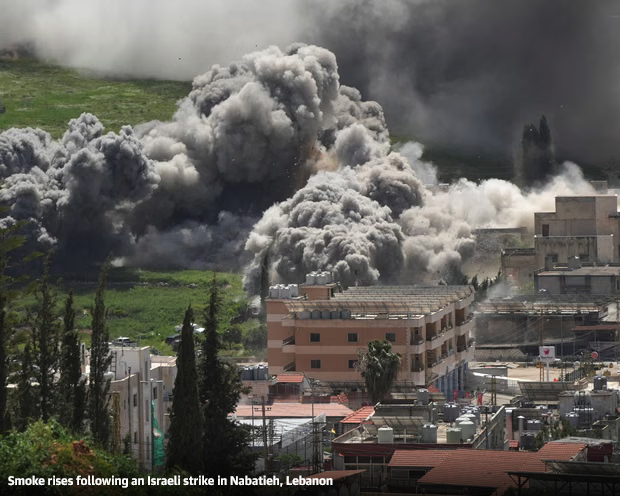
Meanwhile, in the past few hours, Israeli forces have continued to strike Lebanon’s south, killing dozens of people.
An Israeli strike on the southern Lebanese town of Ghazieh killed at least seven people and wounded 33, the health ministry said on Thursday, hours before the 10-day ceasefire is due to take effect.
Lebanese state media reported a “massacre against civilians” in the town, noting that rubble removal operations are ongoing, while the health ministry said its toll is “preliminary and not final”.
An Israeli air strike on the town of Adloun in the Sidon district killed three people and wounded 21 others. Israel also struck the town of Marjayoun, as well as the villages of Sajd and Hanaway, and the Burj Shemali Palestinian refugee camp.
Air raids were also reported in the Bint Jbeil district, which Israel had been attacking heavily in recent days, and several other towns, Al Jazeera reports.
20.43 BST
Lebanese army urges caution in returning to southern Lebanon
The Lebanese army has urged residents to “exercise restraint” in returning to their villages and towns in southern Lebanon until the ceasefire agreement comes into force at midnight local time.
The army added that even then residents should avoid areas that remain occupied by Israeli forces.
The army also stressed the need for residents to follow instructions issued by deployed military units for their safety, and urged caution over potential unexploded ordnance and suspicious objects left behind from Israeli attacks, calling on residents to report them to the nearest military post.
20.36 BST
Israel to preserve ‘right to self-defence’ in Lebanon under terms of ceasefire, says US state department
The US state department has issued an outline of the details of the ten-day ceasefire between Israel and Lebanon that will begin at 5pm EST on Thursday.
It says that both parties, having met for face-to-face talks in Washington this week, “affirm that the two countries are not at war and commit to engaging in good-faith direct negotiations, facilitated by the United States”.
The ceasefire is described as “a gesture of goodwill by the Government of Israel, intended to enable good-faith negotiations toward a permanent security and peace agreement between Israel and Lebanon”.
It also “may be extended by mutual agreement” if negotiations show signs of progress and as “Lebanon effectively demonstrates its ability to assert its sovereignty” (i.e. curb Hezbollah).
However, it reiterates Israel’s right “to take all necessary measures in self-defense, at any time, against planned, imminent, or ongoing attacks”.
Once the ceasefire begins, the Lebanese government, with international support, “will take meaningful steps to prevent Hezbollah and all other rogue non-state armed groups” in its country, it goes on.
All parties involved in the ceasefire recognise the “exclusive responsibility for Lebanon’s sovereignty and national defense”, it says.
And finally, it states that Israel and Lebanon have asked that the US “further direct negotiations between the two countries with the objective of resolving all remaining issues”, including the demarcation of borders and a long-term peace deal.
The Guardian’s expert news coverage is funded by people like you, not a billionaire owner. Readers who choose an All-access digital subscription make the most impact and enjoy great benefits in return. Will you join them today?