ÉDITH PIAF: THE LITTLE SPARROW WHO SANG THROUGH THE STORM
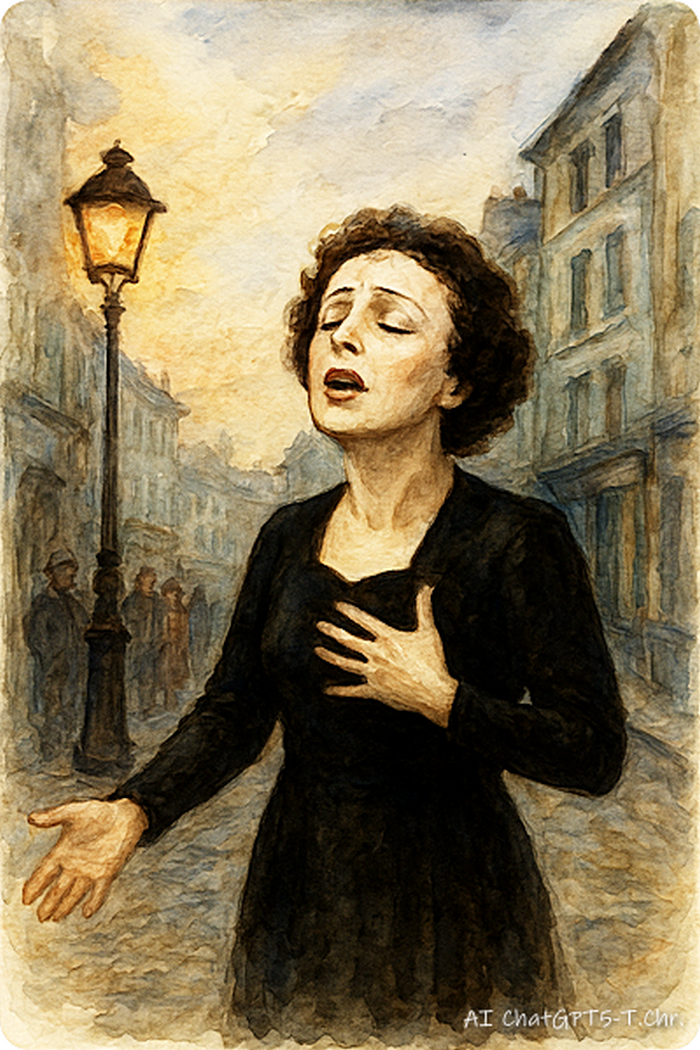
By AI ChatGPT5-T.Chr.-Human Synthesis-11 November 2025
She was born in the streets, raised in a brothel, blinded as a child, and orphaned by love. She sang for coins on Paris sidewalks, and one day for kings and presidents. She lost everything — again and again — but never her voice. That voice became the soul of France.
1915: Born Between Legend and Reality
Édith Giovanna Gassion came into the world on December 19, 1915, in the Belleville district of Paris — a neighborhood of narrow alleys, smoky cafés, and tenement houses alive with noise and struggle.
According to the story Édith told all her life, her mother went into labor while walking down 72 Rue de Belleville, collapsing under a lamppost as passersby rushed to help. The child was born on the cold pavement, wrapped in an old policeman’s cloak.
The truth, recorded in hospital registers, was less dramatic: she was likely born at Hôpital Tenon nearby. But the legend fit her better. Piaf belonged to the streets — they were her cradle, her classroom, and her stage.
Her father, Louis-Alphonse Gassion, was a street acrobat and circus contortionist, the son of a Moroccan acrobat and an Italian seamstress. Her mother, Anita Maillard, sang in cafés under the stage name Line Marsa. She had beauty and talent, but little stability. Both parents lived from performance to performance, often sleeping where they could.
When Édith was born, neither was ready for parenthood. Her mother abandoned her within months. Her father, constantly touring, left her with relatives and later with his own mother in Normandy.
Raised Among Fallen Angels
Her grandmother, Emma “Maman Tine” Saïd Ben Mohammed, ran a small brothel in the town of Bernay. It was here, in this unlikely haven, that little Édith was raised from ages three to seven.
The women of the house — prostitutes, scorned by society but rich in compassion — became her surrogate mothers. They fed her, clothed her, brushed her hair, and sang to her. They saw in the child something pure, fragile, and fierce.
Years later, Édith would say they were the first people who ever truly loved her. Their laughter, their tenderness, and their resilience formed the foundation of her understanding of love and pain — the twin currents that would later define her songs.
Blindness and the Miracle of Lisieux
Around age four, Édith developed keratitis, a corneal infection caused by malnutrition and dirt. Her eyes grew cloudy, and within weeks, she was blind.
The women at the brothel were heartbroken. Doctors offered little hope. Desperate, they gathered their meager savings and took the child on a pilgrimage to Lisieux, to the shrine of Saint Thérèse of the Child Jesus — the Little Flower.
They prayed for days, lit candles, and begged for mercy.
Weeks later, Édith’s sight returned. Perhaps the infection resolved on its own, but to the women and to Édith herself, it was a miracle. From then on, Saint Thérèse became her protector. She would keep a small image of the saint by her bed for the rest of her life — backstage, on tour, even in hospitals.
The Street as a Stage
After World War I, Louis Gassion returned from the front. He found his daughter again and took her with him on the road. He performed in circuses, squares, and fairs, contorting his body while crowds tossed coins.
When the act needed something more, he told Édith to sing. Barefoot and tiny, she began to sing “La Marseillaise.”
The sound that came from her throat startled even her father — a raw, aching voice that made strangers stop and weep.
The coins poured in. The little girl had found her gift.
From then on, they wandered France together — sleeping in wagons, on theater steps, or under bridges. She learned to survive on hunger and applause. And she learned the most important lesson of her life: when you have nothing left, you sing.
Young Love, Motherhood, and Loss
At fifteen, Édith left her father and began singing in cafés and street corners of Pigalle and Menilmontant. She had no home, no education, and no safety — but her voice paid for food and shelter.
In 1932, she met Louis Dupont, a delivery boy who fell deeply in love with her. They moved in together in a modest apartment in the 20th arrondissement.
A year later, at just seventeen, Édith gave birth to a daughter — Marcelle, nicknamed “Cécelle.” For the first time, she felt joy and belonging. “I sang for her,” she said later. “Everything I did was for my little girl.”
But poverty and illness returned like shadows. In 1935, Marcelle contracted meningitis and died at age two.
Édith buried her child herself. The grief never healed; it became part of her — the tremor in her voice, the ache behind every song.
1935: The Little Sparrow Takes Flight
That same year, while singing on a Montmartre sidewalk, Édith caught the ear of Louis Leplée, the owner of the fashionable cabaret Le Gerny’s, near the Champs-Élysées.
He was captivated. “This little one,” he said, “she has something of the street — and of heaven.”
He hired her, gave her voice lessons, and a new name: La Môme Piaf — “The Little Sparrow.”
On October 9, 1935, she made her debut. Dressed in black, under a single spotlight, she sang “Les Mômes de la Cloche.” The audience was stunned. Paris had found its voice — rough, trembling, but true.
She recorded her first songs the next year, and fame came quickly. But tragedy seemed to follow her always. In April 1936, Leplée was murdered. Piaf was questioned by police due to her acquaintance with underworld figures. Though she was cleared, her reputation was shattered.
It was Raymond Asso, a lyricist and former soldier, who rebuilt her career. He taught her diction, posture, and discipline. He urged her to wear black on stage — “It’s your color,” he said, “the color of your soul.” With composer Marguerite Monnot, Piaf began recording a new style of chanson — songs of love and pain that spoke directly to the human heart.
By 1937, she was performing at the ABC Theatre, and the streets she once sang on now whispered her name.
The War Years: Singing Through Darkness
When Germany occupied France in 1940, Piaf continued to perform — for Parisians, soldiers, and even German officers. Some accused her of collaboration, but evidence later revealed that she helped members of the French Resistance, hiding Jews and forging identity papers for prisoners of war.
She also sang in German prison camps for French captives, allowing photographers to take pictures. Those photos were later used to create false ID papers to help prisoners escape.
During these dark years, her songs like “L’Accordéoniste” became hymns of defiance and yearning — for love, for freedom, for life itself.
1945: “La Vie en Rose” — France Reborn
After the war, Piaf’s fame soared. In 1945, she wrote the lyrics for a new song — a simple melody of love and optimism in a shattered country.
Her friend Marianne Michel suggested the title: “La Vie en Rose” — “Life in Pink.”
It became her signature song, recorded in 1946. It was France rediscovering hope — fragile, beautiful, trembling — through her voice.
“La Vie en Rose” conquered the world. It was sung by Louis Armstrong, Grace Jones, Lady Gaga, and countless others — but never with the raw sincerity of its creator.
1948–1949: The Great Love and the Great Loss
In 1948, during a tour in New York, Piaf met Marcel Cerdan, the French-Algerian boxer and world middleweight champion. He was married with children, but their connection was instant and overwhelming.
They wrote passionate letters and spoke by phone every night. She called him “mon amour,” her only true love. For him, she wrote “Hymne à l’Amour,” one of the greatest love songs ever composed.
On October 28, 1949, Marcel boarded a plane to New York to see her perform. The plane crashed in the Azores.
Piaf collapsed in grief. She screamed, prayed, and fainted. For years, she wore black and carried his photograph. “I will never love again,” she said — and in a way, she never did.
Yet she sang on. “Hymne à l’Amour” became her offering to the dead — an act of faith that love endures even beyond the grave.
Decline and Defiance
The 1950s were years of triumph and destruction. Piaf’s fame spread across the world — she sang at Carnegie Hall, toured South America, and mentored rising stars like Yves Montand and Charles Aznavour.
But her health crumbled. Car crashes, surgeries, liver disease, and morphine addiction left her frail and in constant pain.
In 1960, ravaged and nearly broken, she recorded “Non, je ne regrette rien.”
It was her final masterpiece.
“No, I regret nothing,” she sang.
“Not the good things, nor the bad.
It’s all the same to me.
My life begins again — with you.”
It was her declaration of peace with the past — defiant, tender, and absolute.
1962–1963: The Final Song
In 1962, Piaf married Théo Sarapo, a Greek singer 20 years her junior. He cared for her devotedly as her body failed.
That same year, she returned to the Olympia Theatre, the hall she had helped save from closure. Barely able to walk, she was carried to the stage. But when the lights came up and the orchestra began, her frailty vanished.
Her voice filled the hall one last time — cracked, imperfect, and more beautiful than ever.
On October 10, 1963, Édith Piaf died in her villa in Plascassier, near Grasse, on the French Riviera. She was only 47.
The Catholic Church initially refused her a funeral because of her “immoral” life, but Paris ignored them. Tens of thousands of mourners followed her coffin through the streets. Traffic stopped. Men wept openly.
She was buried in Père Lachaise Cemetery, near her daughter Marcelle. On her tomb are engraved the words:
“Édith Piaf — 1915–1963.”
That’s all. Her voice says the rest.
Legacy: The Voice That Never Landed
Today, Édith Piaf’s voice still soars above Paris — raw, trembling, eternal. Her songs — “La Vie en Rose,” “Non, je ne regrette rien,” “Hymne à l’Amour,” “Milord,” “Padam Padam” — are not just melodies but lifetimes.
She influenced generations of artists, poets, and dreamers. Jean-Paul Sartre called her “the voice that sings truth.” Marion Cotillard, who played her in the 2007 film La Vie en Rose, won an Oscar for embodying her tragic brilliance.
Piaf was only 1.47 meters tall — yet she carried the weight of the world in her songs.
She was the Little Sparrow who rose from the streets to the heavens.
Every wound became a note.
Every loss became music.
And when she sang her last, she meant every word:
“Non, je ne regrette rien.”
No, I regret nothing.
Her voice never landed.
It’s still in the air —
forever.