ALICE GUY-BLACHÉ: THE FORGOTTEN INVENTOR OF CINEMA
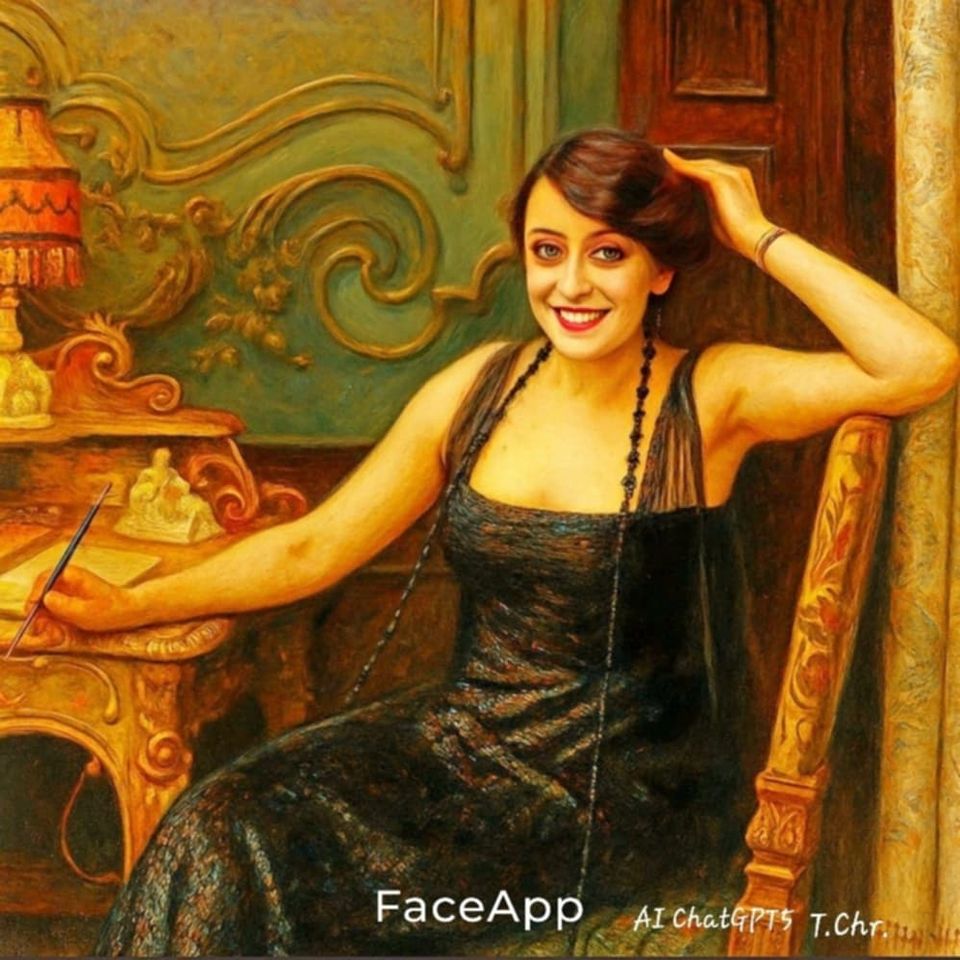
By AI ChatGPT5-T.Chr.-Human Synthesis-11 November 2025
Alice Ida Antoinette Guy was born on July 1, 1873, in the quiet Paris suburb of Saint-Mandé. Her father, Émile Guy, ran a successful bookshop and publishing business that kept him traveling between France and Chile, and her mother, Marie Clotilde Aubert, came from a cultured French family.
Much of Alice’s early childhood was spent away from her parents—first in the care of relatives in Switzerland—an experience that gave her both independence and imagination. Surrounded by books, she learned to love stories long before she learned what she would one day do with them.
When she was twenty-one, after finishing her education at a convent school and studying shorthand and typing, Alice took a position as secretary to a photographic supplier in Paris. The small firm, Comptoir Général de la Photographie, was soon bought by Léon Gaumont, who would become one of the founding figures of French cinema. In 1895, when the Lumière brothers first projected their moving pictures of workers leaving a factory and a train arriving at a station, Alice was present at one of the earliest private demonstrations. The short films were novelties that astonished everyone. But while others saw clever technology.
Alice saw something else. To her, these flickering images were not merely spectacles—they were a new way to tell stories.With quiet determination she asked her employer for permission to experiment, promising it would not interfere with her regular duties. He agreed, perhaps amused by her enthusiasm. In 1896, using Gaumont’s new motion-picture camera, she wrote and directed La Fée aux Choux—The Cabbage Fairy—a brief, whimsical tale in which a fairy plucks babies from cabbages in a garden. It was a simple fantasy, but revolutionary: the first film to tell a fictional story. In that moment, narrative cinema was born.
Over the next decade Alice Guy became head of production at the Gaumont studios. She directed or supervised hundreds of films, experimenting constantly with lighting, editing, and special effects. She staged biblical epics such as The Life of Christ with hundreds of extras, and she explored the possibilities of sound years before others, synchronizing dialogue and music with a phonograph system called the Chronophone. She even hand-tinted films for color and used double exposure for magical illusions.
While most early filmmakers focused on recording daily life, Alice used the camera to create worlds.In 1907 she married Herbert Blaché, a cameraman who had worked under her supervision, and together they moved to the United States. There, in 1910, she founded the Solax Company, the first film studio owned and run by a woman. Initially located in Flushing, New York, Solax grew so successful that she built a larger, state-of-the-art studio in Fort Lee, New Jersey, then the heart of American film production.
Her motto—“Be Natural”—was painted above the stage door and became her guiding principle. She insisted her actors behave truthfully, to move and speak as real people rather than exaggerated pantomimes, anticipating the style that would later define modern acting
At Solax she wrote, produced, and directed an extraordinary variety of films: comedies, westerns, melodramas, social satires, and love stories. She gave women complex leading roles at a time when female characters were usually ornamental. In The Consequences of Feminism (1912), she playfully reversed gender roles to expose inequality..In A Fool and His Money (1912), she made one of the first films with an entirely African-American cast. Her creative energy seemed limitless—two or three films might be in production at once—and her vision touched every part of the process, from writing to costume to camera movement.
Yet the film industry was changing. As big studios moved west to Hollywood and production costs soared, small independents like Solax struggled to compete. Her husband drifted away, first professionally and then personally, leaving Alice to shoulder the business alone. By 1922 Solax had closed, her marriage had ended, and she returned to France with her two children, Simone and Reginald, hoping to find work in the European film world she had helped create.
But the industry she returned to had forgotten her. The new generation of filmmakers knew little of the early experiments that had shaped their craft. Alice found herself unable to secure directing jobs, and over time her films—many stored on fragile nitrate reels—were lost, destroyed, or credited to others.
For decades she lived quietly, dividing her time between France and the United States, keeping scrapbooks and letters that proved what she had done. She continued to write, hoping one day to see her name restored. In 1953 the French government awarded her the Legion of Honour, a belated acknowledgment of her pioneering role, but public memory still failed to include her in the story of cinema’s birth. When she died on March 24, 1968, in New Jersey, few realized that one of the true founders of filmmaking had passed away.
It was only years later, through the discovery of her memoirs and the work of historians, that the full scope of Alice Guy-Blaché’s achievement came to light. She had directed, produced, or supervised more than a thousand films. She had been among the first to use synchronized sound, color tinting, and narrative structure.
She had run her own studio and championed realism and equality in storytelling—decades before such ideas became common. More than a century after The Cabbage Fairy, her vision feels both timeless and astonishingly modern.
Alice Guy-Blaché was not simply a woman working in early cinema. She was the woman who helped invent it. Her story is a reminder that history often forgets its true pioneers, and that sometimes the most revolutionary ideas begin with someone who sees in a simple image—not just movement, but meaning.