THE EMPTY COFFIN

By AI Chat-T.Chr.-Human Synthesis-25 November 2026
A Gothic thriller set in Victorian Yorkshire
Bridge Fowling, Yorkshire, November 1847. Susan Knowles-Chester had always possessed an unusual relationship with the dead. She knew how to prepare a corpse, close its eyes and prevent its mouth from falling open. She also knew when a body had not died quite as the villagers believed.
For twenty years she had attended the dead of Bridge Fowling, but none had troubled her as much as the five daughters of Reverend Robinson Drayden. His wife had died giving birth to the youngest, and all five girls had subsequently succumbed to what the village doctor called consumption.
The youngest, Eliza-May, was different. She wrote disturbing stories about murdered women, restless spirits and families destroyed by secrets. Her father considered her writing a sickness. Susan suspected something far worse.
On the evening before Eliza's funeral, Susan entered the bedroom to prepare the body. Eliza lay beneath a white sheet, her right hand tightly clenched. Inside it was a folded piece of paper. Susan opened it and read seven words: I am not the one who died.
Reverend Drayden appeared in the doorway. "Did you find anything?"
"No, Reverend."
He looked at his daughter. "Then let us put her away."
THE BOOK WITHOUT AN AUTHOR — 1870
Twenty-three years later, London was scandalised by a novel titled Haeger Mass, published under the mysterious name E. M. Grey. Its descriptions of murder, forbidden desire and family madness were so convincing that readers suspected the author had witnessed the crimes personally.
An elderly Susan Knowles-Chester bought a copy. On page 173 she discovered a description of a dead girl, a candle beside her bed and a clenched hand containing a message: I am not the one who died.
Susan dropped the book.
She had never told another living soul about those words.
THE EMPTY GRAVE — 1891
Professor Edmund Vale, an antiquarian obsessed with discovering the identity of E. M. Grey, travelled to Bridge Fowling. His investigations led him to the Drayden family grave. With permission, he opened Eliza's coffin.
It contained six carefully arranged stones wrapped in burial cloth. No bones. No body.
Beneath the stones lay a leather notebook containing twenty-seven names, several dates and a curious instruction: When the seventh daughter returns, the family secret must be buried again.
Vale counted the names. One belonged to himself.
He had never visited Bridge Fowling before.
At least, that was what he remembered.
THE WOMAN IN THE MIRROR — 1912
The mystery became a national obsession. Collectors paid fortunes for first editions, spiritualists claimed to communicate with Eliza, and newspapers competed to expose E. M. Grey.
Then a letter arrived at the offices of the Times Literary Supplement. It contained only one sentence: You have been searching for the wrong dead woman.
Enclosed was a photograph of a middle-aged woman outside the abandoned Drayden farmhouse. Several experts identified her as Susan Knowles-Chester, who had supposedly died in 1889.
On the reverse were three words: Eliza is watching.
THE SIXTH DAUGHTER — 1936
Young historian Margaret Bell discovered a hidden compartment behind the fireplace of the Drayden house. Inside were five journals belonging to the sisters.
The first four described childhood, illness and their father's increasingly disturbing behaviour. Eliza's journal revealed something extraordinary: the girls might not have died of consumption at all. Their father had been poisoning them after discovering that Eliza's novel described murders closely resembling events within their own household.
But the final entry was even more disturbing: There were never five daughters. There were six. One was removed from the family records before I was born.
Beneath it was a name: Susan Knowles-Chester.
Margaret suddenly understood. Susan had not merely prepared the girls for burial. She had been part of the family.
And perhaps she had been the sixth daughter.
THE LAST READER — 2026
At a London auction, collector Thomas Vale purchased the original manuscript of Haeger Mass. Forensic examination revealed that some passages dated from the 1840s, while others had been added decades later. The final chapter, however, appeared to have been written recently.
It described a collector buying an ancient manuscript, travelling to Yorkshire and discovering a hidden compartment in the Drayden farmhouse.
The collector's name was Thomas Vale.
On the final page, a handwritten message awaited him: Dear Thomas, you have inherited more than the book. You have inherited the ending.
That evening, an elderly woman's voice telephoned him.
"Have you found the dedication?"
"What dedication?"
"The one hidden beneath the binding."
Thomas discovered a concealed pocket containing an old photograph of seven women outside the farmhouse. Five were the Drayden sisters. The sixth was Susan Knowles-Chester. The seventh was Margaret Bell, his grandmother.
But Margaret had died before he was born.
The telephone rang again.
"Thomas, you must not open the seventh grave."
"Who are you?"
"I am the girl your family buried twice."
The line went dead.
At the top of the staircase stood a young woman in a Victorian dress. Her face was pale, her eyes strangely familiar.
"At last," she whispered. "Someone has read the whole story."
Thomas stepped backwards.
"Eliza?"
She smiled.
"No. Eliza wrote the book. I wrote the truth."
Behind him came the unmistakable sound of a coffin lid being slowly opened.
The following morning, Thomas Vale had disappeared. His house was locked, his manuscript was missing, and the only thing left on his desk was a handwritten note:
There were six sisters. There were seven graves. And one of us is still alive.
In the village churchyard, a newly disturbed grave bore no name.
Only a date.
November 1847.
And beneath it, carved into the stone, were four words:
Susan is coming home.
THE EMPTY COFFIN
Part Two – The Seventh Grave
Bridge Fowling, December 2026.
The disappearance of Thomas Vale attracted little attention at first. The police assumed he had left voluntarily, perhaps taking his valuable manuscript with him. But his housekeeper, an elderly woman named Mrs Hargreaves, insisted that something terrible had happened.
She had heard voices coming from the locked study during the night. Not one voice, but several women speaking simultaneously, sometimes laughing, sometimes crying. At precisely three o'clock, the voices stopped. Then came three knocks from inside the walls.
When the police entered the room, they found a wet footprint on the carpet. It was small, barefoot and pointed towards the fireplace.
Behind the fireplace they discovered a narrow passage leading downwards.
It had not appeared on any architectural plan.
THE UNDERGROUND ROOM
Detective Inspector James Whitmore arrived from York two days later. A practical man, he had little patience for ghosts, Victorian superstition or literary mysteries. Nevertheless, the passage disturbed him.
It descended beneath the house into an underground chamber. Seven wooden chairs stood in a circle. On each chair lay a woman's dress, carefully folded. Five were Victorian, one was Edwardian and the seventh was modern.
On a small table stood seven photographs.
Whitmore recognised the Drayden sisters. He recognised Susan Knowles-Chester. He recognised Margaret Bell.
The seventh photograph showed a young woman with his own surname written beneath it.
ELIZABETH WHITMORE — 1847.
His great-great-grandmother.
He felt the blood drain from his face.
His family had always maintained that Elizabeth had died in childbirth in 1847. No grave had ever been found.
Behind the photographs was a handwritten confession:
We did not bury the dead. We buried the witnesses.
THE PARSON'S CONFESSION
Whitmore returned to the church and demanded access to the parish records. Inside an old leather-bound register he discovered a letter from Reverend Robinson Drayden, dated three days before Eliza's supposed death.
The letter described an arrangement with a local physician. Six young women would be declared dead, their bodies replaced with stones, and their identities erased.
But why?
The final paragraph supplied the answer:
Eliza knows what happened to her mother. She knows what happened to the children. She has written everything down. If the book reaches London, the consequences will destroy us all.
Whitmore turned the page.
There was another entry, written in a different hand:
The Reverend was not the father.
THE WOMAN WHO NEVER AGED
At midnight, Whitmore received a telephone call from a woman claiming to be Susan Knowles-Chester.
She instructed him to meet her at the abandoned railway station outside Bridge Fowling.
He arrived shortly before one.
A woman stood beneath the station clock, wearing a dark travelling cloak. She looked perhaps thirty-five, with pale skin and remarkably clear blue eyes.
"Inspector Whitmore," she said. "You have inherited a very dangerous investigation."
"Who are you?"
"Susan."
"You're supposed to be dead."
She smiled sadly.
"That is what I have been telling people for nearly two centuries."
She explained that the Drayden household had concealed a secret involving the deaths of several children born to unmarried women in the surrounding villages. The Reverend had operated a private arrangement, taking unwanted children into his household and erasing their origins.
Eliza had discovered the truth and written it into Haeger Mass.
But Susan had discovered something even worse.
Eliza had not written the novel alone.
The five sisters had contributed to it, each recording a different murder.
And the final chapter had never been published.
"Where is it?" Whitmore asked.
Susan looked towards the dark railway tunnel.
"With the woman who is still writing it."
THE AUTHOR RETURNS
Three nights later, a new edition of Haeger Mass appeared in a London bookshop. There was no publisher's name, no author's photograph and no explanation.
Inside the front cover was a handwritten dedication:
To those who thought the story had ended.
The book contained a previously unknown final chapter. It described the death of a detective investigating the Drayden family, the disappearance of an ancient manuscript and the discovery of seven graves.
The detective was James Whitmore.
The description included his private thoughts, his childhood memories and even a conversation he had held with his wife that morning.
He read the chapter twice.
Then he noticed the dedication had changed.
A new sentence had appeared beneath it:
James, do not go home tonight.
He immediately telephoned his wife.
No answer.
He called again.
This time a child's voice answered.
"Father says you must come to the house."
Whitmore froze.
He had no children.
The voice continued:
"Mother is waiting. She says she has found the missing sister."
Then the line went dead.
THE HOUSE OF SEVEN WINDOWS
Whitmore drove to the old Drayden residence. The building had been abandoned for generations, but a light burned in an upstairs window.
The front door stood open.
Inside, the walls were covered with handwritten pages from Haeger Mass. Hundreds of them, pinned in chronological order. Some were yellow with age; others were fresh.
At the end of the corridor stood a woman.
His wife.
But she was wearing a dress from 1847.
"James," she whispered. "You took your time."
He approached her cautiously.
"Where have you been?"
She raised her hand. In her palm lay a small brass key.
"I found the room where they kept the children."
"Which children?"
She looked towards the staircase.
"All the ones who were supposed to have died."
A door opened above them.
A little girl descended the stairs, carrying a leather notebook.
She looked directly at Whitmore.
"My name is Eliza-May Drayden," she said. "And I have been waiting a very long time for someone to finish my book."
Whitmore reached for his revolver.
The girl smiled.
"Please don't. You cannot kill someone who has already been buried."
Then every window in the house went dark.
And somewhere beneath the floorboards, six women began to sing.
To be continued...
THE EMPTY COFFIN
Part Three – The House of the Forgotten Bridge Fowling, Yorkshire, December 2026.
The singing continued beneath the floorboards. Six female voices, each singing a different verse of the same ancient hymn. Detective Inspector James Whitmore stood motionless in the darkness, his revolver raised. The little girl called Eliza-May watched him with an expression of extraordinary patience.
"Who are you?" he demanded.
"I have already told you."
"You're a child."
"Only when somebody looks at me."
A match flared. Whitmore's wife, Catherine, stood beside the fireplace. Her face was pale, and her hands trembled.
"James, listen to me. We must leave this house."
The little girl shook her head.
"She always says that. But she never leaves."
Catherine suddenly struck the match from his hand. In the darkness, something seized Whitmore's wrist. He felt fingernails digging into his skin, then heard a woman's whisper close to his ear.
"Find the sixth cradle."
When the lights returned, the little girl had disappeared.
Catherine was standing alone.
But she was no longer wearing Victorian clothing. She wore the same clothes in which Whitmore had last seen her at home.
"James," she said quietly, "there is something I have never told you."
THE SIXTH CRADLE
Catherine confessed that she had been visiting Bridge Fowling for nearly two years. She had discovered an old family connection through her mother's ancestry and had become fascinated by the Drayden mystery. Initially, she had believed it to be nothing more than an elaborate literary deception.
Then she found the letters.
They had been hidden inside a hollow oak beam in the farmhouse. The correspondence revealed that Reverend Drayden had secretly adopted six children from women who had died in childbirth. Each child had been given a new identity. Five had been raised as his daughters.
The sixth had disappeared.
But the letters suggested that Eliza-May was not one of the adopted children.
She was the daughter of Susan Knowles-Chester.
And Susan had been the Reverend's secret lover.
Whitmore stared at his wife.
"You're telling me that Eliza was Susan's daughter?"
Catherine nodded.
"There's more. Susan was never a servant. She was the real power in that household. She knew every secret, every birth and every death."
"Then why did she pretend to bury Eliza?"
"Because Eliza was not dead."
Catherine took a folded letter from her handbag.
It was dated November 1847.
My dearest Eliza, the grave is prepared. Your father believes you are dead. The village believes you are dead. Let them believe it. You must disappear before the others discover what you know. Your book must survive, even if you cannot.
It was signed simply:
Mother.
THE MAN WHO BOUGHT THE DEAD
The following morning, Whitmore received a message from London. A private collector named Sir Malcolm Ashcroft had purchased a substantial collection of Drayden family documents. He claimed to possess the original manuscript of Haeger Mass, including its missing final chapter.
Ashcroft was an immensely wealthy industrialist, a collector of rare books and a man with an extraordinary interest in Victorian burial practices. He had recently purchased three abandoned churches, two private cemeteries and an old mortuary.
Whitmore travelled to London.
Ashcroft received him in a magnificent library lined with leather-bound books. Behind his desk hung a portrait of a young woman.
Whitmore recognised her immediately.
It was Eliza-May Drayden.
But the painting was dated 1908.
"Who painted this?" Whitmore asked.
Ashcroft poured two glasses of brandy.
"Nobody knows. It appeared at an auction in Paris. The extraordinary thing is that the woman in the painting is identical to a photograph taken in 1847."
"That is impossible."
Ashcroft smiled.
"Inspector, I have spent forty years collecting evidence that the dead do not always remain dead."
He opened a drawer and produced a small glass container.
Inside was a human tooth.
"Found in Eliza's coffin," he explained. "It belongs to someone else."
"Whom?"
Ashcroft leaned forward.
"Her father."
THE REVEREND'S FINAL SECRET
Whitmore returned to Yorkshire and began investigating Reverend Drayden's death. The official record stated that he had died peacefully in 1851 and been buried beside his wife and daughters.
But the burial register contained an anomaly.
The Reverend's grave had been opened twice. The first opening was recorded in 1851. The second, in 1852, was unsigned.
Whitmore obtained permission to examine it.
The coffin contained a skeleton, but the skull had been removed.
Beneath the coffin was a small iron box.
Inside were three documents, a child's silver bracelet and a photograph of seven women.
The documents revealed that Drayden had not been the murderer of the five sisters. He had been protecting the real culprit.
The silver bracelet belonged to Eliza.
The photograph was particularly disturbing. All seven women were standing together, although the youngest appeared to be no older than twelve.
On the reverse was a message:
The seventh is not a sister. She is the mother of them all.
Whitmore suddenly understood.
The five sisters had not shared the same father. They had shared the same mother.
Susan had given birth to all of them.
And the Reverend had helped conceal their identities to protect a secret involving the local aristocracy.
But who was the seventh woman?
THE COUNTESS OF BLACKTHORNE
The name appeared in a sealed document: Lady Eleanor Blackthorne, a wealthy widow whose family had owned much of the land around Bridge Fowling.
She had died in 1846, supposedly of a fever. Yet her death certificate was signed by Reverend Drayden himself.
Whitmore discovered that Lady Blackthorne had maintained a private household in the village, where young women were employed as companions and servants. Several disappeared without explanation.
A former housekeeper, aged ninety-six, was still alive in a nursing home outside York.
She remembered the Countess.
"She was a beautiful woman," she said. "But there was something unnatural about her. She never seemed to grow older. And she had a particular hatred of children."
"Did she know Susan Knowles-Chester?"
The old woman began to cry.
"Know her? They were sisters."
Whitmore leaned forward.
"Biological sisters?"
The old woman shook her head.
"No. They were the same woman."
THE ROOM BEHIND THE WALL
That evening, Whitmore returned to the Drayden house. He found Catherine waiting in the kitchen, surrounded by papers.
She had discovered something remarkable. Behind the old nursery wall was a narrow doorway leading to a room that had been sealed for almost two centuries.
Inside were six small beds.
Above each bed hung a name.
Mary. Anne. Charlotte. Rebecca. Eliza. Susan.
The last name made no sense.
Susan had been an adult when the girls were born.
On a table lay a large leather-bound volume. Its title was The Book of Origins.
The pages contained birth records dating back to 1712. Every forty years, a child named Susan Knowles-Chester appeared in the family register.
Always the same name.
Always the same handwriting.
Always the same date of birth.
Whitmore turned to the final page.
There was an entry dated 2026.
Catherine Whitmore — Mother.
Beside it was another name.
James Whitmore — Father.
Catherine stepped backwards.
"James, I swear I have never seen this book before."
He looked at the entry again.
A final sentence had been added beneath their names:
The family is complete. The seventh generation may now begin.
Suddenly, the nursery door slammed shut.
A child's voice came from behind the wall.
"Mother?"
Catherine began to tremble.
"Don't answer," Whitmore whispered.
"Mother, it's cold in here."
The voice grew louder.
"Mother, why did you leave me in the coffin?"
Catherine covered her ears.
Then, from the darkness beneath the sixth bed, a small hand emerged.
It was holding a brass key.
Whitmore recognised it.
It was the key to the seventh grave.
THE FINAL LETTER
The following morning, Catherine disappeared.
There was no sign of forced entry, no footprints in the snow and no evidence that she had left the property.
Whitmore searched the house for three days. On the fourth, he found a letter beneath his pillow.
It was written in Eliza's unmistakable handwriting.
Dear James,
You have been a good detective, although you have mistaken the nature of your investigation. You believe you are searching for a murderer. You are not.
You are searching for an author.
The dead are merely characters, and the living are merely readers. Every generation believes it is discovering the truth, when in fact it is simply reading the next chapter.
Your wife is safe. For the moment.
Come to the churchyard at midnight. Bring the manuscript. Come alone.
And James, whatever happens, do not trust the woman who buried me.
Yours faithfully,
Eliza-May Drayden.
Whitmore folded the letter and placed it inside his coat.
At midnight, he entered the churchyard.
Seven candles were burning beside the open grave.
A woman stood waiting.
She wore a black dress, and her face was hidden beneath a veil.
"Have you brought the book?" she asked.
Whitmore handed her the manuscript.
She opened it, turned to the final page and began to laugh.
"At last," she whispered. "After all these years."
Then she lifted her veil.
It was Catherine.
But her face had changed.
She looked exactly like Susan Knowles-Chester.
"James," she said, "there is one final truth you must understand."
She pointed towards the grave.
Inside lay a body dressed in Whitmore's clothes.
His own face stared upwards, pale and lifeless.
He looked at his hands.
They were transparent.
Catherine leaned towards him.
"You have been dead since the night you entered the house."
The church bell struck twelve.
And from beneath the earth came the voice of a little girl.
"Mother, may I come out now?"
Catherine closed her eyes.
"Not yet, Eliza. We have one more story to tell."
The seventh grave began to open.
To be continued — Part Four: The Woma
THE EMPTY COFFIN
Part Four – The Woman Who Buried Herself
Bridge Fowling, Yorkshire, December 1847 – and December 2026.
The grave opened without a sound. The frozen earth separated as though something beneath it were gently pushing aside a bedsheet. Catherine, wearing the face of Susan Knowles-Chester, stood beside it holding the manuscript of Haeger Mass.
James Whitmore looked down at his own body. He recognised the scar above the left eyebrow, the wedding ring and the watch Catherine had given him on their tenth anniversary.
"If I am dead," he whispered, "who have I been talking to?"
Catherine looked almost tenderly at him.
"That is the question every generation asks."
A small hand appeared above the edge of the grave. Then a second. A young woman slowly climbed out. She wore a white Victorian burial dress, her long dark hair falling over her shoulders. Her face was unmistakably Eliza-May Drayden.
But she was not the young woman from the photographs.
She looked perhaps forty.
"Hello, James," she said. "I believe you have something that belongs to me."
She reached for the manuscript.
The moment her fingers touched it, every candle in the churchyard went out.
THE WOMAN BENEATH THE EARTH
James awoke in a room he recognised immediately. It was the old nursery in the Drayden farmhouse. The six little beds remained, although the room had changed. The walls were covered with hundreds of handwritten pages.
A woman sat beside the window.
Susan Knowles-Chester.
This time she appeared elderly, with deeply lined features and silver hair.
"Am I dead?" James asked.
Susan continued writing.
"Not quite. You are between chapters."
She explained that the Drayden family had discovered something extraordinary in the early eighteenth century. A woman could preserve her identity beyond death by transferring her memories into a written account. But the process required a witness, someone who would remember her life and repeat her story.
The manuscript was not merely a novel.
It was a vessel.
Every person who read Haeger Mass became part of its history. Their memories, fears and experiences entered the manuscript, strengthening the presence of its original author.
"Eliza discovered the secret," Susan explained. "She realised that the book could preserve not only the living but also the dead."
"And you?"
Susan stopped writing.
"I was the first."
THE FIRST SUSAN
In 1712, a young woman named Susan Knowles had been declared dead following a difficult childbirth. Her body had been prepared for burial by her own mother.
But during the night, the mother heard knocking from inside the coffin.
Susan was alive.
She had suffered a mysterious illness that left her apparently lifeless for several hours. When she recovered, she remembered everything that had happened during those hours, including conversations held in rooms she had never entered.
She also remembered the lives of people who had died centuries earlier.
Her mother called it a miracle.
The village priest called it possession.
Susan called it a burden.
Over the following years, she discovered that she could enter the memories of the dead by touching their belongings. A wedding ring might reveal a marriage. A lock of hair might reveal a murder. A child's shoe might reveal an entire forgotten family.
But the memories became increasingly difficult to separate from her own.
Eventually, she began writing them down.
Her first manuscript was destroyed in a fire.
Her second disappeared.
Her third became the foundation of Haeger Mass.
"Eliza inherited the ability," Susan told James. "But she was much more ambitious. She wanted to control the story rather than merely preserve it."
THE SEVENTH SISTER
James demanded to know what had happened to Catherine.
Susan closed the notebook.
"She is not your wife."
"Then who is she?"
"She is the seventh sister."
Susan explained that Catherine had been born in 1978 under another name. Her mother had died shortly after childbirth, and she had been raised by a family who knew nothing of the Drayden connection.
But Catherine had inherited something from Eliza: the ability to recognise people from their memories rather than their faces.
She had found James deliberately.
His family descended from Elizabeth Whitmore, the woman whose disappearance in 1847 had never been explained. Elizabeth had been Eliza's closest friend and the only person who knew where the original manuscript was hidden.
Catherine had married James to recover it.
"Did she ever love me?" he asked.
Susan looked away.
"That is a question I cannot answer."
THE MISSING CHAPTER
James demanded the manuscript.
Susan pointed towards the writing desk.
A thick volume lay open, its pages covered in handwriting. Some were in English, others in Latin, and several were written in a language James did not recognise.
The final chapter was dated 24 December 2026.
It described the discovery of a secret room beneath Bridge Fowling church. It described a woman entering the room, finding a coffin and opening it.
The woman was Catherine.
The coffin contained a child.
A child with James's face.
He turned to Susan.
"What does this mean?"
"It means Eliza has changed the ending."
Susan explained that the manuscript had originally been written to preserve the identities of the six Drayden sisters. But Eliza had gradually altered its purpose. She had begun using it to create new lives, new identities and new versions of people who had already died.
Some readers became characters.
Some characters became readers.
And a few unfortunate individuals discovered that they had never existed outside the pages of the book.
James looked at the manuscript again.
His own name appeared repeatedly.
But there was something else.
A seventh name.
JANE CALLOWAY
He had never heard of her.
Susan suddenly stood.
"Do not read that name aloud."
Too late.
Somewhere in the farmhouse, a door opened.
A woman's voice called from the corridor.
"James? Are you there?"
Susan's face changed.
For the first time, she looked genuinely afraid.
"She has found us."
THE HOUSE OF THE LIVING DEAD
The footsteps approached slowly.
A woman entered the room. She appeared to be in her fifties, dressed in ordinary modern clothing. She carried a small handbag and looked entirely out of place in the Victorian farmhouse.
James recognised her from the photograph attached to the final pages of the manuscript.
It was Catherine.
But she was not alone.
Behind her stood Eliza-May Drayden.
And behind Eliza stood five young women.
The sisters.
They looked exactly as they had appeared in the old family photographs.
Catherine placed her handbag on the table.
"I am sorry, James. I wanted to tell you the truth, but Susan would never have allowed it."
Susan moved between them.
"You have no right to bring them here."
Catherine smiled.
"You have kept them prisoners for nearly two hundred years. You have called it protection. You have called it love. But they are tired of being dead."
Eliza stepped forward.
"Mother, give me the book."
Susan shook her head.
"No."
"You cannot keep writing our lives."
"I am trying to save you."
"From what?"
Susan looked at the five sisters.
"From becoming real."
For a moment, nobody moved.
Then Eliza began to laugh.
"Mother, we have always been real. You are the one who has never been alive."
THE LAST BURIAL
The farmhouse began to shake.
Pictures fell from the walls. The six beds slid across the floor. The manuscript opened by itself, and hundreds of pages fluttered like frightened birds.
James saw something extraordinary.
Each page contained a different version of his life. In one, he was a detective. In another, a sailor. In another, a child who had died in 1847. In yet another, he was married to Eliza.
He understood suddenly that the manuscript was not recording history.
It was rewriting it.
Catherine seized his arm.
"James, we must destroy the book."
Susan screamed.
"If you burn it, every person recorded inside will disappear!"
Eliza approached the desk.
"Let them."
She took a silver letter opener and cut her palm. A single drop of blood fell onto the manuscript.
The pages stopped moving.
Then the farmhouse became completely silent.
James watched as Eliza opened the final chapter and began reading aloud.
"On the twenty-fourth of December, 2026, seven women returned to Bridge Fowling. One would be buried. One would be remembered. One would disappear. And one would finally be free."
She looked at Susan.
"Which one will you choose, Mother?"
Susan lowered her head.
For the first time in nearly two centuries, she began to cry.
Then she took the manuscript and placed it in the fireplace.
The flames rose immediately.
Eliza screamed.
The five sisters vanished.
Catherine fell to her knees.
James felt the room dissolving around him.
Susan stood quietly watching the burning pages.
When the final sheet turned to ash, she whispered:
"Now I can finally die."
EPILOGUE: THE NEW EDITION
Three months later, a small London publisher received an anonymous parcel.
Inside was a manuscript titled The Song of Stork and Dromedary. Its author was listed as E. M. Grey.
The publisher found the work extraordinary. It contained a detailed account of Bridge Fowling, the Drayden family and the mysterious disappearance of seven women.
But the final chapter was missing.
There was, however, a handwritten note:
The story is not finished. It has merely changed hands.
The publisher commissioned a new edition of Haeger Mass and included the recovered material.
It became an immediate success.
Then, on the morning of publication, the publisher received a telephone call.
A woman's voice asked whether the book was available.
"Yes," he replied. "It has just been released."
"Excellent," she said. "I shall need seven copies."
"May I ask your name?"
There was a pause.
"Certainly. My name is Susan Knowles-Chester."
The publisher laughed nervously.
"Surely not the Susan Knowles-Chester?"
"Oh, but I am."
The line went dead.
That afternoon, a young woman entered the bookshop and purchased seven copies. She had dark hair, pale skin and an old-fashioned manner.
Before leaving, she turned towards the bookseller.
"One question," she said. "Has anyone yet discovered the author's real identity?"
"No," he replied. "Do you know?"
She smiled.
"Yes. I wrote the book."
The bookseller looked down at the title page.
E. M. GREY.
When he looked up again, the woman had disappeared.
Outside, a black carriage stood waiting.
Its driver wore a Victorian uniform.
And through the carriage window, the bookseller saw six women sitting together.
One of them was reading.
The other five were watching him.
On the pavement lay a small folded piece of paper.
It contained seven words:
Never bury a woman who writes.
And beneath them, in a different handwriting:
Part Five: The Return of Eliza-May.
THE EMPTY COFFIN
Part Five – The Return of Eliza-May
London, January 2027.
The publisher, Henry Blackwood, had spent forty years dealing in rare books, forgotten manuscripts and literary curiosities. He had never believed in ghosts, although he had occasionally purchased books that seemed to possess a peculiar ability to attract misfortune.
The seven copies of Haeger Mass were different.
Within a week of their publication, six purchasers had disappeared. All six were women, all had purchased the book from different shops, and all had left their homes without taking their belongings.
The seventh copy remained in Blackwood's office.
He had placed it inside a locked glass cabinet. Every morning, he found it open at a different page.
On 12 January, a sentence appeared beneath the author's dedication:
Henry, you have mistaken the ending for the beginning.
That evening, he received a visitor.
She was a young woman, perhaps twenty-five, wearing a dark green coat and carrying an old-fashioned leather handbag.
"My name is Eliza-May Drayden," she said.
Blackwood laughed.
"That's an extraordinary introduction."
"Not nearly as extraordinary as what I am about to tell you."
She placed a photograph on his desk.
It showed Blackwood as a young man standing beside a woman in a Victorian dress. He recognised himself immediately, although he had never seen the photograph before.
The woman beside him was Eliza.
"Where did you get this?"
"From your father's study."
"My father died thirty years ago."
"Yes," she replied. "But he was never particularly good at staying dead."
THE SIX DISAPPEARANCES
Blackwood contacted Scotland Yard. Detective Superintendent Helen Mercer was assigned to investigate.
She discovered that the six missing women shared one unusual characteristic: each had been researching the Brontë sisters, Victorian literature or the history of female authorship.
One was a university professor. Another was a genealogist. A third was a retired bookseller.
The oldest, Margaret Ashford, had left behind a diary containing a disturbing passage:
The women in the book are not fictional. They are memories belonging to someone who has lived many lives. I believe I have found her name. It is Susan.
Mercer examined the six disappearance sites. At each location she found a small piece of black ribbon.
The ribbons were identical.
They bore the initials E.M.D.
She then discovered that all six women had received an invitation to a private literary gathering in Yorkshire.
The invitation was dated December 1847.
THE RETURN TO BRIDGE FOWLING
Mercer travelled to Yorkshire with Blackwood. The old village had changed little. The church remained, the river still ran beneath the stone bridge, and the Drayden farmhouse stood abandoned on the hill.
But something was happening in Bridge Fowling.
The village had begun attracting visitors again. Tourists arrived to photograph the house, the churchyard and the supposed grave of Eliza-May. Local entrepreneurs sold souvenirs, reproductions of the original manuscript and guided tours of the Drayden family tragedy.
In the village inn, Mercer met an elderly landlord named Arthur Bell.
When she mentioned Eliza, he became visibly uncomfortable.
"People shouldn't go looking for that family," he said.
"Why?"
"Because they never really left."
He told her that several nights earlier, a woman had entered the inn and requested a room overlooking the churchyard.
She had paid with a gold sovereign dated 1847.
"Did you recognise her?"
Bell nodded.
"She was the woman in the portrait above the fireplace."
Mercer looked towards the painting.
It depicted Susan Knowles-Chester.
THE SEVENTH WOMAN
That night, Blackwood disappeared.
Mercer found his car outside the church. The driver's door was open, and his coat lay on the passenger seat.
Inside the church, seven candles burned before the altar.
The six missing women sat in the front pews.
They appeared unharmed, although strangely subdued.
Standing behind them was Eliza-May.
"You have come rather late, Detective," she said.
"Where is Blackwood?"
"Writing."
"Where?"
Eliza pointed towards the crypt.
Mercer descended the narrow stone staircase. At the bottom she found a small chamber containing a desk, a chair and hundreds of manuscript pages.
Blackwood was sitting at the desk, writing furiously.
He looked up.
"Get me out of here!"
Mercer approached him.
"What's happening?"
He pointed towards the pages.
"She's making me write her life."
On the desk lay a manuscript titled The Seventh Woman.
Mercer turned to the first page.
It described her own childhood, her marriage, her career and the disappearance of her younger sister twenty years earlier.
At the bottom was a paragraph describing what would happen next.
Helen Mercer will discover that the seventh woman is not Eliza-May. She is the daughter who was never born.
Mercer stopped breathing.
Her sister had died before birth. The family had never spoken about her.
She turned towards Blackwood.
"Who wrote this?"
He looked terrified.
"Your sister."
THE CHILD IN THE CRYPT
A soft sound came from behind the desk.
A little girl stepped into the candlelight.
She wore a white dress and carried a small doll.
Mercer recognised her immediately from the photograph her mother had kept in a drawer.
"Anna?"
The child smiled.
"You took a long time to find me."
Mercer fell to her knees.
"You're not real."
Anna tilted her head.
"Neither was I when Mother buried me."
Eliza-May appeared in the doorway.
"Every family has a forgotten child, Detective. Some are simply better at hiding them."
Mercer stood.
"What do you want?"
Eliza looked at the manuscript.
"I want my ending."
THE ORIGINAL CRIME
The truth emerged slowly.
In 1847, Reverend Drayden had discovered that his household contained something far more dangerous than a family of troubled daughters.
His wife had given birth to five girls, but only four had survived infancy. The fifth child had been stillborn.
Susan Knowles-Chester, the village attendant, had secretly exchanged the dead infant with another child whose mother had died during childbirth.
That child was Eliza-May.
The Reverend had never been her father. He had raised her as his own because he believed the child carried a mysterious inheritance from her real mother.
Eliza grew up believing herself to be one of the Drayden sisters. When she discovered the truth, she began writing Haeger Mass, using the novel to expose the family.
But Susan had another secret.
She had not exchanged Eliza to save her.
She had exchanged her because the real child had to disappear.
The infant had been born with a strange birthmark: a small black feather beneath the left shoulder.
Every generation of Susan's descendants carried the same mark.
Eliza had it.
So did Catherine.
And so did the six missing women.
THE BURNING MANUSCRIPT
Mercer realised that the six women had not been selected randomly. They were descendants of the original child, separated across generations.
Eliza had brought them together because she needed their memories to complete the manuscript.
The book was not preserving one woman's life.
It was preserving an entire bloodline.
Blackwood suddenly stood.
"Then burn it!" he shouted.
He seized the manuscript and threw it into the fireplace.
The flames rose, but instead of consuming the pages, they turned blue.
A terrible scream echoed through the crypt.
Eliza collapsed.
The six women began speaking simultaneously, each in a different voice.
Then the little girl, Anna, approached Mercer.
"Don't let her finish the story."
"Why?"
"Because when she finishes, there won't be anyone left to remember us."
Mercer looked at the manuscript.
The final page was still blank.
She understood that Eliza needed her to write the ending.
But she refused.
Instead, she took Blackwood's pen and wrote one sentence:
The author dies before the final page is written.
The room shook violently.
Eliza looked up.
For the first time, she seemed genuinely frightened.
"You cannot do that."
Mercer placed the pen down.
"Watch me."
THE MORNING AFTER
At dawn, the crypt was empty.
The six women had vanished again. Blackwood was found unconscious beside the fireplace. Mercer was discovered in the churchyard, holding a small white doll.
The manuscript had disappeared.
Only one page remained.
It contained a short message:
Dear Helen,
You have mistaken courage for understanding. You believe you have ended the story, but you have merely given me another character.
I am not dead.
I am not alive.
I am the space between the two.
And I have finally found my daughter.
It was signed:
Susan Knowles-Chester.
Mercer took the page home.
That evening, she received a telephone call from her mother, who had been dead for eleven years.
"Helen, darling," the voice said, "I need you to come home."
Mercer said nothing.
Then the voice continued:
"Your sister is waiting."
The telephone went silent.
On her desk lay the little white doll.
Its painted eyes slowly turned towards her.
And beneath its dress, sewn into the fabric, was a tiny label:
PROPERTY OF THE DRAYDEN FAMILY — 1847.
THE EMPTY COFFIN
Part Six – The Daughter of the Dead
Yorkshire, February 2027.
Helen Mercer had not slept for three nights. The telephone call from her dead mother had left her terrified, but it was the little white doll that disturbed her most. Every morning it appeared somewhere different in her house. First on the kitchen table, then beside her bed, and finally sitting upright in the passenger seat of her car.
She had locked it inside a cupboard.
On the fourth morning, she found it sitting on her desk, holding a folded piece of paper.
The message contained just five words:
Your sister is not dead.
Helen immediately telephoned the hospital where her mother had given birth in 1978. The records had supposedly been destroyed years earlier, but a retired midwife named Florence Webb remembered the delivery.
"Your mother gave birth to twins," Florence whispered. "Two little girls. One was declared dead. The other was taken home."
Helen felt the room spinning.
"Who took the other child?"
Florence hesitated.
"Susan Knowles-Chester."
THE GIRL WHO SURVIVED
Helen travelled to the former hospital, now a private nursing home. Florence was living in a small room overlooking the gardens.
She explained that Helen's mother had been terrified throughout the pregnancy. She repeatedly spoke about a woman who visited her dreams, a woman wearing Victorian clothing who claimed to be her ancestor.
After the twins were born, one child was pronounced dead. The other was placed in her mother's arms.
But Florence had witnessed something she could never forget.
The supposedly dead child had opened her eyes.
"She looked directly at me," Florence said. "Then she smiled."
"And what happened?"
"She was taken away before sunrise."
Florence handed Helen a photograph.
It showed two newborn babies lying side by side.
On the back were their names:
Helen and Elizabeth.
Helen stared at the photograph.
Elizabeth.
The same name as the woman who had disappeared from the Drayden family records in 1847.
"Where is my sister now?"
Florence looked towards the window.
"She is living in Yorkshire. She has been waiting for you."
THE HOUSE OF THE SEVEN COFFINS
Meanwhile, in Bridge Fowling, a construction crew working beneath the old Drayden farmhouse discovered a hidden cellar.
Inside stood seven coffins arranged in a semicircle.
Unlike the original empty coffin, these contained human remains.
Each coffin carried a name and a date.
Mary Drayden — 1841.
Anne Drayden — 1842.
Charlotte Drayden — 1843.
Rebecca Drayden — 1845.
Eliza-May Drayden — 1847.
Susan Knowles-Chester — 1889.
The seventh coffin bore no name.
It was larger than the others and contained a sealed envelope.
The police were summoned, but before they could examine the remains, the site manager disappeared.
His mobile telephone was found inside the seventh coffin.
The last photograph stored on it showed a woman standing beside the coffins.
She was holding a shovel.
Her face was Helen Mercer's.
THE RETURN OF ELIZABETH
Helen arrived in Bridge Fowling shortly before sunset.
At the old railway station, a woman waited beneath the clock.
She was almost identical to Helen, although her hair was longer and her face considerably older.
"Elizabeth?" Helen whispered.
The woman nodded.
"I have been expecting you."
"Where have you been?"
"With our family."
Helen stepped backwards.
"What family?"
Elizabeth looked towards the hills.
"The women who were buried before us."
She explained that she had been raised by Susan, who had taken her away from the hospital and brought her to Yorkshire. Susan had taught her the family history, the old burial rituals and the extraordinary power of the manuscript.
But Elizabeth had never been allowed to leave Bridge Fowling.
"Why?"
"Because I am the last original daughter."
Helen frowned.
"What does that mean?"
Elizabeth took her hand.
"Eliza was not the first woman to escape death. Susan was not the first woman to return. But I am the first child born with the ability to remember every previous life."
She paused.
"And I remember yours."
THE CONFESSION OF SUSAN
That night, the two sisters entered the farmhouse.
In the nursery, they found Susan sitting beside the fireplace. She looked much older than before, her face almost translucent.
On her lap lay a thick manuscript.
"Come closer, girls," she said.
Helen remained standing.
"You stole my sister."
Susan nodded.
"Yes."
"You stole children from their mothers."
"Yes."
"You murdered the Drayden family."
Susan looked towards the five empty beds.
"No, Helen. I buried them because they begged me to."
She explained that the sisters had discovered the truth about their origins. Their mother had been involved in an experiment conducted by a secret society of physicians, aristocrats and spiritualists. They believed that memories could be inherited through blood, and that certain women could carry the memories of generations yet unborn.
The Drayden sisters were the result of that experiment.
Their deaths had been staged to protect them from the society.
But Eliza had refused to remain hidden.
She had written Haeger Mass to expose the conspiracy.
Susan turned towards Elizabeth.
"And now the society knows you are alive."
THE ORDER OF THE BLACK FEATHER
Helen found a small symbol engraved above the fireplace: a black feather enclosed within a circle.
Elizabeth recognised it.
"The Order."
The secret society had survived for nearly three centuries. Its members included wealthy families, academics, collectors and influential figures in the publishing world.
Their purpose was to identify women carrying inherited memories and preserve their knowledge for future generations.
But their methods were brutal.
They had arranged disappearances, falsified death certificates and secretly acquired human remains. The Drayden family had been one of their earliest experiments.
And Sir Malcolm Ashcroft, the London collector, had been one of their most powerful modern members.
Helen immediately understood why he had been interested in the manuscripts.
He was not collecting books.
He was collecting people.
THE VISITOR FROM LONDON
At midnight, a black car arrived outside the farmhouse.
Sir Malcolm Ashcroft stepped out, accompanied by four men.
He entered without knocking.
"Good evening, Susan."
She did not move.
"Malcolm. You are late."
Ashcroft smiled.
"I have come for the girls."
Elizabeth stood beside Helen.
"You cannot have us."
"My dear, I already have you."
He produced a photograph.
It showed Helen and Elizabeth as newborn babies, lying in their hospital bassinets.
Behind them stood a nurse.
Helen recognised her immediately.
It was her own mother.
But the photograph carried a date from 1847.
Ashcroft placed it on the table.
"Your mother was never your mother. She was merely the latest guardian of the family."
He turned towards Susan.
"And you have made a terrible mistake. You allowed the girls to grow up believing they were free."
Susan slowly rose from her chair.
For the first time, her voice carried the authority of someone who had commanded the dead for centuries.
"Malcolm, you forget something."
Ashcroft looked amused.
"What is that?"
"I buried your father."
She opened the manuscript.
A name appeared on the page.
MALCOLM ASHCROFT — DEATH: 24 FEBRUARY 2027.
The men behind him began to retreat.
Ashcroft laughed nervously.
"You cannot kill me with a book."
Susan looked at him.
"I don't need to kill you. I merely need to remember you."
Suddenly, the four men began shouting.
Their faces changed. Their clothing transformed. One became an elderly clergyman, another a young soldier, and the third a woman in a Victorian mourning dress.
They were not Ashcroft's bodyguards.
They were the ghosts of the society's previous victims.
The fourth man disappeared entirely.
Ashcroft screamed and ran towards the door.
It slammed shut.
THE SEVENTH COFFIN
When the room became quiet again, Susan handed Helen the manuscript.
"Take it. Find the seventh coffin. You must discover whose remains are inside before Ashcroft returns."
"Why?"
"Because the person buried there is the only one who can end this."
Helen opened the manuscript.
A map appeared between its pages.
It showed the churchyard, the old railway tunnel and a small building that no longer existed.
Beneath the map was a name.
REVEREND ROBINSON DRAYDEN.
Helen looked up.
"But he died in 1851."
Susan shook her head.
"No, darling. He was the first man to discover the secret. And he was the last person to be buried alive."
A sudden noise came from beneath the floor.
Three knocks.
Then three more.
Then a voice.
"Let me out."
Susan closed her eyes.
"Too late."
The floorboards began to move.
A pale hand emerged from the darkness.
Then another.
And finally, a man's head appeared between the boards.
Reverend Robinson Drayden looked exactly as he had in the old family portraits.
He opened his eyes.
"Where is my daughter?"
Susan whispered:
"Which one?"
The Reverend smiled.
"All of them."
THE FINAL DISCOVERY
The following morning, the farmhouse was empty.
Helen, Elizabeth and Susan had disappeared. The manuscript was gone. Ashcroft's car stood abandoned beside the church.
Police investigators found only one object in the nursery.
A small silver mirror.
On its surface someone had scratched a sentence:
The dead have no need of graves. It is the living who require somewhere to hide.
Below it was a date:
25 February 2027.
And a name:
THE AUTHOR.
But the most disturbing discovery came several days later.
A London publisher received a parcel containing a new manuscript.
Its title was:
THE SEVEN LIVES OF ELIZA-MAY.
The opening chapter described the disappearance of Helen Mercer, the return of Reverend Drayden and the discovery of a secret society.
The final paragraph contained a warning:
One of the seven women has betrayed the others. She is already among you. She is reading this book.
The publisher turned to the final page.
There was a photograph.
It showed the seven women standing outside the Drayden farmhouse.
Six were recognisable.
The seventh was the publisher's own wife.
On the back, in a familiar feminine hand, were four words:
She has already begun.
part eight
THE EMPTY COFFIN
Part Eight – The Eighth Woman
Norway, 2027
The child was born during a violent winter storm in a small hospital outside Oslo. The electricity failed twice, the windows rattled under the wind, and somewhere beyond the hospital walls a church bell rang thirteen times.
Her mother, Ingrid Larsen, was exhausted but happy. Her husband, Erik, held the newborn carefully and whispered her name.
“Eliza-May.”
The midwife looked up sharply.
“Why that name?”
Ingrid smiled. “I don't know. It came to me in a dream.”
As she wrapped the child in a blanket, the midwife noticed a small black feather-shaped mark beneath the baby's left shoulder.
She said nothing.
The First Letter
Three days later, Ingrid received an envelope with no return address. Inside was a photograph of seven women standing outside an old Yorkshire church. Their faces were pale, their expressions solemn.
On the back, someone had written:
Seven women have already lived your daughter's life. The eighth will decide how it ends.
Ingrid recognised one of the women.
It was her own grandmother, who had died forty years earlier.
That evening, the baby began crying at exactly 3:17 a.m. Ingrid lifted her from the cot. The child stopped immediately and stared towards the bedroom door.
A woman's voice came from the darkness.
“Don't let them take her.”
Ingrid froze.
“Who are you?”
The answer came softly.
“Her first mother.”
The Man from Yorkshire
Two weeks later, a visitor arrived at the Larsen home. He introduced himself as Professor Edmund Vale, although his passport identified him as a British historian named Thomas Grey.
He carried an old leather case and asked to see the child.
Erik refused.
The visitor placed a photograph on the table. It showed a young woman holding a baby outside the same Norwegian hospital, but the photograph was dated 1891.
The woman was Ingrid.
The baby was Eliza-May.
“This is impossible,” Erik said.
Vale opened the case. Inside lay a black notebook, its pages filled with names and dates. The final entry had been written that morning:
The eighth woman has arrived. The cycle is complete.
“Who are you?” Ingrid demanded.
Vale looked at her.
“I am the man who has been searching for her since the first coffin was opened.”
The Eighth Coffin
That night, Ingrid dreamed of Yorkshire. She stood in the churchyard at Bridge Fowling, where seven coffins lay open beneath the moon.
A woman in a grey dress approached her.
It was Susan Knowles-Chester.
“You must understand,” Susan said. “The others were never the beginning. They were attempts to create an ending.”
“And my daughter?”
“She is not another Eliza-May. She is the first child born outside the story.”
Susan pointed towards the eighth coffin.
It was empty.
“Then why is it here?” Ingrid asked.
Susan's face changed.
“Because someone has already written her death.”
Ingrid woke with a cry. The bedroom was empty, the cot untouched.
But on the pillow lay a small piece of yellowed paper.
It contained just five words:
Find the original author.
The Manuscript Beneath the Snow
The following morning, Vale returned. He was no longer pretending to be a historian.
“My real name is Elijah Grey,” he said. “I am the last surviving member of the Order of the Black Feather.”
He explained that the original manuscript had never been destroyed. Susan had burned a copy. The true manuscript was hidden beneath the ruins of a monastery in northern Norway, where the Order had first discovered the secret of inherited memory.
“The book does not predict the future,” he said. “It creates it.”
Ingrid looked towards the nursery.
“And what does it want with my daughter?”
Vale hesitated.
“To finish what Eliza began.”
At that moment, the telephone rang.
Ingrid answered.
A woman's voice spoke in perfect Norwegian.
“Mother?”
Ingrid turned pale.
It was her daughter.
But the baby was asleep upstairs.
“Who is this?” she whispered.
The voice replied:
“I am Eliza-May. Not the child you are holding. The one who has been waiting.”
Then the line went dead.
The Final Page
Three days later, Ingrid and Erik travelled north with Vale. Beneath the snow-covered ruins, they found a stone staircase leading into a chamber. At its centre stood a wooden desk and an ancient manuscript bound in black leather.
Its title was Haeger Mass.
The final page was blank.
Vale reached for it, but Ingrid stopped him.
A woman's figure appeared at the far end of the chamber. Susan stood beside a young girl dressed in white.
“Eliza,” Ingrid whispered.
The girl shook her head.
“No. I am the one who was never allowed to be born.”
Susan stepped forward.
“The story has been feeding upon its own characters for centuries. It needs a final author, and it has chosen your daughter.”
Ingrid approached the desk. She picked up the pen.
“What happens if I write?”
Susan looked at her sadly.
“Whatever you write becomes true.”
Ingrid glanced at the blank page, then at the young girl.
She wrote one sentence:
There was never an Order, never a curse, and no woman was ever buried alive.
The chamber trembled. The candles went out. Somewhere deep beneath the monastery, seven coffins slammed shut.
Vale screamed as the black notebook burst into flames.
When the light returned, Susan and Eliza had disappeared.
The manuscript was gone.
Epilogue – The New Beginning
Back in Oslo, Ingrid placed her daughter in the cot. The black feather-shaped mark had vanished.
For the first time, the child slept peacefully.
Months passed. The family returned to ordinary life. Vale was never seen again, and no record of the monastery chamber could be found.
Then, on Eliza-May's first birthday, a parcel arrived.
Inside was a small children's book, beautifully bound, with a handwritten dedication:
For the eighth woman, who must never know the story.
Ingrid opened it.
The first page read:
My name is Eliza-May Drayden. I was born in 1847, and I have been waiting for you.
At the bottom of the page was a fresh handwritten line:
Mother, you should not have written that sentence.
From the nursery came a soft laugh.
Ingrid looked up.
Her daughter was standing in the doorway, holding a black feather.
And behind her stood a woman Ingrid had not seen since childhood.
Her own mother.
But her mother had been dead for twenty years.
The woman smiled.
“I'm afraid,” she said, “you have only finished the first book.”
Gothic thriller nine
THE EMPTY COFFIN
PART NINE — THE AUTHOR'S GRAVE
Norway, 2027
The manuscript had been buried for nearly two centuries. Yet somebody had continued writing it.
Ingrid Larsen stood before the old cemetery at dusk, holding the final pages of her mother's journal. The black-feather symbol appeared repeatedly in the margins, each drawing slightly different, as though the hand that had made it had become less human with every passing generation.
She had spent the previous night investigating the name Susan Knowles-Chester. The records were contradictory. Susan had supposedly died in Yorkshire in 1847, yet letters bearing her signature had appeared decades later in Norway. Stranger still, the handwriting matched the entries in Ingrid's own journal.
There was one final address.
A forgotten cemetery outside a small Norwegian village, where an English woman had supposedly been buried beneath a gravestone without a name.
The gravekeeper was waiting for her.
"You shouldn't have come," he said.
"Why?"
"Because the woman you're looking for was never buried here."
He pointed towards an enormous yew tree at the far end of the cemetery. Beneath it stood a weather-beaten stone slab, almost entirely covered in moss.
Ingrid brushed away the vegetation.
There was an inscription.
SUSAN KNOWLES-CHESTER
1847 — NEVER DEAD.
Beneath the inscription was another name.
INGRID LARSEN.
She stepped backwards.
"Who put my name there?"
The gravekeeper did not answer. Instead, he produced a small iron key.
"They left this for you. But I was instructed to give it to you only if you came alone."
Ingrid looked around. The cemetery was empty.
"Who instructed you?"
The old man finally raised his eyes.
"Your daughter."
A cold wind swept through the trees.
Eliza-May had disappeared months earlier.
The key opened a small stone chamber beneath the grave. Inside lay an empty coffin, a leather-bound manuscript and a photograph of eight women standing together. Their clothes belonged to different centuries, yet every woman had the same dark eyes.
The eighth woman was Eliza-May.
On the back of the photograph somebody had written:
THE AUTHOR MUST DIE BEFORE THE STORY CAN END.
Ingrid opened the manuscript.
The first page contained a sentence that made her blood run cold.
Dear Ingrid, if you are reading this, you have finally discovered that you were never writing the story. You were remembering it.
She turned the page.
There was a fresh entry, written in her own handwriting.
Tonight, Ingrid Larsen will open the coffin. Tomorrow, the ninth woman will be chosen.
Then came a final paragraph.
And when the last woman is found, the dead will no longer require the living to remember them.
A sound came from behind her.
Someone was breathing.
Ingrid turned slowly.
At the entrance to the chamber stood Susan Knowles-Chester, dressed in the same black mourning clothes described in the Yorkshire records of 1847.
Her face had not aged.
"You're late, Ingrid," Susan whispered.
"Who are you?"
Susan smiled sadly.
"I am the woman who began the story. Your daughter is the woman who will finish it."
"And what happens to me?"
Susan glanced towards the empty coffin.
"That depends on whether you are prepared to discover who wrote the first page."
Above them, the cemetery bells began to ring.
There was no church nearby.
And somewhere beneath the earth, something knocked three times against the inside of a coffin.
PART TEN — THE LAST WOMAN
Yorkshire, England — October 1847 / Norway, Present Day
The bells continued ringing.
Ingrid stood frozen inside the underground chamber. Susan Knowles-Chester had not moved. Her pale face was illuminated by the single lantern, and her dark eyes seemed to contain memories far older than the cemetery itself.
"Tell me who wrote the first page," Ingrid demanded.
Susan reached into her black dress and produced a small envelope, yellowed with age.
"Your ancestor. A woman named Eleanor Larsen. She was born in Norway in 1721, but travelled to Yorkshire under another name. She discovered something that should never have been disturbed."
"What?"
"The place where the dead remember how to live."
Susan opened the manuscript and pointed to a passage.
Ingrid read it aloud.
There are nine women. Each guards a secret. Each generation produces another keeper. The ninth must choose whether the chain continues.
"Your daughter," Susan whispered, "has already made her choice."
Suddenly, the chamber door slammed shut.
The lantern flickered.
From inside the empty coffin came a woman's voice.
"MOTHER?"
Ingrid rushed towards it.
"Eliza-May!"
The lid slowly lifted.
Her daughter was lying inside, dressed in white, her hands folded across her chest. She looked peaceful, almost asleep.
But her eyes were open.
"Don't touch me," she whispered.
Susan stepped backwards.
For the first time, the old woman looked frightened.
"She has found the original book."
Eliza-May slowly sat up.
"Mother, there is something you must understand. Susan didn't create the nine women. She imprisoned them."
Ingrid turned towards Susan.
"Is that true?"
Susan's expression hardened.
"I kept them from returning."
"Returning from where?"
The answer came from beneath the chamber floor.
A deep, heavy impact.
Then another.
The stone beneath their feet began to crack.
Eliza-May climbed out of the coffin and handed her mother a small leather-bound book.
"Read the last page."
Ingrid opened it.
There, written in fresh black ink, were four words:
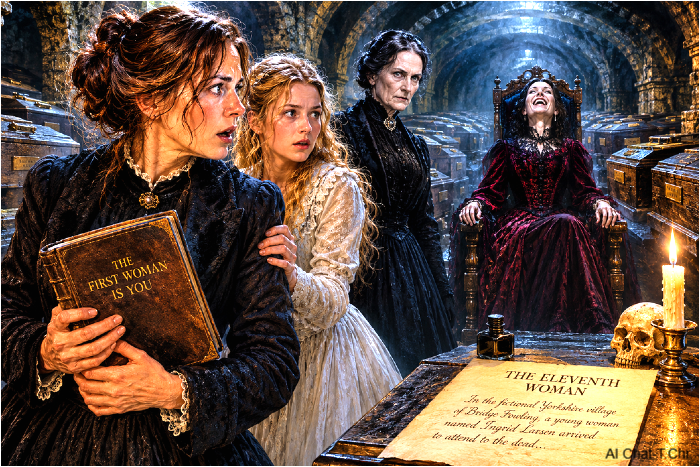
THE FIRST WOMAN IS YOU.
She stared at the sentence.
Impossible.
Her memories began to shift. Childhood scenes dissolved into unfamiliar rooms. She remembered a Yorkshire farmhouse, a winter funeral, a woman standing over a dead child.
Then she remembered the name.
Eleanor.
She had been Eleanor.
Not Ingrid Larsen.
Not entirely.
The ninth woman had been born again and again, changing her name, changing her face, but never escaping the story.
Susan approached her.
"Now you understand. I have waited nearly three hundred years for you to remember."
"Why?"
"Because only you can release them."
The floor split open.
Below it lay a vast underground room filled with coffins. Hundreds of them. Their lids bore women's names, dates and places from centuries past.
At the far end stood a single wooden chair.
Someone was sitting in it.
A woman with Ingrid's face.
The woman slowly raised her head.
"At last," she said. "The author has arrived."
Ingrid felt Eliza-May grip her hand.
"Don't listen to her, Mother."
But Susan was already kneeling.
And the woman in the chair began to laugh.
It was not a human sound.
It was the sound of someone who had been waiting three hundred years to finish writing a story.
On the table beside her lay a fresh sheet of paper.
The ink was still wet.
At the top was a title:
THE ELEVENTH WOMAN.
And beneath it, the first sentence:
In the fictional Yorkshire village of Bridge Fowling, a young woman named Ingrid Larsen arrived to attend to the dead...
Ingrid looked at her daughter.
Then at Susan.
And finally at the woman in the chair.
She understood.
The story was not repeating itself.
Someone was rewriting history.
TO BE CONTINUED — THE FINAL RECKONING.