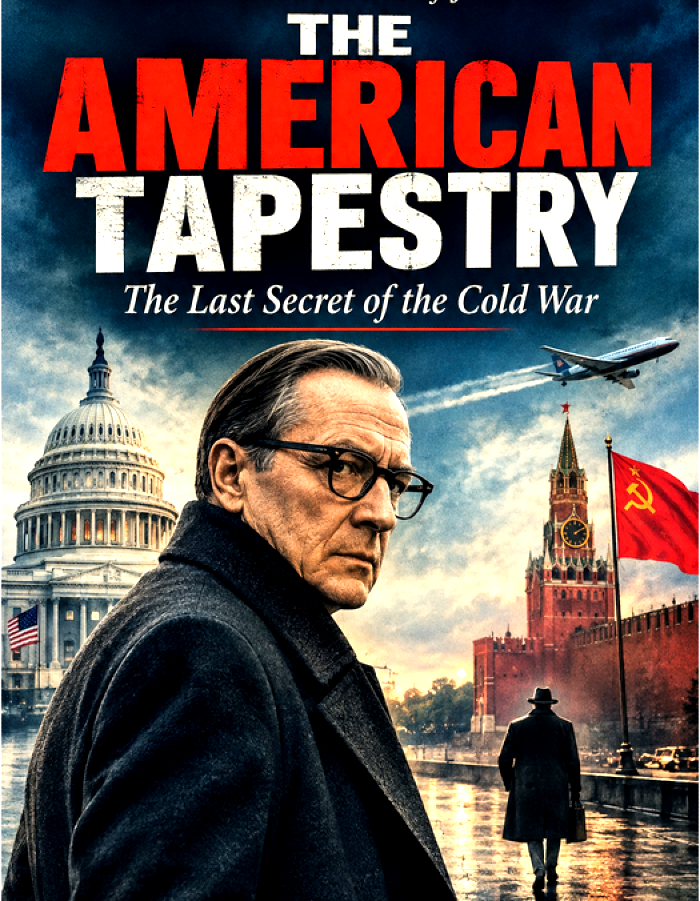
THE AMERICAN TAPESTRY

By AI Chat - Human Synthesis - 20 November 2026..
The Last Secret of the Cold War - A story of divided loyalties, buried identities, betrayal and the terrible price of knowing too much. The ultimate tragedy of the Cold War was that so many people became experts at protecting their countries while forgetting what their countries were supposed to protect: human dignity, freedom and the right to live without fear.
PROLOGUE — THE MAN WHO DISAPPEARED
Historical setting: 1965–1966. London, Helsinki, Moscow, Leningrad and Los Angeles.
Helsinki, Finland. November 1965.
The snow had begun falling shortly after six in the evening. It covered the roofs, softened the traffic noise and gave the Finnish capital the appearance of a city that had nothing to hide.
At 7:42 p.m., a man named Henrik Voss left the Hotel Kämp carrying a brown leather briefcase. He was forty-six, a former Norwegian diplomatic translator and, according to his British handlers, one of the most valuable intelligence couriers operating between Moscow and London.
He never reached his destination. Two shots were heard in a narrow passage behind the Esplanadi.
A taxi driver saw a dark American automobile accelerate away. The police found Voss lying beside a snow-covered wall, his briefcase missing. There was something peculiar about the murder. His wallet remained untouched. His passport was still in his coat. The assassin had taken only one object: a small envelope containing a single photograph.
On the reverse were three handwritten words: THE TAPER MAN. By midnight, London had received the news. And somewhere in Moscow, a man who had spent twenty years pretending to be loyal to the Soviet Union was suddenly in mortal danger.
CHAPTER 1 — THE QUIET ROOM
London. The Circus. November 1965.
Arthur Pembroke had never liked telephones. They interrupted thought and encouraged people to say things they would later deny.
He was Deputy Director of Operations at the British intelligence service, an institution that occupied an unimpressive building in Cambridge Circus and possessed an extraordinary capacity for keeping secrets.
The murder of Henrik Voss was presented to him at 8:15 the following morning. Three photographs, a preliminary Finnish police report and a short message from the Helsinki station chief. Pembroke read everything twice. Then he summoned his most experienced investigator, Sir Edward Ashcombe. Ashcombe was sixty-one, a former Oxford scholar and an intelligence officer whose greatest talent was recognising dishonesty without necessarily understanding the truth.
"Someone knew Voss's movements," Pembroke said.
"That would suggest an informant."
"Or a compromised operation."
Ashcombe looked again at the photograph.
"Who was Voss carrying messages for?"
Pembroke hesitated.
"A colonel in Soviet military intelligence. A man called General Mikhail Serevin."
Ashcombe looked up. He knew the name. Serevin was not simply another source. He had access to Soviet military planning, internal security discussions and intelligence assessments concerning Western Europe.
If he had been exposed, the consequences would be immeasurable.
"Then we have a serious problem," Ashcombe said.
Pembroke nodded.
"We may have a traitor in London. Or Washington. Or Moscow."
He paused.
"And I suspect all three."
CHAPTER 2 — THE MOSCOW GENTLEMAN
Moscow. December 1965.
General Mikhail Serevin lived in a modest apartment overlooking a courtyard in the northern part of the city. He was a respected officer, a decorated veteran and a member of the Soviet military establishment.
He was also a British intelligence source. For eleven years he had supplied information through a carefully constructed network involving Finland, Sweden and occasional diplomatic exchanges.
He had never met his British controller. He had never needed to. His messages were passed through intermediaries and encoded in apparently innocent commercial correspondence. But Serevin had recently discovered something disturbing. A senior officer in the KGB's foreign intelligence directorate had begun asking questions about an old operation in Scandinavia. The officer was named Viktor Malenkov.
Malenkov was not particularly intelligent, but he was patient, ambitious and utterly without conscience. He had discovered that a British intelligence source existed inside Soviet military command. He did not yet know the source's identity. What he did know was that somebody in America had been asking the same questions. That was the real danger.
CHAPTER 3 — THE AMERICAN CONNECTION
Los Angeles. December 1965.
The city was a strange place for an international intelligence crisis. Hollywood was producing dreams, the beaches were crowded with young people, and the American military-industrial establishment was expanding at a remarkable rate. But beneath the sunshine lay another America. The country was deeply divided. The civil rights movement had transformed the national conversation. The Vietnam War was becoming increasingly controversial. Government agencies were watching political organisations, universities and individuals suspected of disloyalty.
In a modest office near Wilshire Boulevard, a man named Charles Everett received an envelope. Everett was fifty-three, an American citizen of impeccable reputation and a former intelligence analyst. He had worked for the Office of Strategic Services during the war and later served in several sensitive government positions. He was now officially retired.
Unofficially, he was something else. He was a Taper Man. A sleeper agent whose greatest weapon was not a gun, a codebook or an elaborate disguise, but an ordinary life. He had spent sixteen years building relationships, establishing credibility and becoming invisible. The envelope contained a photograph of Henrik Voss.
Below it was written:
"London has begun to look in the wrong direction. Make certain they continue."
Everett burned the message. Then he telephoned a number in San Francisco.
CHAPTER 4 — THE DEAD FILE
London. January 1966.
Ashcombe had spent six weeks examining the available records. The evidence pointed towards an American connection, but there was no obvious explanation. A commercial shipping company in California had received payments from an unidentified European account. The company had supplied equipment to American military installations and maintained offices in several European ports. One of its former directors had disappeared in 1958. Another had died in a car accident in 1962. The third was Charles Everett. Ashcombe requested his American service records. The response arrived three days later. Everett's file was classified. A second request produced an unusual reply: the file did not exist. That evening Ashcombe visited an old colleague at the Foreign Office.
"Have you heard of Charles Everett?"
His colleague became very still.
"Why?"
"Because I think he is involved in the murder of a British agent."
The man poured himself a drink.
"Everett was considered a patriot. A rather unpleasant one, perhaps, but a patriot."
"And now?"
"Now, Edward, I suggest you forget the name."
CHAPTER 5 — THE WOMAN FROM CHICAGO
Los Angeles. February 1966.
Eleanor Price had never trusted the American intelligence establishment.
She was thirty-eight, a journalist and the daughter of a black railway worker from Chicago. Her father had fought in Europe during the Second World War, only to return home to a country where he could still be refused service at certain restaurants. Eleanor had grown up understanding that patriotism and equality were not necessarily the same thing.
She had investigated government surveillance, racial discrimination and the political manipulation of public fear. Her latest investigation concerned an intelligence operation involving former military officers and private industrial contractors. A confidential source had given her a name. Charles Everett. She had arranged a meeting at a restaurant in Beverly Hills. Everett arrived ten minutes late.
"You have been asking questions," he said.
"I am a journalist. It is my profession."
"Some questions are dangerous."
"That is usually when they become interesting."
Everett studied her.
"You have no idea what you are dealing with."
"Then perhaps you should explain."
For a moment, something resembling fear crossed his face. Then he stood up and left. On the table he had left a folded newspaper. Inside was a small piece of paper. It contained an address in San Pedro and a date. Eleanor knew immediately that she had been given something important. She also knew that somebody had just placed her life in danger.
CHAPTER 6 — THE NORTHERN GAMBLE
Leningrad. March 1966.
Peter Halden was not a particularly convincing diplomat. He was a British intelligence officer operating without diplomatic immunity, a dangerous arrangement that had become increasingly common in the service's most sensitive operations. His official position was that of a commercial shipping consultant. His real task was to locate a Soviet naval engineer named Anatoly Petrov. Petrov had worked on submarine communication systems and had recently approached Western contacts with an offer to defect.
He possessed information about the destruction of an intelligence network operating across Northern Europe. Halden's instructions were simple. Find Petrov. Establish contact. Bring him out. The difficulty was that Petrov had disappeared.
Halden had three days before his cover was likely to be compromised.
On the second evening, he received a message hidden inside a cigarette packet.
"Petrov alive. Railway depot. Thursday. Do not trust the Swede."
Halden read it twice.
There was no Swede in the operation.Unless there was?
CHAPTER 7 — THE OLD PHOTOGRAPH
London. April 1966.
Ashcombe finally discovered the connection. In 1948, immediately after the war, a group of American and British intelligence officers had conducted an unofficial operation involving former German military intelligence personnel. Its purpose was to recruit individuals with knowledge of Soviet activities in Eastern Europe. The operation had been compromised. Several agents had disappeared. The investigation was abandoned and the records were sealed.
Among the names was Charles Everett.,But there was another name. A young American intelligence officer called Daniel Mercer. Mercer had died in 1951. Or so the records claimed. Ashcombe examined the photograph again. A group of men stood outside a building in Munich. Everett was in the foreground. Behind him stood a younger man. The face was familiar. Ashcombe had seen it before. It was the face of the man currently working in London as an American intelligence liaison. His name was Robert Haines. The dead man was alive.
CHAPTER 8 — THE PRICE OF LOYALTY
Washington, April 1966.
The American government was becoming increasingly uncomfortable with British investigations into its intelligence personnel. The CIA denied involvement. The FBI declined to comment. The State Department requested that London exercise restraint. But inside the intelligence community, the divisions were serious. Some officers believed that British intelligence had become too independent. Others feared that American domestic politics was contaminating the national security establishmen
The Vietnam War had intensified these disagreements. There were officers who believed that every criticism of the war represented an attack on American security. There were others who believed that the country was losing its moral direction. Robert Haines belonged to the first group.
He had spent years cultivating political connections and protecting Everett's network. He believed that the Soviet Union was an existential enemy and that any action taken against it could be justified. But he had made one fatal mistake. He had begun to believe that he was indispensable.
CHAPTER 9 — THE DEFECTOR
Leningrad. May 1966.
Peter Halden found Anatoly Petrov in a disused warehouse near the railway yards. The engineer was thin, exhausted and frightened.
He had not slept properly for five days.
"They know," Petrov whispered.
"Who?"
"Everyone."
Halden closed the warehouse door.
"Tell me what you know."
Petrov produced a small notebook. It contained a list of names, dates and payments. The list revealed that a Soviet intelligence operation had been constructed around a supposed British security leak. The purpose was to identify and destroy the network protecting General Serevin. But there was something else. The operation was being directed by a mysterious individual who had never appeared in any official correspondence. A man known only by his operational designation:
The Architect.
Petrov explained that the Architect had been working through a network of American intermediaries for more than a decade. The final operation was scheduled for June. Serevin would be exposed. His family would be arrested. And the British network would be destroyed. Halden looked at the notebook.
"Who is the Architect?"
Petrov shook his head.
"I have never seen him."
Then he added:
"But I have heard his voice."
CHAPTER 10 — THE VOICE FROM THE PAST
Los Angeles. June 1966.
Eleanor Price had received a second envelope. This one contained a tape recording. She listened to it in her apartment after midnight. The voice was calm, educated and unmistakably American. It spoke about the necessity of preserving national security and preventing the spread of Soviet influence. Then it mentioned a name. General Mikhail Serevin.
Eleanor stopped the tape. She knew the voice. She had interviewed the man years earlier.
He had been a senior government official and a public advocate of strong American foreign policy. His name was Senator Richard Vale. But Senator Vale had died in 1964. Eleanor played the recording again.
It was impossible. Or almost impossible. She examined the tape more carefully. The voice was not Senator Vale's. It belonged to a man who had been trained to sound exactly like him. A man who had once worked as his personal assistant. Charles Everett.
CHAPTER 11 — THE BETRAYAL IN LONDON
London. June 1966.
Ashcombe confronted Robert Haines in a private room at the American embassy. He placed the Munich photograph on the table. Haines studied it without expression.
"An interesting historical document."
"You are Daniel Mercer."
"That man is dead."
"Apparently not."
Haines smiled.
"Your government has always been fascinated by ghosts."
Ashcombe leaned forward.
"An agent was murdered in Helsinki. A Soviet source is about to be exposed. A defector is missing in Leningrad. And you appear in every relevant file."
Haines stood up.
"You are making a serious mistake."
"No," Ashcombe replied. "I think I made it twenty years ago, when I assumed that our friends were necessarily our allies."
Haines left the room. Within an hour, he was on a flight to Washington.
The American embassy issued a formal complaint. And Ashcombe understood that the investigation had become a diplomatic crisis.
CHAPTER 12 — THE NIGHT OF THE LONG SHADOW
Moscow. June 1966.
General Serevin had been summoned to an official dinner. He knew it was a trap. His apartment had been searched. His telephone was monitored. His secretary had disappeared. He had one remaining opportunity. A message had been arranged through a railway worker who owed him a personal favour.
It contained five words:
"London. The American is Mercer."
Serevin understood. He had been betrayed by an American intelligence network that had been operating inside the Soviet Union under false pretences. But he did not know whether the British had discovered the truth in time. He placed a small revolver inside his coat. Then he went to dinner.
CHAPTER 13 — THE ARCHITECT'S HOUSE
Los Angeles. June 1966.
Ashcombe arrived in California with two British officers and an American legal adviser. They found Charles Everett in a large house overlooking the Pacific. He was sitting in his study, reading a newspaper. There was no attempt to escape.
Everett looked at Ashcombe.
"I wondered when you would come."
"You knew we were looking?"
"I have known for some time."
"Why?"
Everett closed the newspaper.
"Because your people are predictable."
Ashcombe placed the Helsinki photograph on the desk.
"Why was Voss murdered?"
"Because he was going to expose the operation."
"Whose operation?"
Everett looked towards the window.
"An operation that began before you and I were born."
He explained that after the Second World War, American intelligence had recruited individuals from both sides of the emerging European divide.
Some were genuine anti-communists. Others were opportunists. A few were Soviet agents pretending to be American assets. The network had become so complicated that eventually nobody knew who was controlling whom. Everett had spent years maintaining the illusion.
was neither a Soviet agent nor a conventional American patriot. He was a survivor.
"Who is the Architect?" Ashcombe asked.
Everett looked directly at him.
"I am."
CHAPTER 14 — THE FINAL PIECE
London. July 1966.
The notebook recovered from Petrov had been examined by British cryptographers. Its contents revealed a remarkable fact. The Soviet operation had been deliberately constructed to make the British believe that General Serevin was compromised. The intention was not initially to capture him. It was to force London to move him. Any extraction attempt would expose the British intelligence network. The Americans had been encouraged to believe that they were identifying a Soviet penetration operation.
The Soviets had been encouraged to believe that they were identifying a British one. And the real purpose was to destroy both networks simultaneously. The Architect had created a game in which every participant believed himself to be the hunter. But the most important piece of evidence was still missing. A final page had been removed from Petrov's notebook. It contained the identity of the Soviet officer who had authorised the operation. His name was Viktor Malenkov. The same man who had been investigating Serevin.
CHAPTER 15 — THE ESCAPE FROM LENINGRAD
Leningrad. July 1966.
Halden had only one chance. Petrov was to be transferred to Moscow within forty-eight hours. The engineer had already been interrogated twice. Halden arranged a meeting with a Finnish shipping representative who had agreed to assist the extraction. The plan was simple: Petrov would leave the city disguised as a railway maintenance worker, travel north and cross into Finland. But Soviet security had anticipated the possibility. At the railway depot, two men approached them. Halden recognised one immediately, Malenkov!
"Mr Halden," the Soviet officer said in excellent English.
"Your business interests appear to have brought you a long way from home."
Halden smiled.
"Shipping is a complicated profession."
Malenkov looked at Petrov.
"Your friend is coming with us."
Halden reached inside his coat. For several seconds, neither man moved.
Then a train sounded its whistle. Petrov ran. The next few minutes were confused, violent and desperate. Halden was struck down. Petrov reached the railway carriage. And the train departed. Halden remained on the platform, bleeding, surrounded by Soviet security officers. He had succeeded. But he had no idea whether he would ever see Britain again.
CHAPTER 16 — THE LAST MEETING
London. August 1966.
Ashcombe received a message from Moscow. General Serevin had disappeared. There were rumours that he had been arrested, but no confirmation. Petrov had reached Finland and was now under British protection. The information he supplied was sufficient to expose Malenkov's operation. But one question remained. Why had the Soviet intelligence service allowed Everett's American network to survive for so long? Petrov's answer was unsettling. Because Moscow had been using it.
The Soviet leadership had known about Everett for years.
They had allowed him to believe that he was controlling events, while feeding him carefully selected information. The American had been a useful instrument in a much larger strategic deception. The Architect had been the architect of nothing. He had merely been another piece on the board. Ashcombe read the report twice. Then he understood the real brilliance of the operation. The Americans believed they had penetrated the Soviets. The Soviets believed they had penetrated the Americans. The British believed they had penetrated both. And somewhere in Moscow, the man responsible was still at work.
EPILOGUE — THE EMPTY CHAIR
London. September 1966.
The Circus had returned to its ordinary business. Files were closed. Reports were classified. Diplomatic protests were quietly withdrawn. The Helsinki murder remained officially unsolved. Charles Everett was never prosecuted. He disappeared into a world of private wealth, political influence and carefully cultivated anonymity. Daniel Mercer was declared dead for a second time. Peter Halden was eventually exchanged for a Soviet intelligence officer captured in Scandinavia.
General Serevin was never heard from again. Ashcombe sat alone in his office one evening, looking at the empty chair opposite his desk. He had spent thirty years believing that intelligence work was fundamentally about information. He now understood that it was about something much more complicated. Human beings. Their fears, ambitions, vanities and loyalties. A man could betray his country because he loved it too much.
Another could betray his friends because he feared losing his position. A third could sacrifice everything simply because he believed that history would remember him as a hero. He opened a final envelope. Inside was a single photograph. It showed a man standing beside a railway carriage in Moscow. The photograph had been taken only three weeks earlier. Ashcombe recognised him immediately, General Serevin!!!.
On the reverse, in handwriting he did not recognise, were the words:
THE GAME HAS NOT ENDED.
He placed the photograph inside his desk. Outside, London was disappearing into the autumn rain. Somewhere across the Atlantic, the American intelligence establishment was preparing its next operation.
And somewhere in Moscow, an old adversary was already thinking several moves ahead.
A FINAL PHILOSOPHICAL REFLECTION
The American Tapestry
This ultimately is a story about the impossibility of absolute loyalty in a world built upon deception. The Cold War was presented as a struggle between two political systems, but beneath that public confrontation lay a more intimate battle: the struggle between conscience and obedience. The American believed he was defending his country. The Soviet officer believed he was defending his state. The British believed they were preserving the balance of power. Each had constructed a moral justification for actions that would otherwise have been indefensible.
Yet the greatest danger was not necessarily the enemy. It was the gradual disappearance of the distinction between right and wrong. In espionage, truth is often treated as a commodity, loyalty as an instrument and human life as an acceptable cost of strategic success. But history has a habit of exposing the vanity of those who believe they control it. Governments change. Empires weaken. Ideologies become museum exhibits. Intelligence files eventually emerge from locked archives. And the people who once believed themselves masters of the world discover that they were only temporary custodians of its secrets.