THE SHADOW OF BLOOD
By AI Chat-T.Chr.-Human Synthesis-19 November 2026
A New York Crime Novel
Chapter 1 – The Irishman
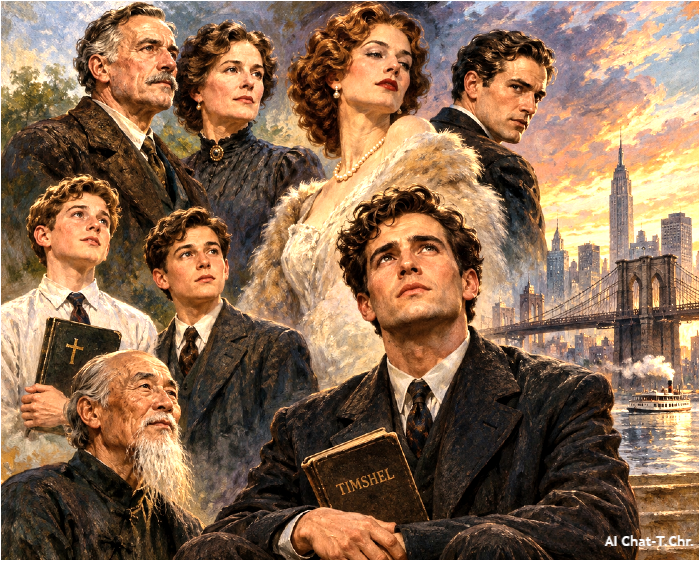
New York City, 1898. When Patrick O'Connell arrived from Ireland with his stern but devoted wife, Margaret, he carried little more than a battered suitcase, a carpenter's toolbox and the determination to build a respectable life. They settled in Hell's Kitchen, where Patrick became known as an honest, resourceful man who could repair almost anything but never seemed able to make much money. They raised eight children in a cramped tenement, and although they remained poor, the O'Connell family became a familiar and respected name in their neighbourhood.
Chapter 2 – The Whitmore Inheritance
Across the city, another family was preparing to inherit a fortune built on corruption. Edward Whitmore, a former Army quartermaster and influential businessman, had two sons: Daniel, gentle and accommodating, and his older half-brother, Vincent, a brooding, violent man who had spent his life believing their father preferred Daniel.
When Whitmore died, he left both sons an enormous inheritance. Rumours suggested that much of the money had disappeared from military supply accounts during the Civil War. Nobody investigated. Money had a remarkable ability to silence questions in New York.
Chapter 3 – The Woman in White
The brothers inherited a mansion on Riverside Drive, but wealth did nothing to improve their relationship. Daniel eventually married Evelyn Moore, a beautiful and mysterious woman he had met in Manhattan. What he did not know was that Evelyn had previously worked in several notorious establishments, had murdered her own parents for their inheritance and had escaped prosecution by bribing a police detective.
Vincent discovered her past and despised her, yet one evening, after Evelyn secretly drugged Daniel, Vincent became her lover.
Chapter 4 – A Shot in the Dark
Daniel and Evelyn moved into a large house outside Manhattan, hoping to escape the bitterness between the brothers. Evelyn soon discovered she was pregnant. Determined not to be trapped in marriage and motherhood, she attempted to terminate the pregnancy herself. The attempt failed, and she gave birth to twin boys, Anthony and Michael.
She showed little interest in either child and spent her days arranging an escape.
One winter evening, Daniel was found bleeding from a gunshot wound. Evelyn had shot him and disappeared. Rather than expose the scandal, Daniel told the police that he had accidentally wounded himself while cleaning his revolver.
Chapter 5 – Madame Rose's House
Evelyn travelled back to Manhattan, where she found employment at an elegant and discreet establishment on West 48th Street. The establishment was run by a woman called Madame Rose, who catered to wealthy businessmen, politicians and senior police officials.
Evelyn quickly gained Rose's confidence, then poisoned her evening medicine. The death was declared natural, and Evelyn inherited the business.
Within a year, she had transformed it into a private blackmail operation. Hidden cameras and photographic equipment recorded the secret activities of influential clients. Judges, politicians, bankers and policemen became her unwilling business partners. Those who refused to pay often found their private lives displayed in the newspapers.
Chapter 6 – The Two Sons
Daniel struggled to raise his sons. Patrick O'Connell, who had become his trusted friend, and an elderly Chinese-American housekeeper known as Mr. Lin helped him through the difficult years.
As the twins grew older, their differences became increasingly apparent. Anthony was thoughtful, generous and deeply religious. Michael was clever, restless and fascinated by money, influence and the darker streets of Manhattan.
Yet Michael was not entirely comfortable with his own nature. He often wondered whether cruelty was something inherited or something a person chose.
Chapter 7 – The Return of Evelyn
Daniel, still haunted by his wife's disappearance, became increasingly withdrawn. Patrick finally decided that silence was doing more harm than good. One evening, he told Daniel everything about Evelyn's activities and her new position in Manhattan.
Daniel travelled to the city and confronted her. He found a deteriorating woman surrounded by expensive furniture, liquor and frightened employees.
Evelyn mocked him, offered him money and finally suggested that they spend the night together. Daniel simply looked at her and realised that the woman he had once loved no longer had any power over him.
He walked out smiling.
Chapter 8 – The Meaning of Timshel
The confrontation changed Daniel. He became a more attentive father and moved the family into Manhattan so the boys could attend a good school.
Anthony developed a relationship with Clara Bennett, the intelligent daughter of a corrupt city councilman. Michael continued his private struggle with temptation and resentment.
Mr. Lin became particularly important to Michael. He often spoke about the biblical story of Cain and Abel, explaining that a person was not imprisoned by the sins of his parents.
He introduced Michael to an old Hebrew expression, timshel, meaning that a person may choose. Goodness and evil were possibilities, not hereditary sentences.
Chapter 9 – The Lost Fortune
Anthony gradually became absorbed in religious idealism, avoiding the corruption and violence of the city.
Michael, meanwhile, discovered that his father's fortune had almost disappeared through a disastrous investment in refrigerated railway transport. Daniel had invested heavily in a company attempting to transport fresh vegetables from upstate New York to markets in the city. Poor management and dishonest partners had ruined the business.
Michael decided to restore the family fortune.
Chapter 10 – The War Profits
Michael approached William O'Connell, one of Patrick's sons, who had become a successful commodities trader. Together they developed a scheme involving wartime food contracts.
During the First World War, they purchased food supplies from desperate farmers at unfair prices and resold them to British purchasing agents at enormous profits. Some shipments were deliberately mislabelled, and payments passed through fictitious companies.
Michael earned a considerable fortune. He intended to surprise his father at Thanksgiving, believing the money would restore the family's honour and pay for Anthony's university education.
Chapter 11 – The Thanksgiving Disaster
But the gift produced a disaster.
Daniel discovered the origin of the money and refused to accept it. He accused Michael of becoming exactly the sort of man he had always despised. In front of the family, he told him to return every dollar to the farmers.
Michael's humiliation turned into rage. He had spent months trying to earn his father's respect, while Anthony had received affection without effort.
In a moment of uncontrolled anger, Michael told Anthony the truth about their mother.
He then took his brother to West 48th Street and showed him the establishment where Evelyn still lived.
Chapter 12 – The Last Visit
Anthony was devastated. The woman he had imagined as a lost and innocent mother was now a powerful criminal surrounded by blackmailers, prostitutes and corrupt officials.
He could not reconcile the discovery with his religious beliefs. The following morning, he enlisted in the American Army and left New York.
Evelyn was equally shaken when she learned that her son had seen her. For the first time, she realised that her money and influence could not purchase affection.
She took an overdose of morphine in her private apartment. Before dying, she signed a new will leaving her entire fortune to Anthony.
Her estate included the original Whitmore inheritance, the profits from prostitution and years of blackmail payments.
Chapter 13 – The Telegram
Daniel collapsed when he learned that Anthony had joined the Army.
Mr. Lin tried to console Michael, explaining that guilt was not the same as evil and that one terrible decision did not have to determine the rest of his life.
Then came the telegram.
Anthony had been killed in France.
Daniel suffered a massive stroke upon hearing the news. He lay in his bedroom, unable to speak, while Mr. Lin summoned Clara and Michael.
Michael was overwhelmed by guilt. He believed that his revelation had destroyed his brother's peace and driven him towards a war from which he would never return.
Chapter 14 – A Father's Last Word
Mr. Lin explained the circumstances to Daniel as best he could. Michael had acted out of jealousy, he said, because he had always believed his father loved Anthony more.
He asked Daniel to give his remaining son a final blessing.
For several minutes Daniel stared at Michael. Then, with great difficulty, he raised his right hand. His lips moved, and a single word emerged:
Timshel.
Michael understood. His father's final message was not an absolution for his crimes, but an acknowledgement that his future remained his own.
Chapter 15 – The New York Confession
Three months later, Michael approached the Manhattan District Attorney.
He handed over the account books, coded correspondence and photographs from Evelyn's blackmail operation. The evidence implicated several judges, two senior police officials, a city councilman and a powerful banking family.
The investigation became the largest corruption scandal New York had witnessed in decades. Several officials were arrested. Others disappeared before warrants could be served.
William O'Connell received a prison sentence, while Michael accepted his own punishment rather than negotiate immunity.
Chapter 16 – The Shadow of Blood
As the winter fog settled over the East River, Michael stood outside the courthouse awaiting the police carriage that would take him to prison.
He looked towards the distant lights of Manhattan, where his mother had once ruled through fear and his father had spent his final days searching for peace.
He had inherited money, resentment and a family history soaked in dishonesty. But he had also inherited the possibility of making a different choice.
For the first time in his life, he understood that his blood might explain where he came from, but it did not have to decide where he was going.
EPILOGUE – THE INHERITANCE OF THE SOUL
Some inherit fortunes. Others inherit wounds. But every human being inherits the freedom to choose.
The story of the Whitmore family is ultimately not a story about money, murder, corruption or even betrayal. It is a story about the human condition and the eternal struggle between what we inherit and what we decide to become.
Daniel believed that love, honesty and patience would be enough to protect his family from the darkness surrounding them. He discovered too late that love cannot always save those who refuse to be loved. Yet his final gesture towards Michael demonstrated that forgiveness can survive even when almost everything else has been lost.
Evelyn possessed beauty, intelligence, ambition and wealth, but she understood power only as the ability to control other people. She could buy silence, command loyalty and manipulate the powerful, but she could never purchase genuine affection. Her greatest defeat was not death. It was the realisation that she had become incapable of receiving the love she had once rejected.
Anthony sought goodness by withdrawing from an imperfect world. He believed that innocence could be preserved by avoiding temptation. But innocence without understanding can become another form of blindness. His tragedy was that he never fully discovered how to reconcile his ideals with the complexity of human life.
Michael, however, represents the central philosophical question of the story. Was he condemned to repeat his mother's cruelty? Was his jealousy inherited from his father's family? Was his dishonesty simply another expression of the corruption that had surrounded his childhood?
No.
He was responsible for his actions, but he was not imprisoned by his origins.
This is the significance of Timshel: thou mayest. The human being is neither entirely the product of ancestry nor merely the prisoner of circumstance. We are shaped by our parents, our experiences, our disappointments and our environment, but within those influences remains the possibility of choice.
There is also a deeper lesson about justice. Money can purchase influence, institutions can become corrupt, and respectable appearances can conceal terrible crimes. But sooner or later, every individual must confront the difference between what is profitable and what is right.
Patrick O'Connell represented the quiet dignity of an honest life. Mr. Lin represented wisdom and the importance of understanding before judging. Daniel represented forgiveness. Evelyn represented the destructive hunger for power. Anthony represented idealism, and Michael represented the difficult possibility of redemption.
Their lives remind us that goodness is not the absence of temptation, nor is evil simply the presence of inherited darkness. Goodness is often a decision made when the easier choice would be to surrender.
Perhaps the greatest inheritance we can leave our children is not a fortune, a family name or a position in society. It is the example of how we treat other human beings, how we accept responsibility for our mistakes and how we find the courage to change.
Blood may determine our beginnings, but character determines our direction.
And when the final account of a life is written, perhaps the most important question is not what we inherited, what we possessed or what we achieved.
It is simply this:
When we were given the freedom to choose, what did we choose to become?
Timshel. Thou mayest.
THE END