AI PANIC GRIPS MARKETS AFTER DEMOCRATS’ MIDTERM SUCCESS – BUSINESS LIVE

By Guardian-Graeme Wearden-06 November 2026-07.05 GMT
Introduction: Global stocks tumble as AI panic grips markets. Fears that the Democratic Party’s blue wave in this week’s midterm elections will sink the AI investment boom are roiling markets, following heavy losses on Wall Street last night.
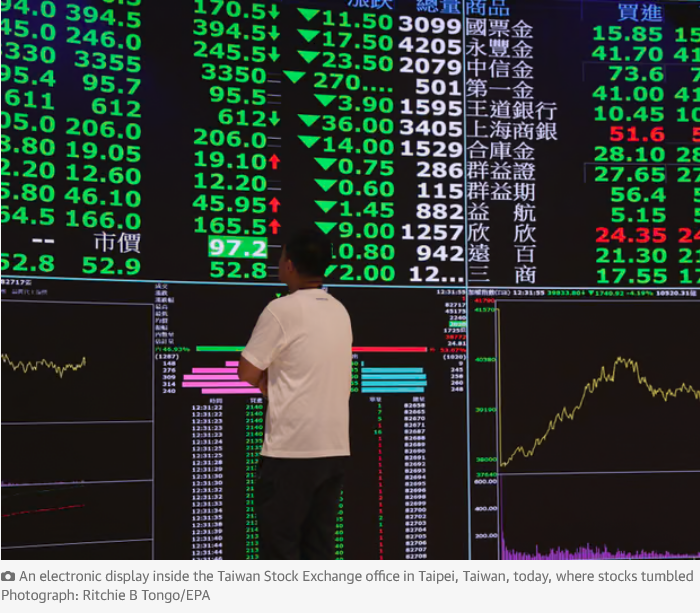
Asia-Pacific markets are a sea of red (unlike the US election map on Tuesday night!), as investors ditch tech stocks after more than $3.2tn was wiped off the US stock market yesterday.
Today, Japan’s Nikkei stock index has slumped by almost 6% – its worst drop since April 7 2025 during the ‘liberation day’ tariff panic.
South Korea’s KOSPI is down 6.7%, and Taiwan’s TAIEX has dropped by 4.5% in a broad rout.
Christopher Forbes, head of Asia and Middle East at CMC Markets, called the market action “a bit of a disaster”, explaining (via Reuters):
“(Clients) were long index, long stocks, and they all got carried out.
“All night, all day – we had client margin calls, client complaints, ... because it’s a very emotional thing, right? People are wedded to their positions and views on a stock or outcome and you’re telling them, look, you’ve just lost money.
“And it’s not just a slap in terms of valuation. It’s basically a whole policy and six-year structural shift that says we’re now going to pause, we’re now going to cool AI, we’re now going to cool data centres, approvals and equity capital markets.”
After months of warnings that AI valuations were too high, and that the bubble might burst, US investors dashed to the exits en masse yesterday. The Nasdaq tech index slumped by 5.5%, while the Dow Jones Industrial Average (DJIA) dropped 1,833.06 points, or 3.44%, and the S&P 500 lost 4.36%.
Memory chip makers, who had been profiting from the AI boom, led the fallers – SanDisk slumped 22% and both Micron and AMD lost 17% of their value.
Chip giant Nvidia led the fallers on the DJIA, down over 9%.
Analysts pointed to policy uncertainty as Democrats are more critical of data centres, which could slow the rollout of AI investment – especially given public opposition to the sector.
Kyle Rodda, senior financial market analyst at Capital.com, says it was a “brutal sell-off” as fears about the future of the AI buildout gripped the markets.
The tumble in tech stocks that took hold in the immediate aftermath of the US midterm elections resumed as investors contemplated what a Democrat-controlled Congress may mean for tech regulation and the overall AI boom.
The regulatory and political risks arise at a time when the proverbial AI trade was already on shakier foundations. Earnings season has been an overall disappointment for the markets, with Magnificent Seven results so far undershooting growth expectations and flashing warning signs that the pace of AI spending is slowing down.
So, it could be a ‘tin hats on’ day in the markets. Investors will also be watching the latest US jobs report, for clues into the health of America’s labour market.
The agenda
- 7am GMT: Lloyds house price index
- 9am GMT: UN’s FAO food price index
- 1.30pm GMT: US non-farm payrolls jobs report
- 3pm GMT: University of Michigan’s US consumer confidence report
US inflation data due next Tuesday could determie whether the sell-off continues, or not, predicts Daniela Hathorn, senior market analyst at Capital.com:
Global markets are ending a turbulent week in which the US midterm elections, concerns about AI investment and renewed uncertainty around interest rates have triggered significant volatility.
What initially looked like a technology-led correction has developed into a broader reassessment of risk, with Thursday’s sharp selloff on Wall Street highlighting how quickly concerns about one sector can spread across financial markets. Looking ahead, next week’s US inflation figures could prove decisive in determining whether equities stabilise or face another round of selling.
That inflation report will show how much pressure is building on the US Federal Reserve to hike interest rates to quash inflation….
Share15m ago11.41 GMT
The UK’s FTSE 100 share index is heading for its worst day since March despite not containing many tech stocks.
Some of the largest fallers, such as advertising group WPP (-4.9%) and data analysis form Relx (-4.44%), are companies who are thought to be under threat from AI, showing it is a broader sell-off.
Share1h ago10.59 GMT
Musk's wealth has fallen by $113bn since midterms
The post-midterms market rout has been particularly painful for Elon Musk.
Musk (who put $446m of support into Republican campaigns), has lost around $113bn of wealth in the last two days.
This is because his two largest companies have both been badly hit in the sell-off.
Tesla fell 3.34% on Wednesday, as investors reacted to the Democrats’ electoral success, then 10.7% on Thursday. Musk owns 17.7% of the carmaker.
SpaceX lost 3.8% on Wednesday, then 9% yesterday – which also hurt Musk as he owns 10.3% of it.
In total, Musk’s paper wealth fell by $33.5bn on Wednesday, and then by another $79.7bn yesterday, according to Bloomberg’s Billionaires Index.
Despite this, Musk is still the world’s richest person with a paper wealth of $785bn, more than double Jeff Bezos in second place with $370bn.
Stock markets in developing nations have hit their lowest level in seven months today.
The MSCI Emerging Markets Index is down 2.7%, touching its lowest level since April and heading for a sixth straight weekly decline, Reuters reports.
London market on track for worst day since March
The sell-off in London is gathering pace!
The FTSE 100 share index is now down 189 points, or 1.75%, to 10,593 points.
That would be its biggest one-day drop since 19 March, when the Iran war was hitting the markets.
The US dollar is strengthening today, often a sign that investors are seeking safe-haven assets.
That’s pushed the pound down by over half a cent to $1.3387.
This had been a bumper week for the pound – it hit its highest level since the Brexit vote against a basket of currencies.
Pound hits highest level since its crash after 2016 Brexit voteRead moreShare2h ago09.59 GMT
Yesterday’s slump in the Nasdaq suggests we have just seen “mass capitulation”, argues Dan Coatsworth, head of markets at AJ Bell, explaining:
[Investors have] sold tech indiscriminately, most likely to lock in any profits they’ve made in recent years given the sector’s previous superior wealth generating capabilities.
“Others might have had no choice but to sell if they’ve borrowed to buy shares. Margin calls can require leveraged investors to put up more cash or sell some of their holdings, with that forced selling adding to downward pressure on the market (as flagged earlier).
Share2h ago09.49 GMT
BlueBay: AI slowdown might help the hyperscalers
The companies rolling out AI data centres might actually benefit, in the long term, if politicians throw some sand into the wheels of the industry.
That’s because the planned pace of AI rollout has been so quick that it’s forced these hyperscalers (such as Amazon, Meta, Microsoft and Google) into hectic sales of debt and shares to fund new multi-billion dollar supply deals.
Mark Dowding of RBC BlueBay Asset Management explains that this could actually make hyperscalers a more attractive investment, saying:
Indeed, a regulatory-induced slowing of AI-related projects may actually help ensure that the pace of growth is more sustainable going forward.
Over recent months, constant upward revisions in spending plans have led to a deluge of debt and equity issuance, which has been weighing heavily on markets, with demand failing to keep pace with supply.
Should this now slow somewhat, RBC BlueBay think that spreads for hyperscalers may stabilise. Consequently, the firm consider adding exposure in that space, having previously been very sceptical of the prospects for AI-related debt over the course of the past year.
Share3h ago09.14 GMT
Wall Street futures show Nasdaq may rise
Just in: Wall Street appears to be on track for a calmer day than yesterday!
Technology shares are expected to rise a little after Thursday’s slump.
That’s based on the latest futures market data, which gives an indication of how shares might move when trading begins in New York at 9.30am EST (or 2.30pm UK time).
They show that S&P 500 e-mini futures are up 0.2%, Nasdaq 100 future are up 1.1%, but Dow Jones industrial average futures are down 0.8%
Some context: The S&P 500 is a broad measure of the US stock market, tracking companies in sectors from financials and healthcare to technology, industrials and energy.
The Dow is much narrower – just 30 large US companies.
And the Nasdaq 100 is the one hundred largest tech stocks on Wall Street (eg Apple, Microsoft, Nvidia, Amazon, Alphabet, Tesla…)
But there’s still more than five hours until Wall Street opens, so we shall see!
Chris Beauchamp, chief market analyst at investing and trading platform IG, warns there is a risk of further losses.
“Yesterday’s brutal session marked a dramatic turnaround from Wednesday, but with AI fears still prominent there is a risk that there is much more selling to come. Investors remain on watch for a potential resumption of the Iran conflict, likely to drive a risk-off move across a broader swathe of equities, and are nervously watching the oil price after its slump earlier in the week. All in all it remains a very febrile atmosphere.”
Share3h ago09.02 GMT
Reuters: Tech selloff wipes out hedge fund gains, leads to layoffs
Technology stocks have been dropping since early October, when the Nasdaq Composite hit a record high.
Those losses have been painful for hedge funds who had used borrowed money to back tech stocks (using ‘leverage’, in market jargon).
As the markets have fallen, those leverage bets will have turned sour, prompting margin calls (when your broker demands more cash or collatoral to cover a losing position).
Reuters reports:
Several large multi-manager hedge fund platforms have cut leverage and laid off loss-making teams in recent weeks, said market participants, who expect more layoffs if declines continue.
The post-US midterm market turmoil extended losses after a bruising October, when sentiment was dampened by elevated AI-related borrowing costs and worries over returns.
The Nasdaq 100 index, which contains many tech heavyweights, plunged 6.6% last month, its biggest monthly fall in 18 months. JPMorgan estimates global hedge funds lost 3% in October.
Share3h ago08.48 GMT
Jefferies: don't see Democrats giving up on AI growth engine
Interestingly, Jefferies economist Mohit Kumar doesn’t believe yesterday’s losses are “the start of the unwind of the AI trade”.
Kumar argues:
We do admit that policy uncertainty after the Blue Tsunami raises concerns over AI investment and the pace of data center buildup.
However, data centers and AI infrastructure also create jobs and Democrats would be reluctant to let those jobs move onto other states or outside the country. AI investment has been a key driver of US growth, and we do not see Democrats as giving up on this growth engine.
Datacenters were on the ballot. US voters rejected them