THE WELL OF SILENCE

By FB-AI Chat-Human Synthesis-New York Murder Mystery -November 1948
New York City, November 1948. A cold autumn rain swept across Manhattan when police received a telephone call from a resident of Chelsea.
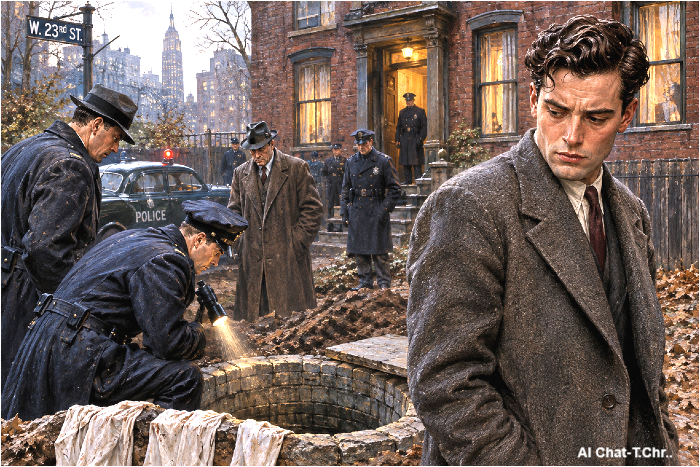
Chapter 1 — The House on West 23rd Street
Neighbours at 104 West 23rd Street had become suspicious of the owner, 27-year-old Edward Whitmore, a Columbia University chemistry graduate. He had recently announced that his mother and two sisters had died in an automobile accident while travelling north. Yet nobody had seen an obituary, funeral announcement or accident report. Edward lived with his widowed mother, Margaret, 58, and his sisters, Eleanor, 24, and Catherine, 20. To outsiders, they were a respectable Manhattan family. Behind their front door, however, relations had become increasingly strained.
Chapter 2 — The Well
At the beginning of October, Edward hired two construction workers to excavate a well in the backyard. He explained that he wanted a private water-storage system. The excavation was almost twenty feet deep. He supervised the work personally, paid the men in cash and insisted that everything be completed quickly. When the work was finished, a heavy concrete cover was placed over the opening. Nobody suspected its intended purpose.
Chapter 3 — November 4th
On the morning of November 4th, Edward put his plan into action. His mother and elder sister were shot inside the house. Their bodies were taken into the backyard and lowered into the well. At noon, his younger sister Catherine returned from her employment at a department store on Fifth Avenue. She, too, was murdered. By evening, all three bodies were beneath the garden, and Edward had sealed the opening with concrete. The following morning, he telephoned relatives in Albany, claiming that his mother and sisters had died in an automobile accident. He said he had not been travelling with them.
Chapter 4 — The Perfect Gentleman
Edward continued attending university appointments, visiting restaurants and spending evenings with his girlfriend, Laura Bennett, a nurse at Bellevue Hospital. He showed no apparent grief. When acquaintances offered condolences, he thanked them politely. The family physician, Dr. Charles Henderson, became suspicious when Edward could provide no convincing details about the accident. There was no record of any such accident, hospital admission or death. Inspector Michael Donovan of the Manhattan Police Department was assigned to investigate.
Chapter 5 — The Discovery
On November 23rd, Inspector Donovan and two detectives arrived at the brownstone. Edward welcomed them into the drawing room and repeated his story. When asked where the bodies had been buried, he claimed they were outside Albany. The inspector replied: "Mr. Whitmore, the authorities in Albany know nothing about your family's accident."
The detectives requested permission to inspect the property. Edward refused. Donovan informed him that they had grounds to obtain a search warrant. When the detectives began examining the backyard, they discovered a rectangular section of recently laid concrete. Edward suddenly excused himself to use the upstairs bathroom. Moments later, a gunshot rang through the house. He had taken his own life. The detectives continued their investigation. Beneath the concrete, they discovered the bodies of his mother and two sisters.
Chapter 6 — The Family Secret
Why had Edward committed such a terrible crime? The most widely accepted theory concerned his relationship with Laura Bennett. His mother strongly opposed their engagement because of Laura's previous romantic relationship, something considered scandalous in conservative society at the time. But there was another possibility. Edward had recently attempted to gain control of the family estate. His father had left substantial investments and property in a trust, with Margaret retaining control until her death. A letter found in her writing desk suggested that she intended to change her will.
Could financial desperation have played a part? Had Edward discovered something about his inheritance? Or was the family conflict much deeper than anyone realised? The police never established a conclusive motive. Laura denied knowing anything about the murders and left New York the following spring.
Chapter 7 — The Building That Burned
The old brownstone was eventually demolished, and a commercial building replaced it. Years passed, and the Whitmore murders gradually faded from public memory. Then disaster struck. A massive fire swept through the building, killing numerous occupants and leaving much of the structure destroyed. The tragedy revived memories of the three women who had disappeared beneath the old garden.
Some elderly residents spoke of strange sounds in the basement. A night watchman claimed to have heard a woman's voice calling from behind a locked service door. Others reported unexplained footsteps in the corridors after midnight. The building acquired a reputation as one of Manhattan's most unsettling addresses.
Three Women Beneath Manhattan
The official investigation was closed. Three women were dead, and their son and brother had escaped justice through suicide. No confession was ever found.
Perhaps the most disturbing detail was not the well, the concrete or even the murders. It was that, for almost three weeks, Edward Whitmore continued living in the same house above the bodies of the three people who had once meant everything to him.
Every morning he opened the front door. Every evening he returned home. And beneath his feet, in the darkness of the sealed well, lay the family he had destroyed.
New York had witnessed another terrible crime. But the house on West 23rd Street had taken its secret to the grave.
Chapter 8 — The Letter from the Dead
Three months after the discovery of the bodies, Inspector Michael Donovan received an unexpected visitor. Florence Miller, the former housekeeper of the Whitmore family, handed him a sealed envelope.
"Inspector, I believe you have misunderstood what happened in that house." Inside was a letter written by Margaret Whitmore the day before the murders: My dearest brother, if anything happens to me or my daughters, you must know that Edward is not the only person responsible. I have discovered something terrible about this family. Tomorrow I intend to confront him.
Donovan looked up. "Why have you waited three months?"
Florence lowered her eyes. "Because I was afraid. And because I know something about Catherine."
Chapter 9 — The Missing Daughter
Florence revealed that Catherine had secretly planned to leave New York. She was seeing a travelling salesman named Robert Hayes and was pregnant with his child. Edward had discovered the relationship. But Florence had also seen Catherine leaving the house on the night before the murders, carrying a suitcase. She had never returned. Donovan immediately questioned the original identification of the three bodies. If Catherine had escaped, whose body had been found in the well?
Chapter 10 — The Fourth Grave
The police re-examined the evidence. One set of dental records had been supplied by Edward himself, and Catherine's identity had never been independently established. The body was exhumed. It was not Catherine. It was another young woman, approximately the same age. Robert Hayes was eventually located in Philadelphia. Under questioning, he admitted that Catherine had arrived at his apartment on November 5th, frightened and carrying bloodstained clothing.
He had hidden her before arranging passage to Europe. But he had received a letter from her only weeks earlier: Dear Robert, you must never look for me. Edward is dead, but the secret remains. Mother knew what happened in 1926. Eleanor knew too. There is something in that house that must never be discovered. Your Catherine. At the bottom, in different handwriting, were six words: There were never three of us. There were four.
Chapter 11 — The Forgotten Child
Investigators searched the old brownstone foundations, which had survived beneath the newer building. Behind a bricked-up cellar wall, they discovered a metal box containing four birth certificates, photographs and letters. The photographs showed Margaret Whitmore with four children, not three. The fourth child, Elizabeth, had supposedly died shortly after birth in 1926. But the death certificate was false.
She had been secretly given away to another family. Edward had discovered the truth years later. In 1948, Elizabeth returned to New York, demanding answers. Margaret feared the scandal would destroy the family's reputation. Eleanor supported her, while Catherine secretly befriended Elizabeth. The three bodies in the well were Margaret, Eleanor and Elizabeth. Catherine had escaped.
Chapter 12 — The Man in the Photograph
Among the documents, Donovan discovered a photograph dated six days before the bodies were found. It showed Catherine standing outside a Manhattan hotel. Beside her stood a man who looked remarkably like Edward Whitmore. But Edward had supposedly died in the bathroom weeks earlier. The inspector ordered the original identification records reviewed. The dentist admitted he had supplied Edward's dental records without personally examining the body. When the police investigated the grave, they discovered that the coffin was empty. Edward Whitmore had never been buried.
Chapter 13 — The Final Warning
Donovan spent six months searching for Edward. Then, one freezing December morning, an envelope arrived at his home. Inside was a photograph of the inspector entering his office the previous afternoon. On the back, written in familiar handwriting, were the words: You should have left the well alone.
Donovan telephoned police headquarters. Before he could finish speaking, the telephone went dead. Outside, a black Cadillac stood across the street. A man in a dark overcoat stepped out, looked towards the inspector's window and slowly raised his hat. It was Edward Whitmore. Donovan ran downstairs, but the Cadillac had disappeared. On the doorstep lay another envelope containing a final message: The fourth daughter is not the only one who survived.
Epilogue — The Well Remembers
Three weeks later, Inspector Donovan disappeared. His car was found abandoned near the Hudson River. Neither he nor Edward Whitmore was ever located. Catherine's whereabouts remained unknown. The police investigation was quietly suspended, and the files were sealed. But years later, during renovation work beneath the building on West 23rd Street, workers discovered a small metal door behind the cellar wall. Beyond it was a narrow staircase leading down into darkness. At the bottom stood an old wooden chair, a table and a telephone. The telephone was still connected.
When a police electrician lifted the receiver, a woman's voice whispered:
"Is that you, Edward? They're coming for us."
Then the line went dead.
And somewhere beneath Manhattan, the Whitmore family secret was still alive.
THE END