MY FAMILY TREE TO 1580
By Geni-Tore Christiansen-Human Synthesis-31 October 2026
A brief summary of my family connections back to Skien 1580
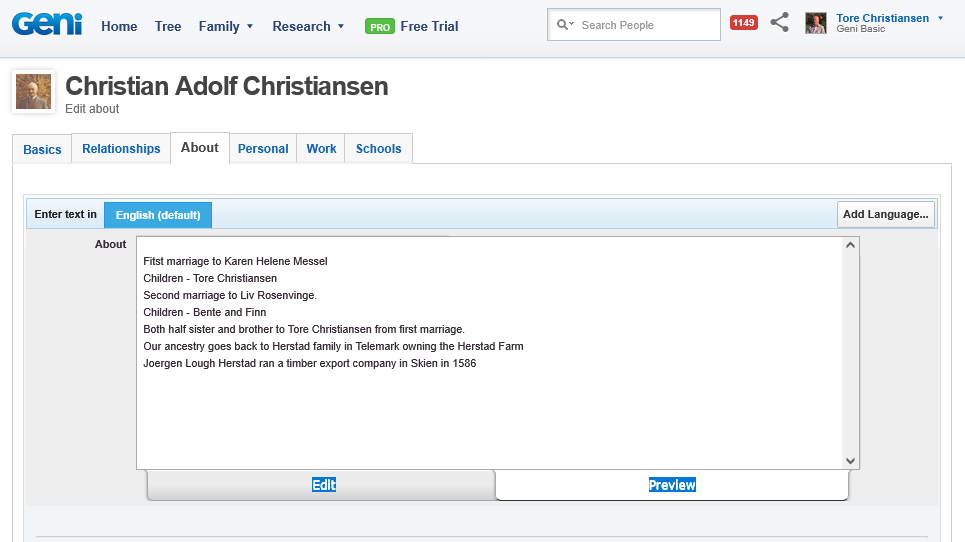
Repeating above family connection to make it more readable.
Christian Adolf Christiansen
First marriage to Karen Helene Messel
Children - Tore Christiansen
Second marriage to Liv Rosenvinge
Children - Bente and Finn
Both half sister and half brother to Tore Christiansen from first marriage.
Ancestry goes back to the Herstad family in Telemark, owning the Herstad Farm.
Joergen Lough Herstad ran a timber export company in Skien in 1586.
HERSTAD GAARD, Herstadveien, Telemark.
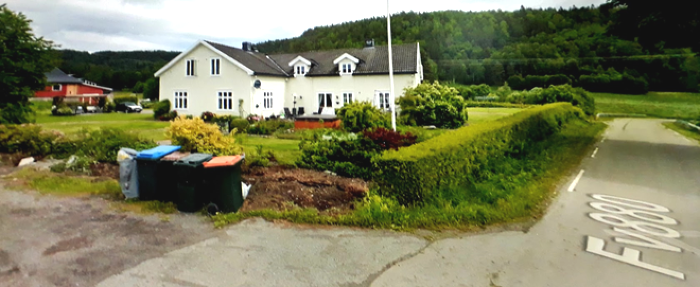
The history of Herstad Gård, Hof, Norway
The history of Herstad Gård is particularly interesting because of its connection with your paternal family and the man you have identified as your ancestor, Jørgen Loug (Low) Herstad, owner of the Herstad farm.
The important distinction is that we are looking at Herstad in Hof, in the former Vestfold region of Norway, rather than other farms carrying the Herstad name.
One particularly valuable genealogical reference is:
Jørgen Loug Herstad og hans etterkommere (Jørgen Loug Herstad and his descendants), written by Ingeborg Bjerknes, published in Oslo in 1961. It is a substantial genealogy of the family.
1. Jørgen Loug Herstad – the first known owner in your family line
Hof prestebolig i Vestfold | Allstadallstad.no
According to the genealogical records:
- Jørgen Low (Loug) Herstad: born approximately 1580, died approximately 1650.
- His wife was Else Lauritsdatter, reportedly born in 1594 in Skien.
- They married around 1615.
- Jørgen was a merchant in Skien as well as an owner of Herstad Gård in Hof.
His name appears in historical documents from 1623 and 1645. He was also mentioned in customs accounts as an importer of various goods in Skien.
lerberg.se+1
Interestingly, researchers have not established his father's identity. There is a theory that he might have been related to Hans Lou (Law or Loe), a prominent legal official in Skien and Tønsberg, but this remains unproven.
lerberg.se
2. The farm in the early 1600s
The farm was already established when Jørgen became involved with its ownership.
An interesting historical transaction is recorded in the Hof local history:
- On 25 April 1621, Jørgen lent 100 silver riksdaler to Karine Nilsdatter.
- He subsequently lent her another 100 riksdaler.
- In return, she pledged her inherited ownership share in Herstad as security.
- The transaction involved 18⅓ lispund of flour-equivalent land value (a historical land assessment measure).
This demonstrates that Jørgen was a financially active man with considerable resources for his time.
lerberg.se
3. Herstad as a working agricultural estate
The farm was more than a simple agricultural holding.
Historical records describe:
- Agricultural land and meadows.
- Extensive woodland providing timber.
- A stream and water-powered sawmill.
- A mill for grinding grain.
- Livestock and hay production.
The sawmill is particularly interesting.
Oppgangssaga på Herand - DigitaltMuseumdigitaltmuseum.no
The local historical registration records that:
- The sawmill was already mentioned in 1656.
- In 1661, 1,600 boards were sawn.
- A grain mill was also operating there.
- In 1770, records mention grinding flour for the farm's own consumption.
The remains of the old sawmill can still be found near Herstadbekken, south of Bergsvannet.
hofhistorielag.com
4. The next generation – Jørgen's sons
Nå kan du kjøpe fredet praktgård - adressa.noadressa.no
Jørgen and Else had several children. Two particularly important sons were:
Jørgen Jørgensen Loug Herstad (1616–1672)
He became a farmer at Herstad. Historical information from 1667 describes the farm as having:
- 12 cows.
- 9 young cattle.
- 10 sheep.
- 3 horses.
- Approximately 60 loads of hay production.
- Woodland and a small sawmill.
He also acquired additional ownership interests in the farm.
lerberg.se
Jan Jørgensen Loug (1620–1699)
He was associated with Herstad and later became a local sheriff (lensmann) and farmer. His descendants continued the family line.
lerberg.se+1
5. What remains of the original Herstad farm?
This is one of the most fascinating discoveries.
The Hof Historical Society registered an old storehouse (stabbur) at Herstad Gård, farm number 8, holding number 1.
Stabbur fra Nordre Gren i Sigdal -Sigdal Museum / DigitaltMuseumdigitaltmuseum.no
According to its historical survey:
- It is the only remaining building from the old Herstad farmstead.
- Its exact construction date is unknown.
- It may date from the 1700s.
- It was restored around 1990.
- It was described as being in very good condition in the 2012 survey.hofhistorielag.com
This is an important physical connection with the farm's past.
6. The most important family-history book
Jørgen Loug Herstad og hans etterkommere
Author: Ingeborg Bjerknes
Published: Oslo, 1961
Length: 95 pages
The book was subsequently reprinted by Hof Historielag. It is listed in the society's bibliography.
hofhistorielag.com+1
This is the book I would particularly like to trace for your family research.
You can find it listed here:
Hof Historielag – Books about Hof.
My conclusion
Herstad Gård was an established agricultural and woodland property with a working sawmill and grain mill in the 17th century. Your ancestor Jørgen Loug was not simply a farmer: he was also a merchant in Skien, a landowner and a lender of substantial sums of money.