THE AGE OF REASON

By FB-AI Chat-Human Synthesis-25 October 2026
The Age of Reason is a novel about a man who wants to remain free at all costs. He believes that he should never allow love, family, money, social expectations or moral obligations to dictate how he lives. The question is : Can a person truly be free while refusing to accept responsibility for the consequences of his freedom?
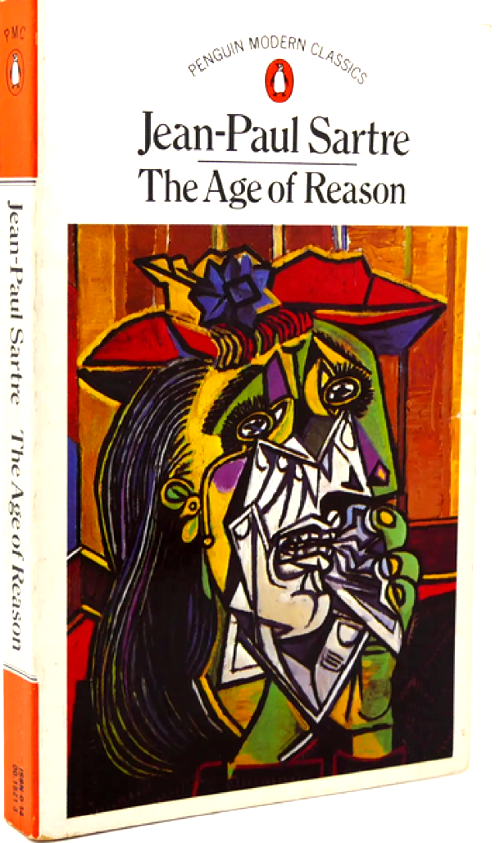
The novel's central character, Mathieu Delarue, believes he is a rational, independent man. But when his lover becomes pregnant, he discovers that his carefully protected independence is much harder to maintain than he imagined.
The book is not simply about an unwanted pregnancy or a complicated love affair. It is about the struggle between the freedom we desire and the responsibilities we would rather avoid.
1. The plot
The story takes place in Paris in the late 1930s, in a world overshadowed by political uncertainty, social change and the approach of war.
Mathieu's desire to remain free
Mathieu Delarue is a philosophy teacher in his thirties. He values his independence and believes that a meaningful life must be chosen freely rather than imposed by society.
He has a long-standing relationship with Marcelle, a woman he cares about, but he has deliberately avoided marriage. He does not want to become tied to conventional domestic life or surrender control over his future.
When Marcelle tells him she is pregnant, Mathieu faces a decision that threatens his entire philosophy.
He must consider whether to marry her, accept fatherhood, or find a way to avoid the responsibility.
What makes the situation difficult is that Mathieu does not simply lack money. He lacks a clear willingness to commit himself to any future that would limit his choices.
The search for money
Mathieu decides that money might solve the problem. If he can obtain enough, he can help Marcelle secure an abortion, allowing both of them to return to their previous lives.
He approaches people who might lend him the necessary sum. His attempts expose the contradictions in his thinking.
He wants to be independent, yet he must depend on others. He wants to make a free decision, yet he is increasingly driven by fear, embarrassment and the expectations of those around him.
The more he tries to control events, the more entangled he becomes in other people's lives.
The people around him
Mathieu's predicament unfolds through a network of relationships involving friends, lovers, family connections and acquaintances. Each person reveals a different way of dealing with freedom, desire and responsibility.
His younger brother, Jacques, represents a more conventional attitude toward life, accepting social respectability and established commitments more readily than Mathieu.
Daniel, a troubled and deeply conflicted acquaintance, provides a darker contrast. His actions expose the distance between the image a person presents to the world and the desires or motives he conceals.
Meanwhile, Mathieu's relationship with Marcelle deteriorates as their crisis reveals how differently they understand their shared future.
A crisis without a simple solution
As the novel progresses, Mathieu finds that his problem cannot be solved merely by obtaining money or removing an immediate obstacle.
His real difficulty lies in himself.
He wants the benefits of freedom without the restrictions of commitment. He wants to preserve his identity while avoiding the consequences of the choices that define it.
By the end, he has been forced into a deeper confrontation with his own evasions. Sartre does not offer a comfortable moral resolution in which every character learns the right lesson. Instead, he leaves us with the unsettling possibility that Mathieu's greatest obstacle has always been his own understanding of freedom.
2. The principal characters
Mathieu Delarue — the man who fears commitment
A philosophy teacher who wants to preserve his independence. He believes he can remain free by avoiding permanent obligations, but his choices increasingly reveal that refusing to decide is itself a decision.
Marcelle — the woman facing the consequences
Mathieu's pregnant lover. Her situation makes their relationship impossible to keep in the comfortable, undefined form he prefers. She brings the practical and emotional consequences of his philosophy into focus.
Daniel — the divided personality
A psychologically troubled character whose hidden desires and complicated motives challenge conventional ideas of identity, morality and self-control.
Jacques — the conventional alternative
Mathieu's brother represents a more socially respectable approach to life. His outlook contrasts with Mathieu's resistance to conventional marriage, stability and responsibility.
Ivich — desire and uncertainty
A young woman who attracts Mathieu and complicates his emotional life. His attraction to her illustrates how difficult it is to separate intellectual ideals from desire, jealousy and insecurity.
The novel also includes Brunet, a politically committed friend whose willingness to embrace collective action contrasts with Mathieu's individualism. Together, the characters form a study of different ways of living in a world where no single path guarantees happiness or certainty.
Google Books+2
3. Sartre's existential philosophy
Sartre uses the novel to explore philosophical questions that he developed more systematically in his work Being and Nothingness (1943).
A. Freedom is unavoidable
For Sartre, people are not born with a completely predetermined purpose. We discover ourselves through our choices.
Mathieu wants to believe that he can remain free by refusing marriage, fatherhood and permanent commitments. Yet Sartre's point is that even refusing to commit is a choice for which a person bears responsibility.
Imagine someone who says:
- I will not marry because marriage would restrict my freedom.
- I will not become a father because fatherhood would restrict my freedom.
- I will not choose a future because choosing would close other possibilities.
Such a person may preserve some options, but he cannot escape the consequences of living in the present.
Freedom does not mean having every possible choice forever. It means deciding how to act when circumstances force a choice upon us.
B. We are responsible for our choices
Sartre's existentialism rejects the idea that our identities are entirely fixed by our past, social position or supposedly permanent character.
Mathieu cannot simply say, "I am the kind of man who does not make commitments," and treat that statement as an excuse.
He continually defines himself through what he does.
This is one of the novel's central moral challenges: a person cannot escape responsibility merely by describing himself as someone who refuses responsibility.
Sartre does not suggest that all choices are easy or that people control every circumstance. Rather, he asks us to distinguish between the circumstances we inherit and the decisions we make within them.
C. Bad faith: deceiving ourselves
One of Sartre's most important concepts is bad faith — self-deception.
It occurs when we conceal our freedom from ourselves by pretending that we are merely following our nature, our social role or an unavoidable necessity.
Mathieu's belief that he must remain unattached can become a form of bad faith. He treats his preferred image of himself as though it were an objective fact that excuses him from choosing differently.
Consider the difference:
- "I cannot commit because I am simply not that kind of person."
- "I am afraid of commitment, and I am choosing not to commit."
The second statement is more honest. It recognises both the difficulty and the freedom involved.
Sartre's uncomfortable suggestion is that people often prefer an explanation that protects their self-image to an admission that exposes their responsibility.
D. Other people complicate our freedom
We do not live in isolation. Our choices affect other people, who have their own desires, needs and freedom.
Mathieu may think of his relationship with Marcelle as something he can keep separate from the rest of his life. But her pregnancy demonstrates that their lives are connected.
He cannot make his decision in a world where only his own preferences matter.
This creates a tension throughout existentialism: we are free individuals, yet we live among other free individuals whose lives cannot simply be treated as instruments for our own convenience.
Sartre's later thought increasingly emphasised solidarity and political responsibility, not merely individual independence.
Nobel Prize+2
4. What does the title The Age of Reason mean?
The title has several possible meanings, and its irony is important.
1. The age of intellectual maturity
Mathieu is an adult, educated and accustomed to philosophical reasoning. He believes that he can organise his life rationally, without surrendering to convention or sentiment.
2. The demand to take responsibility
The crisis forces Mathieu to confront the consequences of his choices. In this sense, reaching the age of reason means more than possessing intelligence: it means recognising the weight of one's decisions.
3. The irony of rationality
Mathieu is capable of explaining his philosophy, but he struggles to live by it honestly. His attempts to reason his way out of responsibility become a source of contradiction rather than liberation.
4. The end of comfortable illusions
The title suggests a threshold: the moment when a person must stop treating life as an unlimited collection of possibilities and begin confronting the reality of the life he is actually creating.
The title should not be understood simply as a celebration of reason. Sartre is also examining its limitations. Intellectual sophistication does not automatically produce courage, honesty or maturity.
5. The historical background: Europe in 1938
The novel takes place in Paris as Europe approaches the Second World War. The political atmosphere provides a larger context for Mathieu's private struggle.
While Mathieu is preoccupied with maintaining personal independence, the world around him is moving toward a crisis that will demand decisions from individuals, political movements and nations.
The approaching war raises a question that extends beyond his love life: Can a person remain detached when the world demands involvement?
Brunet's political commitment offers one alternative to Mathieu's individualism. Their contrasting positions anticipate the wider questions of action, solidarity and historical responsibility developed in the subsequent volumes of The Roads to Freedom.
PenguinRandomHouse.com: Books+2
The trilogy continues with The Reprieve, which explores the international crisis of 1938, and Iron in the Soul, which turns to France's defeat in 1940.
6. What can we learn from Mathieu's struggle?
Mathieu's dilemma is recognisable far beyond the Paris of 1938.
People often want two things that are difficult to reconcile: the security of belonging and the independence of remaining unattached; the intimacy of love and the ability to leave without consequences; the freedom to choose and protection from the results of choosing.
Sartre does not necessarily condemn independence. His deeper concern is the attempt to enjoy freedom while pretending that our decisions do not affect anyone else.
Consider these questions:
- Is a person truly free if fear determines what he refuses to do?
- Can someone love another person while refusing to accept any responsibility for that person's future?
- Is avoiding a decision a form of freedom, or merely a way of postponing responsibility?
- Does maturity mean losing freedom, or learning how to exercise it honestly?
The novel offers no universal formula for answering these questions. It asks readers to examine their own assumptions.
7. My interpretation: the paradox of freedom
I think the central paradox of The Age of Reason can be expressed in one sentence:
Mathieu wants to be the author of his life, but he fears the obligations that come with authorship.
He wants his life to remain open, as though every meaningful decision were a door that could be left permanently unlocked. Yet a life made entirely of postponed decisions can become a life that never fully takes shape.
Love, friendship, parenthood, work and political commitment all involve some surrender of unlimited possibilities. But they can also give life depth, direction and meaning.
This does not mean that marriage is always right, that parenthood is compulsory or that independence is selfish. Mathieu's problem is more subtle: he struggles to distinguish a genuine decision against commitment from an endless attempt to avoid being responsible for any decision at all.
Sartre asks us to consider whether freedom is merely the ability to escape obligations, or whether it also requires the courage to choose what we are willing to stand for.
There is a further distinction worth making. Being free does not mean being free from consequences. It means that, within the limits imposed by our circumstances, we must still confront how we respond to them.
That is why the book remains relevant. A person can spend decades protecting his independence and still discover that the most important question is not what he has managed to avoid, but what he has chosen to make of his life.
8. Final conclusion
The Age of Reason is a novel about the difference between intellectual understanding and genuine maturity.
Mathieu understands freedom as the preservation of his independence. Sartre challenges him — and the reader — to consider whether freedom becomes empty when it is separated from responsibility, honesty and meaningful action.
The book's lasting message is not that we should surrender our independence to society. It is that we should examine why we make our choices and accept that our lives are shaped by the choices we actually make, not merely by the possibilities we wish to preserve.
For further reading, the publisher's description of the novel is available at Penguin Random House, and a scholarly introduction to Sartre's philosophy is available through the Stanford Encyclopedia of Philosophy.
The question Sartre leaves us with is this: Are we using our freedom to create a meaningful life, or are we using it to avoid the responsibilities that would give that life meaning?
9.THE SHADOW OF FREEDOM
Adrian woke before dawn, although he had scarcely slept. Outside, the city was beginning its daily transformation. Delivery trucks rattled over the cobblestones, and voices rose from the street. Ordinary sounds, ordinary lives. Yet Adrian lay staring at the ceiling, wondering why his own life had become so complicated.
He had always believed that freedom meant the absence of obligations: no promises that might become chains, no declarations of love that demanded sacrifice, no decisions that closed the doors to other possibilities. Now he wondered whether he had confused freedom with escape.
On his table lay a letter from Sofia, which he had received three days earlier.
You speak endlessly about freedom, Adrian, but I wonder whether you understand what you are asking for. You want to remain free of every commitment, yet you want Elena to remain available to you. You want the comfort of knowing that someone loves you without accepting the responsibility of loving her in return.
He stopped reading. The words irritated him because they were unfair—and even more because they were not entirely unfair. Perhaps he wanted to keep Elena not as a person whose future mattered to him, but as a possibility that reassured him of his own importance.
He remembered a sentence from one of his philosophy lectures: Man is condemned to be free. He had once admired the idea. Now it seemed to contain something disturbing. If he was free, he could not blame his circumstances or temperament for his choices. Even refusing to choose was a choice, with consequences for others.
At nine o'clock, he would meet Elena. He had promised her nothing, and that was precisely the problem.
Elena waited at the café, her hands wrapped around a cup of cold coffee. When Adrian arrived, she smiled briefly.
"You came," she said.
"I said I would."
"Yes. You usually do what you say, Adrian. It is what you don't say that frightens me."
He sat opposite her. He wanted to explain his confusion, but he recognised the familiar machinery of evasion beginning to turn.
"I read Sofia's letter," he said.
"Of course you did."
"She thinks I'm selfish."
"Do you?"
He hesitated. "I think I've been afraid."
"Of me?"
"Of what loving you might require."
Elena studied him. "I don't want to own you. I don't want to control your thoughts or decide what kind of man you must become. But I cannot build a life with someone who regards every expression of love as a threat to his independence."
"I know."
"No, Adrian. I don't think you do. I am frightened too. I am frightened of wasting years waiting for a man who believes that making a decision is the same as losing himself."
Her voice remained quiet, making her words all the more painful.
"I don't know whether I can promise you the future you want," he said.
"I haven't asked you to promise me the future. I've asked whether you want to try to build one with me."
He could not answer.
Elena stood. "Find out what you want before asking me to wait any longer."
"Can I see you tomorrow?"
She looked at him sadly. "That depends on what you mean by tomorrow."
Then she walked out. Adrian remained seated, knowing he could still call her back, offer another explanation, and preserve the arrangement in which she remained close enough to comfort him but distant enough not to threaten him.
He could do so because he was free. He could also refuse, for precisely the same reason.
That afternoon, Rafael found him in the university library.
"You look like a man who has discovered a terrible truth," Rafael remarked.
"Have you ever known a man who was afraid of being happy?"
"Several. Most of them are married."
Adrian almost smiled, then described his meeting with Elena.
"You love her," Rafael said.
"I believe I do."
"That is a curious qualification."
"I don't want to lie to myself."
"Then stop using uncertainty as a hiding place."
Adrian frowned. "You make everything sound simple."
"No. I make it sound like something you must eventually face. You once told me that a man should never allow society to dictate the meaning of his life. I agreed with you. But rejecting society doesn't mean rejecting responsibility. You are not the only person who must live with your decisions."
Rafael leaned forward. "Freedom isn't a private room, Adrian. You cannot close the door and pretend that nothing outside is affected by what you do inside."
"And if I choose wrongly?"
"You probably will at some point. Everyone does. The question isn't whether you can live without regret. It's whether you're prepared to accept responsibility for the life you actually create."
Adrian looked toward the windows. Responsibility seemed an inadequate answer to the uncertainties of existence.
"There's something else you ought to know," Rafael continued. "Sofia came to see me yesterday. She's leaving the city on Friday. She's accepted a position in Lyon."
Adrian stared at him. "She never told me."
"Perhaps she thought you were too occupied with preserving your possibilities to notice that other people have lives of their own."
For the first time, Adrian felt not merely the fear of commitment, but the fear of becoming irrelevant. He had spent so long imagining himself at the centre of his own drama that he had forgotten how easily other people could move beyond his reach.
That evening, he visited Sofia. She was packing books into cardboard boxes, preparing for her departure.
"Why didn't you tell me you were leaving?" he asked.
"Because I made the decision for myself."
"That sounds like something I would say."
"Perhaps you've finally learned something from me."
Adrian sat down. "Do you think people can change?"
"Of course. The question is whether they're willing to acknowledge what they've become."
He looked at the photograph of himself, Sofia and Elena on the mantelpiece.
"I've spent years believing that if I committed myself to something, I would cease to be myself. Now I wonder whether I've ever really become myself at all."
Sofia nodded. "That is a better question."
"Do you think Elena will forgive me?"
"That's for her to decide."
"Do you think I love her?"
"Adrian, you keep asking other people to tell you what you feel. How can you expect to become free if you refuse even that responsibility?"
He looked out of the window. "I don't want to be alone."
"Then don't make loneliness the price you pay for never risking anything."
"And if I choose Elena and discover I've made a mistake?"
"Then you'll have to face it. But at least it will be a mistake you made honestly, rather than a life you never dared to begin."
He wanted to embrace her, but she was already preparing to leave. Her future had begun to take shape, and he had no claim upon it.
"Will you miss us?" he asked.
"Yes."
"Then why go?"
Sofia smiled sadly. "Because missing someone isn't always a reason to stay."
Adrian walked home through the cold evening streets. He thought about Elena's disappointment, Rafael's impatience and Sofia's half-packed boxes. Each had offered him a different reflection of himself, but none had given him the answer he wanted.
Perhaps there was no answer waiting to be discovered. Perhaps he would have to create one.
He had imagined that freedom meant keeping every door open until he could be certain which room contained happiness. But certainty never came. Behind him lay the years he had spent explaining why he could not decide. Ahead lay a future offering no guarantees.
At his building entrance, he stopped and looked up at his darkened window. For years, his solitary room had been a sanctuary where nobody could demand that he become anything other than what he already was. Now it seemed less like a sanctuary than a waiting room.
Inside, he sat at his desk and began writing to Elena.
I have been afraid that loving you would take away my freedom. I am beginning to understand that my fear has already taken something away from both of us. I cannot promise that I will never be afraid again. I can only promise that I will stop pretending my fear makes the decisions for me.
He put down his pen. It was not a declaration of eternal love or a guarantee of happiness. It was not even a promise that Elena would forgive him. But it was the first honest beginning he had made.
Adrian folded the letter and placed it beside the telephone. He would deliver it in the morning.
For once, he allowed the future to remain uncertain without using that uncertainty as an excuse to do nothing. Perhaps freedom was not the ability to escape consequences, but the courage to choose despite them.
He turned off the light. Tomorrow, he would discover whether courage had come too late.