THE FAIRY QUEEN'S FORBIDDEN KINGDOM
By Guardian - AI Chat-Human Synthesis-19 October 2026
A tale of medieval passion, dangerous enchantment, and a love that defied the laws of God and man.
Chapter One: The Knight Who Had Nothing
In the winter of 1194, when the forests of northern France stood black beneath a moon as cold as silver, a young knight named Alain rode alone through the kingdom of King Philippe. His horse was lame, his purse was empty, and the woman he had loved since childhood had married a wealthy lord who possessed three castles, six hunting dogs, and more gold than Alain had ever seen. He had once believed that courage, honour, and loyalty were enough to win a man's fortune. Now he understood that a man might possess all three and still sleep hungry beneath a hedge.
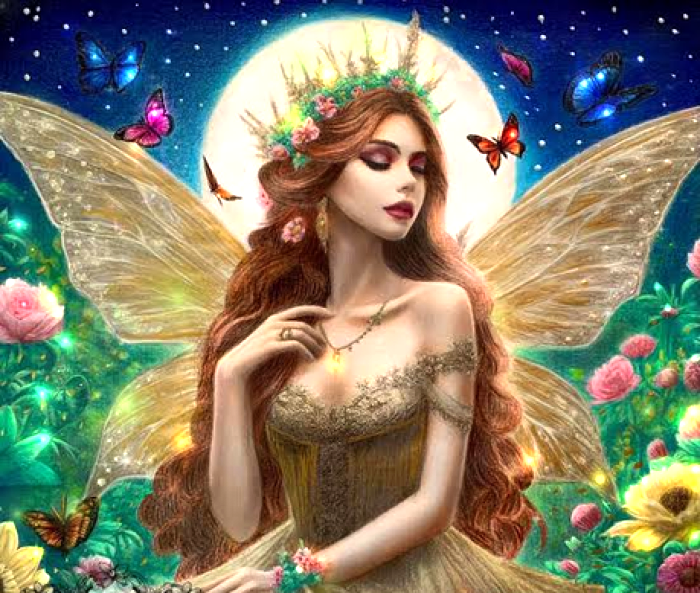
That evening, he dismounted beside a stream and watched the moon tremble in the water. "Let the Devil take this world," he muttered. "If there is another kingdom beyond these trees, I would gladly ride there." From the darkness came a woman's laughter. It was not the laughter of a peasant girl or a noblewoman amusing herself at court. It was so extraordinarily sweet that Alain felt his heart stop for an instant. He turned, reaching for his sword. A woman stood between two ancient oaks. She wore a gown of deep green embroidered with silver stars. Her golden hair fell to her waist, and her eyes possessed the strange luminosity of moonlight shining through amber. She was beautiful, but there was something unsettling about her perfection, as though nature had created her from a secret design never intended for human eyes.
"You have been cursing your fate, Sir Knight," she said. Alain bowed stiffly. "I was speaking to the night." "The night has better things to do than listen to disappointed men." "Then I apologise to the night." She smiled. "Do you know who I am?" "No, my lady." "That is fortunate. Men who know my name tend to make foolish promises." She stepped closer. The stream behind her ceased flowing, every leaf hung motionless, and even his horse stood silent. "I am Ysoria, Queen of the Western Fairies. My kingdom lies beyond that hill, although no road on your maps will lead you there."
Alain knew the old stories: fairy queens who carried handsome knights into enchanted palaces, where a single night might consume a hundred mortal years. Fairies who loved with extraordinary tenderness and punished betrayal with terrible patience. He had always considered such tales the inventions of drunken shepherds.
"Why have you come to me?" he asked. "Because you have nothing." "That is hardly a recommendation." "On the contrary. A man who possesses nothing has very little to bargain with, and therefore very little to lose."
She extended her hand. "Come with me, Alain. I can give you horses, jewels, fine clothes, and a place at my side that no king could offer. You shall never again bow your head before a man merely because he has more gold."
"And what must I give you in return?" Her smile vanished. "Your honesty. Your courage. And, when the time comes, the truth." "What truth?" "That is a question for another night."
He should have refused. Every priest in France would have warned him that the Devil often wore a woman's face. Instead, Alain took her hand. The forest disappeared.
Chapter Two: The Kingdom Beneath the Hill
Alain found himself before a palace that seemed to have grown rather than been built. Its towers rose like white trees, their branches transformed into crystal balconies. Waterfalls poured upwards into fountains suspended in the air, while thousands of lanterns floated above gardens where flowers opened and closed to the rhythm of music no mortal instrument could produce.
Beyond the palace stretched a magnificent city. Fairies rode silver horses along avenues of flowering trees. Women in gowns of blue and violet danced with men whose faces resembled ancient statues. Musicians played golden harps while couples kissed beneath curtains of scented blossoms. Yet not everyone was laughing. Behind the festivities, strange figures watched from darkened archways. Some wore crowns of black iron; others possessed eyes that glowed like embers. Their smiles concealed centuries of anger. This was no harmless kingdom of flowers and butterflies. It was a kingdom with secrets.
Ysoria led Alain to a banquet hall where a hundred guests sat beneath a ceiling painted with stars. The food was magnificent: roasted pheasant, honeyed fruits, warm bread and ruby-red wine. "Eat," said the queen. "You have been hungry for too long." For the first time in months, Alain felt no anxiety about the following morning. Then the dancing began. Ysoria approached him. "Will you dance with me, mortal?" "I have danced at weddings, my lady, and once at a harvest festival." "How dreadful for you."
They danced beneath crystal chandeliers while the musicians played a melody that seemed to enter Alain's blood. He forgot his poverty, his lost love and the cold world beyond the hills. When the music ended, Ysoria remained close enough for him to see the tiny golden flecks in her eyes.
"Are you afraid of me?" she whispered. "I should be." "But are you?" Alain considered the question. "No."
Her expression changed. For a moment, the queen looked less like an immortal enchantress than a lonely woman who had waited a very long time to hear those words. Then she kissed him. It was a gentle kiss, yet Alain felt that something immense had shifted around them. Somewhere in the palace, a bell rang thirteen times.
The queen drew back. "Now," she said quietly, "you have become interesting."
Chapter Three: The Queen Who Chose Her Own Lovers
Days passed, or what Alain believed were days. In Ysoria's kingdom, time was treacherous. The sun rose whenever the queen desired, and the stars appeared at her command. A feast might last until dawn, only for the guests to discover that dawn had arrived before midnight.
Alain learned that the fairy court possessed customs very different from those of mortal France. Marriage did not always mean possession, and desire was not necessarily a promise of lifelong devotion. Some fairy nobles loved one another for centuries, while others followed the restless call of their hearts. A prince might adore a mortal woman, a fairy queen might choose a penniless knight, and a married lord might discover that his greatest happiness lay with someone he had met only that evening. Yet the kingdom had rules. Promises made freely were sacred, betrayal was remembered, and no enchantment could prevent jealousy from taking root.
One evening, Alain was introduced to Prince Vaelor, Ysoria's elder brother. Tall, dark-haired and handsome in a threatening manner, he wore black velvet and a narrow crown of silver thorns. His face remained expressionless while everyone around him laughed and drank.
"So," he said, studying Alain, "you are the mortal who has captured my sister's attention." "I have captured nothing, Your Highness." "Wise answer." Vaelor poured himself wine. "My sister has loved kings, poets, warriors and fools. She has rescued men who later betrayed her, rewarded men who did not deserve it, and destroyed men who mistook her kindness for weakness."
"That sounds like a complicated history." "It is a dangerous one." Vaelor leaned closer. "Tell me, Sir Knight. If the queen offered you a crown, would you take it?" "I would ask why she wished to give it to me." For the first time, Vaelor smiled. "Perhaps there is hope for you after all."
Across the hall, Ysoria watched them. Beside her stood a woman with black hair braided in silver ribbons, a blood-red gown and a necklace of dark pearls. She looked at Alain as though she had been expecting him for years. Later, when he asked Ysoria about her, the queen's face grew cold.
"Her name is Morwenna." "And who is she?" "The queen of the eastern shadows." "Your enemy?" Ysoria turned away. "Sometimes." "And at other times?" "That is precisely the trouble."
Chapter Four: The Lady in the Red Gown
Alain encountered Morwenna three nights later in the palace gardens. He had wandered away from a banquet after hearing music from a distant pavilion. The melody was strange and melancholy, drawing him along a path bordered by white roses. Morwenna sat beneath a tree whose leaves were black as raven feathers.
"You have been looking for me," she said. "I did not know you existed until a few days ago." "That is not the same as saying you have not been looking." She gestured to a stone bench. "Sit with me, knight."
Morwenna regarded him with an expression that was neither friendly nor hostile.
"Tell me about your world." "What would you like to know?" "Everything you have been forbidden to say."
Alain told her of the courts of France, where men spoke of honour while plotting against their neighbours. He described marriages arranged for land, women expected to smile while strangers chose their futures, and knights who sang of devotion to ladies they had never dared to approach. Morwenna listened without interruption.
"And what do you desire?" she asked. "To live without fear of becoming nothing." "Ah." She leaned back against the tree. "That is a very mortal desire. We immortals fear the opposite." "What do you mean?" "To become everything to someone, only to discover that everything is never enough."
For a moment, Alain saw sadness beneath her formidable beauty. Then she touched his hand.
"Ysoria believes she can make you happy. She is kind, in her fashion. But she has forgotten something important." "What?" "That a cage made of gold is still a cage."
She walked away, leaving him with the scent of roses and the uncomfortable feeling that he had heard a truth he did not wish to understand. That night, he dreamed of two queens. One offered him a kingdom. The other offered him freedom. Neither told him the price.
Chapter Five: A Mortal Heart and an Immortal Promise
The trouble began when a messenger arrived from France. Exhausted and covered in mud, he carried a letter sealed with the crest of Alain's former lord. Alain broke the seal. His father had died, his ancestral estate had been sold to pay debts, and his younger sister was to be married against her wishes to a wealthy baron twice her age.
Alain read the letter twice, then turned to Ysoria. "Take me home." The queen's face tightened. "You have been here scarcely a month." "Then perhaps it is time I remembered the world I came from." "You cannot simply leave." "Why not?" "Because you made a promise." "I promised honesty, courage and the truth. I have broken none of them."
Ysoria rose from her throne. "You promised to remain until I released you." "No. You never said that." The silence was terrible. Every fairy in the hall became still. At last, Ysoria descended the steps of her throne. "You are right," she said. Alain was astonished. "I am?" "I never said it. And I will not invent a promise simply because I dislike its consequences."
She removed a small silver ring from her finger and placed it in his palm. "This will protect you from the roads between our worlds. Wear it, and you may return here whenever you wish." He looked at the ring. "Will you come with me?" For the first time since he had met her, the queen appeared uncertain. "I cannot." "Why?" "Because the moment I enter your world, every oath I have made here will begin to unravel. My enemies would rise, my kingdom would fracture, and thousands would suffer."
Alain closed his fingers around the ring.
"Then I shall return." Ysoria smiled sadly. "Do not make another promise merely because you cannot bear to leave."
He wanted to kiss her, but she turned away before he could. And so Alain rode back into the mortal world.
Chapter Six: The Wedding That Never Happened
Alain reached his father's ruined estate three days later. His sister, Elinor, was being held at the baron's castle until the wedding. She was seventeen, clever and furious.
"I will not marry him," she declared. "Then you shall not." "You have no army." "No." "You have no money." "Very little." "You have been away for weeks, and now you promise to rescue me with nothing but a sword and a broken horse?" Alain smiled. "I have also acquired a ring." She stared at him. "Have you lost your mind?" "Possibly."
That night, Alain rode to the baron's castle. He challenged the man to a duel, but the baron refused and ordered his guards to seize the insolent knight. The guards advanced. Alain raised his hand, and the silver ring began to shine. Every torch in the courtyard went out. A wind swept through the castle, though the night was perfectly still. The great doors flew open, and from the darkness came the sound of hooves.
A white horse entered the courtyard, carrying a woman in a green gown. Ysoria had come. Behind her rode twelve fairy knights, their armour glittering like ice beneath the moon. The baron stumbled backwards.
"What sorcery is this?" Ysoria dismounted. "No sorcery, Lord Baron. Merely a correction."
She looked at Elinor, who had appeared on the castle steps.
"Does this young woman wish to marry you?" The baron opened his mouth, but Elinor answered first. "No." "Then the matter is settled." The fairy queen turned to Alain. "I trust you have not been entirely idle in my absence." "I have been rather busy." "Good. I dislike rescuing men who make a habit of needing rescue."
She offered him her hand. This time, Alain did not take it immediately.
"Will you stay?" "No." "Will you return?" "Perhaps." "Do you love me?" Ysoria regarded him for a long moment. "I am a queen, Alain. I have lived longer than your kingdom has existed. I have loved more deeply than you can imagine and lost more than you could bear." "That was not my question." Her eyes softened. "Yes."
It was the simplest word she had ever spoken, and the most dangerous.
Chapter Seven: The Midnight Masquerade
News of the fairy queen's appearance spread through France like wildfire. Some claimed Alain had sold his soul; others insisted he was a saint favoured by Heaven. The priests condemned him from their pulpits, while young ladies at court whispered about the mysterious queen who had defeated a baron without drawing a sword.
King Philippe himself summoned Alain.
"I am told you command the loyalty of immortal warriors," the king said. "I command no one, Your Majesty." "Then persuade your queen to lend me her armies." Alain bowed. "I fear she would refuse." The king's expression darkened. "Every man has a price." "Perhaps, Sire. But not every woman is for sale."
Alain was dismissed from court.
That evening, he found a black envelope beneath his door. Inside was an invitation to a masquerade at the ruined Château de la Lune, where, according to legend, the fairy queens met once every hundred years to settle disputes among their kind. The invitation bore two signatures: Ysoria and Morwenna. Alain arrived shortly before midnight. The castle was illuminated by thousands of candles. Masks of gold and silver concealed the guests' faces, and musicians played beneath a ceiling reflecting a sky filled with unfamiliar constellations. He found Ysoria dancing with a silver-haired prince and Morwenna speaking with a man whose face appeared different every time he looked at him.
He discovered, to his embarrassment, that he was not the only mortal in attendance. Women wore gowns from distant centuries, men dressed as Roman emperors, and a red-haired lady claimed to have been Charlemagne's lover.
"Fairies are remarkably poor at respecting historical boundaries," she explained cheerfully.
Before Alain could reply, the music stopped. Morwenna stood upon the marble staircase.
"Tonight, we shall decide who rules the Western Gate." The crowd erupted into whispers. Ysoria stepped forward. "You have no claim to it." "Nor have you, sister." Alain looked from one queen to the other. "Sister?" Morwenna laughed. "Oh, dear knight. Did you imagine that we were merely rivals in love?"
The hall fell silent.
"We are the daughters of the first queen," she continued. "Ysoria inherited the gardens and the sunlit courts. I inherited the shadows, the dreams, and the doors that should never be opened." "And the Western Gate?" Alain asked. "Belongs to whoever can open it without destroying the worlds on either side. For three hundred years, neither of us has succeeded."
"Then why tell me?" Morwenna's smile faded. " Because the gate has begun to open by itself."
At that moment, the castle shook. Somewhere beneath the earth, a great lock turned. The candles went out, and from the darkness came a voice no living creature had heard since the beginning of time.
"At last," it whispered. "Someone has remembered my name."
Chapter Eight: The King Beneath the World
They descended a spiral staircase into the foundations of the castle. Ysoria carried a lantern of blue flame. Morwenna walked beside her, pale and silent, while Alain followed with his sword drawn. At the bottom stood a door of black stone covered in symbols older than any human language. At its centre was an empty circle, precisely the size of Alain's silver ring.
He understood. The ring was not merely a gift. It was a key.
"Do not put it in the door," Ysoria warned. "Why?" "Because whatever lies beyond must remain there." Morwenna stepped closer. "And because the creature behind that door is our father." Alain lowered his sword. "Your father?" "The first king of the fairies," she said. "He tried to rule both worlds. When the other immortal courts rose against him, he was imprisoned beyond the gate. His power has been growing ever since."
A voice emerged from the stone.
"My daughters." The words were gentle, almost affectionate. "Have you brought me a mortal sacrifice?" Morwenna trembled. Ysoria raised her lantern. "We have brought you nothing." The voice laughed. "Still quarrelling, my beautiful children? Still pretending that love is not merely another form of possession?"
The stone door began to glow. Alain looked at the ring.
"What happens if I open it?" "The two worlds will become one," Ysoria replied. "The dead will walk among the living. The immortal will rule the mortal. Every desire will become a command, every fear a weapon." "And if I destroy the ring?" "The gate will remain closed," Morwenna answered. "But so will every passage between our worlds. We shall never see the mortal lands again."
Alain thought of his sister, free at last to choose her own future. He thought of the peasants who lived beneath the baron's cruel laws, of women traded in marriage, and of men taught that tenderness was weakness. He thought of Ysoria, who had offered him wealth without demanding obedience, and Morwenna, who had warned him against a golden cage.
"Is there another way?" he asked. The sisters looked at one another. "There is," Ysoria whispered. "But it requires the one thing our father cannot understand." "What?" "Love without ownership."
Alain stared at the door. Then he did something that astonished both queens. He placed the ring upon the stone floor and stepped away.
"I will not open the gate for a king who believes that love gives him the right to possess the world."
The voice behind the door became furious.
"You are nothing! A mortal! A creature who will die before the next century has passed!" Alain drew his sword. "Perhaps. But while I live, I shall decide what I do with my own heart."
The ring shattered. For one blinding instant, the chamber filled with light. The black door cracked from top to bottom, and a sound like a thousand breaking bells echoed through the foundations. The symbols vanished, the stone crumbled, and the terrible voice fell silent. The first king was gone. The gate had closed forever.
Chapter Nine: The Last Dance of the Fairy Queen
When the three emerged from the ruins, dawn was breaking. The masquerade guests had vanished. The castle stood empty, its candles extinguished and its music silenced. Outside, the first birds sang in the trees.
Morwenna approached Alain.
"You have destroyed our passage between the worlds." "Yes." "You will never see us again." "I know." She studied him, then laughed softly. "Perhaps my sister chose more wisely than I thought." She kissed his cheek. "Farewell, mortal knight. May your brief life be longer than your fears."
Then she walked towards the eastern woods and disappeared among the shadows.
Ysoria remained. Alain turned to her.
"I am sorry." "For what?" "For the ring. For your kingdom. For everything." She shook her head. "You have given up a great deal for people you barely know." "That is what people are supposed to do for one another." "Are they?" "At least, that is what I hope."
Ysoria smiled. For the first time, she seemed entirely free of the weight of her crown. They walked together through the forest until they reached the stream where they had first met. The water flowed again, reflecting the pale morning sky.
"I could remain here," she said. "I could live among mortals, grow old beside you, and watch the seasons change." Alain's heart leapt. "Would you?" She touched his face. "No." He looked away. "But I shall remember you," she continued, "and you shall remember me. Sometimes that is more precious than possession."
She kissed him once, gently, and stepped back. The air around her shimmered. Her green gown became a mantle of leaves, and her golden hair caught the morning light. For a moment, Alain saw not a woman but something vast and ancient, a being whose life stretched back beyond the first castles, the first kings and the first human songs. Then she was gone. Only a single white rose remained upon the grass.
Epilogue: The Book of Forgotten Loves
Alain lived for many years. He restored his father's estate, protected his sister's freedom, and became known as a knight who refused to fight for causes he did not believe in. He never married, although several noblewomen attempted to persuade him otherwise. He told no one the full story of the fairy queens.
Late at night, when the wind moved through the trees and the moon shone upon the stream, he sometimes heard distant music. On such nights, he would take the white rose from its wooden box and sit beside the water. Sometimes, just before dawn, a woman in a green gown appeared among the trees. She never stayed long. They spoke of little things: the changing seasons, the folly of kings, and the extraordinary stubbornness of mortal men. Once, she told him that Morwenna had become the ruler of the eastern shadows and had taken a mortal poet as her companion.
"Is she happy?" Alain asked. "She says she is bored," Ysoria replied. "For Morwenna, that is practically the same thing." He laughed, then the queen grew quiet. "Do you regret it?" she asked. "What?" "Choosing the mortal world."
Alain considered the question. He thought of the years that had passed, of the friends he had buried, the pleasures he had enjoyed, and the grief that had taught him the value of happiness.
"No," he said. "But I regret that I could not keep you." Ysoria sat beside him and took his hand. "Perhaps you never had to keep me. Perhaps it was enough that, for a little while, we chose one another."
They watched the sun rise. Then she vanished, as she always did.
Alain lived until his hair turned white and his hands trembled too much to hold a sword. When he died, his servants found him beneath the old oak tree beside the stream, with the white rose resting upon his chest. They buried him in the churchyard, but the grave remained empty. On the night after his burial, shepherds saw a procession of silver horses riding through the forest. At its head sat a beautiful woman in a green gown, her golden hair shining beneath the moon. Behind her rode an elderly knight in a dark cloak. He was laughing.
As the procession passed beneath the ancient trees, the shepherds heard a voice singing a song in a language no mortal had spoken for a thousand years. The next morning, there was no trace of the riders. Only a white rose lay upon the knight's grave. From that day forward, the people of the valley told their children that the fairy kingdom had not been destroyed after all. It had merely moved beyond the reach of kings, priests, and men who believed that love was something they could own.
Somewhere beyond the hills, the fairies were still dancing. Their queens were still choosing their lovers. Their knights were still losing their hearts. And every hundred years, when the moon turned silver and the forests fell silent, the gates between the worlds trembled in their sleep.
For desire, once awakened, is a difficult thing to imprison. And magic, like love, has never been very good at obeying the rules.