THE HOUSE WHERE JOHANNA NEVER REALLY LEFT
By FB-AI Chat-Human Synthesis-17 October 2026
A story of silence, survival, and the lives abandoned along Norway’s Sognefjord
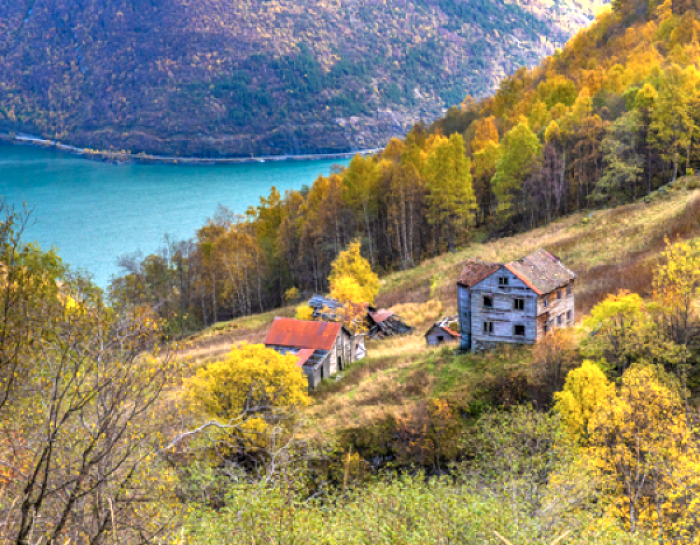
The first thing you notice about Nundalen is not what remains. It is what is missing.
There are no roads winding between the houses, no engines breaking the silence, no distant voices calling from one garden to another. There are no lights in the windows, no smoke rising from chimneys, no children running down to the water, and no dogs barking at strangers approaching the village.
There is only the mountain, the fjord, the dark shapes of old buildings, and the extraordinary feeling that something has happened here which the world has simply forgotten.
Yet Nundalen was not always a ghost village.
For centuries, people lived here. They were born in these houses, grew old beneath these roofs, raised children, buried their dead, and fought their daily battles against a landscape that offered little comfort to those who wished to survive. They worked, loved, quarrelled, celebrated, suffered, and endured. Their lives were not remarkable by the standards of their own time. They were simply Norwegian lives, lived in one of the most beautiful and unforgiving corners of the country.
And then, gradually, the people disappeared.
The village remained.
The houses remained.
And the things people left behind began to tell a story of their own.
I. ARRIVING AT GHOSTLY HOUR
I have decided to visit Nundalen at night.
There seems to be little point in exploring a ghost village in the cheerful light of an ordinary afternoon. A place like this deserves a different hour, when the world beyond the mountains has gone quiet and the imagination is free to wander among the shadows.
The roadless village lies deep within the landscape of the Sognefjord, Norway's great western fjord, where steep mountains descend towards dark, cold water. Here, the geography has always dictated the terms of human existence. The mountains are not merely scenery. They are barriers, walls, and silent witnesses. The fjord is not merely beautiful. For generations, it was a highway, a source of food, and the connection between isolated communities and the wider world.
I approach Nundalen in the fading light of a Norwegian summer night.
The sky refuses to become completely dark. Far to the north, summer holds the night in its pale embrace, leaving a thin, silvery glow above the mountains. The water reflects the last traces of light, and the outlines of the abandoned buildings emerge slowly from the darkness.
At first, the village looks almost peaceful.
Then I notice the silence.
It is not the ordinary silence of a place where nobody happens to be speaking. It is the silence of a place where nobody has spoken for years.
The houses stand in their old positions, their windows dark, their walls weathered by rain and wind. Grass has grown where feet once passed. Vegetation presses against the buildings. Wooden fences lean at uncertain angles, and paths that once connected one home to another have begun to surrender to the land.
I imagine the last people who walked here.
Perhaps one of them carried a bucket. Perhaps another was returning from the shoreline. Perhaps someone stood in a doorway, looking towards the fjord, wondering what tomorrow would bring.
They could not have known that their ordinary movements would one day become the subject of speculation by strangers.
They were not living in history.
They were simply living.
I step towards one of the houses.
Somewhere in the darkness, a piece of timber creaks.
I stop.
The sound is small, almost ridiculous, but in Nundalen even the smallest noise seems important. A building settles. A loose board moves in the night air. Something brushes against the outside wall.
The imagination immediately begins its work.
I have come looking for a ghost village, and the village appears willing to oblige.
II. JOHANNA'S HOUSE
The house belonged to Johanna, an elderly woman who lived here until 1961.
That date stays with me.
It is tempting to think of abandoned settlements as belonging to a distant past, to a Norway of black-and-white photographs, wooden shoes, primitive farming, and people who never travelled farther than the next valley.
But 1961 was not the Middle Ages.
The world already had television. Commercial aviation was expanding. Cars were becoming increasingly common. Cities were growing, factories were producing goods in quantities unimaginable to earlier generations, and modern life was accelerating across Europe.
Norway itself was changing rapidly.
And yet Johanna was still living in this remote house, in a village without a road, surrounded by a landscape that had shaped the lives of her ancestors for centuries.
While the modern world hurried forward, time moved differently here.
I stand at the entrance and look inside.
The darkness makes it difficult to distinguish details at first. The rooms seem to hold their breath. The air has the stillness of a place that has been closed to ordinary human life, where the smells, sounds, and daily habits of a household have slowly been replaced by damp timber, dust, and decay.
I imagine Johanna moving through these rooms.
How many times had she crossed this floor?
How many mornings had she opened the door and looked out at the weather? How many evenings had she sat near a window while the light faded over the fjord?
Perhaps she had a favourite chair. Perhaps there was a table where she prepared food, mended clothing, or sorted the small possessions that accumulate over a lifetime.
Perhaps she had kept things because they might be useful one day.
People who live far from shops and services often learn not to throw things away casually. A length of rope, a broken tool, an old container, a piece of cloth: each might have a second life. When replacement is difficult, even an apparently worthless object can retain its importance.
The houses of abandoned settlements often preserve traces of this mentality.
A room may contain objects that no museum would consider valuable. Yet together they reveal a way of life that has nearly vanished.
A worn chair tells us that somebody sat down to rest.
A cooking pot suggests a meal prepared countless times.
An old implement hints at work repeated through the seasons.
A coat left hanging may make us wonder whether its owner expected to return.
And an ordinary object can suddenly become extraordinary when we realise that nobody has touched it for decades.
What did Johanna leave behind?
What was important enough to keep?
What did she carry away when she finally departed?
And what did she believe would happen to the house after she was gone?
I cannot know her private thoughts. The house cannot answer my questions. But the uncertainty makes the place more powerful, not less.
For the mystery of Nundalen is not that we know nothing about the people who lived here.
It is that we know enough to understand how much we have lost.
III. THE WOMAN WHO LIVED ON THE EDGE OF THE WORLD
To understand Johanna's life, we must first understand the place in which she lived.
In modern Norway, distance is usually measured in kilometres and minutes. A journey is planned according to roads, ferry schedules, fuel, and the condition of the vehicle.
For the people of Nundalen, distance had a different meaning.
A destination could be close as the crow flies and still be difficult to reach. A mountain might make a neighbouring settlement effectively inaccessible. A journey that appears short on a map could require a boat, a climb, careful timing, and favourable weather.
The fjord could connect people, but it could also isolate them.
A storm could make travel dangerous. Rain and cold could turn a familiar route into an ordeal. Supplies could not always be obtained when needed, and outside help might be far away.
Everyday life required planning, patience, and physical effort.
Food had to be produced or obtained. Animals needed care. Buildings needed maintenance. Clothing had to be repaired. Tools had to be kept in working order. Children had to be raised, and the elderly had to be cared for.
There was little room for the careless waste of time or resources.
The landscape offered beauty, but beauty was not enough to feed a family.
A patch of useful land mattered more than a spectacular view. A safe landing place could be more valuable than a magnificent mountain. A dry roof could mean the difference between comfort and misery during a long winter.
The people who lived here were not romantic figures posing in a landscape.
They were practical people confronting practical problems.
And yet, there must also have been moments of astonishing beauty.
Imagine an early summer morning when the mist rises from the fjord and the mountain walls appear to float above the water. Imagine the first clear day after a week of rain. Imagine the sound of a boat approaching, bringing news from another settlement, perhaps a letter, a visitor, or supplies that had been eagerly awaited.
In a place where life could be lonely, the arrival of another human being might transform an entire day.
Perhaps neighbours visited one another whenever circumstances allowed. Perhaps news travelled along the fjord faster than the weather. Perhaps family stories were told so often that children could repeat them before they understood their meaning.
Every settlement develops its own world.
People learn who can be trusted, who is good with tools, who knows the weather, who can be relied upon in an emergency, and who will offer help without expecting immediate payment.
In an isolated village, these qualities are not merely pleasant characteristics.
They are part of survival.
Johanna would have understood this world. She would have known the landscape not as a visitor knows it, but through the accumulated experience of countless ordinary days.
She would have known how the weather could change, how the seasons affected the work, and how the fjord looked under different skies.
The mountains might have appeared timeless to a stranger.
To her, they were part of the practical geography of life.
And perhaps that is why the thought of her departure feels so significant.
When Johanna left Nundalen, she did not merely leave a building.
She left a world that had helped define who she was.
IV. THE HOUSE THAT WAITED
There is something unsettling about an empty house.
A ruined castle is easy to understand. It belongs to another age, and its broken walls seem appropriate to the passage of centuries.
An abandoned home is different.
It was designed for people. Its rooms were arranged around the movements of daily life. Doors were placed where someone needed to pass. Windows were built to admit light. Shelves and cupboards were intended to hold useful things. The hearth or stove provided warmth. The table gathered people together.
Everything had a purpose.
Then the people disappeared, and the purpose remained without anyone to fulfil it.
The house became a question.
Why is nobody here?
Who was the last person to sleep in this room?
What was the last meal prepared in this kitchen?
Did the final departure take place quietly, with time to pack belongings and say goodbye? Or was it hurried, forced by illness, family circumstances, or a decision that could no longer be postponed?
The appearance of abandonment can suggest haste, but appearances alone do not tell us exactly what happened.
A house may be left behind over several days. Valuable possessions may be removed while less useful objects remain. Furniture may be too heavy to transport. Tools may be given away. Things that once mattered deeply may become inconvenient burdens.
Sometimes a house is abandoned because the owner has died.
Sometimes the family has moved to a town.
Sometimes the next generation has no wish to continue the old way of life.
And sometimes the decision is made because the practical disadvantages have become impossible to ignore.
Whatever the reason, the building enters a new existence.
Rain finds its way through damaged roofing. Frost works into cracks. Timber expands and contracts. Metal rusts. Plants grow close to the walls, and roots begin to disturb the ground around foundations.
The house slowly becomes part of the landscape again.
But before that happens, there is a strange interval when it seems almost ready to receive its former occupants.
A chair remains where someone left it. A doorway still frames the view it once framed. The floor remembers the arrangement of the rooms, even if the people who crossed it are gone.
The house is neither fully alive nor completely dead.
It is waiting.
Perhaps that is the real source of the ghostly atmosphere in Nundalen.
Not the possibility of supernatural visitors, but the persistent suggestion of human presence.
We look at an empty chair and imagine somebody sitting there.
We see a doorway and picture a person appearing in it.
We enter a room and instinctively lower our voices, as though we might disturb someone who is sleeping.
The mind restores the missing inhabitants because the architecture itself invites us to do so.
And in Johanna's house, the effect must be particularly strong.
She lived there until 1961. The distance between her life and ours is shorter than the distance between her life and the world of her great-grandparents.
Yet the difference between the two worlds is enormous.
That is what makes the house a time machine.
V. WHEN THE MODERN WORLD PASSED BY
During the twentieth century, Norway underwent profound changes.
Road networks expanded. Public services developed. Education opened new possibilities. Industry, commerce, and urban employment drew people away from small rural communities.
For younger generations, life in a remote settlement could begin to look less like an inheritance and more like a limitation.
A young person might leave to attend school.
Another might seek employment in a town.
Someone else might marry and establish a household elsewhere.
A family might move because caring for an elderly relative had become difficult. Another might leave because farming or other traditional work no longer provided a sufficient livelihood.
Each departure could seem entirely reasonable.
Nobody needed to announce the end of the village.
It could happen one decision at a time.
A child left for school and never returned permanently. A young man found work elsewhere. A daughter moved to a larger community. An older couple could no longer maintain their property. A house stood empty after a death, and no relative wished to occupy it.
The population diminished, and with it the number of people available to maintain the shared life of the settlement.
When there are fewer residents, every remaining household must carry a greater burden. There may be fewer neighbours to help with difficult work, fewer children to keep local traditions alive, and fewer people to justify the effort of maintaining shared facilities and transport connections.
Isolation becomes more difficult as the community shrinks.
The final residents face a particularly painful choice.
They can remain in the place they know, accepting the disadvantages that come with declining services and increasing isolation.
Or they can leave for somewhere more convenient, where medical assistance, shops, transport, and family members may be easier to reach.
It is easy for outsiders to describe such departures as inevitable.
For the people making the decisions, they are rarely simple.
Leaving means abandoning familiar surroundings, but it may also mean gaining security, opportunity, companionship, and a less demanding daily life.
The choice can involve relief and grief at the same time.
Perhaps someone leaving Nundalen looked back at the house and felt that a chapter of life had ended.
Perhaps someone else felt only that the time had come.
We should not assume that every departure was a tragedy. Nor should we pretend that every resident wished to remain.
The truth is likely to have been more complicated.
A place can be loved and still be difficult to live in.
A house can contain a lifetime of memories and still become too much to maintain.
A person can miss the old world while being grateful to have escaped its hardships.
And yet, when the last people depart, the settlement loses something that cannot be restored simply by repairing the buildings.
It loses the daily exchange between human beings that made it a community.
Nundalen's houses remained, but the world that had connected them was disappearing.
VI. THE NIGHT VISITOR
I move deeper into the village.
The light has faded further, and the shapes of the buildings have become harder to distinguish. There is still enough brightness to see the outlines of the roofs and the uneven paths between the houses, but the details are disappearing.
The village seems larger at night.
In daylight, a deserted settlement can be examined with the detached curiosity of a historian or photographer. We notice the construction of the buildings, the condition of the walls, and the relationship between the houses and the landscape.
At night, the same place becomes something else.
The distance between one building and another feels greater. Every dark window becomes an opening into an unknown room. The mountains appear closer, and the fjord seems to hold the entire village in a deep, black silence.
I imagine a light appearing in one of the windows.
Not a modern electric light, but the glow of a lamp, perhaps a candle, illuminating a small area of a room.
Behind it, someone moves.
A shadow crosses the wall.
A chair scrapes across the floor.
Then the door opens, and an elderly woman looks out into the night.
For a moment, Johanna is no longer a name attached to an old house.
She is a person.
She has a face, a voice, a history, and a life that existed independently of anyone who might one day come to investigate the abandoned village.
Perhaps she was strong and independent. Perhaps she worried about her health. Perhaps she enjoyed visitors, or perhaps she valued the quiet. Perhaps she was cheerful, or perhaps she carried sorrows that nobody else knew about.
We cannot fill these gaps with certainty.
But we can recognise that she was more than a symbol of an old Norway.
She was an individual who experienced the world from a particular place, at a particular time, under circumstances we can only partly reconstruct.
That thought changes the way I look at the house.
The darkness no longer belongs to ghosts.
It belongs to memory.
A sound comes from somewhere behind me.
I turn.
Nothing.
The old buildings stand motionless, their windows black.
The sensible explanation is simple: wood moves, wind stirs vegetation, and unfamiliar surroundings sharpen our hearing.
Yet I cannot entirely escape the feeling that the village is occupied.
Not by spirits, but by the countless human lives that once filled these rooms.
Every house has its invisible inhabitants.
Every abandoned room contains the possibility of a memory.
And perhaps the most haunting thing about Nundalen is that the people who lived here did not know they were leaving behind a ghost story.
They were simply getting on with their lives.
VII. WHAT THE OBJECTS REMEMBER
Imagine entering an abandoned house and finding a small collection of ordinary possessions.
There might be a plate, a bottle, a worn piece of clothing, a wooden box, or a tool whose purpose is immediately obvious to anyone familiar with traditional work.
None of these objects would necessarily be worth much money.
Yet each has a history.
The plate was held by somebody's hands. The bottle once contained something that was needed or enjoyed. The clothing protected a body against cold and rain. The box stored something that mattered enough to keep. The tool was used to perform a task that had to be completed.
Objects acquire meaning through use.
A new object is full of possibilities. An old object has accumulated evidence of what actually happened.
Its worn surface tells us that it has been handled. Its repairs reveal that somebody cared enough to extend its life. Its presence in a particular room may suggest how that room was used.
The evidence is incomplete, of course. We should be careful not to invent a story simply because an object invites one.
But when many small clues are considered together, they can reveal a great deal about daily life.
An abandoned village is, in this sense, an accidental archive.
Unlike an official archive, it was not assembled to preserve history. Nobody selected its contents according to their importance to future generations. The objects remain because they were left behind, overlooked, forgotten, or too inconvenient to remove.
That makes them especially revealing.
They preserve the unplanned details of ordinary existence.
History books often tell us about kings, governments, wars, inventions, and great social changes. Such subjects are important, but they do not always show us how people experienced those changes inside their homes.
The abandoned house offers another perspective.
Here, history is not a sequence of political events.
It is a room where someone prepared meals.
It is a place where clothes were dried after a wet day.
It is the corner where a person sat to rest tired legs.
It is the cupboard where useful things were kept.
It is the doorway through which a family entered and left, year after year.
The objects are modest, but the lives surrounding them were not.
To the people who owned them, these possessions belonged to the ordinary business of being alive.
Only later did their ordinary nature become historically significant.
VIII. THE LAST WINTER
I find myself wondering what the final winter in Nundalen was like.
Perhaps it was much like any other winter, with the same familiar work, the same concerns about the weather, and the same determination to make it through until spring.
Or perhaps the end was already approaching.
Perhaps there were fewer neighbours to visit. Perhaps some houses had been empty for years. Perhaps the sounds that once marked the village's daily rhythm had become less frequent.
A place does not need to be completely deserted to begin feeling abandoned.
Sometimes the transformation starts when the first house remains dark for too long.
The next empty house changes the atmosphere further.
A familiar path becomes less travelled. A garden is no longer maintained. A fence collapses and is not repaired. The absence of children becomes noticeable. The community's old routines begin to lose their purpose.
The remaining residents must have understood, at least in part, what was happening.
They could see which families had left. They knew which houses were no longer occupied. They could recognise the gradual weakening of the ties that had held the settlement together.
But nobody can know precisely when the end of a community begins.
There is no official announcement when the balance tips from a living village to a place that is merely inhabited by its last few residents.
Perhaps one year still feels normal.
The next year feels different.
And then, eventually, the question is no longer whether the village will survive in its old form.
The question is who will leave last.
For Johanna, the year 1961 marks the end of her residence in the house at Hagen.
We should not assume that her departure was the final departure from every building in Nundalen. A village can empty gradually, and individual houses may have different histories.
But her date gives us a powerful point of reference.
In 1961, she was still there.
The house was still a home.
Whatever its limitations, whatever difficulties accompanied its isolation, it belonged to a living person who had made a life within its walls.
At some point, that life moved elsewhere.
And the house began its long transition from home to relic.
IX. A VILLAGE WITHOUT A ROAD
A road is more than a strip of asphalt.
It is a promise of connection.
It allows goods to arrive, people to visit, children to travel, workers to commute, and emergency services to reach those who need them. It changes the practical relationship between a settlement and the rest of the country.
For a roadless village, the absence of that connection shapes nearly every aspect of life.
Travel must follow the possibilities offered by the landscape. Water may be the most practical route, but it depends on boats, weather, and safe access to the shore. Walking routes may be steep, difficult, or unsuitable for transporting heavy goods.
An isolated settlement can flourish for centuries under such conditions, particularly when its inhabitants have the skills and resources to support one another.
But the same isolation becomes a disadvantage as society changes.
Modern expectations are different from those of earlier generations. Access to medical care matters increasingly as people grow older. Education requires travel. Employment may be available only elsewhere. Maintaining buildings and moving supplies can become expensive or exhausting.
The absence of a road may once have been an ordinary fact of life.
Later, it can become a reason to leave.
There is a certain irony in this.
The same landscape that helped preserve Nundalen's distinctive character also made it vulnerable to abandonment.
The mountains protected its remoteness, but they limited access. The fjord connected it to the world, but the connection was not always convenient. The houses sheltered generations, but maintaining them required effort that could no longer be justified.
Nature did not drive the inhabitants away by itself.
Neither did modernisation alone.
The transformation came from the meeting of geography, economics, changing expectations, family circumstances, and individual choices.
This is what makes the village more than a picturesque ruin.
It represents a dilemma experienced by communities in many parts of the world.
How do people preserve a way of life when the conditions that once sustained it have changed?
How much hardship should a person accept in order to remain in a beloved place?
And what happens when the younger generation chooses a different future?
There are no easy answers.
But in Nundalen, the questions are written into the empty houses.
X. THE PEOPLE WHO NEVER LEFT
The residents may be gone, but their relationship with Nundalen did not necessarily end when they moved away.
People carry their former homes with them.
A person who grew up in an isolated village may spend the rest of life living in a town, yet still remember the sound of water against the shore, the shape of a mountain seen from a particular window, or the way the light fell across a familiar field.
Memory preserves details that photographs often miss.
A photograph can show the house.
It cannot show how cold the floor felt on a winter morning.
It cannot reproduce the smell of wet wool, the sound of a familiar door, or the precise quality of the light in the kitchen.
It cannot tell us what somebody was thinking while looking out at the fjord.
Those experiences remain with the people who lived them.
Perhaps former residents returned to Nundalen after leaving. Perhaps they brought children or grandchildren to see the houses where earlier generations had lived. Perhaps they told stories about relatives whose names were no longer familiar to outsiders.
Or perhaps some never returned, because revisiting the place would have been too painful, too inconvenient, or simply unnecessary.
We cannot know without the testimony of those involved.
But it is worth remembering that a deserted settlement may still exist vividly in the minds of people who live elsewhere.
A village can lose its population without immediately losing its place in family history.
For the descendants of its inhabitants, Nundalen may be a place of origin, a name attached to stories, a collection of photographs, or a location on a map that becomes more meaningful with age.
The buildings may be silent.
The human history continues.
XI. WHAT IS A GHOST?
By now, the word ghost seems less straightforward than it did when I arrived.
At first, it suggested something supernatural: a shadow moving through an empty house, a figure appearing in a window, or the sound of footsteps where no living person could be.
But perhaps there is another kind of haunting.
We are haunted by things that have disappeared but have not entirely lost their power over us.
An old song can return us to a time we thought we had forgotten. A smell can bring back a person who died decades ago. A familiar object can suddenly make the past feel closer than the present.
An abandoned village performs the same trick on a larger scale.
It gives us the physical remains of a vanished way of life.
The houses are still there, but the voices are missing.
The paths remain, but the footsteps have stopped.
The windows still look out towards the fjord, but nobody is waiting for a visitor.
The buildings make absence visible.
That is why places like Nundalen can affect us so deeply. They turn an abstract idea — that time passes and lives end — into something we can walk through.
We can touch the walls.
We can stand in the doorways.
We can look out at the same mountains that the former residents saw.
For a moment, we share their physical world, even though their lives remain beyond our reach.
The experience creates a peculiar mixture of closeness and distance.
We are close enough to imagine their routines, but too late to ask them questions.
We can examine the evidence, but we cannot recover the conversations.
We can reconstruct the broad circumstances of their lives, but the private details remain private.
The village offers a history without a complete narrative.
And that is where the imagination enters.
Not to replace the truth, but to help us understand the human significance of what survives.
XII. MORNING WILL COME
The night is advancing, although in this part of Norway summer darkness never quite behaves as darkness should.
A faint brightness remains beyond the mountains.
I take one last look at Johanna's house.
It is an ordinary building, shaped by the practical needs of people who once lived here. It was not constructed to become a monument. Nobody built it so that strangers could wander through it decades later and contemplate the passage of time.
It was built to be used.
That is what makes it moving.
The house was part of a living world. Its significance lay not in its appearance, but in the activities it made possible. It sheltered a person. It provided a place to rest. It offered protection against the weather and a familiar setting for the ordinary routines of life.
Now those functions have ended.
The building remains, but its meaning has changed.
I think of Johanna at Hagen, living here until 1961.
Perhaps she looked towards the mountains on a clear morning and thought about the work that needed doing.
Perhaps she listened to the weather and decided whether it was safe to travel.
Perhaps she sat quietly in the evening, content with the familiar surroundings.
Perhaps she sometimes wondered what life would be like elsewhere.
We should not turn her into a tragic figure merely because her house later became abandoned. She may have had a full and satisfying life. She may have valued her independence. She may have welcomed the opportunities that came with moving away.
Her story belongs to her, even where we cannot know it.
The ghost village does not give us permission to invent her feelings.
It gives us a reason to remember that she had them.
I leave the house and walk back through the settlement.
The old buildings stand behind me. Their walls are dark against the pale summer sky, and the fjord lies quiet beyond them.
Soon, another day will begin.
Somewhere else, people will wake, put on the kettle, prepare breakfast, and begin their work. Doors will open. Cars will start. Children will go to school. Boats will move across the water.
Life will continue.
But Nundalen will remain here, suspended between the world that was and the world that has replaced it.
The village has no need to produce a ghost to be haunting.
Its greatest mystery is already visible.
People lived here for centuries.
They made homes, raised families, endured hardship, and created a world that seemed perfectly ordinary while they were living in it.
Then circumstances changed.
One by one, the inhabitants departed, until the buildings were left to face the mountains and the fjord without them.
Their absence is now the village's most remarkable feature.
And the longer I think about it, the more I realise that Nundalen is not really a story about houses that have been abandoned.
It is a story about time.
Time changes the meaning of ordinary objects. It turns a home into a historical relic, a familiar path into an overgrown track, and a person's final year in a house into a date that captures the imagination of strangers.
It also changes our understanding of the past.
We sometimes imagine that the old Norway belonged to an impossibly distant age, when people lived according to rules and customs we can scarcely understand.
But Johanna lived in her house until 1961.
Some people who remember that year are still alive.
The distance between her world and ours is not measured only in centuries or generations. It is measured in the extraordinary speed with which human life has changed.
That is the true power of the ghost village.
It reminds us that the modern world is not the natural and permanent condition of humanity. It is simply the world we happen to inhabit at this moment.
One day, our own houses, streets, offices, and familiar possessions may seem equally strange to people who come after us.
They may walk through places where we once lived and wonder what our lives were like.
They may look at the things we left behind and attempt to reconstruct our routines, our relationships, and our hopes.
They may wonder why we stayed, why we left, and what we thought the future would bring.
And perhaps they, too, will discover that the most revealing evidence is not found in grand monuments or official histories.
It is found in the ordinary traces of people who were simply trying to live their lives.
Nundalen is quiet now.
The mountains keep their secrets.
The fjord carries the last traces of light.
And Johanna's house stands where it has stood for generations, a small wooden witness to a human story that began long before her and continued long after she was gone.
No ghost appears in the window.
No footsteps follow me down the path.
There is no need.
The people who once lived here have left something more enduring than a legend.
They have left the evidence of their existence.
And in the stillness of Nundalen, that is haunting enough.
For the greatest ghost of all is not a spirit condemned to wander the earth. It is the past itself — forever present in the places we leave behind, waiting for someone to come and remember.