THE GIRL WHO FOUND THE KING’S SILVER

By FB-AI Chat-Human Synthesis-10 October 2026
A Historical Story of Discovery, Greed, Courage, and a Forgotten Girl.
I. THE STONE THAT SHONE
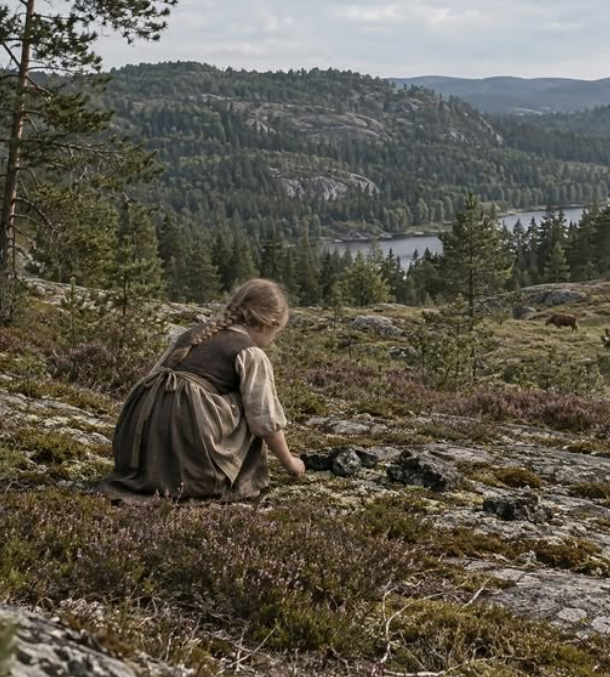
In the summer of 1623, in the rugged forests and valleys of Sandsvær, Norway, a young girl named Helga Verp discovered something that would change the history of the region. She was not a noblewoman, a merchant, or a scholar. She was simply a girl who knew the mountains, the streams, and the silent places where adults rarely bothered to look.
Helga had grown up among people who measured a person's worth by age, strength, and usefulness. Girls were expected to help, obey, and remain quiet when men discussed important matters. Helga was observant, curious, and stubbornly independent, but her questions were often met with impatient smiles.
She had learned to keep many of her thoughts to herself.
That summer, while exploring the mountainside, she noticed a stone unlike the others. Something in its surface caught the light. She bent down and brushed away the dirt. Beneath the grey crust lay a strange, metallic shine.
She turned the stone in her hands. It glimmered again.
Helga felt a sudden excitement so powerful that she almost laughed aloud. She had found something extraordinary, something that had been hidden in the mountain for centuries. For a moment, she forgot the chores waiting at home and the familiar feeling of being overlooked.
She had discovered something that mattered.
She showed the find to Jacob Grosvold. Together, they examined the strange material and began to understand that it might be silver.
Silver!
Helga could scarcely imagine what that meant. She had heard of silver coins, silver cups, and the treasures possessed by wealthy people, but this was different. The precious metal was not locked in a chest or displayed in a merchant's shop. It lay within the mountain itself.
The mountain had given up a secret.
And Helga had been the one to find it.
II. WHAT BELONGED TO A KING
News of the discovery did not remain a private wonder for long. Adults soon began to take an interest, and the possibility of valuable silver changed the atmosphere around Helga.
Arne Verp and Kristoffer Loftstuen became involved in the discovery. They began extracting silver-bearing material and secretly selling some of it. What had started as a remarkable find became something dangerous.
Helga watched the adults discuss the discovery in low voices. They spoke about money, secrecy, and the risks of attracting attention. They did not speak much about the girl who had first noticed the shining stone.
At first, Helga believed that everyone would remember what she had done. Surely, she thought, the adults would tell the story honestly. Surely, finding something so important would mean that people would finally listen when she spoke.
But the discovery belonged to a world in which power mattered more than curiosity. Men made decisions, men negotiated, and men decided what could be said aloud.
The silver was valuable, but it was also a potential source of trouble. In Denmark-Norway, the king claimed authority over important mineral resources. A discovery of silver could attract royal officials, outside experts, and people eager to control the wealth.
Helga gradually understood that the adults were afraid.
Their fear unsettled her. She had imagined the discovery bringing excitement and perhaps even good fortune. Instead, she found herself surrounded by secrecy. Conversations stopped when she approached. Questions were answered with vague remarks. The silver that had first filled her with wonder now seemed to cast a shadow over the household.
She began to wonder whether finding the silver had been a mistake.
Yet how could a discovery be wrong simply because powerful people might want to possess it?
III. THE PRICE OF SILENCE
As the weeks passed, the secret became increasingly difficult to keep. Silver-bearing material had been removed from the mountainside, and the authorities began asking questions.
Helga knew more than she could safely say. She had seen the discovery with her own eyes. She knew where the first shining stone had been found. She also knew that the adults had been trying to keep the matter quiet.
She felt trapped between loyalty and truth.
If she spoke, she might expose people close to her to punishment. If she remained silent, she might help conceal what had happened. Neither choice seemed fair, and nobody had asked her what she thought.
The burden was especially painful because she was still a child. The adults had taken a discovery that began with her curiosity and transformed it into a secret that she was expected to carry without complaint.
At night, she wondered what would happen if the authorities arrived. Would they take the silver away? Would they punish her family? Would anyone believe her if she explained how the discovery had begun?
Most of all, she feared that the truth would disappear beneath the arguments of grown men.
The mountain had been there long before any king, official, or merchant claimed authority over it. Helga had found the silver by looking closely at the natural world around her. Yet now she felt that she had lost control of the story almost as soon as it began.
She could not know that the discovery would eventually become part of Norway's industrial history. She knew only that something wonderful had happened, and that wonder had turned into fear.
IV. THE DRAGON’S TREASURE
The secret could not remain hidden.
According to the traditional account, Arne Verp was eventually arrested after making a remark about killing a dragon and taking its treasure. Whether spoken in jest or made in an attempt to explain the strange events, the remark drew attention to the silver and helped bring the matter into the open.
On 4 October 1623, Arne made a confession.
For Helga, the confession would have marked the end of one uncertainty and the beginning of another. The secret was no longer safely contained among the people who had first discovered the silver. The authorities now knew that something valuable had been found in the mountains of Sandsvær.
The dragon story lingered in the imagination: a hidden treasure, a dangerous secret, and a prize that had awakened greed and fear. It was the sort of tale people might remember and repeat around a fire.
But Helga knew that there had been no dragon.
There had been a mountainside, a curious girl, and a stone that caught the light.
On 14 October, German mining experts arrived to examine the discovery. Their presence transformed the event from a local mystery into a matter of royal importance. They brought knowledge and authority, and their inspection helped establish the potential value of the silver deposits.
On 18 October, the accounts were opened.
The process that followed would eventually lead to organised mining, royal investment, and the development of a settlement around the silver works.
Helga could not have understood the full consequences. She could only watch as the discovery grew larger than the people who had made it. Officials and specialists came to investigate what the mountain contained, while the girl's own place in the story remained uncertain.
She had helped open a door. Other people were now walking through it.
V. WHEN THE WORLD CAME LOOKING
The discovery of silver attracted attention because it promised wealth and strategic value. For the authorities, the question was no longer simply who had found a shining stone. It was how the silver could be extracted, managed, and used.
For Helga, the change was bewildering.
The mountain that had once been part of her familiar world was becoming the centre of a larger enterprise. The adults spoke of the future, but their future was measured in ore, money, labour, and royal interests.
She might have felt pride when she considered that the whole affair had begun with her discovery. Yet pride was difficult to sustain when nobody could promise that she would be remembered.
Perhaps she imagined someone writing down her name. Perhaps she hoped that one day a person would ask how the silver had first been found and listen carefully to her answer.
Or perhaps she gradually stopped expecting such things.
The deepest hurt was not that other people had become involved. A discovery of that importance could never have remained a private adventure. It was that the story was being taken out of her hands without anyone acknowledging what that meant to her.
She had found the silver, but she could not decide what it would become.
She had helped change the future of the region, but she had little power over her own place within that future.
There is a particular sadness in being present at the beginning of something extraordinary and discovering that history may remember the event while forgetting the person who first noticed it.
Helga's achievement did not become less remarkable because she was young or because she was a girl. Yet the world around her was not arranged to make such an achievement easy to recognise.
VI. THE GIRL AND THE MOUNTAIN
On 2 May 1624, King Christian IV issued a decree establishing a mining town at the site. The settlement would grow into Kongsberg, which became closely associated with Norway's silver-mining history.
The consequences of the discovery reached far beyond the mountainside where Helga had first seen the glimmering stone. Mining brought workers, technical knowledge, administration, and a new economic importance to the region. The silver became a resource of the kingdom, and the settlement developed around its extraction.
For the king and his officials, the discovery offered an opportunity. For the miners, it meant dangerous work and the hope of earning a living. For the people of the surrounding region, it brought changes that would shape generations.
For Helga, the meaning was more intimate.
She had once held the silver-bearing stone in her hands and felt that the mountain had shared a secret with her. Now that secret belonged to an expanding world of official records and royal ambitions.
Perhaps she returned to the mountainside in the days that followed. Perhaps she stood quietly among the rocks, looking at the place where everything had begun.
If she did, she might have remembered the first moment of discovery: the dirt beneath her fingers, the unexpected glimmer, and the thrilling belief that she had found something no one else had noticed.
That memory would have remained hers, regardless of what others decided to do with the silver.
The mountain had not changed its nature. It had held its riches long before the discovery and would continue to hold them after the people involved had passed away. Human beings came and went, making claims, building settlements, and recording achievements. The mountain endured.
Helga's discovery was part of that enduring history, even if the details of her own life were not preserved.
Perhaps this is where her story becomes most moving. She did not need to become famous to have mattered. Her act of observation was real, and its consequences were enormous. Yet it is natural to wonder what she felt when the world celebrated the silver while leaving so little behind about the girl who found it.
VII. WHAT BECAME OF HELGA?
History can preserve the date of a confession, the arrival of mining experts, the opening of official accounts, and a king's decree. It can describe the growth of a town and the wealth extracted from the earth.
But history does not always preserve the private lives of the people who set events in motion.
The historical record does not tell us what ultimately happened to Helga Verp. We cannot say with certainty how she lived, what she thought about the silver mines, or whether she received any recognition for her part in the discovery.
The scenes of her private feelings in this story are imagined. They are an attempt to explore what such an experience might have meant to a young girl living in a world where adults held most of the power.
Perhaps Helga grew older and remembered the discovery as the great adventure of her childhood. Perhaps she became bitter that other people took control of what she had found. Perhaps she felt both pride and disappointment, as people often do when an achievement becomes larger than their own lives.
We do not know.
What we do know is that the discovery in Sandsvær in 1623 became the foundation of an important chapter in Norwegian history. The silver mines helped shape Kongsberg, and the town's name became inseparable from the mineral wealth beneath its mountains.
But behind the official story stands a more personal question.
Who remembers the girl?
It is easy to celebrate a king's decree, the skill of mining experts, or the wealth produced by a great enterprise. It is harder to recover the voice of a young person whose role may have been overshadowed by the powerful people who followed.
Helga's story reminds us that history often begins in small, uncelebrated moments: a child noticing something unusual, a curious mind refusing to look away, a hand brushing dirt from a stone.
Before the officials arrived, before the accounts were opened, and before a mining town began to rise, there was a girl who saw something shining in the mountain.
For one brief moment, the discovery was hers alone.
And even if the historical record has left her later life unknown, we can still acknowledge the significance of that moment.
The silver belonged to the mountain before it was claimed by men and kings. The mining town became part of Norway's history. But the discovery began with Helga Verp.
Sometimes, the most important person in a great historical story is the one whose name nearly disappears.
THE END