WHY AM I OBSESSED WITH CHINA’S ANCIENT GOLDEN AGE? I TOOK MY DAUGHTER ON A TRIP TO FIND OUT.
By Guardian- Xiaolu - 29 Sep 2026 05.00 BST
I felt a duty to write about the Tang dynasty and its incredible social and cultural sophistication – but also to connect my Chinese past with my child.
Tang
During the Tang dynasty, which lasted from the seventh to the early 10th century, Vikings were raiding the coasts of what today is called Europe. In the small archipelago now known as Britain, Anglo-Saxon kingdoms flitted by. Meanwhile, in Mesoamerica, after 3,000 years of flourishing, the Maya civilisation was collapsing. In the east, China had been united for nine centuries and the Tang dynasty was already a proverbial high point of world culture.
The Tang dynasty achieved an incredible level of social and cultural sophistication. Advances in science and medicine, sublime poetry, mystical paintings, high fashion in women’s clothing beyond the palace walls, exquisite ceramic and pottery arts, the invention of gunpowder and printing, highly elaborate cuisine, creative urban design and much more. It was a truly cosmopolitan empire with dynamic diplomatic relations with the neighbouring kingdoms.
When I ponder this, an urge arises in me: a kind of duty, if you like, to write about this era. The Tang contrasts sharply with the image of a self-enclosed, inward-looking China, one that the west has long liked to promote. An open, cosmopolitan melting pot, it was the eastern centre into which flowed the riches of the silk roads that stretched all the way to the Byzantine empire.
But still, why the Tang? And why learn about the Tang from me? I have my own story to tell, which has no pretence to objectivity. My story involves a specific, passionate reconnection with my own heritage. I wanted to return to China after a long absence. The last time I was there had been a decade before, along with my then three-month-old child, Moon. My desire to go back was in part for her, now 11 years old. So she and I set off on a journey back to the cultural womb from which I had emerged and had left behind. I had to explain the Chinese past not only to the child, but to myself.
Xi’an
Our journey began in Xi’an, the capital of the Tang dynasty. A high-speed train had brought us from Beijing on a searingly hot day in July. On the road, the tarmac glistened and oozed out its black heat, while the city roared in full force with an immense river of traffic.
I had booked a traditional-looking hotel, thinking we should taste more of the old China. When we reached the hotel, we had to squeeze ourselves in between a gang of businessmen all wearing black suits with alcohol-flushed faces. They spoke at high volume, while coughing and hawking. Was it a gathering for people with respiratory illnesses? I could smell their strong cigarettes from several metres away. With “no smoking” signs in the lobby, they stood by the hotel gate puffing away while cracking loud jokes. They spoke Shanxi dialect and I could vaguely make out that their laughter was to do with food and women. How familiar all this was; men in suits, chain-smoking, looking for girls – the kind of stuff that came with the recent wealth from the “Chinese miracle”. Where were the women, though? As usual, women worked. The receptionist and the manager were women. They gave us the room key after taking our money.
Our room reeked of smoke; even the white bedding. We wanted to venture out immediately. We jumped into an air-conditioned taxi and set off to find some famous landmarks.
An hour later we were standing by the Giant Wild Goose Pagoda. Moon hid under a nearby pomegranate tree, sucking an ice lolly, her chestnut-coloured hair tangled with sweat. Beyond the deafening sound of cicadas high up in the tree, the heat formed a shimmering layer of pink fog above the pagoda. Sweat was dripping from my eyebrows, obscuring my vision.
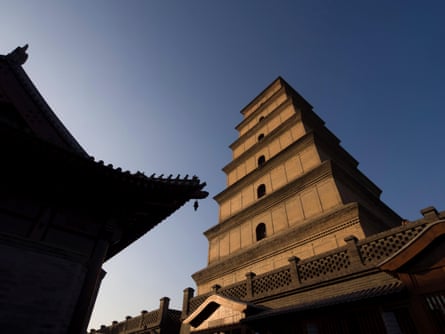
Everyone in China knows that Xi’an is one of the oldest cities in the country. It’s our Rome or Athens. Over a 2,000-year period, it served as the capital for several dynasties, though it was called Chang’an back then. Traces of the Tang are everywhere. Like many other old monuments, the Giant Wild Goose Pagoda of today is not original. Built at the beginning of the Tang in the seventh century, it was restored in the eighth century, then rebuilt in the 16th century after an earthquake. Constructed of brick and wood, the facade displays elaborate sculptures and carvings on the eaves. We joined a swirl of tourists around the tall tower, but we were not allowed to enter because it is too fragile for crowds.
Moon was born and brought up in England. She had never experienced this climate, nor such crowds massed around her. There was not a single puff of wind. I feared she might get sunstroke. Hopping from the shadow of one tree to another, we managed to exit the park.
Once outside, we leaned on the ancient city walls, enjoying the small respite offered by the shade. The wall, I read, was 14km in length, mainly built in the Ming dynasty in the 14th century. But the original was Tang. Xi’an is a great palimpsest on which many cultures have written their lives. This is very different from Rome or Athens, which are full of original ruins. Nothing in China can remain as ruins – the government either recreates the supposed original or builds something totally new. Ruins cannot exist under communism.
Numbers
We wandered around a street market looking at all kinds of Chinese vegetables. We were eating stir-fried potato strips with vinegar and chilli.
‘What’s this, Mum?’ Moon prodded a plate of white vegetables with her chopsticks.
‘They are lotus root slices. Try it!’
Embarking on this trip led me to think about my own relationship to China, but also about my daughter’s. Such an immense past. I wondered how I could educate her. What importance could it hold for her? Moon was English, or British: her first language was English, despite my ongoing efforts to fill her ears with my native tongue. These efforts have resulted only in the most moderate success. Moon could understand my Chinese, but it was as though the language had not penetrated beneath her skin. In England, at the end of a school day, she would say to me: “I find history difficult to enjoy.” I would respond: “If you do not know your history, you won’t know who you are!” And I heard myself say to her: “We can learn from the brilliance of the past, and one of these is the Tang.”
But what did I really mean by that? Was I trying to convince myself as much as I was trying to convince my daughter?
We spent the evening in one of the city squares, eating a half watermelon. We squatted by the flowerbeds and watched elderly couples dancing under the street lamps. The music, very kitsch 1980s Chinese songs, blasted in our ears. So at the top of my lungs I screeched at Moon about the ancient past, sounding not unlike the way the lectures were delivered in a re-education camp.
“In the beginning, Xi’an was a stone-age village. Then a long, long time ago, like 3,000 years ago, it became the centre of a kingdom. Didn’t you learn about the Trojan war in ancient Greece? So that was around the same time.”
I was already flailing, but I went on. “One of those earlier dynasties, the Zhou, was the founding dynasty of this area.” Moon started to look around, displaying her boredom. I paused, feeling a rising anguish.
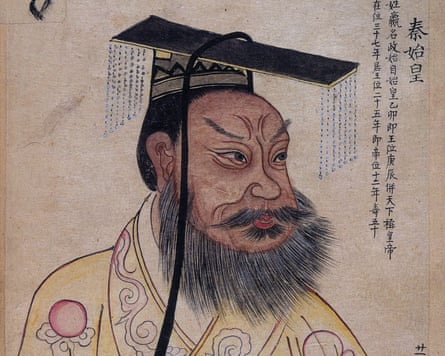
“The Qin emperor – Shi Huang – decided to design his capital. It was called Xian-yang then, north-west of Xi’an. He built many palaces and unified the Chinese writing system. That was 2,000 years ago. You know he was the same one who started building the Great Wall of China.”
Moon spat out a few watermelon seeds. I searched desperately for something more dramatic.
“But he also burned a great number of books and buried the scholars alive … Can you believe that?”
“Horrible! Poor scholars!” Moon cried. “Why did he do that?”
“Well, because he wanted to control people’s thoughts. Many emperors or dictators have done similar things. Anyway, the Qin empire only lasted for a short time. Then, around 202BC, a new dynasty came, one called the Han. The first emperor was Liu Bang.”
I stopped, now frowning myself.
“What’s wrong, Mum?”
“Well, I really don’t like talking about Chinese history using western ways of counting years!”
“You mean BC or AD. I don’t like those either!”
“Yeah, what has China got to do with some man, Jesus Christ, being born so far away, who meant nothing to the emperor Liu Bang! We have our own way of dating different periods.”
Now Moon turned to look at me: “What is your Chinese way?”
I thought for a while, but I found myself fumbling. I could not translate the Chinese calendar in a simple way to an 11-year-old. The Chinese dynasty calendar is based on the name of the emperor followed by the name of the dynasty, along with a number to signify the year within that dynasty. Each new dynasty starts again from year zero.
“Just give me an example, Mum,” she said, swallowing a piece of watermelon.
“OK. We say: ‘唐高祖 12 年’, meaning the 12th year of the reign of Emperor Gaozu of the Tang. Or, in your western equivalent, AD630.”
As seemed to be so often the case, my speech to Moon was a mix of Chinese and English words. I went on, feeling like a schoolmistress. “You know, in the beginning of the Tang, in the early seventh century, Xi’an was one of the world’s largest and most populous cities.”
It is estimated that about 1 million people lived within the city walls. By the dynasty’s end, in the ninth century, the country’s population had grown from 50 million to 80 million.
For a contemporary Chinese person, numbers are essential to measure things, since we grew up in a populous country and under a governing party that was obsessed with numbers and numerical record-keeping. The Chinese Communist party would always describe a place with wording such as “the village used to have 38 Communist party members, which has expanded to 380, occupying an area of 32,000 sq metres”. We Chinese children grow up reciting numbers. Moon nodded, vaguely. Numbers are difficult for a British kid in this context.
Silent armies
Contemporary Chinese tourism is about rediscovering the country’s wondrous past, often in a banal and highly commercial fashion. History, it seems, can be a place for solace and the temporary forgetting of the stresses of contemporary Chinese life. I keenly felt that “history” was packaged as a touristic spectacle during this trip. Even so, I was confident that our travels would allow me to reassess my relationship to a past which had been entirely denied during the Cultural Revolution. I felt this intensely, and I believed that many in China felt the same way.
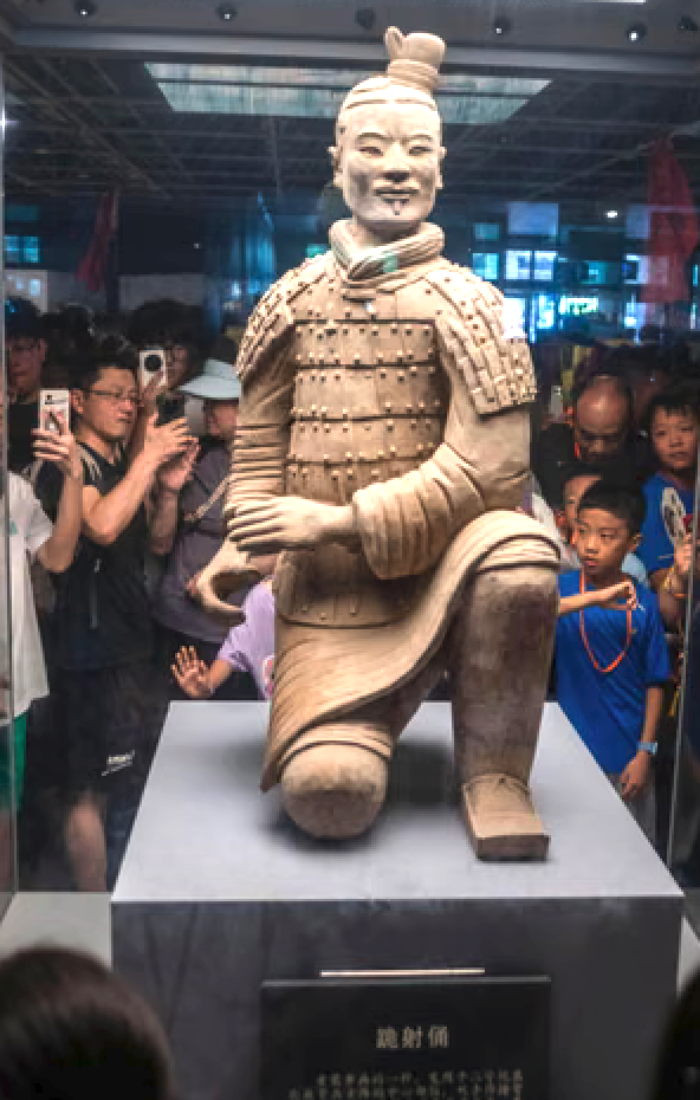
Once you are in Xi’an, you cannot avoid passing the site where the terracotta army was buried. The warriors are not from the Tang dynasty, but from the earlier Qin, about 2,200 years ago. After waiting in an enormously long queue outside the Qin tomb site, a great throng of tourists pushed its way into the tomb like a host of locusts. By then we were already exhausted and our water bottles were empty.
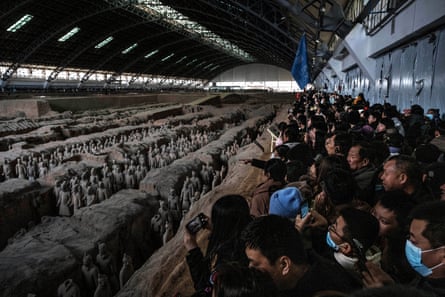
Inside the vast hall where the terracottas were displayed, the eager tourists pressed on top of one another – not unlike the statues themselves. Beneath us, on the brown earth, headless figures, broken arms and body parts were neatly laid out. Most of them bore the uniform of a Qin dynasty warrior. They were ethereally still, as though waiting, or listening, but outside of time. I felt that we ourselves had come here to be temporarily buried along with these effigies of imperial power, a living host of terracotta tourists.
These are not the traces of the Tang, though the Qin led to the Tang by way of a great tangled knot of dynastic struggle.
“If there had been no Qin dynasty, then there would be no Tang,” I said to Moon.
“So it’s like if there had been no Greeks, there would be no Romans?” she responded, boldly. She knew much more about Greek gods and Roman goddesses than I did.
I pondered what the child had said while I gazed down at the broken statues. I asserted, and she agreed, that ancient Chinese culture was as rich and advanced as ancient Greek culture. But what did it mean really? I tried to breathe better. The air inside the hall was musty and thick with dust while the army of tourists pushed us this way and that in a vortex of human interaction. At one point, my child and I were desperate to get out from under the oppressive weight of all this history.
The court diary and the sisters
Very similar to the Anglo-Saxon Chronicle, or even the Domesday Book from 1,000 years ago, there is the Old Book of Tang, comprising 200 chapters that chronicle the events during the Tang era as recorded by court ministers. The book is difficult to understand as it is written in classical Chinese.
The difference between the Anglo-Saxon Chronicle and the Old Book of Tang is that the former was written by monks living in monasteries, while the latter was written by mandarins living in the imperial court. Church culture was surely very different from court culture. The western church was a sanitised place peopled by men only, whereas the palace court was a luxurious and sensual inner city full of cultured courtesans and powerful women.
“It was a tradition during those times that the palace diary, or any official record, was kept by the ladies of the palace,” I said to Moon.
We had just arrived at the Huaqing hot springs, 20km from Xi’an, a site where the Tang emperors and their wives would spend their leisure time. Now it is a major tourist destination.
“But I thought women were badly treated back then, and they could not read or write,” Moon said.
“Not during the Tang! From the Tang dynasty onwards, women were celebrated for their literary and artistic skills, not just because of their beauty.”
Indeed, around the eighth century, there were five famous sisters, whose key responsibility was to keep the court diary. The sisters were the granddaughters of a well-known poet, Song Zhiwen, and were educated not only in classical poetry, but also in politics. All five became accomplished writers and thinkers, and they made a pact never to marry but to devote themselves to literature and art. Together they wrote the Analects for Women, a counterpart of the Confucian Analects from a female perspective, which became a classical text in women’s education in the Ming and Qing dynasties. In AD788, these sisters were recommended by a local official to Emperor Taizong, a great devotee of literature, who personally examined their work and recruited them all into the palace service as xueshi – masters of learning. The emperor held them in the highest esteem. It was during the Tang that, for the first time, literate women became important court ministers, called shangshu.
“That’s pretty amazing,” Moon said. “You told me that in ninth-century England, there were just Vikings raiding villages, and most people were illiterate.”
“That’s right. And if Alfred the Great had not promoted literacy, no one would be able to read except the monks.”
During the Tang, one of the areas in which women assumed an increasingly significant role was as artists, and some courtesans were famed singers and dancers, as well as being known for their extravagant clothing and hairstyles. Before the Tang, women in China were mostly veiled, and almost never in public service. The women of the Tang changed that tradition with the support of an enlightened court. They became fashion-makers, inventing elaborate makeup and sporting lavish dresses.
Would it be too pretentious, too pompous, to call the Tang era one of the earliest feminist eras in ancient history? I thought of the Anglo-Saxon women during that period, or the wives of the Vikings and Romans. I was not convinced that they had achieved such power.
The Grand Canal
In Britain, I have always lived by Regent’s Canal, around east London. After I left China, more than two decades ago, my daily routine revolved around that rusty urban English water. I would pass by the narrowboats along the winding waterways and often I thought of the Grand Canal in China. The Grand Canal is the longest and oldest artificial waterway in the world. The most ancient part was built in the fifth century BC. Later, in the seventh century AD, Emperor Yang of Sui undertook an ambitious project to connect the south and the north by a waterway. Then the Tang emperors expanded its scale and perfected its usage.
I first saw the canal in 1993 when I left my southern home town and travelled to Beijing to study. The Beijing Film Academy is located right next to the canal, by the gate of the old Yuan dynasty ruins, and a park had recently been built along the waterway, with willows hugging the banks. After the day’s classes, I would leave the campus and sit by the water, reading or eating a takeaway. The water was motionless. I always wondered how such great quantities of rice and tea had been transported on this water in olden days.
Often, on a cold sunny afternoon after snow had fallen, with one hand holding a translation of Pier Paolo Pasolini’s poetry, I would throw little stones on to the frozen surface to see if the ice would break. It was by that canal, dare I say, that I became a young intellectual, however arrogant and pretentious that may sound. I could even say that I was part of the historical landscape, stoic but everlasting, regardless of the destruction of ancient culture in China since the Cultural Revolution. For me, the Tang is the exact opposite of the Cultural Revolution. The former is rich and culturally diverse, whereas the latter is poor, unimaginative and functional in all aspects of life and thought.
When we briefly visited Beijing, I wanted to show Moon the canal and the park near the Beijing Film Academy, but I never managed to venture to that part of the capital. Beijing was too big to get around. The six massive ring roads and countless highways surrounding it seemed larger than the orbits in our solar system.
Luoyang
One might complain about the quality of water or air in China, but one can only admire the public transport: roads and railways lead to every possible destination. This is a very recent phenomenon. When I left China some 20 years ago, the infrastructure was very poor. The train from Shanghai to Beijing took two days: today it takes less than five hours.
We were on a high-speed train from Shanxi to Henan province. The landscape was lush and mountainous; the vegetation was emerald green and luminous under the sun after a rainstorm.
We arrived in Luoyang at noon, hoping the day would be cooler than the 39C we had suffered through in Xi’an.
During the Tang dynasty, Luoyang was called Dongdu (東都), the eastern capital. When Wu Zetian became empress, she constructed the tallest palace in Chinese history in Luoyang, of which there is now a duplicate in the old town, to the east of the city.
We stayed in a brand new Hyatt hotel in the new town of Luoyang. So new, in fact, that the hotel lobby was still filled with the large bundles of fresh flowers brought in for the opening celebration. From the 16th floor, I gazed down. On my left was the huge campus of the Luoyang Institute of Science and Technology; on my right was the jigsaw-like People’s Park, with sports facilities; on the horizon, skyscrapers stood in a bland, uniform line, like a monoculture forest. Where was the history? I longed for old sights and sounds.
From Luoyang, we visited the nearby Longmen Grottoes, one of the largest Buddhist sites in the world, which has survived more than 1,500 years. What a monumental sight to see countless statues of Buddha! Their elaborately sculpted details were once painted in gold. Now, all of them stood bare and colourless and most of them were missing body parts.
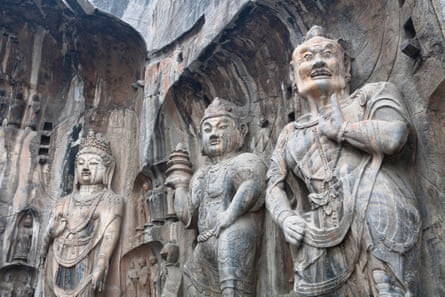
“Mum, do you know that there are 100,000 statues on these hills?” Moon said, reading a signpost.
“That’s a lot,” I said. “What else does it say?”
“It says there are more than 2,345 caves, some are little more than small holes, some are as large as 17 metres in height.”
As always, the Chinese fanatically list numbers when referring to any historical artefact, but anyone who visits these grottoes hardly needs to learn them. Like me, they can experience a dizzying feeling of disbelief, even as our feet stand firmly on these old rocks. Like Stonehenge in England, or the Egyptian pyramids, these monuments induce a feeling of the sublime.
As we descended toward the riverbank, I looked back at the blurred faces and figures of the Buddhist caves on the hill. How much more history could I take in one afternoon? Must we see 10,000 Buddha statues to come to the conclusion that there is a Buddha? Must we erect 20m Jesus on the cross statues to prove he died for us? Why are we so wedded to the materiality of spiritual life? Isn’t the sky vast and awesome enough to be pondered upon? Emptiness is where the richest possibility lies.
Weary and drowsy, we abandoned the sumptuous spectacle. Flagging down a taxi by the gate, we wanted to hurry back to the hotel before the rush hour, where we would deal with the small and ungodly things in our daily life, such as paying our bills, charging our phones, ordering a meal and brushing our teeth.
The Qianling Mausoleum and the
afterlife
We travelled over great distances on high-speed trains. From the northern plains we crossed over the Yangtze River and then zoomed down to southern regions, before going north again, entering the grasslands of Inner Mongolia. Moon had been tasting all sorts of strangely flavoured food and learning local dialects and could almost have passed as a native Chinese kid.
At the very end of our trip, to draw a full circle, I wanted to pay a visit to the place where the Tang emperors and empresses were buried, so we returned to Shanxi province and arrived at Qing Xian, 85km north-west from Xi’an.
Here, along the highways, even the ginkgo trees are newly planted, all trimmed, standing straight and of even height, like an obedient army waiting to be summoned to action. Even though this place was very much part of the royal centre of Chang’an during the Tang, visually there is nothing much to see now. Because of its peripheral location, its past has been totally paved over to make way for its new industrial purpose. One can see only some traces of the old ways of life half-hidden in a street corner: a tiny shoe repair place, an old tailor’s shop or a grandmother selling tea-brewed eggs by the roadside. Otherwise, large trucks carrying steel and cement rushed through streets, horns blasting.
Qianling Mausoleum is where some of the most important imperial families of the Tang dynasty are entombed. After a long, stifling ride, the bus finally dropped us in front of a large complex.
The scale of the mausoleum was something I had never seen in my life. A labyrinth to confuse anyone. Once we entered, we had to take another bus inside the vast complex, again with crowds of tourists. The bus took you up to the hills to get to the different burial sites. It was like travelling into an ancient settlement, with pavilions and waterways and inner gardens. There was even a busy street full of restaurants inside the Number Four Mausoleum site.
It was difficult to correlate the tomb numbers on the map with the actual sites. There seemed to be a lot of tombs, but few were open to the public. The sound of cicadas faded away while the noon heat was rising. Under the burning sun, we felt like two roasted ducks. We staggered towards a mausoleum that promised some air-conditioning.
We arrived at two tomb sites, one belonging to a princess and another to a prince. From the gate, we could see a sloping tunnel stretching into a darkening underground world. Cool but sepulchral air coming from the tunnel gate enticed us inside.
We followed a group of perspiring tourists, walking into the narrow tunnel. It was the tomb of Princess Yongtai. She was the seventh daughter of Emperor Zhongzong and the second daughter of his wife, Wei. She died when she was 15, apparently while giving birth.
“Oh, she died so young!” exclaimed Moon.
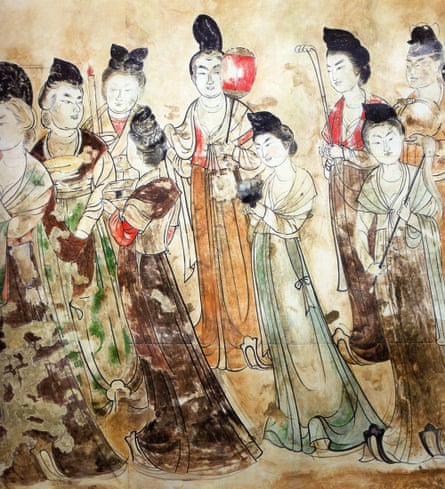
There were elaborate murals around us, depicting palace ladies and officials in an enchanted garden. The colours were faded and the walls full of holes and patches. As we entered further, the air became musty and heavy.
As we approached the end of the tunnel, we came upon a chamber with frescoes, and the mausoleum revealed itself. It was a miniature wooden house with carved windows and inscriptions on the surface. Inside, there was the actual coffin.
What was life like for Princess Yongtai 1,300 years ago? I could not decipher the obscure inscriptions, but what I had read earlier from the New Book of Tang told me a different story of how she died. Since the all-powerful Empress Wu was her mother-in-law, Princess Yongtai did not have an easy life. An animosity persisted between the two women. It was well known that Empress Wu led an unconventional sexual life; even in her old age, royal family members, as well as ministers, were well acquainted with her exploits. As a result, indignation and resentment accumulated in the court, and when the princess was found to be disloyal, punishment immediately ensued. According to the New Book of Tang, it was said that the princess was caned to death, though elsewhere it was recorded that she was forced to kill herself.
We did not visit the next tomb – we wanted to go straight to the most mysterious site, Empress Wu’s tomb. After much inquiry, we learned that it was impossible: no one would be allowed to enter the mausoleum of the emperor and the empress. In fact, we were told, the two main tombs were not even excavated.
So we wandered on the hills of this sacred place, sucking on our ice lollies in the shade of pine trees. We imagined a curious dark world inside the uncovered tombs, barred to modern people. Time to leave, but still we lingered on: we suspected we would
never return to this place.
Along the road was a procession of statues, some headless and some armless. We walked past these ancient figures and sometimes stood before them, as if waiting for speech, a command or a bow. They stood like sturdy sentinels, without acknowledgment of our presence, their stone minds, far beyond the doings of the passing parade of tourists. I thought of John Keats’s “cold pastoral”, and felt a shiver and prickling of skin in the heat. Was that a slight puff of wind, or time itself touching our all too fragile bodies?
Adapted from Everyday Tang, published by Notting Hill Editions (£9.99). To support the Guardian, buy your copy at guardianbookshop.com. P&P may apply.
Xiaolu Guo is a novelist, memoirist and film-maker. Her most recent novel is Call Me Ishmaelle (Vintage), a retelling of Melville’s Moby-Dick.