AI CHAT WORLD NEWS 23/09/2026
By AI Chat-Human Synthesis-23 September 2026
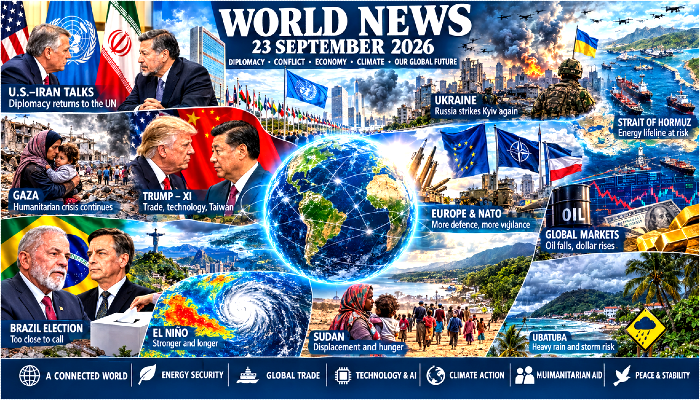
The most important development today is the unexpected opening of a diplomatic channel between the United States and Iran at the United Nations in New York. At the same time, Russia has launched another major drone attack on Kyiv, Israel's war in Gaza continues, President Donald Trump is preparing for talks with China's Xi Jinping, and Brazil's presidential election is entering an exceptionally close phase.
1. U.S. AND IRAN — A POSSIBLE OPENING FOR DIPLOMACY
After months of confrontation, American and Iranian representatives have held several hours of mediated discussions in New York during the UN General Assembly.
Iranian Foreign Minister Abbas Araghchi and U.S. representatives Steve Witkoff and Jared Kushner were involved in the discussions through mediation. Accounts differ over exactly how directly the two sides met, but the talks represented a significant diplomatic contact after weeks of little progress.
Iran has made reopening the Strait of Hormuz part of the negotiations.
Tehran says it could reopen the vital waterway within days if the United States reduces military pressure, lifts the blockade on Iranian ports and addresses Iranian financial assets. Iranian officials have also demanded an end to attacks on what Tehran calls the regional "resistance" fronts.
The United States and Iran remain far apart on fundamental issues, so the talks do not constitute a peace agreement. Nevertheless, the fact that negotiations have resumed is important because the Hormuz crisis has become a major international economic problem.
The Strait carries a substantial share of the world's seaborne oil and gas. Disruption has reduced tanker traffic and contributed to higher energy costs.
For the first time in weeks, however, the possibility of an agreement is being discussed seriously enough to affect financial markets.
2. STRAIT OF HORMUZ — THE WORLD'S ENERGY SYSTEM REMAINS VULNERABLE
The Strait of Hormuz remains one of the most important pressure points in the world economy.
Even limited shipping through the strait has continued, but traffic remains far below normal levels. Saudi Arabia's East-West oil pipeline has also become increasingly important because it allows some crude to reach the Red Sea without passing through Hormuz.
Improved Saudi oil flows have helped push international oil prices lower in recent sessions.
Brent crude has moved back below the psychologically important US$100-a-barrel level, although prices remain highly sensitive to every development involving Iran, Saudi Arabia, Yemen and shipping.
The second major danger is the Bab el-Mandeb Strait, between Yemen and the Horn of Africa. Restrictions there can force ships travelling between Asia and Europe to take much longer routes around Africa.
The consequences extend well beyond petrol.
Higher crude prices raise the cost of:
- diesel and aviation fuel
- transport
- electricity
- industrial production
- food distribution
- plastics and chemicals
- shipping and insurance
Thus, the Middle East conflict has become an economic issue for countries that are geographically thousands of kilometres away.
3. UKRAINE — RUSSIA STRIKES KYIV AGAIN
Russia launched another large drone attack on Kyiv on Wednesday.
Reuters reported that Russian drones struck railway infrastructure, warehouses and fuel stations. One person was killed and several others were injured.
The attack came shortly after discussions between Ukrainian President Volodymyr Zelenskyy and President Trump.
Ukraine continues to seek an arrangement that would halt attacks on energy infrastructure. Zelenskyy has indicated that Ukraine is prepared to discuss an energy ceasefire if Russia accepts reciprocal restrictions.
The fundamental disagreement remains unresolved.
Russia continues to demand conditions concerning Ukrainian territory and security arrangements, while Ukraine insists on its territorial sovereignty and long-term security guarantees.
The war therefore remains one of Europe's largest security problems, while the Middle East conflict is creating additional pressure through energy prices and military resources.
NATO countries remain alert to the possibility of Russian drones or other military activity approaching or crossing the airspace of neighbouring states.
4. GAZA — WAR AND HUMANITARIAN CRISIS CONTINUE
The Gaza conflict remains unresolved despite continuing international diplomatic efforts.
On Wednesday, an Israeli airstrike in western Khan Younis killed at least two Palestinians, according to local medical officials. The Israeli military confirmed the strike and said it had targeted a militant.
Palestinian authorities say that more than 73,000 Palestinians have been killed since the Israeli military operation began following the Hamas-led attack of October 2023. Those figures do not distinguish between combatants and civilians.
Israel disputes accusations that its military campaign constitutes genocide and says its operations are directed against Hamas and other armed groups.
The dispute remains one of the most politically divisive international issues at the United Nations.
Israeli Prime Minister Benjamin Netanyahu is scheduled to address the UN General Assembly on Thursday. He has said he intends to defend Israel's military actions and respond to international criticism.
The continuing violence demonstrates how difficult it has been to convert previous ceasefire arrangements into a durable political settlement.
5. TRUMP AND XI — THE WORLD'S TWO LARGEST POWERS MEET
Another major event begins today: Chinese President Xi Jinping is visiting the United States for talks with President Donald Trump.
The meeting is taking place against a background of competition over:
- tariffs
- advanced semiconductors
- artificial intelligence
- rare-earth minerals
- technology exports
- industrial supply chains
- Taiwan
- Iran and the Middle East
The relationship between Washington and Beijing is particularly important because the two countries dominate much of global manufacturing, technology, finance and trade.
Both governments have an interest in preventing the relationship from deteriorating into an uncontrolled economic confrontation.
At the same time, the disagreements are substantial.
China regards Taiwan as a core sovereignty issue. Washington maintains close unofficial relations with Taiwan and provides it with defensive support.
Technology is another major battleground. The United States is restricting China's access to certain advanced technologies, while China is attempting to strengthen its own semiconductor and artificial-intelligence industries.
The Trump-Xi meetings therefore have consequences far beyond the two countries.
6. WORLD ECONOMY — OIL, INTEREST RATES AND THE DOLLAR
Financial markets remain extremely sensitive to the Middle East.
The recent decline in oil prices has provided some relief to markets, while hopes for U.S.-Iran diplomacy have reduced fears of an immediate further deterioration.
At the same time, the US dollar is near a two-month high.
Investors are also watching central banks carefully because prolonged energy-price increases can produce renewed inflation.
The dilemma is straightforward:
Higher oil prices → higher inflation → pressure for higher interest rates → slower economic growth.
Conversely:
Lower oil prices → reduced inflation pressure → greater room for central banks to support economic activity.
This is why developments in the Strait of Hormuz are being followed by financial markets almost minute by minute.
7. BRAZIL — PRESIDENTIAL ELECTION ENTERS A VERY CLOSE PHASE
Brazil's presidential election is now less than two weeks away.
The latest AtlasIntel/Bloomberg poll, published on 23 September, shows President Luiz Inácio Lula da Silva at 47.7% and Senator Flávio Bolsonaro at 47.4% in a simulated second round.
The difference is only 0.3 percentage points and is well within the poll's margin of error.
The survey interviewed 5,015 people between 17 and 22 September, with a margin of error of one percentage point.
In the first-round scenario in the same survey, Lula received 45.8% and Flávio Bolsonaro 43.4%, followed by other candidates.
Brazil's first round is scheduled for 4 October, with a second round on 25 October if no candidate obtains more than half of the valid votes.
Other recent surveys have also shown a closely contested race, although individual polls differ.
The figures should therefore be read as measurements of opinion at particular moments, not as predictions of the election result.
8. THE UNITED NATIONS — A WORLD DIVIDED BUT STILL TALKING
The 81st UN General Assembly is now underway in New York.
The central issues include:
- Iran and the Middle East
- Gaza
- Ukraine
- global energy security
- climate change
- artificial intelligence
- international trade
- development
- reform of the United Nations
Outgoing UN Secretary-General António Guterres has warned that the world's major powers cannot solve global problems by themselves.
The UN is under pressure because the international system is increasingly divided between competing geopolitical blocs.
Yet the General Assembly remains one of the few places where almost every government can speak directly to the rest of the world.
That makes this week's meeting particularly important.
9. CLIMATE — A VERY STRONG EL NIÑO IS DEVELOPING
One of the most important non-military developments is the strengthening of El Niño.
The World Meteorological Organization says El Niño is firmly established and is expected to become very strong.
The WMO gives an exceptionally high probability — nearly 100% — that the event will continue through February 2027.
El Niño does not produce the same weather everywhere. Its effects depend on geography, season and interaction with other ocean-atmosphere systems.
Nevertheless, a strong event can increase the likelihood of:
- extreme heat
- drought
- heavy rainfall
- flooding
- crop losses
- water shortages
- disruption to transport and infrastructure
The UN's Climate Summit is being held in New York today, making the timing particularly significant.
The challenge is that the world is simultaneously dealing with war, energy insecurity and economic pressure while trying to adapt to increasingly disruptive climate conditions.
10. U.S. AND CHINA — AI BECOMES A STRATEGIC ISSUE
Artificial intelligence is no longer simply a technology story.
It is increasingly connected with national security, economic power and international competition.
The United States and China are both investing heavily in AI.
The major questions now concern who will dominate:
- advanced computing
- AI chips
- data centres
- military applications
- scientific research
- robotics
- autonomous systems
The technology competition is becoming part of the wider strategic rivalry between Washington and Beijing.
The danger for the global economy is that technological competition could become increasingly separated into two competing systems.
The potential benefit is that competition is also accelerating investment and innovation.
11. SUDAN AND AFRICA — ANOTHER MAJOR HUMANITARIAN CRISIS
Sudan remains one of the world's most serious humanitarian emergencies, although it receives considerably less international attention than Gaza or Ukraine.
Fighting has produced enormous displacement, food insecurity and destruction of infrastructure.
The crisis also affects neighbouring countries because millions of people have crossed borders or require humanitarian assistance.
South Sudan is experiencing its own political uncertainty, with President Salva Kiir dissolving the government ahead of the country's planned national elections.
Africa therefore remains an important part of the global security picture, particularly as food, migration, energy and climate pressures interact.
12. UBATUBA — HEAVY RAIN AND STORM RISK TODAY
Ubatuba is experiencing a markedly cooler and wetter day.
The current forecast calls for considerable cloudiness, heavy showers and thunderstorms.
INMET has an Orange Alert for excessive rainfall covering Ubatuba today, 23 September. The warning specifies possible rainfall of approximately 30–60 mm per hour or 50–100 mm per day, with risks including flooding, landslides and overflowing rivers.
There is also a yellow storm warning for intense rainfall, winds of approximately 40–60 km/h and possible hail.
A separate yellow alert warns of a temperature decline of approximately 3–5°C.
The weather is expected to remain unsettled into Thursday before becoming warmer toward the weekend.
For Ubatuba, the immediate concern is therefore not extreme heat but heavy rain, localized flooding, slope instability and strong thunderstorms.
13. THE BIGGER PICTURE — HOW THE CRISES ARE CONNECTED
The most important feature of today's world is not any single conflict.
It is the way the crises are becoming interconnected.
MIDDLE EAST → ENERGY
Iran and the Strait of Hormuz affect oil and gas supplies.
ENERGY → INFLATION
Higher energy costs increase transportation and production costs.
INFLATION → INTEREST RATES
Central banks may have to maintain or increase interest rates.
INTEREST RATES → ECONOMIC GROWTH
Higher borrowing costs can slow investment and consumption.
UKRAINE → EUROPEAN SECURITY
Russia's war continues to shape NATO defence policy and European military spending.
CHINA–USA → TECHNOLOGY
Semiconductors, AI and rare-earth materials are becoming strategic assets.
EL NIÑO → FOOD AND WEATHER
Changing rainfall and temperatures can affect agriculture, water supplies and food prices.
CLIMATE → POLITICS
Governments face increasing pressure to protect populations from extreme weather while maintaining affordable energy.
These are no longer completely separate stories.
They form a global chain of cause and effect.
14. WHAT TO WATCH NEXT
The most important developments during the next several days are likely to be:
1. U.S.–Iran diplomacy
Whether the New York discussions lead to a concrete agreement concerning the war and Strait of Hormuz.
2. Oil and shipping
Whether more tankers can safely pass through Hormuz and whether Saudi alternative routes continue to operate.
3. Trump–Xi talks
Whether Washington and Beijing can reduce trade and technology tensions.
4. Ukraine
Whether Russia and Ukraine can establish any form of energy ceasefire.
5. Gaza
Whether international pressure produces a new ceasefire or humanitarian arrangement.
6. Brazil
Whether the extremely close polling continues as the 4 October election approaches.
7. El Niño
Whether the exceptionally strong forecast translates into increasingly unusual weather patterns around the world.
CONCLUSION
The world on 23 September 2026 is experiencing several major crises simultaneously.
The wars in the Middle East and Ukraine remain unresolved. Gaza remains a humanitarian catastrophe. The Strait of Hormuz continues to threaten global energy security. The United States and China are entering another important period of strategic competition.
Yet today's most significant development is that diplomacy has unexpectedly returned to the centre of the Iran crisis.
If Washington and Tehran can reach even a limited understanding that restores shipping through Hormuz, the economic consequences could be considerable.
At the same time, the developing very strong El Niño reminds the world that geopolitical crises are occurring alongside a rapidly changing climate system.
The coming weeks therefore matter not only for individual countries, but for the stability of the international economy itself.
23 SEPTEMBER 2026 — THE WORLD REMAINS IN A PERIOD OF GREAT UNCERTAINTY, BUT DIPLOMACY, TRADE AND INTERNATIONAL COOPERATION REMAIN POSSIBLE TOOLS FOR REDUCING THE RISKS.
Key reporting sources: Reuters reporting on the U.S.–Iran talks, Ukraine, China–U.S. relations, markets and Brazil's election; the UN on the General Assembly and Climate Summit; WMO on El Niño; and INMET weather information for Ubatuba.
For Brazil specifically, the latest AtlasIntel/Bloomberg survey covered 5,015 respondents on 17–22 September, with a ±1 percentage-point margin of error; its 47.7%–47.4% runoff result should therefore be understood as a statistical tie, not an election prediction.
For Ubatuba, today's INMET warning is orange for excessive rainfall, with the possibility of 30–60 mm/hour or 50–100 mm/day.