AI CHAT WORLD NEWS 22/09/2026
By AI Chat - Human Synthesis-22 September 2026
THE MOST IMPORTANT WORLD NEWS TODAY.
A WORLD UNDER PRESSURE — BUT DIPLOMACY IS RE-EMERGING
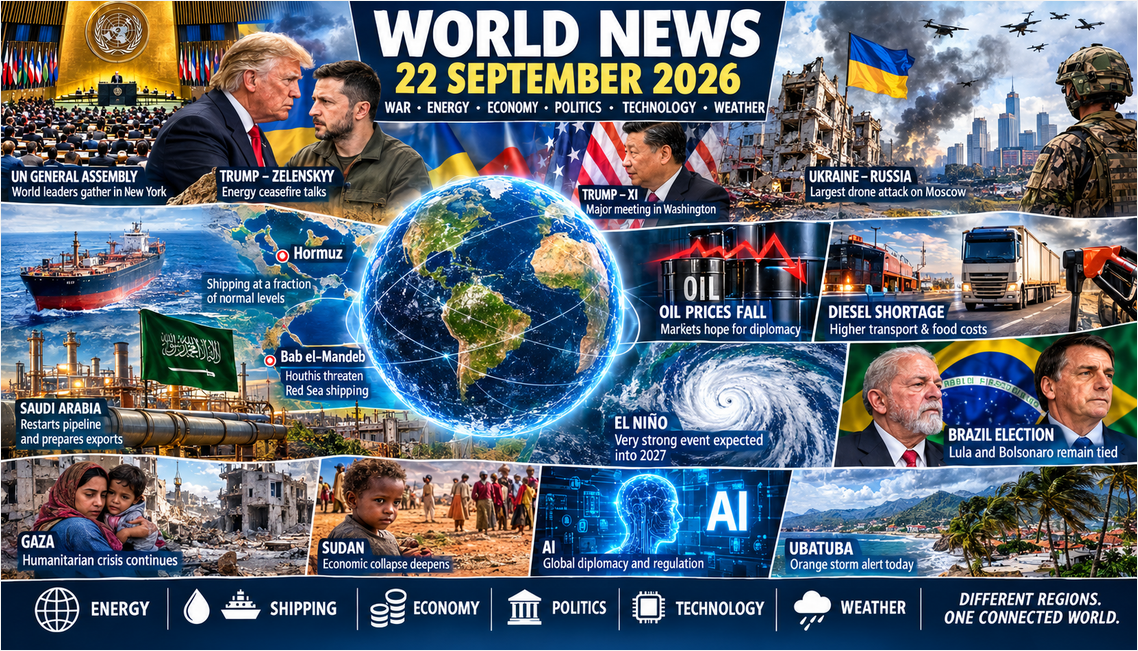
The world enters 22 September with several major crises developing simultaneously. The wars and confrontations around Iran, Israel and Gaza, Ukraine and Russia, and Yemen continue to affect energy supplies, shipping, financial markets and international diplomacy. At the same time, world leaders are gathering in New York for the 81st United Nations General Assembly, making this one of the most important diplomatic weeks of the year.
The most significant development today is a possible opening for diplomacy over the Strait of Hormuz. Iran has indicated that it could reopen the strategic waterway to Gulf shipping within seven days under conditions involving reduced U.S. military pressure. Saudi Arabia is also restarting its East-West oil pipeline and preparing to resume exports through the Red Sea port of Yanbu. The combination has pushed oil prices sharply lower from their recent highs.
Meanwhile, Ukrainian President Volodymyr Zelenskyy is meeting Donald Trump in New York to discuss a possible energy ceasefire with Russia. Trump and Chinese President Xi Jinping are preparing for their own major meeting in Washington on Thursday.
The United Nations is therefore becoming the centre of an extraordinary diplomatic week involving Iran, Ukraine, Gaza, China, Russia, Saudi Arabia, Israel and many other countries.
1. HORMUZ: A POSSIBLE DIPLOMATIC OPENING
The Strait of Hormuz remains the world's most important immediate energy chokepoint.
Iran has now indicated that it could reopen the strait to Gulf shipping within seven days if the circumstances surrounding the U.S.-Iran confrontation change. Even before any reopening has occurred, the statement has had a substantial effect on financial markets.
The strait normally carries a huge share of the world's seaborne oil and LNG trade. Recent shipping data showed that only 17 commodity vessels crossed Hormuz during the latest weekend, compared with 37 the previous weekend and roughly 125 per day before the war.
The reduction has created enormous pressure on refiners, tanker operators and countries dependent on imported energy.
There is, however, still some movement through the waterway. Saudi Arabia has increased some crude shipments through Hormuz while simultaneously working to restore alternative routes.
Saudi Arabia's East-West pipeline has restarted after being damaged by drone attacks. Riyadh is also preparing to resume crude exports from Yanbu on the Red Sea.
These developments explain why Brent crude has fallen below $100 a barrel after recently trading substantially above that level.
The important point is that the shipping crisis has not ended. A diplomatic reopening of Hormuz would be a major development, but the market remains dependent on whether the promise becomes an actual restoration of safe navigation.
2. SAUDI ARABIA, YEMEN AND THE RED SEA
The second major maritime danger is the Bab el-Mandeb Strait at the entrance to the Red Sea.
Russia's Vladimir Putin and Saudi Crown Prince Mohammed bin Salman spoke by telephone today and stressed the importance of safe and unrestricted passage through both Hormuz and Bab el-Mandeb.
They also called for a rapid cessation of fighting in Yemen and emphasized a political and diplomatic settlement.
The humanitarian consequences are already severe.
The UN refugee agency says more than 130,000 Yemenis have been displaced during September alone because of intensified fighting. More than 3,000 people have crossed the Red Sea to Africa, particularly toward Djibouti and Somalia.
UNHCR says another 100,000 people could be displaced during the coming three months if the fighting continues.
The humanitarian response is seriously underfunded, with the UNHCR Yemen response plan reported to be less than 20% funded.
Thus the Red Sea crisis is no longer simply a shipping problem. It is becoming a major humanitarian crisis as well.
3. UNITED NATIONS: THE WORLD'S LEADERS ARRIVE IN NEW YORK
The 81st UN General Assembly opens under exceptionally difficult circumstances.
Around 130 heads of state and government are expected to participate in the high-level proceedings.
The principal subjects are the wars in Iran and the Middle East, Gaza, Ukraine, Sudan, Congo and Myanmar, together with climate change, artificial intelligence, energy security and the future of international institutions.
UN Secretary-General António Guterres delivered his final major opening address before leaving office at the end of 2026.
He called for greater international cooperation and warned against a world in which military power alone determines international outcomes.
The United Nations itself is under pressure.
The United States has reduced its financial support and demanded major reforms, while China is concentrating heavily on bilateral diplomacy rather than relying exclusively on the UN framework.
Russia has said it supports expanding permanent membership of the Security Council but wants the existing veto system retained.
Turkey's President Recep Tayyip Erdoğan has argued for much deeper reform, including changes to permanent membership and veto powers.
The disagreement illustrates one of the central problems facing the UN: virtually everybody agrees that the international system needs reform, but the major powers disagree sharply about what that reform should be.
4. TRUMP AT THE UN — IRAN, UKRAINE AND GLOBAL POWER
Donald Trump is at the United Nations during one of the most complicated periods of his presidency.
The Iran war and the Hormuz crisis are central to his international agenda.
Trump is also meeting European and Middle Eastern leaders while seeking diplomatic movement over Ukraine.
The UN gathering provides an unusual opportunity for simultaneous discussions involving Iran, Saudi Arabia, Israel, Ukraine, Russia and other governments.
The question surrounding Iran is particularly important because the reopening of Hormuz could reduce pressure on the global economy.
For Washington, however, any agreement would have to be balanced against the broader confrontation with Tehran.
5. UKRAINE: ZELENSKYY MEETS TRUMP
Ukrainian President Volodymyr Zelenskyy is meeting Donald Trump in New York today.
One of the principal subjects is a proposed energy ceasefire.
The concept would stop Russia and Ukraine from attacking each other's energy infrastructure, including oil refineries, power installations and other critical energy facilities.
The proposal is particularly important because winter is approaching in Ukraine.
Russia has continued using missiles and drones against Ukrainian infrastructure, while Ukraine has increasingly targeted Russian oil refineries.
Ukraine argues that attacks on Russia's petroleum industry are an important means of putting economic pressure on Moscow.
Trump has been urging Ukraine to stop attacks on Russian refineries, while Kyiv wants corresponding guarantees that Russia will stop attacking Ukrainian energy and civilian infrastructure.
The two sides therefore face a difficult question: whether an energy ceasefire can become a first step toward wider negotiations.
There is currently no confirmed comprehensive peace agreement.
6. RUSSIA'S WAR AND EUROPE'S SECURITY
Russian and Ukrainian forces continue to exchange missile and drone attacks.
Recent attacks have struck infrastructure, energy installations, ports and cities on both sides.
The continuing use of large numbers of drones is changing the character of modern warfare. Cheap unmanned systems can threaten expensive infrastructure and force governments to spend enormous amounts on air defence.
Ukraine is also seeking additional Patriot air-defence systems from the United States ahead of winter.
At the same time, European governments remain increasingly concerned about the possibility that the conflict could spread beyond Ukraine through cyberattacks, drones, sabotage or other forms of hybrid warfare.
The war therefore remains both a Ukrainian-Russian conflict and a wider European security issue.
7. GAZA AND ISRAEL AT THE UN
Gaza remains one of the most divisive subjects at the UN.
Israeli Prime Minister Benjamin Netanyahu is expected to defend Israel's military actions when he addresses the international community.
Netanyahu said today that he intends to "tell the truth" about Israel's actions and strongly rejected criticism of Israel.
The Palestinian question is particularly prominent at this year's General Assembly because Palestinian President Mahmoud Abbas has again been denied entry to the United States for the UN meeting.
The political dispute surrounding Gaza is therefore playing out not only on the ground but also inside the diplomatic institutions of the international system.
At the same time, the humanitarian situation remains severe, and international organizations continue to press for protection of civilians and increased humanitarian assistance.
8. CHINA AND THE UNITED STATES: TRUMP–XI SUMMIT
Another major event of the week will occur on Thursday when Donald Trump and Chinese President Xi Jinping meet in Washington.
The two leaders are seeking greater stability in a relationship affected by trade, tariffs, technology, Taiwan, artificial intelligence and critical minerals.
Trade is likely to be the immediate practical subject.
China's exports have remained strong despite the American tariff campaign, while Washington continues to seek changes in Chinese trade practices.
Artificial intelligence is becoming another major part of the relationship.
U.S. and Chinese officials have discussed possible mechanisms for notifying each other about serious AI incidents and improving communication over emerging technologies.
Taiwan remains one of the most sensitive issues.
Reports indicate that Xi may press Trump to halt or reduce U.S. arms sales to Taiwan.
Washington, meanwhile, continues to regard Taiwan as a major security issue in the Asia-Pacific region.
The Trump-Xi meeting could therefore have consequences far beyond trade.
9. ARTIFICIAL INTELLIGENCE BECOMES A GLOBAL POLITICAL ISSUE
AI is no longer simply a technology story.
It is becoming a major subject of international diplomacy.
Governments are discussing AI safety, military applications, misinformation, elections, cybersecurity, employment and control of advanced computing.
The UN General Assembly is addressing the problem at precisely the moment when the United States and China are trying to establish their own rules for managing AI competition.
The central question is increasingly whether governments can develop international safeguards quickly enough to keep pace with the technology.
10. BRAZIL: ELECTION CAMPAIGN ENTERS A CRITICAL PHASE
Brazil's presidential election is now only weeks away, with the first round scheduled for October 4.
Recent polling shows an extremely close contest between President Luiz Inácio Lula da Silva and Senator Flávio Bolsonaro in simulated runoff scenarios.
Two major polls released recently produced opposite one-point leads.
A Quaest poll showed Flávio Bolsonaro at 42% and Lula at 41%.
A BTG Pactual/Nexus poll showed Lula at 46% and Flávio Bolsonaro at 45%.
Both margins were within the respective polls' ±2 percentage-point margins of error, so neither result establishes a statistically clear leader.
A Datafolha poll released September 17 showed Lula at 46% and Flávio Bolsonaro at 44% in a simulated second round.
These are measurements of voter intentions at specific moments, not predictions of the election result.
The campaign is also being affected by a corruption investigation involving Flávio Bolsonaro connected to the Banco Master case. Court documents unsealed earlier this month revealed the investigation; Bolsonaro has denied wrongdoing.
Brazil's Supreme Court remains another major political issue, with continuing disagreements among justices and intense political criticism from opposing sides.
The coming weeks are likely to be dominated by the economy, public security, social programmes, the Supreme Court and the question of political succession.
11. GLOBAL ECONOMY: OIL SHOCK EASING — FOR NOW
The energy situation has produced one of the most dramatic changes in financial markets during September.
Oil prices have fallen sharply from their recent highs because of three developments:
- Iran has indicated that Hormuz could reopen.
- Saudi Arabia is restoring alternative export capacity.
- Investors are hoping for diplomatic negotiations.
Brent crude has fallen below $100 a barrel.
That is significant because expensive oil feeds directly into transport, electricity, manufacturing, food production and inflation.
Lower oil prices therefore reduce pressure on consumers and central banks.
However, the underlying danger has not disappeared.
The world's dependence on a small number of maritime energy routes remains extremely high. Any renewed closure of Hormuz or Bab el-Mandeb could rapidly reverse the recent fall in prices.
12. GOLD AND FINANCIAL MARKETS
Gold remains exceptionally strong as investors continue to seek protection from geopolitical and economic uncertainty.
At the same time, global stock markets have received support from falling oil prices and hopes for progress in U.S.-China trade discussions.
The financial markets are therefore responding to two opposing forces:
Positive: lower oil prices, possible Hormuz reopening and improved U.S.-China diplomacy.
Negative: wars, high government debt, inflation risks, uncertainty over interest rates and geopolitical instability.
The result is a market environment that can change rapidly when a single major diplomatic or military development occurs.
13. EL NIÑO: A SECOND GLOBAL THREAT
The world is also facing a major climate development.
The World Meteorological Organization says the current El Niño is expected to strengthen significantly and persist into early 2027.
The phenomenon can alter rainfall and temperature patterns across large parts of the planet.
Potential consequences include:
- heavier rainfall and flooding in some regions;
- drought in others;
- extreme heat;
- agricultural disruption;
- pressure on food prices;
- increased wildfire risk;
- changes in tropical storm activity.
The WMO has warned that the event could become exceptionally strong.
This means that the world is confronting two interconnected systems of risk: geopolitical disruption and climatic disruption.
14. UBATUBA: STORM WARNING TODAY
Ubatuba is under an INMET orange storm alert today, 22 September, extending through tonight.
The warning calls for possible rainfall of 30–60 mm per hour or 50–100 mm in a day, winds of 60–100 km/h, and hail.
Possible consequences include flooding, falling trees, damage to crops and electricity interruptions.
The forecast indicates heavy thunderstorms particularly during the afternoon.
Another significant rainfall alert is scheduled for Wednesday, September 23.
The local forecast also shows a marked temperature change, with cooler conditions developing after today's storm.
15. SUDAN: ANOTHER CRISIS DEEPENS
Sudan receives less international attention than the Middle East and Ukraine, but its humanitarian crisis is enormous.
The Sudanese pound has lost almost half its value in army-controlled areas since the beginning of summer.
The war between the Sudanese Armed Forces and the Rapid Support Forces has lasted roughly three and a half years.
The economic consequences are now devastating.
Basic food prices are rising, shops report falling sales and many people are forced to take additional jobs simply to survive.
The country is effectively divided economically as well as militarily, with important sources of gold, livestock and agricultural exports located in areas controlled by different forces.
The crisis demonstrates how prolonged war can destroy an economy even when fighting is far from the world's television cameras.
THE BIG PICTURE — FIVE CRISES CONNECTED
The events of 22 September are not isolated.
They form a series of interconnected global chains.
Iran → Hormuz → oil → inflation → interest rates → household costs
Yemen → Bab el-Mandeb → shipping → energy → global trade
Russia–Ukraine → refineries → diesel → European security → energy prices
U.S.–China → trade → Taiwan → technology → AI → global supply chains
El Niño → floods/drought/heat → agriculture → food prices → migration
And alongside all of these is the political struggle over the future of the international system itself.
CONCLUSION
The most important development on 22 September is that diplomacy is beginning to compete with military escalation as the central story.
Iran's signal that Hormuz could reopen has immediately affected oil markets.
Saudi Arabia is restoring alternative oil-export routes.
Putin and the Saudi leadership are calling for safe passage through the world's critical maritime chokepoints.
Zelenskyy is meeting Trump to discuss an energy ceasefire with Russia.
Trump and Xi are preparing for a major U.S.-China summit.
And approximately 130 national leaders are gathering at the United Nations to discuss a world increasingly defined by war, climate disruption, artificial intelligence and economic uncertainty.
None of these diplomatic initiatives guarantees a settlement.
But they show something important: the world's major crises are becoming so interconnected that energy, security, trade, technology, climate and war can no longer be treated as separate subjects.
The world is entering a period in which one event in the Persian Gulf can affect fuel prices in Europe, elections in Brazil, inflation in America, shipping in Asia and household costs almost everywhere.
That is the defining feature of the world situation on 22 September 2026.
Key source notes for the article:
Reuters reports the Iranian signal on reopening Hormuz and the resulting fall in oil prices, as well as Saudi Arabia's restarting of its East-West pipeline. Reuters also reports today's Trump–Zelenskyy meeting and the proposed energy ceasefire, while the UN week brings the major international crises together in New York.
The Brazil polling figures are from recent Quaest, BTG Pactual/Nexus and Datafolha surveys; the one-point differences are within the reported margins of error and therefore should not be treated as a prediction. The Yemen displacement figures come from UNHCR reporting carried by Reuters, and the Sudan economic crisis from today's Reuters reporting.
For climate, the WMO continues to warn that the unusually strong El Niño is likely to persist into early 2027.