AI CHAT WORLD NEWS 21/09/2026
By AI Chat-Human Synthesis-21 September
THE MOST IMPORTANT WORLD EXTENSIVE NEWS TODAY.
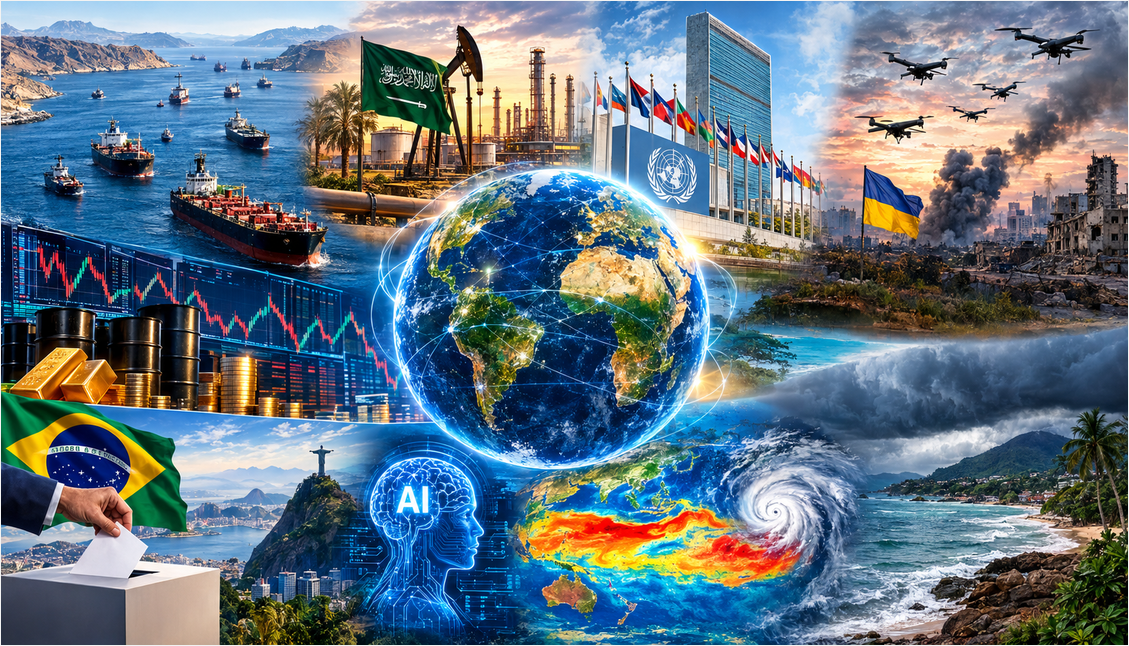
1. THE WORLD'S LEADERS GATHER AT THE UNITED NATIONS
The United Nations General Assembly opens this week in New York under exceptionally difficult circumstances.
Wars in the Middle East and Ukraine dominate the international agenda, while governments are also struggling with energy disruption, economic uncertainty, artificial intelligence and climate-related risks. More than 100 world leaders are expected to participate in the diplomatic gathering.
U.S. President Donald Trump is returning to the UN, while Ukrainian President Volodymyr Zelenskyy is expected to meet him during the week.
Russian President Vladimir Putin is not attending personally, although Russian Foreign Minister Sergey Lavrov is expected to represent Moscow.
China's President Xi Jinping is also not attending the General Assembly personally and is instead preparing for separate discussions with Trump.
The UN meeting therefore takes place while the major powers remain deeply divided over several of the world's most dangerous conflicts.
2. HORMUZ: SHIPPING REMAINS AT A FRACTION OF NORMAL LEVELS
The Strait of Hormuz remains the world's most important immediate economic chokepoint.
Reuters reports that only 17 commodity vessels passed through Hormuz over the weekend, compared with 37 the previous weekend and approximately 125 vessels per day before the war.
Some oil is still moving.
Tankers are using increasingly complicated arrangements, including ship-to-ship transfers outside the Strait. One very large crude carrier was reported transferring approximately 2 million barrels of Iraqi crude near Fujairah to another tanker bound for China.
This illustrates an important change in the oil market:
The oil is not necessarily gone.
The problem is getting it safely to the buyer.
That distinction is crucial.
3. SAUDI ARABIA IS TRYING TO KEEP THE OIL FLOWING
Saudi Arabia is attempting to compensate for the disruption by using alternative routes and increasing shipments through Hormuz when possible.
Reuters reported that 22 tankers carrying about 42 million barrels left through the Strait during the week of September 13. At the same time, no crude loadings from Saudi Arabia's Red Sea port of Yanbu had been observed since September 16.
The Saudi East-West pipeline is therefore becoming strategically important.
But the Houthis have attacked Saudi infrastructure, making the alternative routes less secure.
This creates an extraordinary situation:
Saudi Arabia needs alternative routes because Hormuz is dangerous — but those alternative routes are themselves becoming targets.
4. THE HOUTHI THREAT EXTENDS TO THE RED SEA
The second major maritime chokepoint is the Bab el-Mandeb Strait, between Yemen and the Horn of Africa.
Traffic there also declined over the weekend, with 51 vessels crossing compared with 57 the previous weekend.
The two waterways are connected to the same global shipping system.
If Hormuz remains severely restricted and Bab el-Mandeb also becomes unreliable, shipping companies face increasingly difficult choices.
Cargo can be rerouted around Africa, but that adds:
- thousands of kilometres;
- fuel consumption;
- crew costs;
- insurance;
- time;
- and freight charges.
Ultimately, consumers pay some of those costs.
5. OIL PRICES ARE FALLING — DESPITE THE WAR
An unusual development emerged Monday.
Oil prices have been falling for several consecutive sessions despite continuing military tension.
Reuters reported that Brent crude was heading toward its longest daily losing streak since June, with markets increasingly focusing on diplomatic possibilities and increased Saudi exports.
The market is therefore responding to two opposing forces.
Forces pushing oil higher:
- Hormuz disruption;
- attacks on energy infrastructure;
- uncertainty about Iranian exports;
- Houthi attacks;
- reduced refining capacity.
Forces pushing oil lower:
- some Saudi exports continuing;
- alternative shipping arrangements;
- hopes for U.S.–Iran diplomacy;
- evidence that some oil is still moving through Hormuz.
The oil market is consequently extremely sensitive to every diplomatic and military announcement.
6. DIESEL MAY BE THE BIGGER GLOBAL PROBLEM
The crude-oil headline can obscure a more serious problem: refining capacity.
The Iran and Ukraine wars are simultaneously affecting important refining centres.
The Wall Street Journal reports that U.S. diesel prices have reached exceptionally high levels, while shortages are appearing in parts of Africa and Latin America.
Diesel is essential for:
- trucks;
- agricultural machinery;
- ships;
- construction;
- generators;
- mining;
- buses;
- and industrial equipment.
Therefore the chain can become:
refinery disruption → diesel shortage → higher transport costs → higher food prices → higher inflation.
This is why the diesel situation is becoming an increasingly important part of the global economic story.
7. TRUMP URGES UKRAINE TO STOP STRIKING RUSSIAN REFINERIES
A significant new development concerns the Russia–Ukraine war.
The Financial Times reports that Trump urged Zelenskyy to stop Ukrainian strikes against Russian oil refineries, citing concern that the attacks are contributing to the global diesel shortage and higher fuel prices.
The Ukrainian government has indicated that it would consider a mutual ceasefire involving energy infrastructure if Russia also complies.
This creates a difficult strategic question.
Ukraine considers Russian energy infrastructure an important part of Russia's ability to finance and sustain the war.
At the same time, attacks on refineries can reduce available fuel supplies at a moment when the global refining system is already under pressure.
8. UKRAINE LAUNCHES ITS BIGGEST DRONE ATTACK ON MOSCOW
Ukraine has carried out an enormous drone operation against Russia.
Reports indicate that approximately 1,600 drones were involved in the wider assault, making it the largest reported Ukrainian drone attack on Moscow since the full-scale war began. At least two people were killed in Russia, according to regional authorities.
Targets included energy and military-related infrastructure.
The operation demonstrated Ukraine's rapidly expanding ability to manufacture and deploy long-range unmanned weapons.
Ukraine says it has increasingly developed its own long-range strike capability rather than relying exclusively on foreign weapons.
9. RUSSIA PROMISES MORE ATTACKS ON KYIV
Russia has responded by threatening to intensify attacks against Kyiv and other Ukrainian targets.
Russian drones subsequently struck the southern Ukrainian city of Zaporizhzhia, damaging apartment buildings, a university and a shopping centre and injuring people.
The cycle is becoming increasingly familiar:
Ukraine attacks Russian military and energy infrastructure → Russia launches large-scale attacks against Ukrainian cities and infrastructure → Ukraine retaliates again.
There is currently no clear sign that this cycle is ending.
10. THE WAR IS SPREADING INTO NEIGHBOURING AIRSPACE
The continuing drone war is also creating problems for countries that are not directly participating in the conflict.
Moldova reported another unidentified aerial object entering its airspace and temporarily closed part of its northern airspace.
Romania has also experienced repeated drone-related airspace incidents.
Authorities have warned that electronic warfare can cause drones to deviate from their intended routes, making it difficult in some cases to establish immediately whether an incursion was deliberate.
The geographical risk of the war is therefore becoming wider.
11. RUSSIA'S PARLIAMENTARY ELECTION ENDS
Russia's parliamentary election has concluded.
Early results show the Kremlin-aligned United Russia party retaining control of the State Duma.
International observers and Ukrainian authorities have criticized the election conditions, particularly voting in Russian-occupied Ukrainian territories.
The election took place while the country was simultaneously experiencing one of the largest Ukrainian drone attacks of the war.
12. TRUMP AND XI: A CRITICAL U.S.–CHINA WEEK
One of the most important diplomatic meetings of the week will be between Donald Trump and Xi Jinping.
Before the leaders meet, U.S. Treasury Secretary Scott Bessent and Chinese Vice Premier He Lifeng are holding discussions concerning:
- artificial intelligence;
- tariffs;
- critical minerals;
- trade;
- and wider geopolitical issues.
The importance goes far beyond trade.
The United States and China are competing for technological leadership in:
AI + semiconductors + batteries + critical minerals + advanced manufacturing.
At the same time, both countries have enormous economic interests in avoiding an uncontrolled confrontation.
13. ARTIFICIAL INTELLIGENCE ARRIVES AT THE CENTRE OF UN DIPLOMACY
AI is now one of the principal subjects at the UN General Assembly.
Governments are debating how to deal with rapidly advancing artificial intelligence while there is still no comprehensive global system governing the most powerful AI technologies.
Questions include:
- autonomous weapons;
- deepfakes;
- election manipulation;
- AI-generated misinformation;
- cyberwarfare;
- employment;
- control of advanced AI systems;
- and the possibility of AI being developed faster than governments can regulate it.
AI has therefore moved from being primarily a technology story to becoming a national-security and international-diplomacy issue.
14. THE MIDDLE EAST WAR DOMINATES THE UN
The United States and Iran continue exchanging threats while the Houthi conflict with Saudi Arabia adds another dimension to the war.
The United States has issued security warnings to Americans throughout the Middle East as officials assess the possibility of further escalation.
The UN therefore faces an extraordinary diplomatic challenge.
Several major conflicts are happening simultaneously:
Iran/Middle East
Ukraine
Gaza
Sudan
Congo
Myanmar
while governments are also dealing with climate shocks and rapid AI development.
15. GAZA REMAINS A MAJOR HUMANITARIAN CRISIS
Gaza remains extremely unstable despite diplomatic efforts surrounding the ceasefire framework.
Violence continues, while the territory faces enormous requirements for:
- food;
- clean water;
- medical treatment;
- housing;
- electricity;
- education;
- and reconstruction.
The UN General Assembly will again place the Palestinian question among its major diplomatic issues this week.
The broader Middle East conflict makes the possibility of a stable regional settlement even more complicated.
16. BRAZIL: LULA AND FLÁVIO BOLSONARO REMAIN STATISTICALLY TIED
Brazil's election is now only 13 days away.
A new BTG Pactual/Nexus poll released today places Lula at 46% and Flávio Bolsonaro at 45% in a simulated second round.
The poll's margin of error is two percentage points, so the result is classified as a statistical tie.
In the first round, the same survey has Lula at 40% and Flávio Bolsonaro at 37%. The poll interviewed 2,006 voters by telephone between September 18 and 20 and has a 95% confidence level.
Other recent polls have produced different numerical results.
For example, a Datafolha poll published September 17 put Lula at 46% and Flávio Bolsonaro at 44% in a simulated runoff.
These figures are polling measurements, not election results or forecasts.
The first round is scheduled for 4 October 2026.
17. BRAZIL: THE CAMPAIGN ENTERS ITS FINAL STAGE
With less than two weeks remaining before voting, the campaign is entering its most intense period.
The election is being fought against a background of disputes involving:
- the economy;
- social programmes;
- public security;
- taxation;
- environmental policy;
- the Supreme Federal Court;
- corruption investigations;
- and the use of artificial intelligence in political communication.
The increasingly close polling numbers mean that campaign events, debates and new allegations are receiving particularly intense attention.
18. BRAZIL AND AI-GENERATED POLITICAL CONTENT
Artificial intelligence is becoming a new problem for Brazilian voters.
Hundreds of cases involving AI-generated or manipulated political material have been documented during the 2026 campaign.
The problem is not simply false information.
AI can now create apparently realistic:
- photographs;
- speeches;
- videos;
- voices;
- interviews;
- and political statements.
This makes independent verification increasingly important.
Before accepting a dramatic political video as genuine, voters can check:
Who originally published it?
When was it published?
Is the complete video available?
Do independent news organizations report the same event?
Is there an official record?
19. EUROPE WATCHES THE RUSSIA–UKRAINE WAR WITH GROWING CONCERN
European governments are increasingly focused on the possibility that the war's effects could extend beyond Ukraine.
Repeated drone incidents involving neighbouring countries have raised questions about airspace security.
At the same time, European governments are increasing defence spending and strengthening air-defence systems.
The question facing Europe is no longer only how to support Ukraine.
It is also how to protect European territory from spillover.
20. THE GLOBAL FINANCIAL SYSTEM IS WATCHING OIL AND DIESEL
Financial markets enter this week with several competing influences.
Oil prices have recently fallen because of hopes for diplomacy and continued Saudi exports.
But diesel supplies remain tight.
Central banks are also dealing with inflationary pressure.
The U.S. Federal Reserve recently raised its benchmark rate to 3.75%–4.00%, while Japan raised its rate to 1.25%.
The result is an unusual economic environment:
energy prices are volatile while interest rates remain relatively high.
That can create pressure on consumers, companies and governments simultaneously.
21. INDIA AND RUSSIA: ENERGY SANCTIONS CREATE ANOTHER GLOBAL TEST
India is facing increasing pressure over its purchases of Russian energy following new U.S. sanctions legislation.
India has indicated that it intends to protect its own economic interests.
This illustrates one of the central problems of the current world economy:
Western sanctions can change the direction of energy trade, but they cannot easily eliminate global demand for oil.
As a result, Russian oil can continue moving through alternative buyers and shipping networks, although at greater financial and logistical cost.
22. EL NIÑO: A GLOBAL WEATHER WARNING
The World Meteorological Organization says the current El Niño is expected to become very strong during the coming months.
The WMO says there is an exceptionally high likelihood — nearly 100% — that the event will persist through February 2027.
The potential consequences include:
- extreme rainfall;
- drought;
- heat;
- flooding;
- agricultural disruption;
- water shortages;
- changes in fisheries;
- and pressure on food prices.
El Niño is therefore not merely a meteorological story.
It can become an economic and humanitarian story.
23. BRAZIL: A MAJOR WEATHER CHANGE IS DEVELOPING
Brazil is also experiencing significant weather instability.
INMET reports that a cold front and an extratropical cyclone are contributing to severe weather across parts of southern Brazil, while instability is affecting other regions.
São Paulo state is facing a particularly changeable period, with heat followed by storms and a significant temperature decline later in the week.
24. UBATUBA: ORANGE STORM ALERT TODAY
For Ubatuba, the weather situation has become more serious than in the previous editions.
INMET currently has an orange storm alert for Ubatuba today, Monday 21 September, valid through 23:59.
The warning indicates possible:
- rainfall of 30–60 mm/hour or 50–100 mm/day;
- winds of 60–100 km/h;
- hail;
- flooding;
- falling trees;
- and power interruptions.
A yellow storm alert is currently indicated for Tuesday as well.
The latest forecast shows hot, humid conditions followed by a strong afternoon thunderstorm today, with another potentially heavy storm Tuesday.
For practical purposes, today is therefore a day for extra caution around trees, loose outdoor objects, electrical equipment and exposed coastal areas.
25. THE BIG PICTURE: FIVE CONNECTED GLOBAL SYSTEMS
The events of 21 September reveal five increasingly interconnected systems.
1. ENERGY
Hormuz → oil → diesel → transport → inflation
2. WAR
Iran → Houthis → Saudi Arabia → Red Sea → global shipping
3. EUROPE
Ukraine → Russian energy infrastructure → European security → defence spending
4. TECHNOLOGY
AI → elections → misinformation → national security → international regulation
5. WEATHER
El Niño → heat/rainfall changes → agriculture → food prices → economic pressure
None of these systems operates completely independently.
26. THE MOST IMPORTANT HEADLINES — 21 SEPTEMBER 2026
1. UNITED NATIONS: World leaders gather in New York amid wars in the Middle East and Ukraine.
2. HORMUZ: Weekend vessel traffic falls to only 17 commodity ships.
3. SAUDI ARABIA: Alternative oil routes remain essential but face Houthi attacks.
4. OIL: Prices fall despite continuing Middle East tensions as markets watch diplomacy and Saudi exports.
5. DIESEL: Refined-fuel shortages are emerging as a major global economic concern.
6. UKRAINE: Kyiv launches its largest reported drone assault against Moscow.
7. RUSSIA: Moscow promises intensified attacks against Ukraine.
8. MOLDOVA: Another unidentified aerial object enters Moldovan airspace.
9. USA–CHINA: Trump and Xi prepare for major talks involving trade, AI and critical minerals.
10. AI: Artificial intelligence becomes a major UN diplomatic issue.
11. GAZA: Humanitarian and security problems continue.
12. BRAZIL: New BTG/Nexus polling shows Lula 46%, Flávio Bolsonaro 45% in a simulated runoff, within the margin of error.
13. BRAZIL: The first presidential round is only 13 days away.
14. EL NIÑO: WMO expects the event to become very strong and continue into early 2027.
15. UBATUBA: INMET has upgraded today's local storm warning to orange, with possible heavy rain, strong winds and hail.
CONCLUSION
21 SEPTEMBER 2026 — A WORLD UNDER MULTIPLE PRESSURES
Today's world news is increasingly difficult to understand by looking at individual events separately.
The Hormuz crisis is not simply a Middle Eastern military problem.
It is an energy problem.
The energy problem is becoming a diesel problem.
The diesel problem is becoming an inflation problem.
The Ukraine war is no longer confined to the battlefield because attacks on refineries affect the international fuel market.
The Russia–Ukraine drone war is also creating airspace concerns in neighbouring countries.
Meanwhile, China and the United States are preparing negotiations over AI, trade and critical minerals — three areas that will help determine the economic structure of the coming decade.
Brazil is approaching its October election with a highly competitive polling environment.
And the world's meteorological system is entering a major El Niño episode that the WMO expects to become very strong.
Above all, the UN General Assembly provides a remarkable picture of the present world:
WAR + ENERGY + ECONOMY + AI + CLIMATE
These are no longer separate stories.
They are increasingly connected.
A tanker stopped in Hormuz can influence the price of diesel in another continent.
A drone striking a refinery can affect farmers thousands of kilometres away.
A decision by Washington or Beijing can change global technology supply chains.
A political deepfake can influence an election.
And a change in Pacific Ocean temperatures can affect food and weather far beyond the Pacific.
DIFFERENT COUNTRIES. DIFFERENT CRISES. ONE CONNECTED WORLD.