AI CHAT WORLD NEWS 20/09/2026

By AI Chat.-T.Chr.-Human Synthesis-20 September 2026
THE MOST IMPORTANT WORLD EXTENSIVE NEWS 20/09/2026
1. HORMUZ: GLOBAL SHIPPING NEARLY GRINDS TO A HALT
The Strait of Hormuz has become the world's most important immediate economic chokepoint.
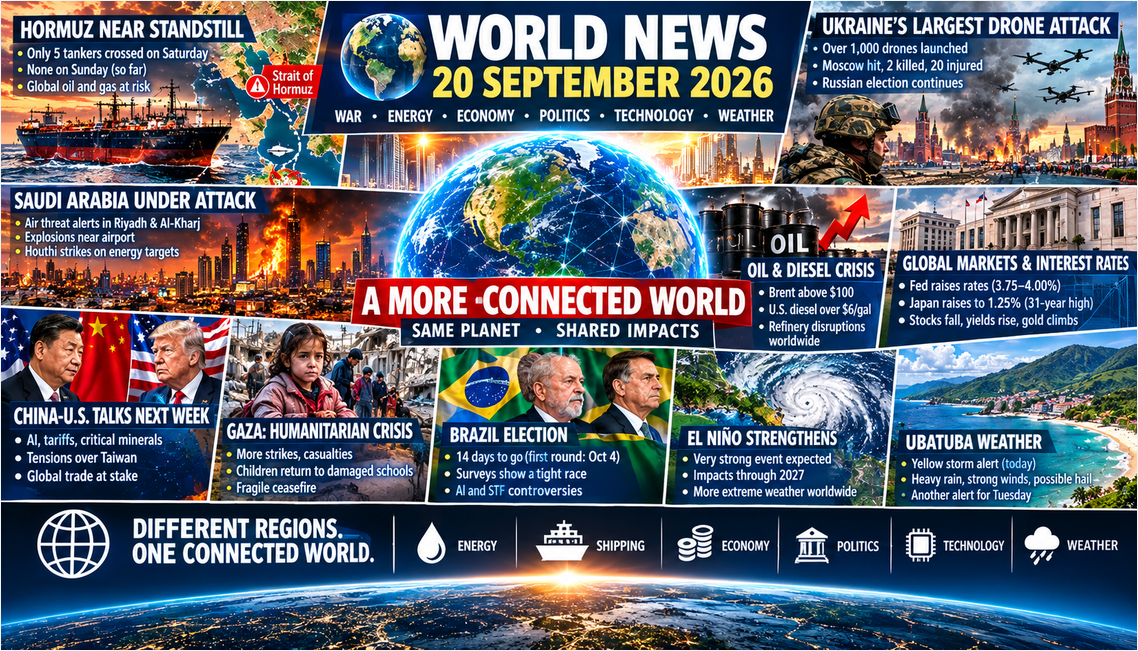
Shipping data show that only five commodity vessels crossed Hormuz on Saturday, while none were recorded on Sunday at the time of the latest report. The previous weekend saw 31 crossings. Tanker attacks and stalled U.S.–Iran diplomacy are contributing to the dramatic reduction in traffic.
The significance is enormous because Hormuz normally carries a major share of the world's seaborne oil and gas.
The crisis has now moved beyond the question of individual tanker attacks. Even vessels that could physically make the journey may remain in port because owners, crews and insurers consider the risk too high.
That means the effective supply disruption can become considerably larger than the number of ships actually attacked.
2. IRAN WAR: TEHRAN WARNS AGAINST A NEW U.S. ATTACK
Iran warned the United States and its allies on Sunday against what Tehran says could be a new major attack.
Iran's military command said any new attack would bring sustained retaliation against U.S. bases and interests and that regional allies of Washington could also be regarded as participants.
The United States issued a security alert warning Americans in the region of the possibility of unforeseen escalation, including possible flight cancellations and airspace closures.
The conflict has now lasted almost seven months, with neither side showing signs of accepting the concessions necessary for a durable settlement.
Iran is also maintaining that Hormuz will not be reopened until conditions connected with the failed June ceasefire agreement are met.
3. SAUDI ARABIA: THE WAR IS MOVING CLOSER TO CRITICAL ENERGY INFRASTRUCTURE
Saudi Arabia has become one of the most important countries in the entire energy crisis.
The Iran-aligned Houthis have claimed attacks on Riyadh and on an oil facility at Yanbu, while Saudi authorities and the Saudi-led coalition have reported intercepting attacks.
Reuters footage showed a large plume of black smoke near Riyadh's main international airport following explosions overnight.
The problem for Saudi Arabia is particularly serious because it has been attempting to compensate for the closure of Hormuz by moving oil through alternative routes.
If those routes are attacked as well, the amount of oil that can reach world markets falls further.
4. YEMEN AND BAB EL-MANDEB: A SECOND GLOBAL CHOKEPOINT
The Houthi advance along Yemen's Red Sea coast has placed the group close to the Bab el-Mandeb Strait, another crucial maritime passage.
The combination is unprecedented:
Hormuz threatened from the east + Bab el-Mandeb threatened from the west.
Together, the two waterways connect the Persian Gulf and Red Sea with the principal international shipping system.
If both remain unreliable, ships may have to take longer routes around Africa, increasing fuel consumption, insurance and freight costs.
This is one reason why the present Middle Eastern conflict has consequences far beyond the region.
5. THE NEXT PROBLEM: DIESEL
Crude oil is not the only concern.
A potentially more immediate problem for ordinary economies is diesel.
Diesel powers trucks, agricultural machinery, construction equipment, ships, generators and many industrial operations.
Current reporting says U.S. diesel prices have risen above $6 per gallon, while shortages are appearing in parts of Africa and Latin America. The disruption is being caused by reduced refining capacity in the Middle East and Russia, attacks on refineries, and interrupted international trade routes.
This creates a dangerous economic chain:
less diesel → more expensive transport → more expensive food → higher industrial costs → higher inflation.
The diesel problem could therefore eventually be more economically damaging than the headline crude-oil price itself.
6. RUSSIA'S REFINERIES ARE ALSO UNDER PRESSURE
Ukraine has increasingly targeted Russian energy infrastructure.
Reuters reported that half of Russia's six largest diesel-producing refineries have significantly reduced or halted production during September following drone attacks.
The result is a remarkable convergence of two wars.
The Iran conflict is disrupting Middle Eastern refining and shipping.
The Russia–Ukraine war is disrupting Russian refining.
Both are therefore reducing the world's available supply of refined fuels at the same time.
7. UKRAINE LAUNCHES ITS LARGEST DRONE ATTACK ON MOSCOW
Sunday brought a major escalation in the Russia–Ukraine war.
Ukraine launched more than 1,000 drones against Russian territory, according to Russian authorities, including hundreds directed toward the Moscow region.
Moscow Mayor Sergei Sobyanin described it as the largest drone attack on Moscow reported so far.
Two people were killed and 20 injured in the Moscow region, according to regional authorities, while a Moscow oil refinery and a residential building were damaged.
Ukraine said the operation involved domestically produced missiles and drones and targeted oil and logistics infrastructure.
The attack occurred on the final day of Russia's parliamentary election.
8. RUSSIA'S PARLIAMENTARY ELECTION TAKES PLACE DURING THE ATTACK
Russia's State Duma election is being held over three days and concludes Sunday.
It is the first Russian parliamentary election since the full-scale invasion of Ukraine in 2022.
Russian authorities have reported cyberattacks and the drone strikes, while the Kremlin has presented the election as a demonstration of national unity and support for the war.
Most prominent anti-war candidates have been excluded from the ballot, according to Reuters, and opposition parties operate under significant restrictions.
Results are expected later Sunday and Monday.
9. THE WAR IS BECOMING INCREASINGLY A DRONE WAR
One of the most important military developments of 2026 is the rapid expansion of long-range drone warfare.
Ukraine has demonstrated an ability to strike targets hundreds of kilometres inside Russia.
Russia, meanwhile, continues to use large numbers of drones against Ukrainian cities and infrastructure.
The battlefield is consequently changing from a conflict concentrated around a front line into a war in which oil refineries, logistics centres, airports and industrial facilities far behind the front can become targets.
That also increases the economic consequences of the war.
10. CHINA AND THE UNITED STATES: XI AND TRUMP PREPARE FOR WASHINGTON TALKS
Another major international event is approaching.
U.S. President Donald Trump is scheduled to meet Chinese President Xi Jinping in Washington this week.
Before that meeting, U.S. Treasury Secretary Scott Bessent and Chinese Vice Premier He Lifeng are scheduled to hold talks on AI, tariffs and critical minerals.
These subjects are strategically important.
Artificial intelligence
Both countries want leadership in advanced AI.
Tariffs
Trade restrictions remain a major source of friction.
Critical minerals
China occupies an important position in the global supply chain for several minerals essential to electronics, batteries and advanced technology.
The talks therefore concern much more than conventional trade.
11. TAIWAN: A RARE MINISTERIAL VISIT TO CHINA
Taiwan's labour minister has travelled to China to attend an APEC ministerial event.
Reuters describes it as the first ministerial-level visit to China by the administration of President Lai Ching-te.
The visit comes while Beijing has increased military and political pressure around Taiwan and has rejected repeated offers of talks from Lai.
The visit is nevertheless taking place within the APEC framework, providing a rare channel for official-level contact.
Taiwan remains one of the world's most important technology centres because of its semiconductor industry.
12. GAZA: HUMANITARIAN CRISIS CONTINUES
The Gaza situation remains highly fragile.
Reuters reported that Israeli airstrikes on Saturday killed at least three Palestinians according to Palestinian health officials.
The Israeli military said it had struck militants, including a man identified by Palestinian officials as the son of Gaza's health ministry director-general.
The broader ceasefire arrangement remains under severe strain, with disagreements over Hamas disarmament and Israeli military withdrawal continuing to obstruct progress toward a durable settlement.
Gaza also continues to face enormous reconstruction, housing, food, medical and educational needs.
13. WEST BANK TENSIONS ALSO RISING
An Israeli man was fatally shot near the Neve Tzuf settlement in the occupied West Bank.
Israeli forces subsequently killed a Palestinian man whom the military said had attempted to ram troops with a vehicle.
The incidents occurred shortly before Yom Kippur, Judaism's holiest day.
Israeli forces also carried out arrests in Al-Mughayyir.
The developments demonstrate that the regional crisis extends beyond Gaza and Iran.
14. BRAZIL: PRESIDENTIAL ELECTION ENTERS THE FINAL TWO WEEKS
Brazil's first-round presidential election is now only 14 days away, scheduled for 4 October.
The latest polling continues to show a highly competitive contest between President Luiz Inácio Lula da Silva and Senator Flávio Bolsonaro.
An AtlasIntel/Bloomberg survey conducted September 11–16 among 5,018 voters showed Flávio Bolsonaro at 47.2% and Lula at 46.8% in a simulated second round. The margin of error was one percentage point, making the result a statistical tie.
Other polls have produced different numerical results. A Datafolha survey earlier in September had Lula at 46% and Flávio Bolsonaro at 44% in a second-round simulation.
These are poll measurements, not election results or predictions.
The first round will determine which candidates advance if no candidate obtains more than half of valid votes.
15. BRAZIL: NEW TSE CASE INVOLVING LULA AND FLÁVIO BOLSONARO
Brazil's Superior Electoral Court (TSE) has accepted for processing an action brought by Flávio Bolsonaro concerning the 2026 Carnival parade by Acadêmicos de Niterói, which honoured Lula.
The case alleges political and economic abuse and requests serious electoral penalties.
The TSE's acceptance of the case does not mean that the allegations have been proven.
It begins the stage in which evidence can be collected and the accused parties can present their defence. Lula and Vice President Geraldo Alckmin were given five days after notification to respond.
This distinction between accepting a case for investigation and finding wrongdoing is important.
16. BRAZIL'S ELECTION AND ARTIFICIAL INTELLIGENCE
Artificial intelligence is also becoming a significant factor in the Brazilian election.
Hundreds of political cases involving AI-generated or manipulated material have already been documented during the 2026 campaign.
Deepfake videos, manipulated audio and synthetic images create a new problem for voters.
A convincing political video is no longer necessarily evidence that the event shown actually happened.
The safest approach is increasingly to check:
original source → date → full video → independent reporting → official record.
17. THE GLOBAL ECONOMY: WAR IS NOW A REFINING PROBLEM
The most important economic development today may not be crude oil itself.
It is the growing shortage of refined petroleum products.
The world's refining system is being hit simultaneously by:
- Middle Eastern war;
- Saudi infrastructure disruption;
- Houthi attacks;
- Russian refinery attacks;
- sanctions;
- reduced international shipping;
- and rising demand for fuel.
The Wall Street Journal reported that the disruption has pushed U.S. diesel above $6 per gallon and caused shortages in parts of Africa and Latin America.
This is particularly important because diesel is directly connected to the cost of moving almost everything.
18. CENTRAL BANKS HAVE A DIFFICULT PROBLEM
The world's central banks are now facing conflicting pressures.
Higher oil and diesel prices push inflation upward.
Higher interest rates push economic growth downward.
If central banks keep rates high to control inflation, borrowing becomes more expensive.
If they lower rates too quickly while energy prices remain high, inflation could remain difficult to control.
This is one reason why financial markets are watching every movement in oil prices so closely.
19. GOLD AND INVESTOR UNCERTAINTY
Gold remains an important defensive asset while geopolitical and economic uncertainty remain elevated.
Investors are simultaneously watching:
- Middle Eastern energy supplies;
- the Russia–Ukraine war;
- U.S. interest rates;
- inflation;
- the dollar;
- China–U.S. relations;
- and government debt markets.
The financial system therefore remains highly sensitive to political developments.
20. EL NIÑO: THE OTHER GREAT GLOBAL STORY
Beyond the wars and political crises, another major development is taking place in the Pacific Ocean.
The World Meteorological Organization says El Niño is firmly established and expected to intensify into a very strong event during the coming months.
The WMO gives an exceptionally high likelihood — nearly 100% — that El Niño will persist through February 2027.
The WMO warns that the effects can cascade through:
- agriculture;
- food prices;
- fisheries;
- water supplies;
- energy;
- transport;
- health;
- and disaster management.
This makes El Niño an economic story as well as a weather story.
21. EL NIÑO AND 2027
The strongest effects are expected toward the end of 2026 and into 2027.
A very strong El Niño can alter rainfall patterns dramatically in different parts of the world.
Some regions may experience flooding.
Others may experience drought.
Other regions can experience unusually high temperatures.
The WMO says the impacts of this event may continue long after the Pacific temperatures themselves begin to decline.
22. UBATUBA: STORM ALERT TODAY
For Ubatuba, Sunday 20 September begins under an INMET yellow storm alert.
The current forecast indicates humid conditions with periods of cloud and a chance of afternoon rain.
The INMET alert indicates possible rainfall of 20–30 mm/hour or up to 50 mm/day, winds of 40–60 km/h and possible hail.
A further yellow storm alert is currently indicated for Tuesday, 22 September.
The important point for Ubatuba residents is that the present alert represents a potential risk, not a certainty that severe weather will occur at a particular location.
23. THE WORLD'S FOUR BIGGEST DOMINO EFFECTS
ENERGY DOMINO
Hormuz → less oil shipping → higher energy prices → inflation → pressure on interest rates.
DIESEL DOMINO
Refinery attacks → less diesel → more expensive transport → higher food and industrial costs.
SECURITY DOMINO
Iran → Houthis → Saudi Arabia → Bab el-Mandeb → global shipping.
CLIMATE DOMINO
El Niño → altered rainfall/temperature → agriculture → food prices → economic pressure.
24. WHY THE HORMUZ CRISIS IS DIFFERENT
The most worrying characteristic of the present crisis is that several alternative routes are being threatened simultaneously.
Normally, if one shipping route becomes dangerous, cargo can be redirected.
But if Hormuz, Bab el-Mandeb and major refining centres are all affected, simply changing the route becomes much more difficult.
This is why the crisis has become a global economic issue rather than merely a regional military conflict.
25. THE MOST IMPORTANT HEADLINES — 20 SEPTEMBER 2026
1. HORMUZ: Shipping through the Strait approaches a near standstill.
2. IRAN: Tehran warns against a possible new U.S. attack.
3. SAUDI ARABIA: Houthi attacks threaten Riyadh and energy infrastructure.
4. YEMEN: Houthi control around Bab el-Mandeb threatens another major shipping route.
5. DIESEL: Global refined-fuel supplies are becoming increasingly tight.
6. UKRAINE: More than 1,000 drones are reported launched against Russia.
7. MOSCOW: Russia reports its largest drone attack on the capital so far.
8. RUSSIA: Parliamentary elections conclude amid wartime conditions.
9. CHINA–USA: Senior officials prepare talks on AI, tariffs and critical minerals.
10. TAIWAN: A rare Taiwanese ministerial visit to China takes place under the APEC framework.
11. GAZA: Violence and humanitarian difficulties continue despite the ceasefire framework.
12. BRAZIL: The presidential election enters its final two weeks before the 4 October first round.
13. BRAZIL: Recent Lula–Flávio Bolsonaro polling remains within statistical margins in some runoff scenarios.
14. BRAZIL: The TSE begins examining an electoral case involving the Lula campaign and the 2026 Carnival parade.
15. EL NIÑO: WMO expects a very strong event with impacts extending into 2027.
16. UBATUBA: INMET has a yellow storm alert for today and another currently indicated for Tuesday.
CONCLUSION
ONE WORLD — MANY INTERCONNECTED CRISES
The most important story on 20 September 2026 is not one individual event.
It is the growing connection between several major systems.
The war involving Iran is disrupting Hormuz.
The Houthi advance threatens Bab el-Mandeb.
Saudi Arabia is attempting to maintain alternative energy routes.
Russia and Ukraine are damaging each other's energy infrastructure.
The result is a developing global refining and diesel crisis.
At the same time, China and the United States are preparing negotiations involving AI, trade and critical minerals.
Brazil is entering the final weeks of its presidential campaign.
And over everything lies an increasingly powerful El Niño, with the WMO warning of major weather and economic consequences into 2027.
The central lesson of today's world is therefore increasingly clear:
A crisis in one region no longer stays in that region.
WAR affects ENERGY.
ENERGY affects INFLATION.
INFLATION affects INTEREST RATES.
INTEREST RATES affect MARKETS.
WEATHER affects FOOD and WATER.
And all of them together affect the daily lives of people around the world.
20 SEPTEMBER 2026 — DIFFERENT REGIONS, ONE CONNECTED WORLD.