AI CHAT WORLD NEWS 19/09/2026

By AI Chat-Human Synthesis — Saturday, 19 September 2026
THE MOST IMPORTANT WORLD EXTENSIVE NEWS TODAY
1. MIDDLE EAST: THE HORMUZ CRISIS REMAINS THE WORLD'S BIGGEST IMMEDIATE RISK
The most consequential international story remains the continuing disruption of shipping through the Strait of Hormuz, the narrow waterway through which a major share of the world's seaborne oil and gas normally passes.
Commercial traffic has fallen to extraordinarily low levels. Reuters reported that only three commodity vessels transited Hormuz on Wednesday, compared with much higher normal traffic before the crisis.
The consequences are no longer confined to Iran and the Gulf. They are affecting:
- oil prices;
- diesel and fuel costs;
- shipping insurance;
- Asian energy supplies;
- European energy security;
- inflation;
- government bond yields;
- airline and transport costs;
- and the outlook for global economic growth.
The crisis has therefore become an international economic problem as well as a military and diplomatic one.
2. SAUDI ARABIA: NEW ATTACKS BRING THE ENERGY CRISIS CLOSER TO RIYADH
Saudi Arabia experienced a serious new security alert overnight.
Saudi authorities issued warnings of a possible aerial attack covering Riyadh and Al-Kharj. Reuters reported that explosions were heard and that a large column of smoke and flames was subsequently visible near Riyadh's main airport. The alerts were later lifted.
At the time of reporting, there was no confirmed information of casualties or major damage from the incident.
The significance is considerable.
Saudi Arabia has been one of the world's principal alternative sources of oil when Gulf shipping is disrupted. But attacks by Yemen's Iran-aligned Houthis are now threatening Saudi cities, energy infrastructure and the alternative Red Sea route.
That creates a dangerous chain:
Hormuz disrupted → Saudi alternative routes become more important → Houthi attacks threaten those alternatives → available oil becomes harder to move → global prices remain vulnerable.
The UN Security Council has condemned Houthi attacks affecting Saudi civilian and energy infrastructure.
3. CHINA IS TRYING TO LIMIT THE HOUTHI ESCALATION
An important diplomatic development involves China.
Reuters reported that China has privately asked Iran to help restrain the Houthis after Saudi Arabia sought Beijing's assistance. Three Iranian sources familiar with the matter were cited.
China has a powerful economic interest in keeping Middle Eastern energy routes open because it is one of the world's largest oil importers. The growing Houthi presence around the Red Sea and Bab el-Mandeb therefore represents a direct threat to China's commercial interests.
This creates an unusual diplomatic triangle:
Saudi Arabia → China → Iran → Houthis
Whether Tehran can or will significantly restrain the Houthis remains uncertain.
4. THE RED SEA IS BECOMING A SECOND ENERGY CHOKEPOINT
The importance of the Bab el-Mandeb Strait is increasing.
The Red Sea is the principal maritime connection between the Indian Ocean and the Suez Canal. If both Hormuz and Bab el-Mandeb become unreliable, ships carrying energy and other goods have to take much longer routes around Africa.
That means:
longer journeys → more fuel consumption → higher insurance → higher freight rates → higher delivered prices.
The danger is therefore not simply that oil becomes expensive.
The entire international transportation system becomes more expensive.
5. IRAN CLAIMS ANOTHER TANKER WAS HIT IN HORMUZ
Iran has claimed that its forces struck a Togo-flagged oil tanker attempting to pass through the Strait of Hormuz.
The claim was reported by several international news organizations. Details surrounding the incident remain contested, and independent verification of Iran's account is limited.
The incident nevertheless illustrates the central problem facing international shipping:
Even when ships are physically able to move, owners and insurers may decide that the risk is unacceptable.
That can reduce shipping without every vessel actually being attacked.
6. OIL: STILL ABOVE $100 A BARREL
Oil prices remain exceptionally sensitive to developments in the Gulf.
Earlier this week Brent crude was around $104 a barrel, while U.S. crude was also above $100. Prices temporarily eased after Saudi Arabia found ways of moving additional crude through alternative arrangements, while China pressed Iran regarding Houthi attacks.
But the Saudi security incidents demonstrate why the market remains nervous.
The world is effectively balancing two opposing forces:
Supply disruption pushes prices UP.
Attempts to find alternative supply routes push prices DOWN.
The result is extreme volatility.
7. GLOBAL ECONOMY: OIL + INTEREST RATES = A DIFFICULT COMBINATION
The financial consequences are now becoming clearer.
The United States Federal Reserve raised its policy rate by 0.25 percentage point this week, bringing its target range to 3.75%–4.00%.
Japan also raised its key rate to 1.25%, its highest level in decades.
At the same time, oil remains above $100.
That creates a difficult combination for central banks:
Higher oil → higher inflation
while
Higher interest rates → slower economic activity.
Central banks therefore face the possibility of having to fight inflation while economic growth is simultaneously being weakened by expensive energy.
8. GLOBAL STOCK MARKETS REMAIN NERVOUS
Reuters reported that global equities fell on Friday while Treasury yields rose as investors assessed the effect of central-bank tightening and the continuing Middle East war.
The U.S. market finished approximately:
- Dow Jones: -0.4%
- S&P 500: -0.2%
- Nasdaq: -0.1%
European equities also declined.
The important point is not the size of one day's movement.
It is the underlying combination:
war + oil above $100 + inflation + higher interest rates + expensive government borrowing.
That combination can affect households, companies, governments and pension investments simultaneously.
9. GOLD REMAINS A MAJOR SAFE-HAVEN ASSET
Gold has continued to benefit from geopolitical uncertainty and concerns about financial markets.
European trading on Friday saw gold around $4,395 per troy ounce, according to market reporting, while silver also rose.
Gold is being supported by several forces:
- geopolitical uncertainty;
- inflation concerns;
- central-bank activity;
- currency movements;
- and demand for assets perceived as defensive.
10. UKRAINE: WAR CONTINUES WHILE EUROPE STRENGTHENS ITS SUPPORT
The Ukraine war remains another major source of international instability.
Ukraine has been subjected to continued Russian missile and drone attacks, while Ukrainian forces continue strikes against Russian military and industrial targets.
A particularly important development is that President Donald Trump signed legislation imposing sweeping additional sanctions aimed at Russia's energy revenues and networks supporting its war effort. The measure passed both houses of Congress with large majorities.
The legislation also gives the U.S. president authority to impose potentially very high tariffs on countries continuing to purchase Russian oil and gas under specified circumstances.
This adds another layer to the global energy crisis.
The Russia–Ukraine conflict is therefore increasingly connected to the wider struggle over:
oil + gas + sanctions + shipping + international trade.
11. A SERIOUS NUCLEAR-SAFETY INCIDENT IN RUSSIA
The International Atomic Energy Agency said it had been informed that a drone struck a cooling tower at the Kursk nuclear power plant in western Russia.
The IAEA reported that the reactor continued operating and that there was no fire. Russian nuclear authorities said the damage was minor and that radiation levels remained normal.
The event is significant because attacks or incidents near nuclear installations carry risks extending beyond the immediate battlefield.
So far, the available information does not indicate a radiation emergency.
12. UKRAINE BUILDS A NEW REGIONAL ECONOMIC AND SECURITY NETWORK
President Volodymyr Zelenskyy has launched a new cooperation initiative involving eight Central and Eastern European countries and the European Union.
More than 50 agreements worth over €1 billion were announced, with more than half involving energy projects, particularly solar and wind power.
The broader objective is to strengthen regional energy independence and economic connections.
This is particularly important after Europe's experience with dependence on Russian energy.
13. RUSSIA HOLDS PARLIAMENTARY ELECTIONS
Russia is holding a three-day vote for its State Duma, with polling continuing through Sunday.
President Vladimir Putin has accused Ukraine of attempting to interfere with the election and said Moscow must continue strengthening its nuclear deterrent and missile defenses.
Russia's election is taking place while the war with Ukraine continues.
14. GAZA: CHILDREN RETURN TO DAMAGED SCHOOLS
Despite the continuing humanitarian difficulties, UNRWA says that more than 280,000 children in Gaza have returned to education, many of them studying in tents or heavily damaged school buildings.
At the same time, Israeli military strikes continue to be reported in Gaza.
The latest reports say two men were killed in separate Israeli strikes, with the Israeli military saying it had targeted military operatives.
The situation therefore remains one of fragile security combined with enormous humanitarian needs.
15. PAKISTAN: DEADLY MOSQUE ATTACK
Pakistan has suffered another major security incident.
Reports say a bombing at a mosque killed at least 15 people and injured more than 50. The victims included civilians and police officers.
The incident adds to the wider security concerns affecting South Asia at a time when the Middle East crisis is already placing pressure on international diplomacy and energy supplies.
16. JAPAN MOVES TOWARD HIGHER INTEREST RATES
The Bank of Japan raised its key rate from 1.00% to 1.25%, its highest level in approximately 31 years.
Japan's monetary policy matters globally because the yen and Japanese financial markets are deeply connected to international capital flows.
The combination of:
U.S. rate increases + Japanese rate increases + European monetary tightening
means that the era of extremely cheap global money is becoming increasingly distant.
17. BRAZIL: PRESIDENTIAL ELECTION ENTERS ITS MOST INTENSE PERIOD
Brazil's presidential election is now only weeks away.
The first round is scheduled for 4 October, with a possible second round on 25 October.
Recent polling has produced very close results between President Luiz Inácio Lula da Silva and Senator Flávio Bolsonaro in hypothetical second-round matchups.
A Datafolha poll published on 17 September showed Lula at 46% and Flávio Bolsonaro at 44% in a second-round simulation. The difference was within the poll's margin of error.
Other recent surveys have produced different numerical results, including an AtlasIntel survey showing Flávio Bolsonaro narrowly ahead in one runoff simulation.
These differences illustrate why individual polls should not be treated as election results or forecasts.
Brazil's Supreme Court controversy
The political atmosphere is also being affected by continuing controversy surrounding the Supreme Federal Court and Justice Alexandre de Moraes, as well as the Banco Master investigations.
There remain allegations and procedural disputes involving public figures. These should be distinguished carefully from established judicial findings.
In particular, there has not been a conviction of Moraes for fraud. The matters involving him remain part of ongoing legal and political controversy.
18. AI IS BECOMING A NEW BRAZILIAN ELECTION BATTLEGROUND
Artificial intelligence is becoming increasingly important in the Brazilian campaign.
A study by the Observatório IA nas Eleições identified hundreds of political cases involving AI-generated or manipulated material during 2026.
The material includes deepfakes, manipulated videos and other synthetic political content.
This introduces a new problem for voters:
A video that looks authentic may not actually be authentic.
The importance of checking the original source, date and context is therefore increasing rapidly.
19. CHINA'S ROLE IS GROWING
China is now involved in several of the world's most important economic and diplomatic questions simultaneously.
China is:
- a major importer of Middle Eastern oil;
- a major trading partner of Russia;
- a central participant in BRICS;
- a major technology competitor of the United States;
- and now involved diplomatically in attempts to restrain the Houthi escalation.
Beijing's request that Iran help limit Houthi attacks demonstrates that the Hormuz/Red Sea crisis is affecting China's own strategic interests.
20. SOUTH KOREA: PROTECTING SHIPPING WITHOUT JOINING THE WAR
South Korea has indicated that it is prepared to contribute to efforts to restore safe passage through Hormuz while not deploying forces to participate directly in the wider war.
The distinction is important.
South Korea is highly dependent on imported energy and therefore has a direct economic interest in keeping shipping lanes open.
21. EL NIÑO: A SECOND GLOBAL SYSTEM TO WATCH
The geopolitical crisis is happening alongside another enormous global development: El Niño.
The World Meteorological Organization says El Niño is firmly established and is expected to strengthen into a very strong event during the coming months.
The WMO says there is an exceptionally high likelihood that El Niño will continue through the 2026–27 Northern Hemisphere winter, with consequences for rainfall and temperature patterns and increased risks of floods, drought and extreme heat in different regions.
This is not simply a Pacific Ocean story.
El Niño can influence weather patterns across large parts of:
- South America;
- North America;
- Asia;
- Australia;
- Africa;
- and the Pacific.
Its consequences can also affect agriculture, food prices, water resources and electricity demand.
22. UBATUBA: HUMID WEATHER WITH STORMS AHEAD
For Ubatuba, the immediate picture is considerably calmer than some other parts of São Paulo state.
Today, Saturday 19 September, conditions are cloudy and humid with showers possible.
More importantly, INMET has issued a yellow storm alert specifically for Ubatuba for Sunday 20 September, with possible rainfall of 20–30 mm/hour or up to 50 mm/day, winds of 40–60 km/h and possible hail.
A further yellow alert is currently indicated for Tuesday 22 September.
The forecast also points toward a warmer and more unstable period early next week, including a possibility of a strong afternoon thunderstorm on Monday.
The Ubatuba situation should therefore be watched especially from Sunday through Tuesday, while remembering that a yellow alert indicates potential rather than certainty of severe conditions.
23. THE FOUR BIG GLOBAL DOMINO CHAINS
Looking at today's world as a whole reveals four major interconnected chains.
ENERGY
Hormuz disruption → oil shortage risk → higher prices → inflation → higher interest rates → slower growth.
SECURITY
Iran war → Houthi expansion → Saudi attacks → Red Sea disruption → international shipping risk.
EUROPE
Russia–Ukraine war → sanctions → energy restructuring → European defense spending → closer regional cooperation.
CLIMATE
El Niño → altered rainfall and temperature → agricultural stress → food/water pressure → economic consequences.
These chains increasingly overlap.
24. WHY TODAY'S WORLD NEWS IS DIFFERENT
The important feature of September 2026 is not simply the number of conflicts.
It is the interconnection between them.
A crisis in the Gulf can affect a factory in Europe.
A Houthi attack can affect an oil price in Asia.
An oil price can affect inflation in Brazil.
Inflation can affect central-bank decisions.
Central-bank decisions can affect currencies and pensions.
The Russia–Ukraine war can affect European energy policy.
El Niño can affect food production.
And political uncertainty can affect financial markets.
The world is therefore functioning less like a collection of separate crises and more like one interconnected system.
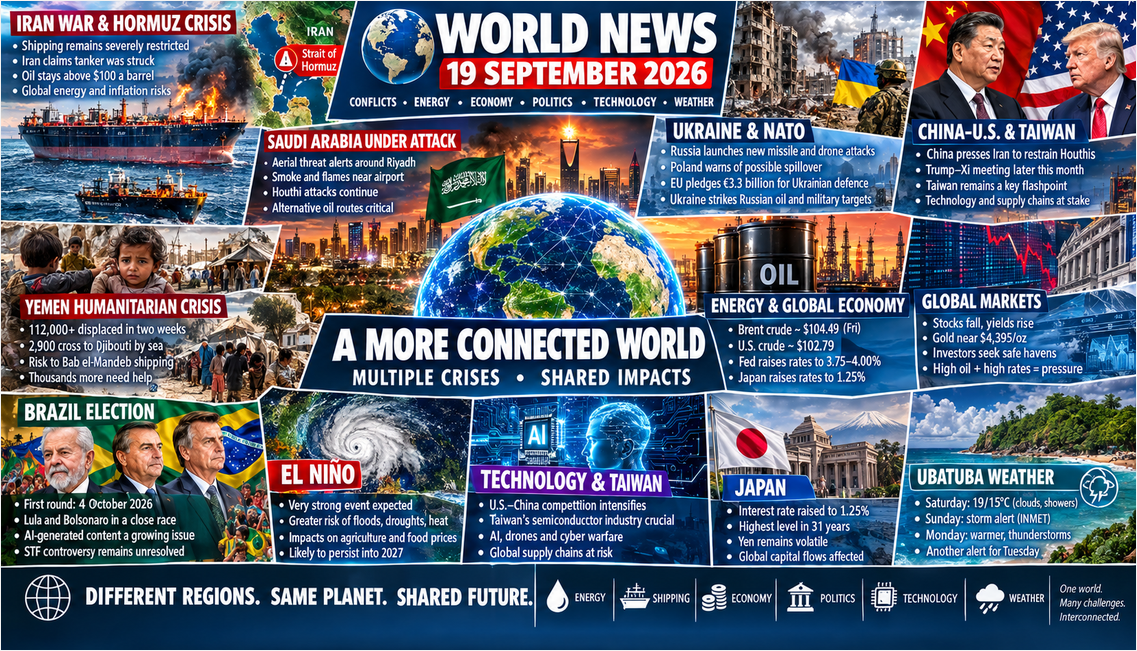
25. THE MOST IMPORTANT HEADLINES — 19 SEPTEMBER
- Saudi Arabia issues aerial-threat alerts around Riyadh.
- Smoke and flames reported near Riyadh airport after overnight alerts.
- Hormuz shipping remains severely restricted.
- Oil remains above $100 amid continuing supply risks.
- China presses Iran to restrain the Houthis.
- Red Sea and Bab el-Mandeb shipping face growing risks.
- The United States imposes new sanctions targeting Russia's war economy.
- Ukraine continues strikes and faces Russian missile and drone attacks.
- IAEA reports a drone strike on a cooling tower at Russia's Kursk nuclear plant, with no reported radiation emergency.
- Gaza continues its fragile post-ceasefire humanitarian struggle.
- Japan raises interest rates to a 31-year high.
- Global markets remain sensitive to oil, inflation and interest rates.
- Brazil's presidential race remains highly competitive in recent polls.
- AI-generated political material is becoming a significant Brazilian election issue.
- El Niño is expected to strengthen substantially toward the end of 2026.
- Ubatuba has a yellow storm alert for Sunday and another currently indicated for Tuesday.
CONCLUSION
MANY CRISES — ONE CONNECTED WORLD
On 19 September 2026, the most important global story is no longer any single war, election or economic statistic.
It is the way several systems are interacting.
The Hormuz crisis is affecting oil.
Oil is affecting inflation.
Inflation is influencing central banks.
Central banks are influencing financial markets.
The Middle East conflict is expanding the importance of the Red Sea and Saudi Arabia.
China is becoming involved diplomatically because its own energy security is at stake.
Meanwhile, the Russia–Ukraine war continues to reshape Europe's security and energy policies.
And above all these political and economic developments is a changing climate system, with El Niño expected to become very strong and influence weather patterns well into 2027.
For Brazil, the next major focus will be the October presidential election, while for Ubatuba the immediate practical concern is the changing weather and the storm alerts for the coming days.
The world therefore enters the final part of September with several powerful forces moving simultaneously:
WAR — ENERGY — MONEY — POLITICS — TECHNOLOGY — WEATHER.
And increasingly, what happens in one part of the world is felt somewhere else.