AI CHATGPT - 2025 Technology Prosperity Deal.
By AI ChatGPT-Human Synthesis-17 September 2026
The September 2025 Technology Prosperity Deal is still active, and during September 2026 there have been concrete developments—particularly in fusion energy, AI, advanced computing and quantum technology.
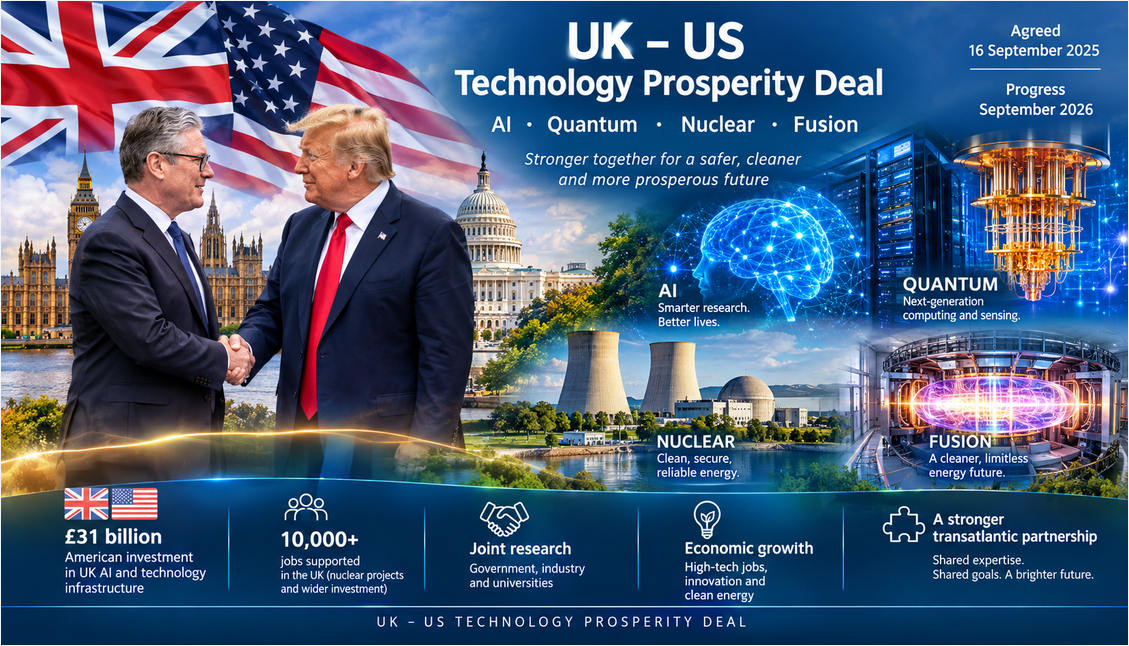
UK–US TECHNOLOGY PROSPERITY DEAL
One-year progress report — September 2025 to September 2026
1. What exactly was agreed?
The agreement was signed on 18 September 2025, not 16 September. The British government announcement was issued on 16 September, while the actual Memorandum of Understanding was signed by President Donald Trump and Prime Minister Keir Starmer at Chequers on 18 September.
The agreement covers four principal technological areas:
- Artificial intelligence
- Quantum technology
- Civil nuclear energy
- Fusion energy
It also includes cooperation on 6G, secure communications, positioning/navigation, research security and private investment.
One important qualification is that the MOU itself is not legally binding and does not commit either government to spend money. It was intended as a framework for cooperation. Moreover, it says that the agreement becomes operative alongside substantive progress on the broader UK–US Economic Prosperity Deal.
2. The £31 BILLION investment — what happened?
This was one of the biggest headlines surrounding the agreement.
At the September 2025 announcement, American technology companies announced more than £31 billion of investment in Britain's AI and technology infrastructure.
The commitments included:
Microsoft:
$30 billion (£22 billion) for UK AI infrastructure and operations, including a planned supercomputer with more than 23,000 advanced GPUs, developed with Nscale.
AI Pathfinder:
More than £1 billion in planned AI-computing capacity beginning in Northamptonshire.
NVIDIA:
Investment in Britain's AI start-up ecosystem.
Scale AI:
£39 million investment over two years and expansion of its London operation.
The British government presented these investments as being enabled or accelerated by the new technology relationship.
By June 2026, the British government was still describing the Technology Prosperity Deal as having "kickstarted" £31 billion of investment in British communities and businesses.
So the £31 billion figure should be understood as announced investment commitments associated with the September 2025 package, rather than £31 billion already spent.
3. BUT THEN CAME A MAJOR SETBACK
This is an important part missing from many accounts of the deal.
In late 2025, the United States paused work on the Technology Prosperity Deal.
The issue became entangled with negotiations over the wider UK–US economic relationship, including American concerns about British regulatory and trade policies.
In March 2026, British ministers told Parliament that the U.S. had paused the deal, but emphasized that some parts were continuing.
Chris Bryant, the UK technology minister, described it as a collection of different "chunks": some were paused while others continued.
He specifically identified quantum research and fusion cooperation as areas where work was still proceeding.
A subsequent parliamentary document confirmed:
the US paused the TPD at the end of last year
but said that civil-nuclear cooperation had been reopened in January 2026.
So, one year on, the accurate description is:
The Technology Prosperity Deal was not cancelled, but neither has the complete original programme been implemented.
4. NUCLEAR — perhaps the clearest practical progress
This is where the partnership has produced some tangible developments.
In January 2026, Nuclear Transport Solutions, a UK government nuclear organisation, signed an agreement with American company Westinghouse to develop Pegasus, a transport package for HALEU — High-Assay Low-Enriched Uranium.
HALEU is an important fuel for several types of next-generation advanced nuclear reactors.
This directly relates to the original TPD objective of developing secure advanced nuclear-fuel supply chains.
The original agreement also set an ambitious objective:
UK and US cooperation should eventually help reduce reactor-design approval times to around two years and site licensing to around one year.
The two countries also committed themselves to reducing dependence on Russian nuclear fuel, with the MOU setting a target of full independence from Russian nuclear fuel by the end of 2028.
5. Nuclear-powered ships — a fascinating new development
There is another development that I think you may find particularly interesting given your maritime background.
The original TPD specifically mentioned exploring civil maritime applications of advanced nuclear energy, including the possibility of a nuclear-powered shipping corridor between Britain and America.
In September 2026, that idea moved a little closer to practical study.
Lloyd's Register, Maersk, the Port of Charleston and the Port of Felixstowe launched the "Pink Corridor" project.
It is examining what would actually be required for a theoretical nuclear-powered container ship travelling between the United States and Britain.
The study covers:
- nuclear safety
- port access
- security
- emergency response
- cyber resilience
- insurance
- nuclear safeguards
- regulatory compatibility
Importantly, this does not mean nuclear container ships are about to begin operating. It is a feasibility and regulatory study.
But it is directly related to an area explicitly identified in the original Technology Prosperity Deal.
6. FUSION — the most exciting development of 2026
This is where the partnership has really gathered momentum.
In June 2026, the UK's Atomic Energy Authority (UKAEA) and America's Princeton Plasma Physics Laboratory (PPPL) signed a new memorandum of understanding.
It covers:
- fusion research
- plasma science
- advanced computing
- academic cooperation
- staff exchanges
- access to major experimental facilities
- ITER-related diagnostics
- information sharing
The stated objective is to accelerate the development of commercial fusion energy.
And then, just three days ago, on 14 September 2026, Britain and America took another major step.
7. UK AND US FUSION SUPERCOMPUTERS ARE BEING LINKED
This is probably the most concrete technological development directly connected with the original deal.
UKAEA and PPPL announced a plan to link two advanced computing systems:
UK:
SUNRISE — UKAEA's AI supercomputer.
US:
STELLAR-AI — the AI/high-performance computing platform at Princeton Plasma Physics Laboratory.
The proposed SUNRISE–STELLAR-AI Federation will allow researchers to explore moving computing workloads between the two systems.
The researchers also plan to investigate digital twins of fusion facilities.
A digital twin is essentially a sophisticated computer model of a real machine, continuously informed by experimental data. Researchers can then test changes virtually before making them on the actual fusion equipment.
That is a very good example of the original agreement's concept of combining:
AI + supercomputing + nuclear/fusion science.
8. The Global Fusion Policy Summit
The development became even broader on 14 September 2026, when Britain hosted the Global Fusion Policy Summit in London.
The UK and US co-chaired the meeting, which brought together representatives from:
Canada, France, Germany, Italy, Japan, South Korea and Finland, among others.
The stated objective was to accelerate the commercialisation of fusion energy. The UK–US cooperation was explicitly described as building on the 2025 Technology Prosperity Deal.
So, ironically, fusion cooperation is now one of the areas where the original 2025 agreement is most visibly producing new international activity.
9. QUANTUM — significant British progress, but bilateral progress is less clear
Quantum computing was another central pillar of the original agreement.
The MOU proposed:
- a UK–US quantum benchmarking task force
- a transatlantic Quantum Code Challenge
- joint quantum algorithms
- AI-assisted quantum research
- common standards
- quantum sensing
- cooperation between national laboratories
- a UK–US Quantum Industry Exchange Programme.
There has nevertheless been some uncertainty about how much of the bilateral programme has actually moved forward.
British officials told Parliament in March that quantum research was still progressing, even while some other elements were paused.
Meanwhile, Britain has pursued a substantial domestic quantum programme.
In March 2026, the UK announced up to £2 billion for quantum innovation, including a commitment to deploy quantum computers at scale in the early 2030s.
By June, the government said it had pledged more than £1 billion to its National Quantum Missions and committed up to another £1 billion for large-scale quantum-computer procurement.
So Britain's quantum programme is moving forward strongly, but not all of that progress should be attributed to the UK–US Technology Prosperity Deal itself.
That distinction is important.
10. AI — Britain is building rapidly, but the TPD itself is harder to measure
AI was arguably the largest financial component of the original announcement.
The September 2025 deal envisaged cooperation in:
- AI infrastructure
- computing capacity
- scientific datasets
- AI models
- biotechnology
- cancer research
- precision medicine
- fusion
- AI safety and standards
- chips
- data centres
- AI exports.
The UK has continued to expand its own AI infrastructure.
In June 2026, Britain announced a £1.1 billion AI Hardware Plan, including:
£750 million for a new national AI supercomputer.
Within that:
£400 million is earmarked for next-generation AI chips.
And £150 million is an advance commitment to buy novel chips from British firms and innovative start-ups.
The government has also established a major AI investment programme and continues to pursue large-scale computing infrastructure.
But again, it is important not to say that all this represents implementation of the bilateral TPD. Much of it is Britain's own national AI strategy.
11. The deeper significance
The original idea was essentially:
Britain provides scientific expertise, research institutions, regulation and specialised technology.
America provides enormous computing capacity, private capital, semiconductor technology and large technology companies.
Together they could potentially create a powerful transatlantic technology ecosystem.
The original MOU explicitly envisaged combining:
American computing + British science + private investment + joint standards + nuclear/fusion expertise + quantum research.
That remains the basic concept.
12. What has actually been achieved?
Here is my factual assessment based on the evidence available today:
| Area | Position September 2026 |
|---|---|
| AI investment | Major investment commitments announced; UK AI infrastructure expanding |
| AI bilateral government programme | Some cooperation, but not fully implemented |
| Quantum | Research cooperation continues, but parts of the bilateral programme have been slower |
| Nuclear fission | Cooperation restarted and concrete industrial agreements emerging |
| Advanced nuclear fuel | UK–US industrial cooperation progressing |
| Fusion | Strongest area of recent bilateral progress |
| Fusion supercomputing | UK and US systems now being linked |
| Nuclear maritime | Feasibility/regulatory work underway |
| £31bn investment | Announced commitments, not £31bn already spent |
| Overall TPD | Partially implemented; some elements paused/restarted |
The UK Parliament's own evidence is particularly useful here because it acknowledges both sides: the U.S. paused the overall TPD, while significant pieces of cooperation continued.
13. So where does the agreement stand TODAY?
As of 17 September 2026, I would describe it as:
PARTIALLY ACTIVE AND BEING REBUILT
It is not accurate to say the agreement has simply gone ahead unchanged.
It is equally inaccurate to say that it has collapsed.
Instead, the story over the past year has been:
September 2025
Agreement signed; £31bn technology investment announced.
↓
Late 2025
U.S. pauses the broader technology programme amid disagreements connected with the wider economic relationship.
↓
January 2026
Civil nuclear cooperation begins reopening.
↓
March 2026
UK Parliament confirms that some TPD elements remain active, particularly research and business cooperation.
↓
June 2026
UKAEA and America's Princeton Plasma Physics Laboratory deepen fusion cooperation.
↓
September 2026
UK and US link their fusion-supercomputing ambitions and hold a major international fusion summit in London.
↓
Today
The most tangible momentum is in nuclear and fusion, while AI and quantum cooperation remain important but less clearly delivered through the original bilateral framework.
That is the more complete one-year story.
Original UK Technology Prosperity Deal announcement
Full UK–US Technology Prosperity Deal MOU
UK–US fusion supercomputer announcement — 14 September 2026
UK–US Global Fusion Policy Summit statement — 14 September 2026
UK Parliament evidence on the status of the TPD
One particularly interesting next step to watch is whether Washington and London eventually reactivate the TPD's formal Ministerial-Level Working Group. The original MOU envisaged that group being established within six months of the agreement becoming operative, but UK parliamentary evidence in 2026 says the formal group will meet when cooperation is resumed in full.